The next transport property boom could happen on rooftops
Dubai has delivered a technically complete airport vertiport. British property owners should investigate useful sites, but passenger demand and operating commitments must justify any rooftop premium.

British property owners should assess their sites for future air-taxi use, but a rooftop premium must be earned through viable operations. Dubai’s technically completed airport vertiport shows that the infrastructure is becoming tangible. My view is that the opportunity lies in connecting a usable site, electricity and paying passengers, with rooftop development justified only where it improves that connection.
Key pointers
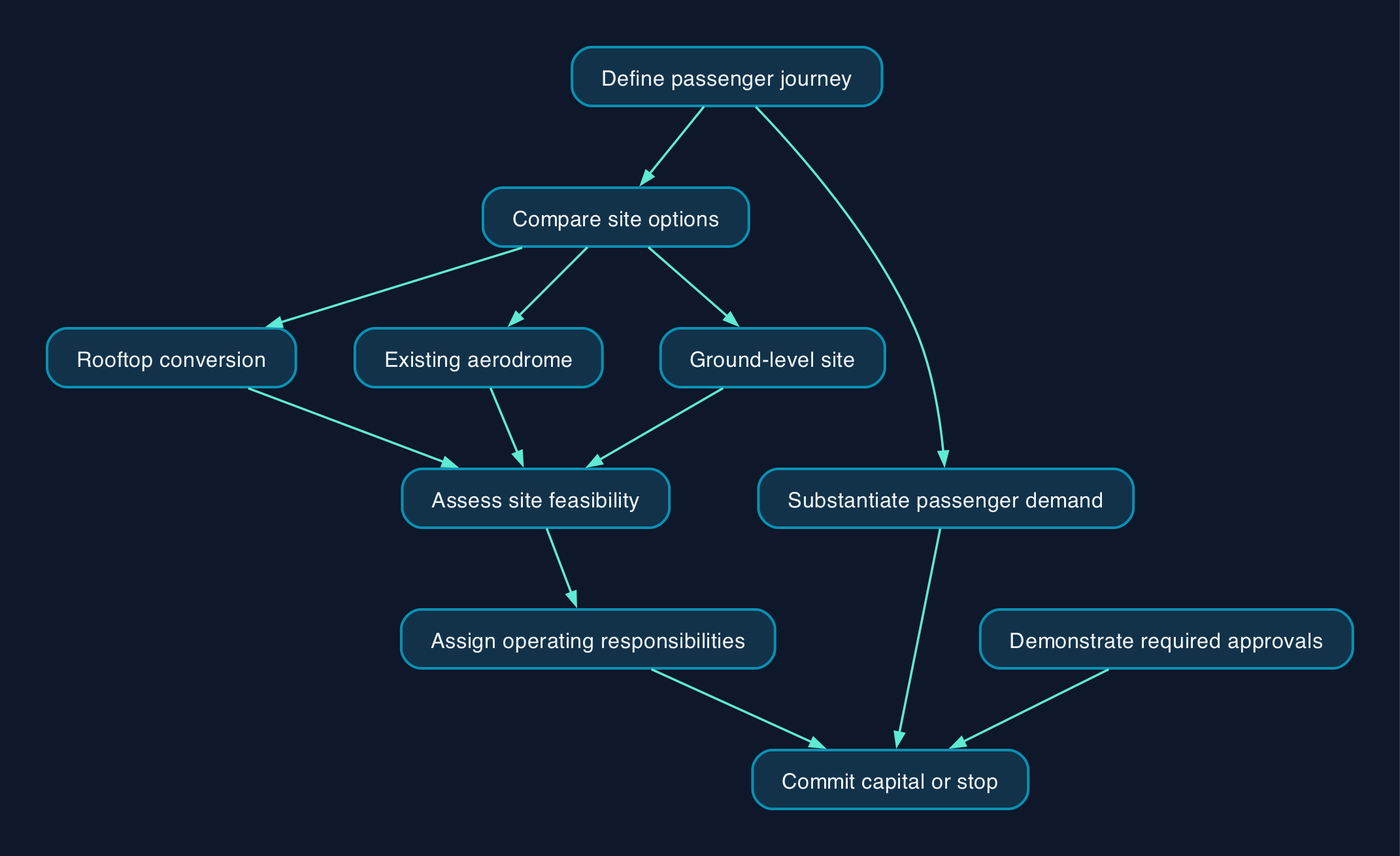
- Commission a site feasibility assessment before assigning any vertiport value to a roof.
- Compare rooftop development with existing aerodrome space and a purpose-built ground-level site.
- Ask prospective operators for evidence of passenger demand, aircraft compatibility and responsibility for cancellations.
- Evaluate the entire passenger journey, including access, security, waiting and onward travel.
- Make charging compatibility, maintenance responsibilities and data export explicit procurement questions.
- Release construction funding against demonstrable approvals and commercial commitments.
Dubai is building a transport interchange
A vertiport is a site for aircraft that take off and land vertically. Electric versions are commonly called eVTOL aircraft, short for electric vertical take-off and landing.
Dubai’s project makes the property question concrete. Its airport facility combines a passenger terminal and central flight operations, alongside charging equipment and connections to ground transport. The April 2026 project announcement describes a booking experience through Joby Aviation’s app, automated check-in and managed boarding flows.
Those details matter more to a British property owner than an aircraft’s appearance. A terminal needs somewhere for passengers to arrive, wait and leave. Charging needs to fit the aircraft’s turnaround. A landing area without those supporting functions is an incomplete commercial proposition.
The roles are also distinct. Skyports provides the infrastructure; Joby supplies the aircraft-related technology and planned passenger service; RTA coordinates the transport project. Their arrangement illustrates a chain of responsibilities, rather than interchangeable suppliers competing to sell the same product.
My argument is that a new property category could emerge around that chain. Its value would depend on the journeys it enables and the operating commitments it attracts. The Dubai facility demonstrates infrastructure delivery, not a proven increase in rooftop rents or property valuations.
Britain should start with useful sites
A British airport, station owner or commercial landlord should begin with a particular journey. Who needs to travel between these locations, how frequently, and what would make them pay for an air connection?
The CAA’s 2024 explanation of its design proposals favoured existing aerodromes for initial specifications because they already handled aviation activities. That is a credible starting point for commercial assessment, even if a city-centre roof looks more attractive in a presentation.
I would compare the site options against the following tests.
| Site option | Reason to investigate | Question that could stop the project |
| --- | --- | --- |
| Existing aerodrome | Build on an established aviation location | Does surface access leave a worthwhile time saving for passengers? |
| Purpose-built ground-level site | Design passenger access and supporting facilities together | Can demand justify the land and infrastructure commitment? |
| Rooftop conversion | Put an arrival point close to a valuable destination | Can the structure, access arrangements and operating environment support the proposed service? |
These are assessment criteria, not findings that any particular British site is suitable.
The UK timetable also needs careful reading. The CAA’s stated ambition concerns the regulatory framework and operational systems needed to enable initial services from the end of 2028. It is not a promise that a landlord’s chosen aircraft, route or building will be approved by then.
The technology opportunity sits between the systems
For UK technology firms, the near-term opportunity I would investigate is the coordination of ground operations.
Dubai’s published passenger workflow already brings together booking, check-in, boarding and aircraft charging. A British proposal should identify who owns each handover and what happens when it fails.
Consider an illustrative disruption. A charger becomes unavailable while passengers are checking in. The operating team needs to know whether another aircraft or departure is available; the passenger service needs to communicate the change; the property team needs to restore the equipment. Buying separate systems without assigning those responsibilities would leave an expensive gap.
A procurement brief should therefore ask for interface documentation, maintenance arrangements, incident ownership and a workable manual fallback. It should also establish whether the owner can export operational records and replace a supplier without rebuilding every connection.
This is a potential market for British software and engineering services. The evidence does not support a ranking of competing management platforms or charging suppliers, so buyers should seek comparable specifications and demonstrations before choosing one.
Price the operating business before the roof
There is no defensible GBP construction price or investment return in the cited material. A landlord should obtain a site-specific cost model rather than apply Dubai’s design to a British building.
I would ask bidders to separate feasibility and approvals work, structural alterations, passenger access, electrical supply, charging, communications and emergency provision. Recurring costs should identify staffing, maintenance, insurance, electricity, software support and equipment replacement.
The contract should then answer a harder question: who pays when the site is ready but the aircraft service is delayed?
A property owner leasing space to an infrastructure operator faces a different exposure from an owner funding the terminal and sharing passenger revenue. Compare the obligations, guarantees and exit arrangements in those models before comparing headline rent.
For a smaller business with a potentially useful site, a bounded feasibility commission is the sensible first purchase. It should produce a documented go-or-stop decision, including reasons to reject the roof.
The strongest objection is that the passengers may never arrive
A technically complete vertiport can still be a poor business. The cited sources provide no established UK fares, route-level passenger demand or evidence of profitable rooftop operations.
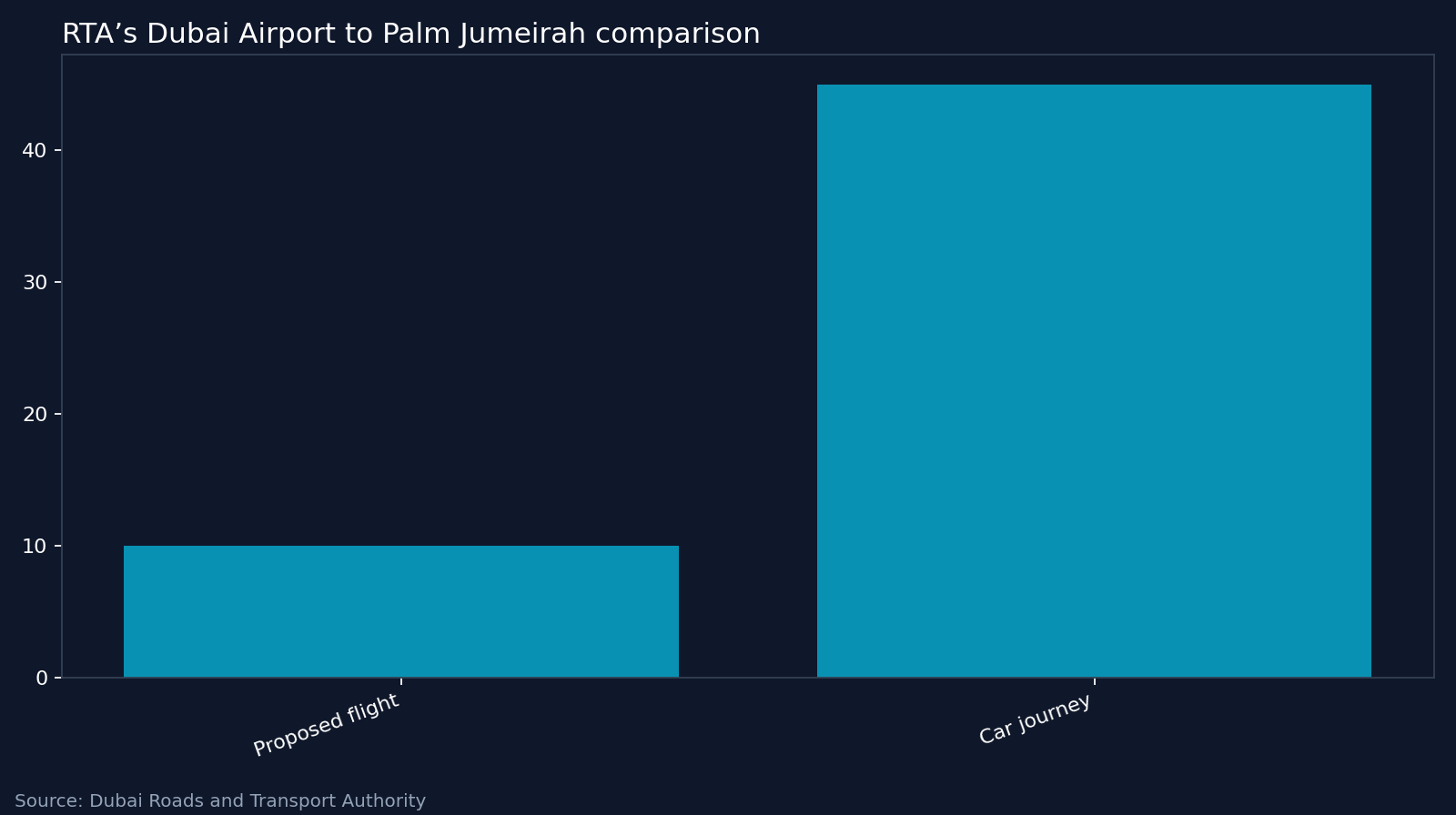
RTA’s 10-minute flight and 45-minute car comparison is an attractive proposition. But the traveller experiences the trip from their starting point to their destination. Access, security, waiting and onward travel belong in the assessment.
A British operator should demonstrate that complete journey under realistic conditions. Property owners should also require a commercial case that survives lower demand and disrupted service, with clear responsibility for refunds and alternative transport.
This objection limits the rooftop thesis substantially. A convenient roof has no transport premium if customers will not pay enough to support its use. Existing aerodromes, ground-level facilities or continued reliance on surface transport may be the better choice.
Editorial analysis
The rooftop opportunity deserves investigation because Dubai has moved beyond an architectural proposal to a technically completed facility. It does not yet justify treating unused roofs as an emerging investment class.
My recommendation is to preserve options through surveys and conditional commercial agreements, then commit capital when an operator can substantiate the route. For technology firms, sell a demonstrable solution to a defined operational problem. For landlords, demand evidence that the location improves the passenger journey.
If a transport property boom reaches British rooftops, its foundations will be built in those decisions.
FAQ
Has Dubai already proved that commercial air taxis work?
The April 2026 announcement establishes technical completion of the airport vertiport and describes preparations for commercial operations. It does not establish sustained passenger service, profitability or a return for property investors.
Could a British office roof become a vertiport?
It is a possibility to assess, not a conclusion supported for any particular building here. The CAA’s current programme includes vertiport design, obstacles, emergency planning and firefighting considerations, so a roof survey alone would not settle suitability.
Does the UK have a guaranteed launch date?
No. The CAA describes an ambition to enable initial commercial passenger operations from the end of 2028, rather than guaranteeing individual services. A property agreement should distinguish that ambition from an operator’s own approvals and launch commitments.
What should a UK business owner do first?
Define the proposed journey and identify who would operate it before commissioning detailed design. Then compare the site with alternatives and obtain a feasibility assessment covering access, engineering, operational responsibilities and commercial demand.
Sources
- Roads and Transport Authority, Aerial Taxi in Dubai by 2026. Publication date not stated; supplied evidence retrieved 28 September 2026.
- Skyports Infrastructure, Airport vertiport reaches technical completion. Published 16 April 2026; supplied evidence retrieved 28 September 2026.
- UK Civil Aviation Authority, Enabling advanced air mobility. Update date not stated; supplied evidence retrieved 28 September 2026.
- UK Civil Aviation Authority, eVTOL operations a step closer as regulator considers vertiport design proposals. Published 24 January 2024; supplied evidence retrieved 28 September 2026.