Britain’s technology leaders should treat green steel as an energy systems opportunity, with metallurgy remaining essential. Sweden’s HYBRIT programme makes the case through hydrogen production, electricity supply and storage, alongside the furnace itself. Its partners report hydrogen cost savings from operating storage against electricity markets. My view is that British firms should prepare to buy, integrate and verify these systems, while requiring commercial evidence before committing to a particular production route.
Key pointers
- Ask steel suppliers which production route, electricity source and emissions boundary support their environmental claims.
- Separate demonstrated production from planned capacity before relying on a delivery date.
- Evaluate hydrogen storage against its full installed cost, maintenance needs and operating constraints.
- Put energy procurement, production engineering and technology teams around the same investment decision.
- For a British manufacturer, begin with a qualified material trial and a supplier evidence request.
Sweden has demonstrated a chain of production
The useful starting point in Sweden is the material already made. HYBRIT’s August 2024 report describes hydrogen-reduced iron production and the use of resulting steel in vehicles, machinery, buildings and consumer products. That establishes a stronger basis for discussion than a proposed furnace or a hydrogen production target alone. These remain claims reported by the project itself.
The ownership also explains the industrial problem. SSAB, LKAB and Vattenfall bring steelmaking, ore production and energy into one initiative. Their shared programme suggests a useful model for British investment decisions. A technology team cannot evaluate the controls while someone else treats electricity availability as an assumption outside the project.
The supplied evidence establishes pilot achievements and published demonstration plans, but does not confirm commissioning or commercial availability against the older 2026 targets. British buyers should therefore use those plans to understand the proposed system, then require fresh delivery evidence for any contract.
Electricity becomes part of the production strategy
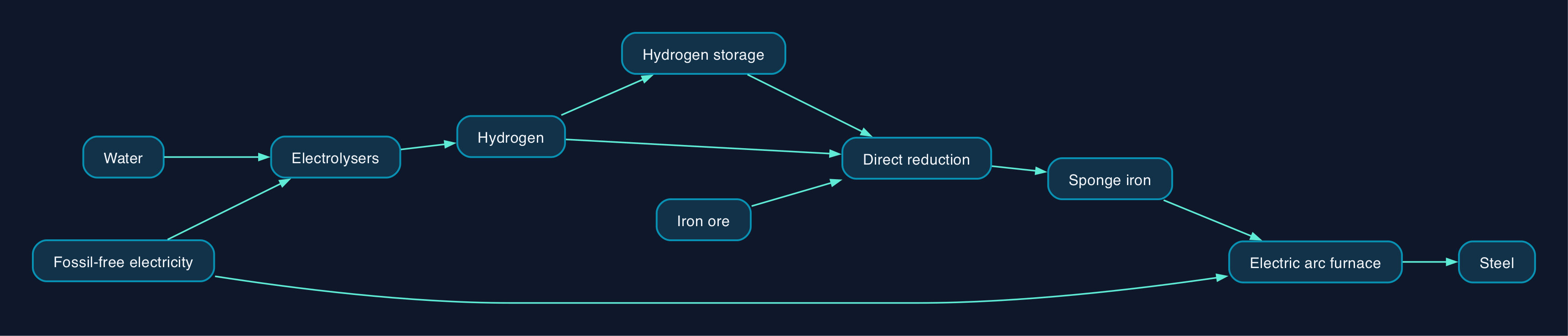
HYBRIT changes the chemical job performed inside ironmaking. In its process, electrolysers use electricity and water to produce hydrogen. That hydrogen removes oxygen from iron ore, leaving solid sponge iron, which is subsequently melted in an electric arc furnace. Hydrogen is doing chemical work, rather than simply replacing a burner fuel. The pilot process description explains that distinction.
Electricity consequently serves both hydrogen production and steel melting. HYBRIT’s demonstration design brings these stages together around fossil-free electricity.
Storage introduces a further operational choice. Vattenfall describes producing and storing hydrogen when electricity is cheaper, then supplying it during more expensive periods. That creates a way to separate the timing of some electricity purchases from the timing of hydrogen consumption.
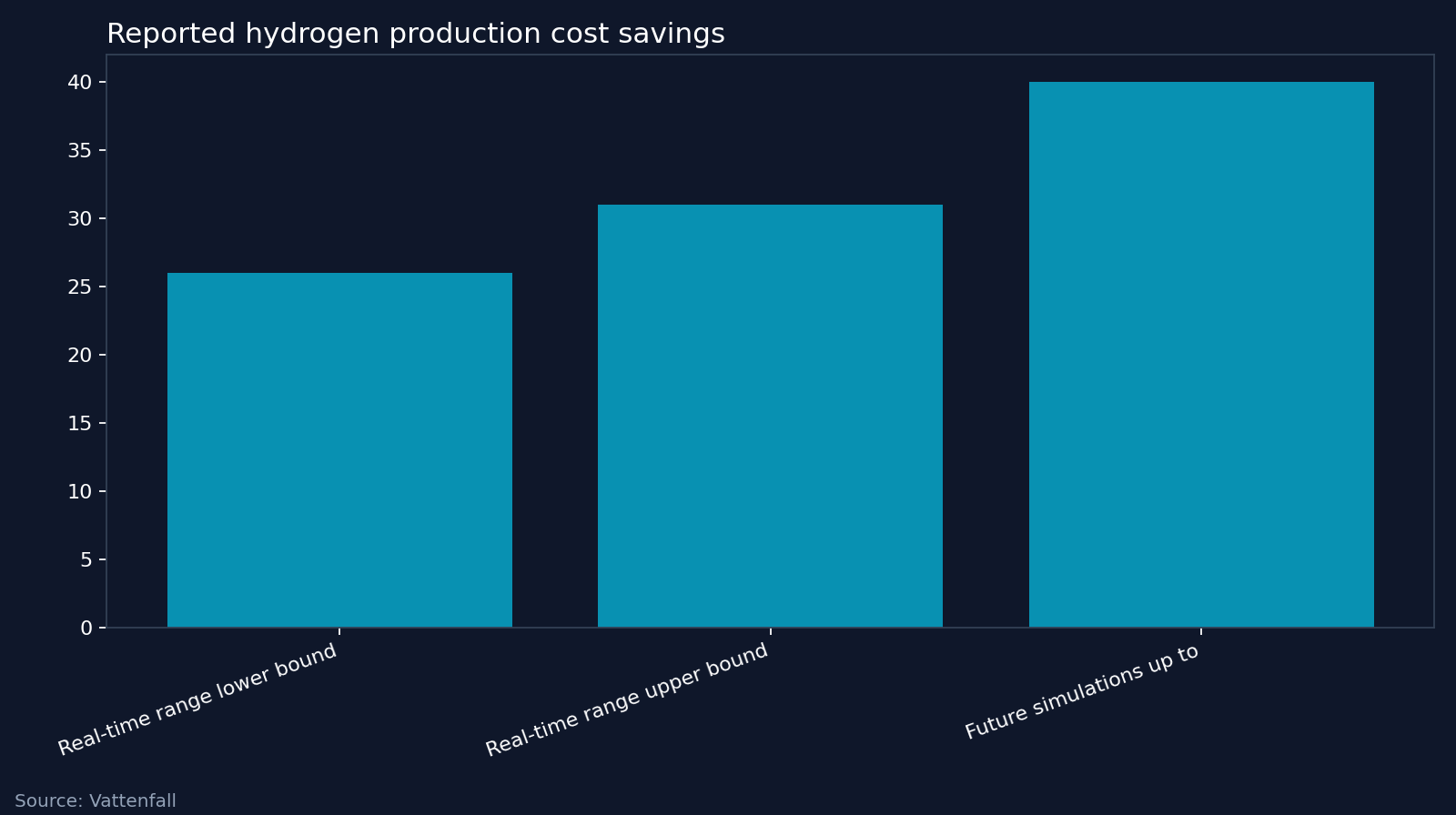
The reported results deserve careful wording. Real-time operation against electricity markets delivered hydrogen production cost savings of 26% to 31%. Simulations of future conditions indicated potential savings of up to 40%. Those are different kinds of evidence, and neither represents a reduction in the complete cost of making steel. Both figures come from Vattenfall’s account of the storage programme.
For UK technology businesses, this is a concrete integration problem worth investigating. A proposed control system would need to connect electricity prices, hydrogen inventory, equipment limits and the production schedule. Its acceptance test should measure reliable production and realised costs, alongside forecast accuracy.
Price the whole system before celebrating cheaper hydrogen
A British steel producer evaluating this route needs a cost model spanning the electricity connection, electrolysers, hydrogen handling, any storage, direct reduction equipment and electric melting. HYBRIT’s published value chain makes the breadth of that investment visible.
My recommendation is to require separate estimates for construction, financing, commissioning, maintenance, staffing and production interruptions. A saving in variable hydrogen costs cannot establish the return on a storage investment without its capital and operating costs.
For a smaller British engineering company buying steel, the calculation is different. Start with the delivered quotation, then add qualification work, trial production, any tooling changes, inventory requirements and rejected material. Ask whether electricity movements affect the quoted price and who carries the risk of a delayed shipment.
The evidence supplied does not establish a current UK delivered price or a defensible percentage premium. A procurement decision should therefore remain conditional on quotations for the required grade, quantity and delivery terms.
The strongest objection is that pilot success does not pay for a steelworks
The strongest counterargument is commercial. A working process and successful storage trials do not establish that a full plant will deliver competitively priced steel at dependable volumes.
HYBRIT itself says its pilot results and specifications apply to Swedish conditions. Britain cannot inherit those conditions by buying similar equipment. Electricity contracts, site infrastructure, financing and the available production skills would all need their own assessment.
Nor does the evidence justify treating hydrogen as the answer to every steel requirement. HYBRIT’s documentation identifies established scrap-based electric melting and commercially proven natural-gas direct reduction as relevant reference points. Its work extends those foundations towards hydrogen-reduced feedstock and demanding steel qualities. Those distinctions appear in its demonstration design and direct reduction explanation.
Buyers should compare suitable material from different production routes against the same specification, verified emissions boundary, delivered cost and supply commitment. The available evidence supports that comparison of approaches, but cannot support a ranking of competing suppliers.
This objection strengthens the case for energy expertise. If commercial success depends partly on when electricity is purchased and how hydrogen is stored, those decisions belong inside the industrial investment case.
Editorial analysis
British technology companies should seek work at the interfaces between energy supply, plant operation and purchasing evidence.
For an industrial software supplier, I would favour a bounded assignment such as reconciling metered electricity, hydrogen production and saleable output. For an engineering integrator, I would prioritise clearly assigned responsibility for equipment faults and interrupted production. For a steel buyer, I would start with batch documentation that connects the delivered material to the claimed production route.
These are proposed opportunities, rather than evidence of contracts already available. Each needs a customer willing to pay for a measurable result.
Carbon reporting deserves the same discipline. HYBRIT reports Scope 1 and Scope 2 emissions below 0.05 tonnes CO2e per tonne of steel, rounded to zero in its headline result. Its footnote identifies residual emissions from electrodes and slag formers. A purchasing system should retain that boundary and qualification instead of reducing the record to a “zero carbon” checkbox.
My position is that British firms should build the capability to evaluate and operate these energy-dependent supply chains now. The first commitment can be a material trial, an integration study or a better purchasing specification. A whole steelworks need not be the entry ticket.
FAQ
Does hydrogen replace coal simply by supplying heat?
In HYBRIT’s process, hydrogen removes oxygen from iron ore, forming water and leaving sponge iron. The material is then melted for steelmaking, so the change involves both chemistry and energy supply, as the process documentation explains.
Does HYBRIT prove that hydrogen steel will be cheaper in Britain?
No. HYBRIT says its pilot results apply to Swedish conditions. A British investment case needs its own electricity terms, capital costs, operating assumptions and customer commitments.
Can hydrogen storage cut the total steel bill by 40%?
That is not what the cited evidence establishes. Vattenfall reports hydrogen production cost savings of 26% to 31% from real-time market operation, with up to 40% indicated by future simulations. Its storage account does not establish an equivalent saving on total steel production costs.
What should a small British manufacturer do first?
Choose a component with a clear material specification and request a quotation supported by production and emissions evidence. Agree a trial, acceptance criteria and fallback supply before committing a critical order. Treat a supplier’s published project capacity as background information until it can demonstrate delivery capability.
Sources
- HYBRIT — Facts and milestones
- HYBRIT — Pilot scale direct reduction with hydrogen
- HYBRIT — Six years of research paves the way for fossil-free iron and steel production on an industrial scale, 27 August 2024
- HYBRIT — Demonstration project
- Vattenfall — HYBRIT partnership with LKAB and SSAB
- HYBRIT — Fossil-free steel production ready for industrialisation