Flying taxis need a power strategy before a route map
British companies should assess flying taxis through charging requirements, site capacity and operating costs. Dubai's plans and UK demonstrator projects point towards work that can begin before passenger demand is proven.

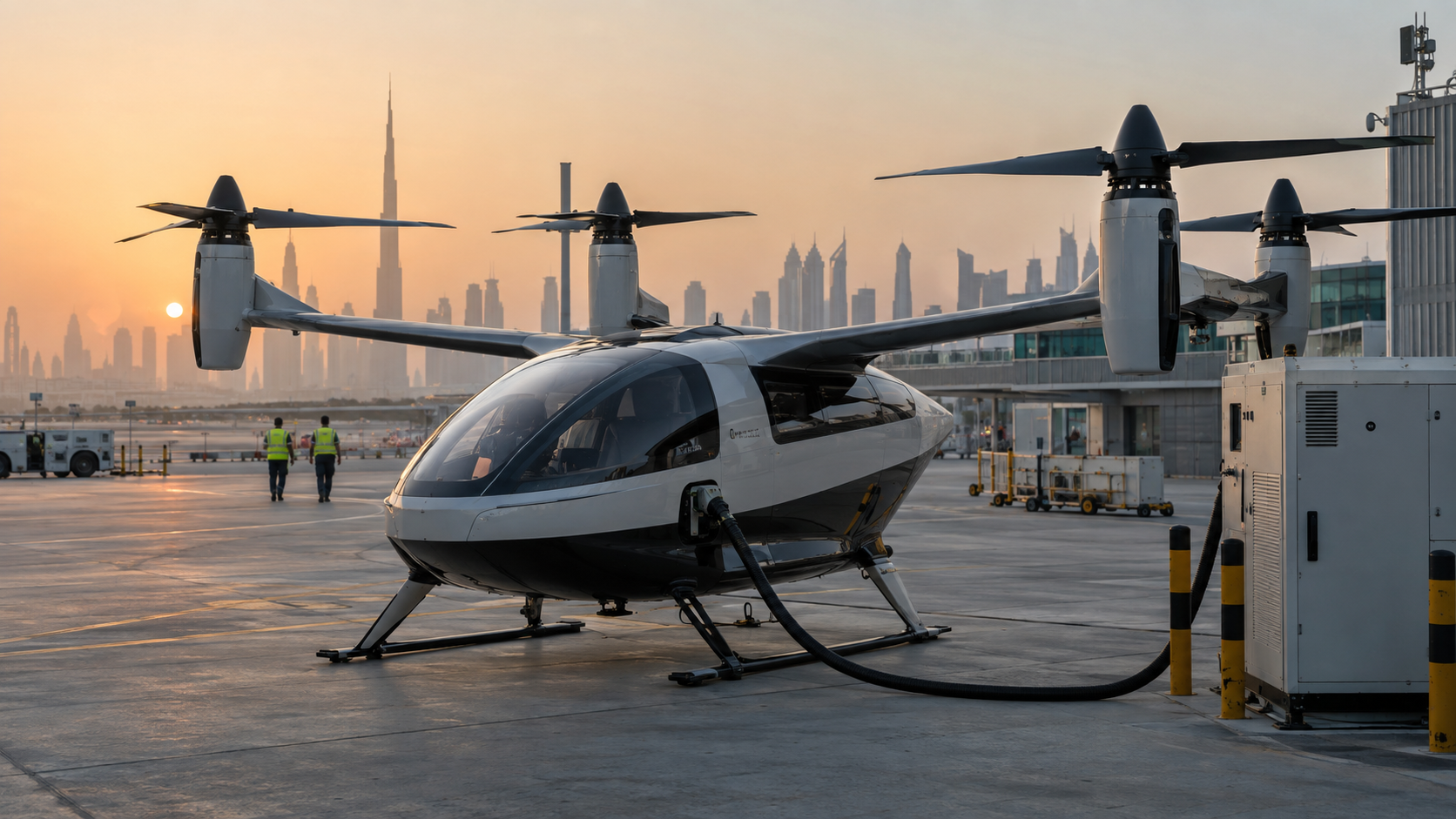
British companies should treat flying taxis as an electricity-infrastructure opportunity before betting on passenger services. My position is that site capacity, charging and operational control deserve earlier investment scrutiny than route-launch promises. Dubai’s planned network explicitly includes charging alongside landing areas and passenger facilities. That creates a useful question for UK technology leaders: who can make the ground infrastructure commercially workable, even while demand for the flights remains uncertain?
Key pointers
- Ask for the aircraft charging profile and proposed flight schedule before approving a site design.
- Compare investment in charging equipment, airport power planning and operating trials as distinct opportunities.
- Make storage an option to assess against measured requirements, rather than an assumed component.
- Require a named owner for faults spanning the electricity connection, charger, cooling equipment and operating software.
- Release capital against demonstrated performance and credible customer commitments, rather than publicity milestones.
Dubai puts the ground infrastructure in view
Dubai’s Roads and Transport Authority describes a transport network with buildings, passenger processing and electrical equipment. Its project page establishes the planned scope; it does not establish that all four sites or commercial passenger services are operating.
That distinction matters to a British business deciding where to spend development money. A proposed flight creates several separate commercial questions. Can the aircraft perform the service? Will passengers pay? Can each destination support the turnaround needed for the next departure?
The electricity question belongs in that first investment discussion. A route proposal without a site-specific charging assessment leaves a central operating dependency unresolved.
For UK software companies, electrical contractors and infrastructure specialists, my recommendation is to begin with a bounded customer problem. Produce a charging-demand assessment, an equipment-monitoring integration or an operating-cost model. Each gives a prospective operator something testable before either party commits to a wider network.
The UK opportunity extends beyond aircraft manufacturing
The government’s demonstrator portfolio provides a more useful market map than a list of aircraft brands. It supports several approaches to the ground infrastructure, with different purposes.
| Project and lead | Work described in the funding record | Question for a British buyer or partner |
| --- | --- | --- |
| ECLiPSE, Vertical Aerospace | High-power charging and thermal management | Can the equipment meet the required turnaround within the site’s physical constraints? |
| SPARC-AIR, Syselek | Airport electrification planning and commercial models | What power-system design makes the proposed operation viable? |
| Project SEAN, Bristow Helicopters | Regional flight demonstrations and location-specific electricity assessments | What does an operating network require at each airport? |
| HyPRIME, ZeroAvia | Mobile liquid-hydrogen refuelling and airport demonstrations | Does the intended aircraft require a different ground-energy system altogether? |
These are funded development and demonstration projects, not interchangeable commercial products. Hydrogen refuelling is also a different infrastructure proposition from battery charging.
That breadth should shape procurement. An airport seeking an electrification plan needs different evidence from an operator selecting charging hardware. Neither should mistake participation in a funded consortium for proof that a supplier can deliver a complete managed service.
For a smaller British technology firm, the practical opening may be one interface between those organisations. Before building software, obtain the equipment documentation, establish which data the customer can access and agree who will maintain the integration.
Connect the flight schedule to the electricity requirement
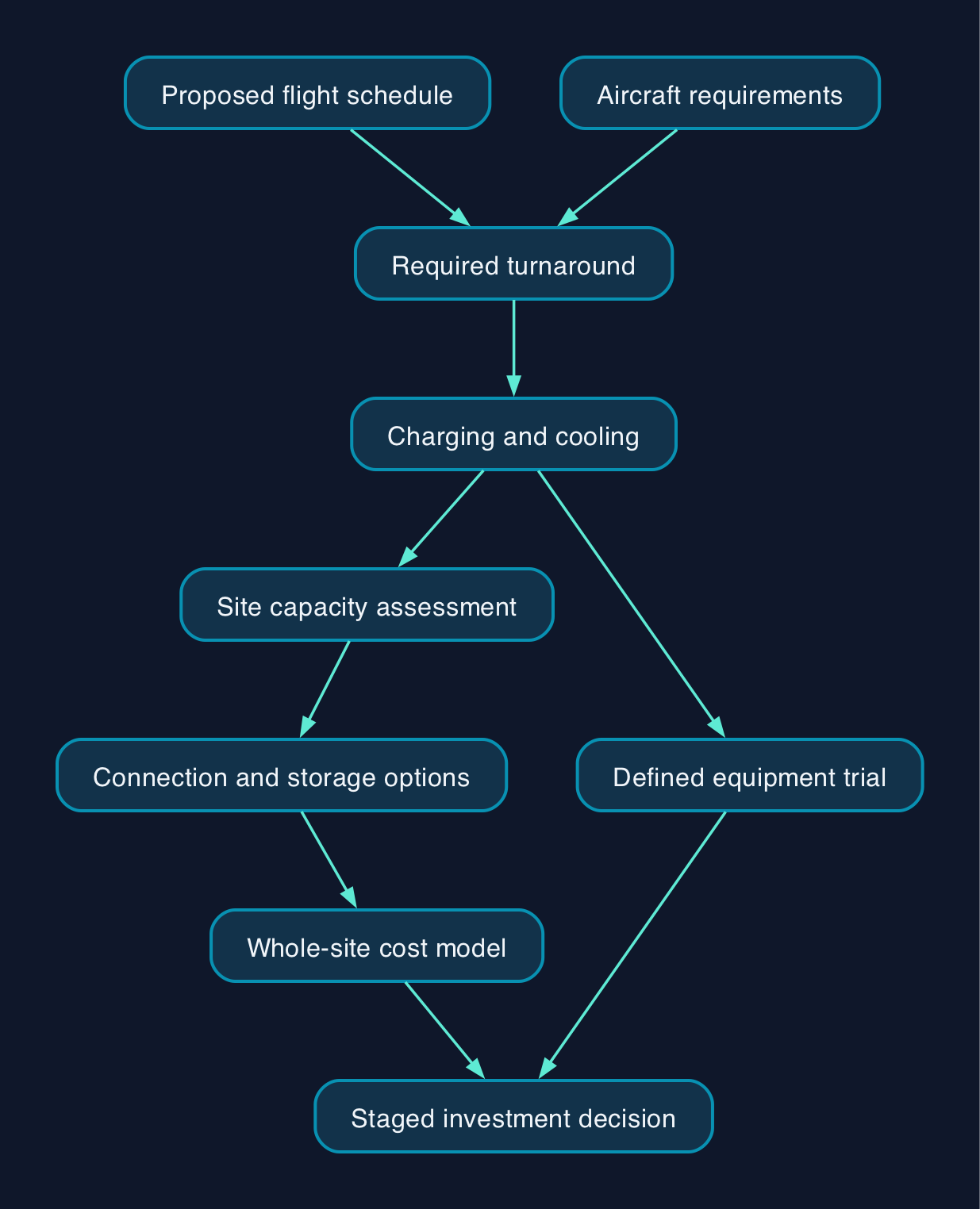
A useful proposed workflow starts with planned departures, then works backwards through aircraft turnaround, charging requirements, cooling and available site capacity.
The operator should supply the intended schedule and aircraft requirements. The electrical designer should assess the site. Equipment suppliers should substantiate charging and cooling performance under the proposed operating conditions. The site owner should name the party responsible for resolving failures across those boundaries.
This is an editorial proposal for organising the work, not a description of Dubai’s installed architecture.
For technology leaders, I would separate monitoring from operational authority. A dashboard might show equipment availability and charging progress. Its contract should also specify who can change settings, who receives an alarm and what happens when communications fail.
Storage belongs in the assessment as a conditional option. Ask the designer to compare the proposed operation with and without it, including replenishment, maintenance and replacement costs. The supplied evidence does not establish a storage requirement, charger rating or electricity demand for Dubai’s sites.
Budget for a working site
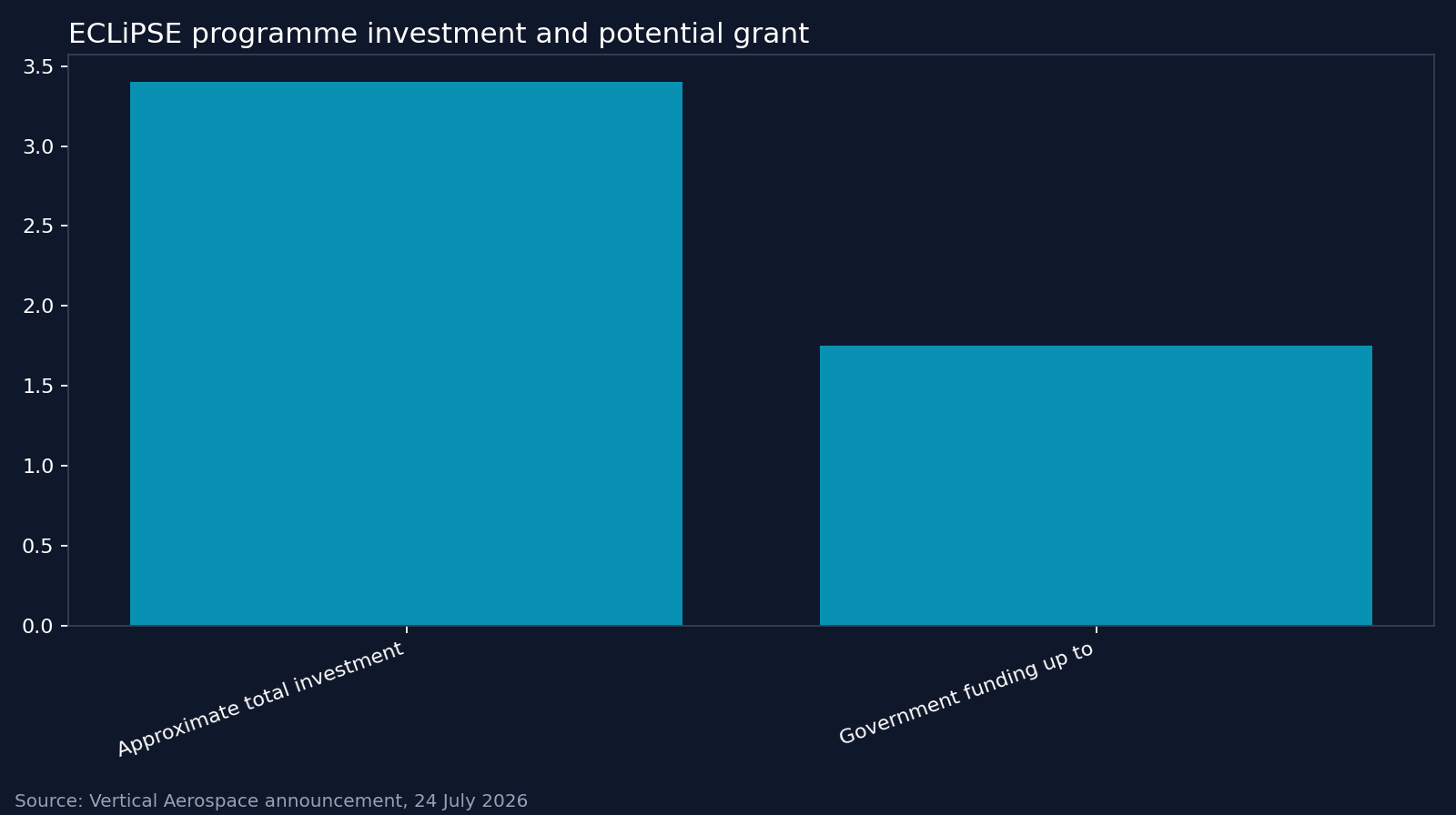
Vertical’s 24 July 2026 announcement describes approximately £3.4 million of total ECLiPSE investment, including up to £1.75 million of government funding, subject to completion of the grant agreement. The grant is part of that total, not an additional amount.
Those figures describe a development programme. They provide no defensible price for a charger, a vertiport or a commercial electricity connection.
A buyer’s budget should instead request separate quotations or explicit assumptions for:
- Connection assessment, electrical design and site works.
- Charging equipment, cooling, installation and commissioning.
- Monitoring, systems integration, communications and access management.
- Electricity, maintenance, support, staff training and replacement equipment.
- Any storage proposal, decommissioning and supplier handover.
Ofgem’s 2014 explanation of connection costs identifies connection size, location, distance from the network and available capacity as relevant factors. It is useful background, not a current quotation or a basis for asserting today’s charging rules.
There is a more recent illustration of the cash-flow problem in Salix’s January 2026 guidance. For its Public Sector Decarbonisation Scheme, it explains that electrical upgrade payments may precede completed works by several months. Those scheme rules do not establish funding eligibility for an aviation project, but they show why a project budget needs payment milestones as well as a final total.
The strongest objection is that the flights may not sell
The strongest counterargument is straightforward. If aircraft approval, passenger demand or route economics disappoint, an excellent charging installation could still become an underused asset.
I agree with that objection. The evidence does not justify building a speculative British vertiport network, nor does it establish that electricity will be the binding constraint on every route.
The Department for Transport describes its funded work as demonstrations of viability. Treating those awards as proof of a mature passenger market would go beyond the evidence.
My response is to stage investment. Start with site assessment and a defined operating scenario. Proceed to equipment trials against agreed acceptance criteria. Commit to permanent capacity when customer commitments, aircraft requirements and site economics support it.
This leaves room to stop. A feasibility study that exposes an uneconomic site has done useful work.
Editorial analysis
The opportunity I would prioritise is reducing uncertainty between the aircraft developer, airport, electrical designer and operator. British firms can compete on whether their work makes that handover measurable and accountable.
Ask a prospective customer for the charging requirement, site constraints and operating schedule. Then propose a paid assessment or pilot with a clear completion test.
Flying taxis may eventually become a visible transport business. For a UK technology company deciding what to build now, making a proposed site operable is the more concrete starting point.
FAQ
Is Dubai’s aerial-taxi network already operating?
The supplied RTA project page describes the planned initial locations and facilities. It does not confirm that the complete network or commercial passenger service is operating.
Does every vertiport need battery storage?
The supplied evidence does not establish that requirement. Ask for a site-specific assessment comparing the intended schedule, charging demand and connection options before including storage in the investment case.
What should a small UK technology company offer first?
My recommendation is a narrowly defined assessment or integration pilot with an identified customer. Agree the required data, equipment access, support responsibilities and acceptance criteria before developing a broader product.
Do the UK funding awards prove commercial readiness?
No. The Department for Transport describes projects intended to demonstrate viability, including charging development, feasibility work and operational trials. Buyers still need evidence for their particular aircraft, site and service.
Sources
- Dubai Roads and Transport Authority — Aerial Taxi in Dubai by 2026. Publication date not supplied; evidence retrieved 28 September 2026.
- Department for Transport — Zero emission flight demonstrator competition round 1 successful projects. Published 23 July 2026.
- Vertical Aerospace — High-power charging technology announcement, reproduced by Nasdaq. Published 24 July 2026; evidence retrieved 28 September 2026.
- Ofgem — A guide to electricity distribution connections policy. Published 16 April 2014.
- Salix — Public Sector Decarbonisation Scheme guidance on distribution network operator costs. Updated January 2026.