Britain’s businesses should keep control as the grid reaches inside
Connected chargers and batteries bring external energy signals inside business premises. British buyers should insist on operating limits, demonstrable provider switching and a business case that survives uncertain flexibility income.


British companies should treat connected energy equipment as part of their technology estate, with explicit limits on who can control it. Australia’s initial device requirements signal that direction, although they are early guidance ahead of a regulatory framework. The opportunity is to earn value from flexible electricity use; the condition should be that businesses retain control over operating priorities, access permissions and supplier exit.
Key pointers
- Give facilities, IT and operations joint responsibility for any equipment that accepts external control signals.
- Ask suppliers to demonstrate provider switching before signing a long equipment contract.
- Separate permission to read energy data from permission to change device settings.
- Specify what chargers and batteries should do when communications fail.
- Compare several providers against the same equipment list, operating constraints and exit requirements.
- Assess flexibility income after integration, support, equipment wear and staff time.
Australia is specifying the conversation inside the premises
Australia’s work on consumer energy resources, including solar, batteries and electric vehicle charging, deserves attention because it concerns how equipment communicates after installation.
The government’s consultation separates functions that buyers might otherwise bundle together under “smart energy”. Reading a device’s output, changing its settings, sending it a price signal and switching its service provider are distinct requirements. The paper also identifies proprietary systems as a potential obstacle to consumer choice and a source of stranded-asset risk.
That distinction should shape British procurement. A charger that shares its status with an operator presents a different management decision from one that accepts remote changes to its charging schedule. Buyers should ask which functions exist, who can invoke them and how that authority ends.
The evidence supports a direction of travel, rather than a claim that Australia has completed a universal mandatory regime. Its announcement explicitly describes initial requirements as early industry guidance before a regulatory framework is established. Initial device requirements announcement
The commercial lesson does not depend on predicting a British legislative timetable. When external software can influence equipment inside a business, purchasing the hardware also means choosing an ongoing control relationship.
Britain already has a route into the market
The National Energy System Operator’s Demand Flexibility Service rewards changes in electricity use. Its service page records the introduction of bi-directional flexibility on 9 April 2026, alongside a reduced eligibility threshold of 0.1 MW. NESO Demand Flexibility Service
That threshold should not be presented as a minimum equipment purchase for each business. NESO explains that aggregators combine smaller assets into portfolios that meet service requirements, while larger organisations may have the scale to register directly. Flexibility onboarding
For a small business, my starting recommendation would be to assess existing equipment and working patterns before buying anything. Identify which electricity use can move without delaying deliveries, reducing service quality or exhausting a battery reserved for continuity.
The British market evidence here concerns Great Britain. Businesses in Northern Ireland should establish their applicable market arrangements separately.
The control boundary needs an owner
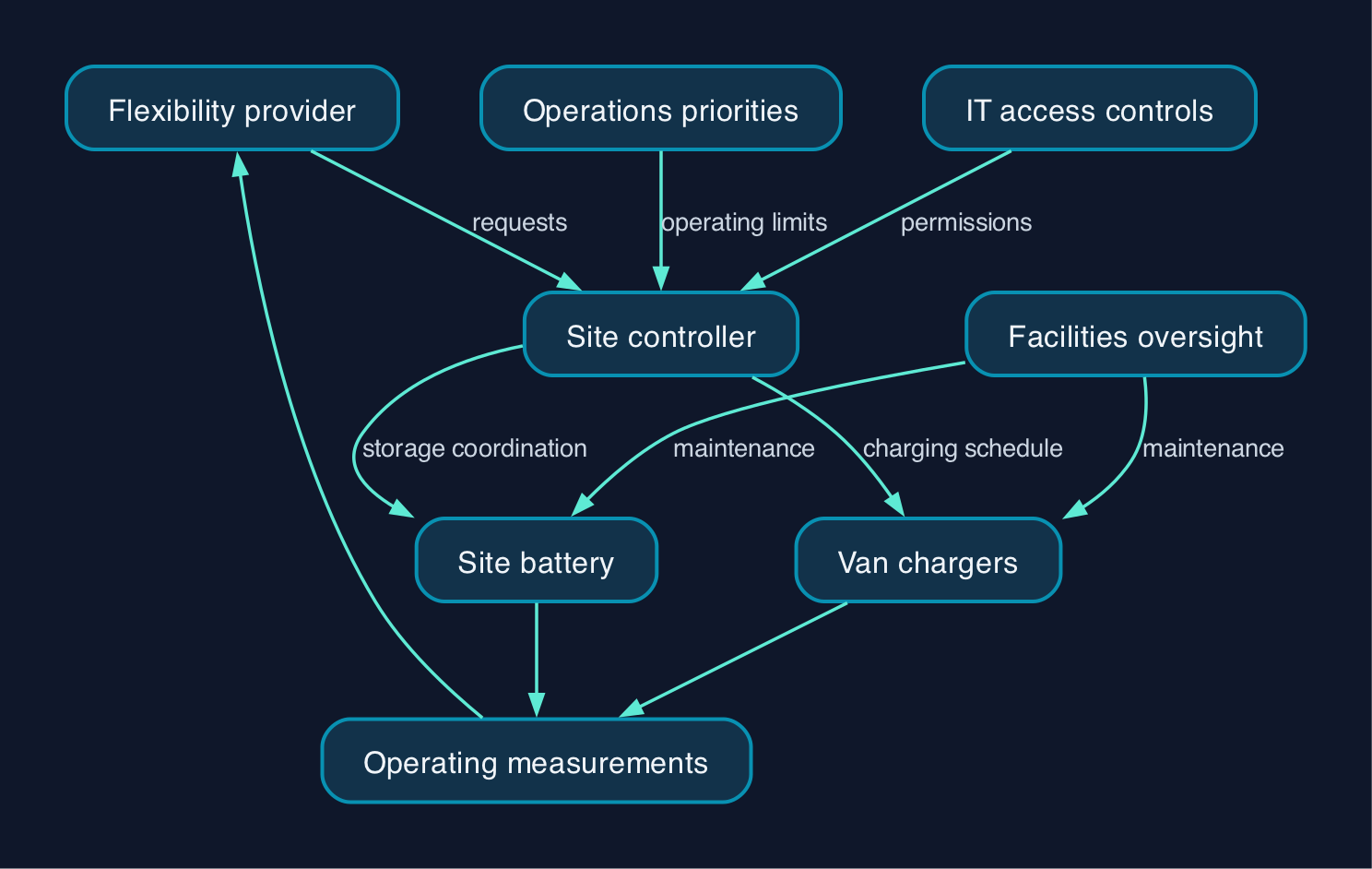
Consider an illustrative British depot with electric vans, rooftop solar and a battery. Its operations manager needs vehicles ready for departure. Its finance team wants a lower electricity bill. An external flexibility provider may want charging shifted or battery output changed during a service window.
A proposed design should route external requests through a site controller that applies the depot’s agreed operating limits. That controller would coordinate chargers and storage, while returning measurements needed to establish what happened. This is a recommended architecture, not a claim that every product provides those functions.
Operations should define departure requirements and minimum battery reserves. Facilities should own electrical design and maintenance. IT should review remote access, credentials, software updates and logging. Finance should approve the commercial terms.
The Australian implementation report treats testing, continuing conformance, cybersecurity and identity management as parts of the interoperability ecosystem. A shared communications protocol is therefore only one element of the problem.
For a small company, one person may hold several of these responsibilities. The essential step is to record them before the installer hands over the equipment.
Connection rules can change the equipment decision
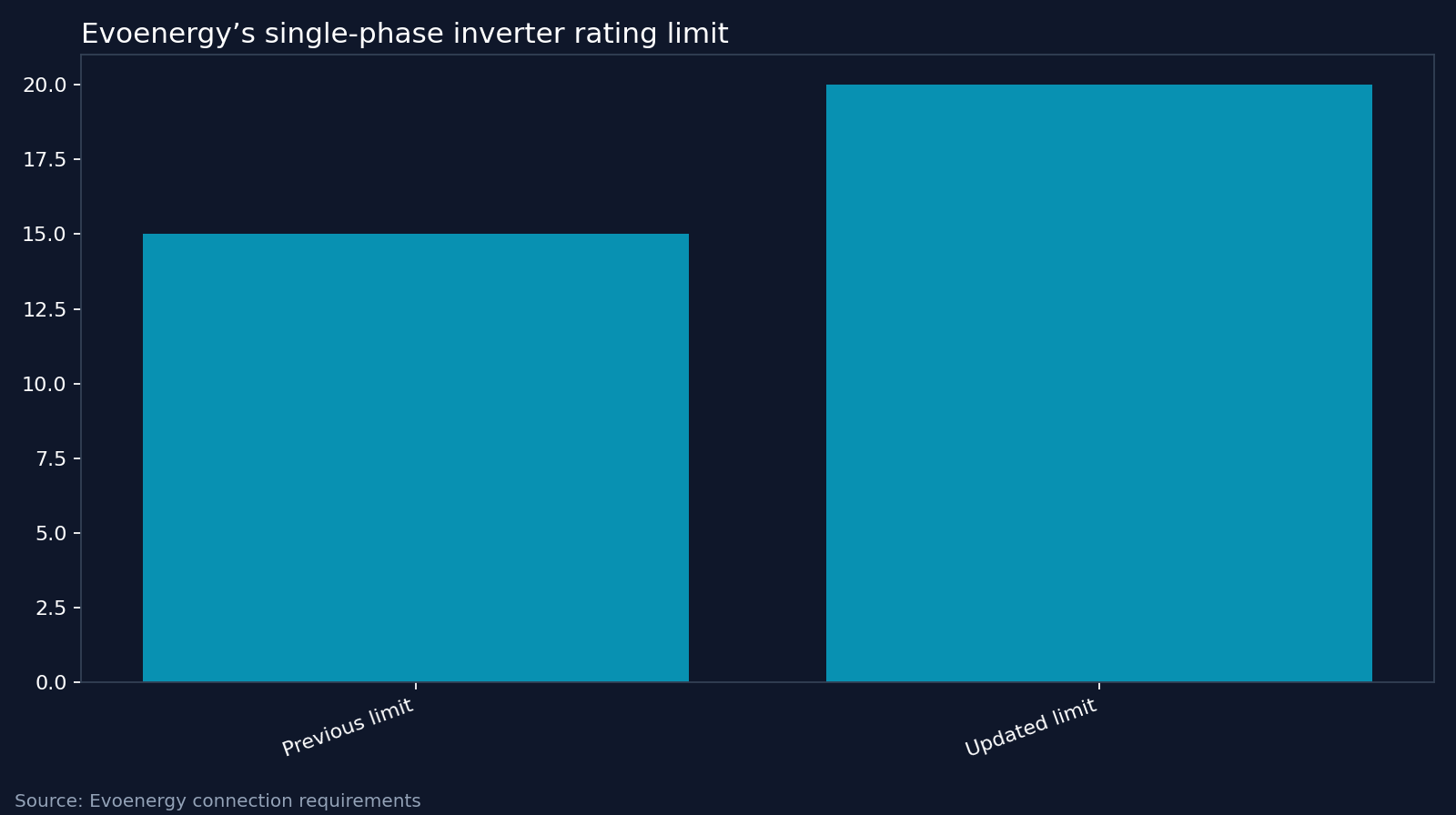
An Australian network example makes the relationship tangible. Evoenergy’s published connection update increased the permitted single-phase inverter rating, including energy storage systems, from 15 kVA to 20 kVA. These are apparent-power ratings, not battery storage capacities. Evoenergy connection requirements
The same update sets out configuration restrictions and circumstances in which changes to an existing installation require the whole site to meet current requirements. Its rules are specific to that network and should not be transferred to a British installation.
The procurement implication is broader. Ask the installer to document the approved configuration, export settings and consequences of adding equipment later. A battery purchase should include a clear account of what expansion would require.
Price the operating relationship
The supplied evidence does not establish comparable UK equipment quotations or provider tariffs. A defensible business case therefore needs supplier proposals tied to the actual premises.
Request separate costs for equipment, installation, metering, controls, connectivity, commissioning and staff training. Then identify recurring platform charges, maintenance, support, provider revenue share and any equipment-wear assumptions.
Require the proposal to distinguish electricity-bill savings from payments for delivering flexibility. Ask how each is measured, what happens when the site declines a request and which charges remain payable during periods with little activity.
Ofgem’s 2024 decision explicitly acknowledged uncertainty about how frequently the system would require flexibility. That historical warning supports a conservative appraisal; it does not establish any provider’s current payment terms. Ofgem’s service approval
My recommendation is to test whether the project remains worthwhile with lower participation income than the supplier’s central forecast. A business buying essential equipment should understand how much of its return depends on an external market.
Compare delivery routes before comparing brands
Several delivery approaches deserve consideration. NESO describes both aggregated participation and direct registration, with aggregators handling coordination and communications for smaller asset owners. NESO participation routes
For procurement, compare those routes against retaining local control without joining an external flexibility service.
| Approach | When to consider it | What the buyer should establish |
| --- | --- | --- |
| Keep or improve local scheduling | Operational predictability matters more than external participation | Whether existing controls can meet the business’s needs |
| Join through an aggregator | The business wants market access with less administration | Compatible equipment, control permissions, revenue share and exit process |
| Register directly | The organisation can resource market participation | Technical requirements, staffing, onboarding and ongoing obligations |
These are delivery choices, not supplier rankings. The evidence does not support a named comparison of competing UK providers.
When seeking proposals, give several suppliers the same site information and require a demonstration of the same tasks. Include changing provider, revoking access, recovering from a communications failure and retrieving operating records. A compatibility claim becomes useful when the supplier can show what survives a change of contract.
The strongest objection is operational risk
The strongest argument against external energy control is straightforward. A missed delivery or interrupted process could outweigh the income from adjusting electricity use. A business with little genuinely movable demand may reasonably decide that participation is not worth the work.
That objection should determine the scope of a pilot. Choose equipment whose operating window can change, define unacceptable outcomes and test loss of communications before allowing external requests to affect normal operations.
Interoperability should preserve choice. The Australian implementation report explicitly says that making minimum functions available does not mean all participants must use them in every circumstance.
Keeping a working installation may be the right answer. Paying for optionality during a planned replacement is a different decision from replacing useful equipment purely to chase flexibility revenue.
Editorial analysis
The opportunity for UK technology businesses is to make energy participation understandable and reversible. Useful products would show who requested a change, which site rule permitted it, what the equipment did and how the result affected the bill.
British buyers should demand those answers now, even when they choose to leave external control disabled. The boundary with the grid may become more permeable, but responsibility for the business’s operations should remain explicit.
FAQ
Does Australia’s approach create a new requirement for British businesses?
The Australian announcement concerns early guidance for future devices in Australia, ahead of a regulatory framework. It does not establish a British requirement. Its value for UK buyers is as a procurement signal about interoperability and provider choice. Australian Government announcement
Can a small business participate without registering directly with NESO?
NESO says smaller asset owners can work through aggregators that combine assets and manage coordination. Ask a prospective provider to confirm eligibility, equipment compatibility and the business’s retained responsibilities before committing. NESO onboarding guidance
Does interoperability mean surrendering control of the premises?
The Australian implementation report distinguishes available capabilities from universal use. Buyers should require contracts and technical controls that define permitted actions, operating limits and how access is withdrawn. Those safeguards need demonstrating for the proposed system.
Should we replace existing chargers or batteries now?
My recommendation is to assess the existing installation first and replace equipment only against a documented operational or commercial need. The Australian consultation identifies provider switching and stranded assets as concerns, which supports asking about compatibility and exit before purchasing. It does not prove that your current equipment needs replacing.
Sources
- Australian Government, Initial consumer energy resource device requirements now available.
- Department of Climate Change, Energy, the Environment and Water, Technical Standards for Consumer Energy Resources Interoperability, consultation paper, 2025.
- Australian National University and Grids Energy, Technical and Interoperability Standards for CER — Pathway for Implementation, prepared 31 October 2024.
- NESO, Demand Flexibility Service.
- NESO, On-Boarding Flexibility.
- Evoenergy, Important updates to solar and battery connection requirements.
- Ofgem, Decision on the Demand Flexibility Service, letter dated 21 November 2024.