The next premium industrial site may advertise molecules as well as megawatts
Germany’s hydrogen network could change what makes an industrial site valuable. British buyers should assess usable capacity, supply and connection costs before paying for proximity to a pipeline.

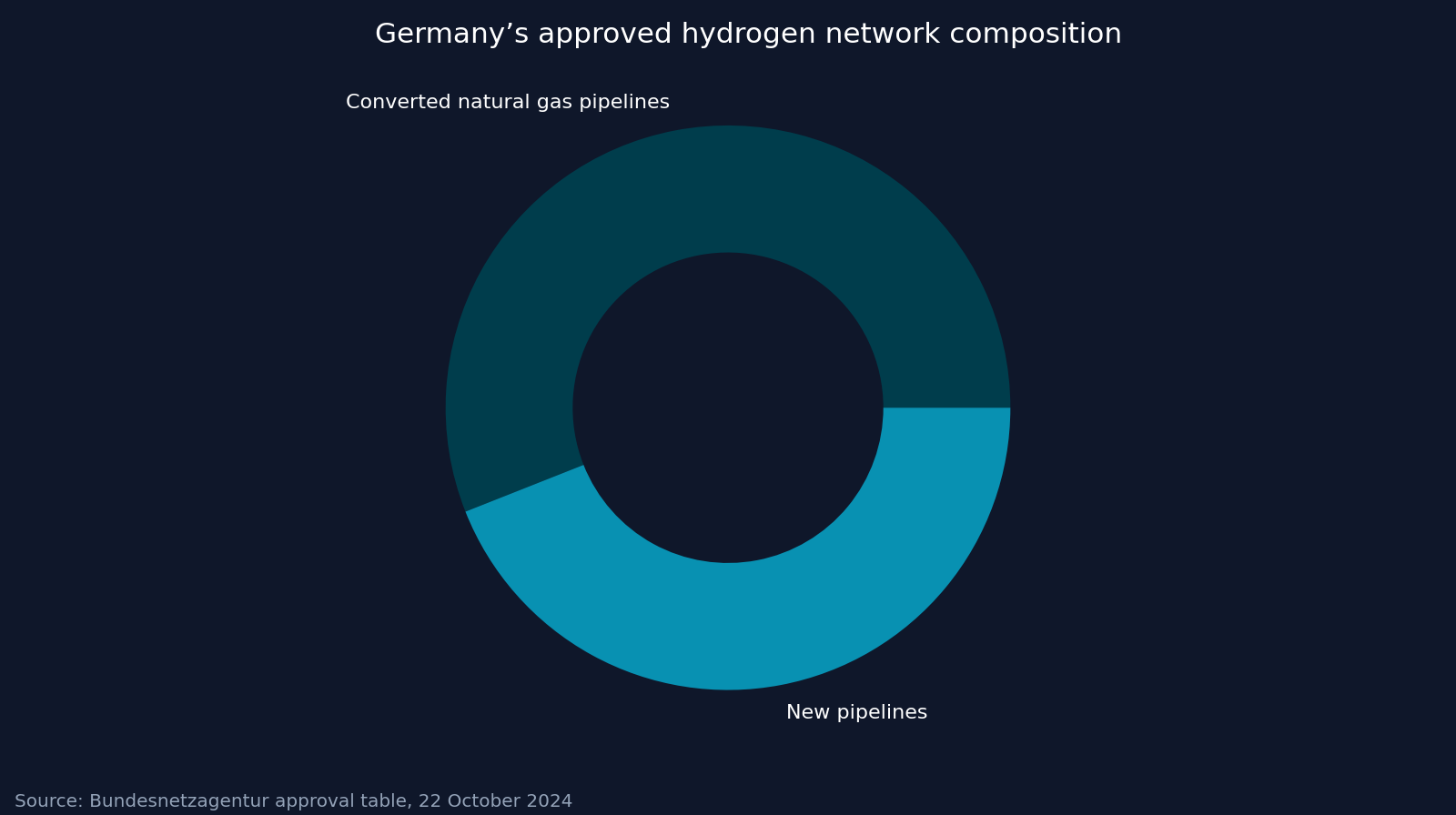
Hydrogen access should become a site-selection criterion for British industrial businesses with a credible use for it. But a premium belongs to deliverable supply and usable capacity, not proximity to a proposed pipeline. Germany’s approved 9,040-kilometre core network makes that distinction commercially relevant. For UK leaders, the opportunity is to secure future operating choices before committing to premises, while refusing to overpay for infrastructure that cannot yet serve their process.
Key pointers
- Put hydrogen access into the property brief only when an engineering assessment identifies a credible use.
- Ask which operator would connect the premises and what remains between its pipeline and your equipment.
- Treat a capacity reservation, a physical connection and a hydrogen supply agreement as separate checks.
- Compare moving premises with adapting the existing site and pursuing an electricity-led alternative.
- Require the business case to survive a delayed connection and a higher delivered fuel cost.
- Give any proposed property premium an explicit ceiling based on the operational benefit it could deliver.

Germany is making energy access a location decision
Germany’s network is intended to connect major industrial centres, storage facilities, power plants and import corridors. That gives a location-based investment thesis something more substantial than a collection of production announcements. The approved infrastructure has a defined purpose and geography. Bundesnetzagentur network scope
The property implication is our judgement, not an observed valuation result. The supplied evidence contains no transaction data establishing that hydrogen access has already increased industrial land prices.
Nevertheless, the mechanism is credible. If a process needs hydrogen, and one site can obtain suitable supply on acceptable terms while another cannot, the first site offers an operating choice the second lacks. A buyer might reasonably pay for that advantage.
For a British manufacturer considering German premises, this belongs in the location assessment now. For a UK-only business, Germany supplies a useful method for scrutinising future infrastructure claims. It does not establish that equivalent connections or commercial arrangements exist at a British site.
Smaller businesses should start with process suitability. Before commissioning a property search, ask an engineer what hydrogen would do in the production process and what an electricity-led alternative would require. A site premium has no business purpose without an identified operational benefit.
A pipeline nearby is only the first dependency
The connection question reaches beyond distance. The operators’ March 2026 information package distinguishes capacity within network clusters from onward transport through distribution networks, where additional technical testing may be necessary. It also requires individual connection details to be agreed with the responsible operator. Capacity and connection conditions
For a site assessment, follow the proposed chain from hydrogen supply through transport capacity and the local connection to the equipment consuming it. Assign a named owner to each dependency.
The network operator should confirm the relevant connection point, capacity and technical conditions. The proposed hydrogen supplier should explain the delivery arrangement. The equipment provider should establish process compatibility. The property team should document the land and access arrangements needed to connect those components.
This is a proposed due-diligence workflow, not a claim that one contract covers everything.
The reservation mechanism makes the distinction particularly important. The March package describes reservations lasting up to seven years, followed by transport bookings under specified conditions. Customers pay an operator-specific reservation fee during that period. Reservation concept and fees
A landlord’s statement that capacity has been reserved therefore needs supporting documents. Ask who holds it, which premises it could serve, what must happen before use and whether the proposed occupancy arrangement can benefit from it.
Price the operating choice before the property premium
Germany’s €18.9 billion network investment estimate cannot tell a British buyer what a particular factory will pay for hydrogen. Nor does KfW’s financing facility remove the need for customers to fund network use. Its explanation says customer fees finance the network, with an amortisation account bridging early shortfalls while usage develops. Network financing model
For a prospective occupier, I would require the following costs before accepting a hydrogen-related property premium.
| Cost component | Evidence to request |
| --- | --- |
| Property purchase or lease | The additional price attributed to hydrogen access and the assumptions supporting it |
| Capacity reservation and transport | Operator quotation, charging basis, start dates and commitment conditions |
| Hydrogen supply | Delivered-price proposal, quantity, specification and availability assumptions |
| Connection and site equipment | Engineering scope, ownership boundaries and installation quotation |
| Process conversion | Equipment changes, commissioning, training and planned production interruption |
| Operation and resilience | Maintenance responsibilities, monitoring, backup arrangements and staffing |
| Delay and exit | Exposure if commissioning slips or the proposed process changes |
These are quotation requirements, not published tariffs. There is no defensible site-level total in the supplied evidence.
The decision should compare the complete cost of relocation with adapting the existing premises and with an alternative process design. Where inputs remain unknown, keep the property premium conditional. Do not turn an unpriced connection into a zero-cost assumption.
Compare routes and responsibilities before operator brands
Several operators appear in Germany’s network, but their geographical roles matter more to a site buyer than a general supplier ranking.
Fluxys describes planned contributions through partial repurposing of EUGAL in eastern Germany and a German-Belgian connection in the west. These are route-specific proposals in its October 2024 announcement, not evidence that every neighbouring plot can obtain service. Fluxys project scope
Gasunie describes Hyperlink as connecting production, import and storage locations with industrial regions, including connections to the Netherlands and Denmark. Gasunie network description
The shared market information package identifies other geographical responsibilities, including GASCADE in the Flow cluster and ONTRAS in central Germany. Operator and cluster information
For procurement, compare candidate sites against the same requirements for usable capacity, connection timing, process compatibility and total cost. Do not assume that operators serving different routes are interchangeable bidders for the same premises.
The strongest objection is that the premium may never arrive
The strongest counterargument is economic. A pipeline could be built while suitable hydrogen supply, industrial demand or the customer’s conversion project develops too slowly to justify paying more for land.
Germany’s financing structure explicitly anticipates low initial usage. KfW explains that early customer fees would be insufficient to cover network costs, which is why the amortisation account exists. Early utilisation and financing The possibility of deferring individual measures to 2037 also makes a single national completion date an inadequate basis for choosing premises. Implementation flexibility
Paid reservations strengthen the case that businesses are taking the network seriously. Operators reported just under 6 GW across entry and exit reservations by 23 July 2026. But that figure does not establish actual throughput, profitable production or higher property values. Reservation results
My answer is to value flexibility before committing to a permanent premium. Explore staged commitments, conditional property agreements and sites that remain commercially useful if hydrogen arrives late. These are negotiating objectives to test with advisers, rather than assurances that such terms are available.
If the project only works when every infrastructure milestone lands on schedule, the location decision is too fragile.
Editorial analysis for British technology leaders
The useful technology opportunity is a verifiable record of site readiness.
A proposed assessment system should keep planned pipelines, reserved capacity, contracted connections and operating supply as separate statuses. Each record should identify its source, responsible organisation, date and unresolved dependencies. A map that collapses those states into a single “hydrogen-ready” marker would conceal the distinction a buyer most needs.
British software firms and engineering service providers could build around that requirement. The useful product would connect property due diligence with process engineering and procurement, allowing a director to trace a claimed advantage back to supporting documents. This is a proposed opportunity, not evidence of an established software market.
For a business owner, the immediate action is smaller. Add an energy-access schedule to the next premises brief and make the operations lead accountable for checking it.
The premium industrial site may eventually advertise molecules alongside megawatts. Buyers should reward the ability to use them.
FAQ
Does Germany’s network prove that nearby industrial land will rise in value?
No property-price effect is established by the supplied evidence. The regulator documents an approved network intended to connect industrial and energy locations, which supports a possible mechanism for future value differences. Any premium remains a site-specific commercial judgement. Approved network purpose
Is a hydrogen capacity reservation the same as having supply?
No. The operators’ information package describes a reservation period followed by a transport booking, with commissioning dependencies and separate connection conditions. A buyer should also establish where the hydrogen will come from and whether its process can use it. Reservation and connection arrangements
Should a UK small business choose premises on this basis now?
Only where its process assessment identifies a credible use for hydrogen and the proposed site advantage can be documented. Compare that option with adapting existing premises and an electricity-led design. The German evidence does not establish availability at a UK address.
Can a buyer rely on the 2032 target?
It is a network target, not a site-specific service commitment. FNB Gas says individual approved measures may be deferred to 2037 where they are needed later. Obtain the relevant operator’s project schedule and test the business case against delay. Network timing and deferrals
Sources
The following pages and document extracts were supplied for this article on 28 September 2026.
- Bundesnetzagentur — Hydrogen core network and approval data, including the approval dated 22 October 2024.
- FNB Gas — Hydrogen core network, including implementation and reservation updates.
- Hydrogen core network operators — March 2026 capacity reservation information package, hosted by GASCADE.
- Gasunie Deutschland — Third market information package and reservation results, 4 August 2026, reporting reservations as of 23 July 2026.
- KfW — Hydrogen core network financing.
- Fluxys — Green light for Germany’s hydrogen core network, 22 October 2024.