British buyers should treat workplace robots as machinery
British companies should buy workplace robots around tested tasks, operating limits and accountable support. China’s standards work strengthens the case for treating deployment as an operational investment.

China’s work on humanoid robot safety requirements should push British companies to buy workplace robots with the discipline they apply to machinery. My position is that tested operating limits, commissioning and responsibility for failures should come before software features. The Chinese project remains a draft, but buyers need not wait for its completion to demand evidence that a proposed robot can perform a defined task safely in their workplace.
Key pointers
- Define the job, working area and prohibited actions before inviting robot demonstrations.
- Ask suppliers to identify the exact hardware and software configuration covered by their test evidence.
- Make responsibility for installation, acceptance testing and maintenance explicit in the contract.
- Compare a humanoid with narrower automation and improvements to the existing process.
- Include supervision, recovery, training and downtime in the business case.
- Agree which changes require another assessment before the robot returns to work.
China is making robot behaviour a procurement question
The useful signal from China is the specificity of the work. The proposed environmental perception requirements break capability into functions such as recognising objects and predicting behaviour, alongside performance measures including error and accuracy.
For a British buyer, that suggests a better tender question than whether a machine has advanced artificial intelligence. Ask what it can recognise, under which conditions, with what evidence, and what happens when recognition fails.
The distinction between a standards project and a finished standard matters. China’s general humanoid safety project records work in progress, not proof that any particular robot has passed an assessment.
My forecast is that the commercially valuable document will increasingly be the record of tested behaviour for the proposed installation. A buyer should be able to connect a supplier’s claim to a specific machine, configuration, task and operating environment.
British procurement needs an operational owner
Consider a hypothetical British wholesaler evaluating a robot to move containers between workstations. Its acceptance criteria should cover the route, permitted loads, pedestrian interaction and recovery from a blocked path.
The IT manager should examine connectivity, access permissions and update controls. The operations manager should own the task and workplace conditions. A competent safety specialist should assess the proposed application, while the supplier or integrator should document how the installation meets the agreed requirements.
That division follows an established distinction in industrial robotics. ISO 10218-2:2025 addresses the integration of robots into applications and cells, including commissioning and maintenance. Buying the machine and accepting the completed installation are different decisions.
For a smaller business, the practical answer may be buying integration and maintenance support alongside the robot. My recommendation is to name one internal operational owner even when the supplier performs most of the technical work. Someone on the customer’s side must be able to stop the trial, reject an incomplete handover and authorise a restart.
Make the acceptance process part of the purchase
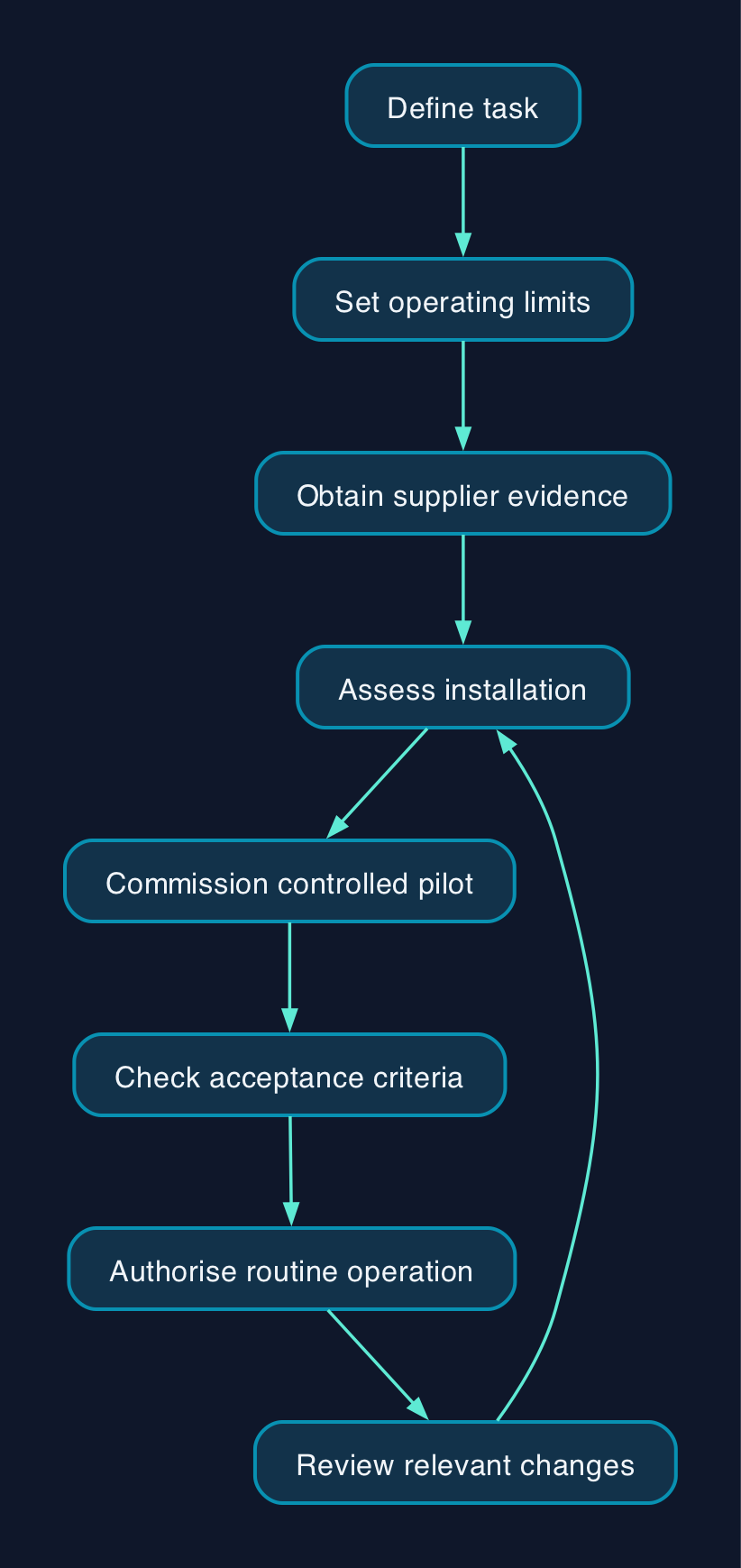
I would structure procurement around a documented sequence. Define the task and operating limits, obtain supplier evidence, assess the proposed installation, commission a controlled pilot, then authorise routine operation only after the agreed checks pass.
The acceptance record should identify the hardware, software version, tools, permitted loads and working area. Buyers should request a safe demonstration of the specified response to lost connectivity, an obstructed route and any other failure conditions relevant to the application.
Change control belongs in the same agreement. Ask which software updates, replacement components, new tasks or layout changes require reassessment, who performs it and who pays.
For the hypothetical wholesaler, moving the robot into another aisle should trigger a review against its documented operating limits. The commercial question is whether that review is included in support or becomes a separately charged engineering visit.
Price the installed task and its support
The business case should price a defined period of useful operation, including the work needed to reach acceptance. I would request separate quotation lines for the machine or rental, installation, workplace alterations, integration, assessment, training and maintenance.
Recurring costs should include software services where required, supervision, consumables, repairs and recovery support. Exit terms should address equipment removal, access to operational records and the handover of any customer-specific integration.
There are no verified robot quotations or UK supplier delivery records in the available evidence, so a priced comparison or brand ranking would be unjustified.
Buyers can still compare competing proposals fairly. Require each supplier to quote against the same task, operating conditions, support hours and acceptance criteria. Ask a manufacturer, an integrator and a managed-service provider to state precisely which responsibilities their offer includes, rather than assuming their commercial roles provide equivalent coverage.
Compare the robot with a narrower solution
A humanoid proposal should face competition from task-specific equipment, other automation approaches and improvements to the existing process.
For the wholesaler, I would ask whether changing workstation placement or container handling could remove enough movement to avoid the purchase. If automation remains attractive, compare alternatives on the completed task, supervision required, recovery arrangements and cost over the same period.
The standards themselves reinforce the need to classify the application carefully. ISO 13482:2014 concerns personal care robots and excludes industrial robots and medical devices. A robot’s human-like appearance does not establish which standard fits its intended use.
The buying question should therefore be “Which supported system can do this job within these limits?” A familiar body shape is not a selection criterion.
The strongest objection is that machinery procurement could stifle learning
A reasonable objection is that demanding a fully specified installation before experimentation could make trials too expensive, especially for smaller businesses. Buyers need room to discover whether a robot can perform useful work.
I agree with allowing bounded experimentation. The distinction should be between permission to learn under controlled conditions and permission to enter routine operation.
A pilot can have a narrow task, restricted working area, trained supervision and explicit stopping conditions. Procurement can release further spending when the supplier demonstrates agreed results. That gives a smaller company a route to evidence without requiring it to commit immediately to a broad deployment.
Nor should buyers require an inappropriate industrial standard for every application. The published scope of ISO 10218-2:2025 expressly excludes several uses and leaves some hazards outside its coverage. Assessment must match the application, rather than reward the longest list of standard numbers.
Editorial analysis
The opportunity for UK technology firms is to make robot deployments understandable and maintainable. I would expect demand for services that translate a proposed task into acceptance criteria, document responsibilities and manage changes after installation.
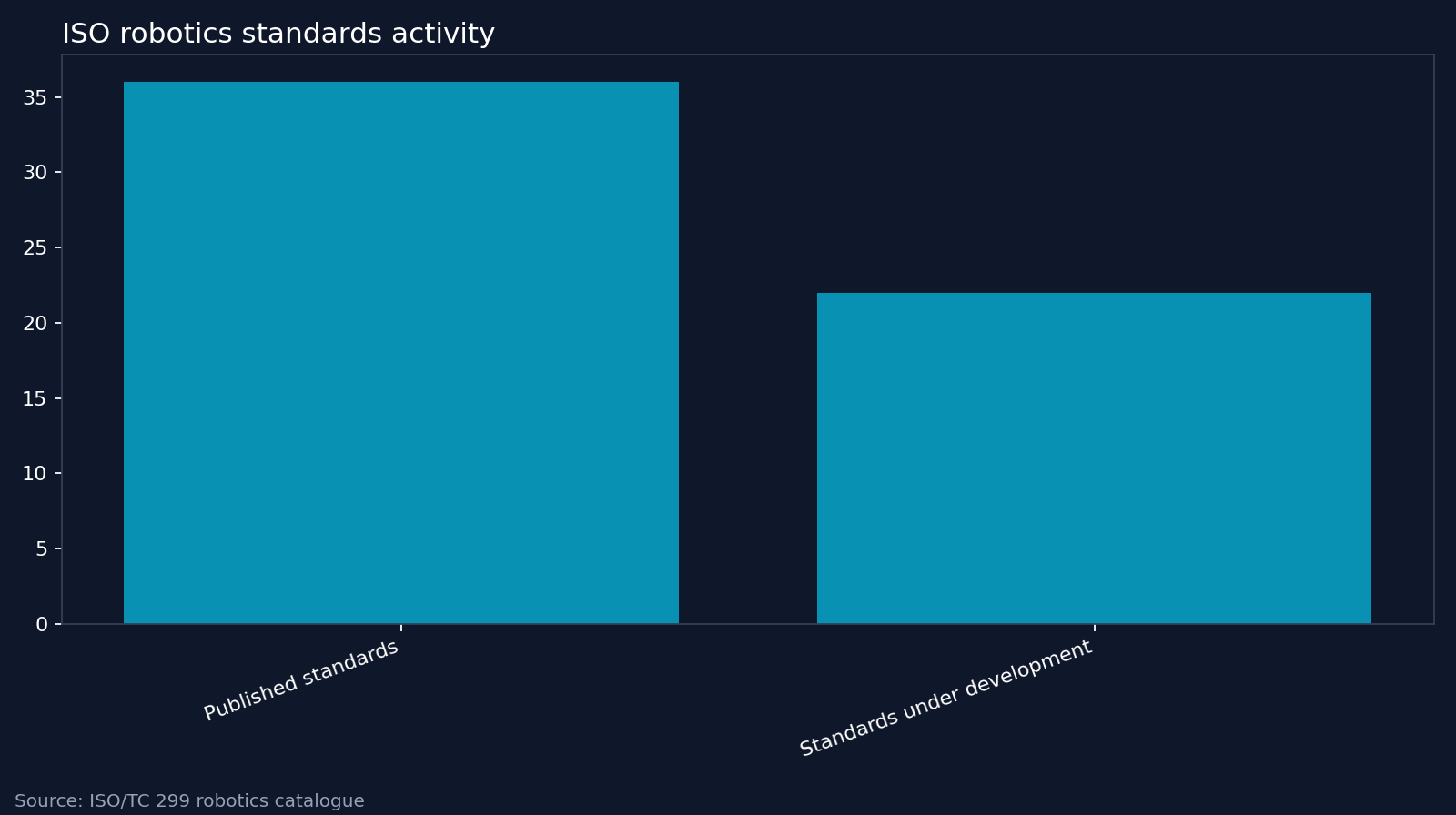
ISO’s robotics committee programme includes work on service robot management, physical human-robot interaction and mobile robot safety. Its breadth supports treating robotics as an operational discipline, although the number of standards cannot establish the safety of an individual product.
British buyers should ask for a handover they can use on the day something goes wrong. It should say who can stop the machine, who diagnoses the fault, what evidence permits a restart and how the business continues while the robot is unavailable.
That is the procurement shift worth making now. Approve a defined task with documented limits and accountable support.
FAQ
Should a British business wait for China’s humanoid standards?
I would not make a British procurement timetable depend on a Chinese drafting programme. The general humanoid safety project remains under development, so buyers should assess the evidence available for their proposed application and define what is needed before acceptance.
Does an ISO reference prove a workplace robot is safe?
A reference alone does not demonstrate that the proposed installation has been assessed against the relevant requirements. Ask for the applicable scope, version and supporting evidence, particularly because ISO 10218-2:2025 has explicit exclusions.
What should a small business request before paying for a pilot?
Request a written task definition, operating limits, supervision requirements, stopping conditions and acceptance criteria. Agree the pilot price, responsibility for recovery and the conditions under which either party can end the trial.
Should IT or operations own the robot?
My recommendation is joint involvement, with a named operational owner accountable for accepting the task into everyday work. IT should own the agreed digital controls, while the contract assigns installation, maintenance and technical support responsibilities to named parties.
Sources
- China National Public Service Platform for Standards Information — Humanoid robot general safety project 20261658-T-604, issued 31 March 2026
- China National Public Service Platform for Standards Information — Humanoid robot environmental perception project 20250856-T-604
- ISO — ISO 10218-2:2025 industrial robot applications and robot cells, published February 2025
- ISO — ISO 13482:2014 personal care robot safety, published February 2014
- ISO — Robotics committee catalogue and work programme