Hydrogen’s future depends on storage becoming a business priority
Hydrogen production capacity cannot guarantee dependable supply. The Dutch HyStock commitment offers British businesses a practical lesson in storage, infrastructure timing and who carries the risk.

Britain should judge hydrogen projects by their ability to deliver fuel when customers need it, with storage treated as a condition of expansion. The Netherlands’ €450 million commitment to HyStock makes that argument concrete. My position is that production investment without a credible balancing plan risks creating an unreliable market. Storage cannot rescue hydrogen that customers cannot afford, but production capacity alone cannot guarantee dependable supply.
Key pointers
- Ask hydrogen suppliers how they will meet demand when production falls below your contracted requirement.
- Separate an announced infrastructure project from storage capacity your business can actually book.
- Require named owners for production, transport, storage and delivery failures.
- Compare the delivered fuel bill, including flexibility and backup arrangements, rather than the production price alone.
- Test investment plans against delayed infrastructure and slower customer uptake.
- Give any software pilot a measurable operational purpose, such as reconciling booked capacity with available inventory.
The Dutch decision changes the investment question
The revealing part of HyStock is the risk the Dutch government has chosen to absorb. Its announcement explicitly recognises that storage may not fill sufficiently during the market’s early years. That is a commercial coordination problem as much as an engineering challenge. The government’s explanation treats production, transport, consumption and storage as developments that must proceed together.
A storage developer needs customers. A prospective industrial customer needs confidence that fuel will arrive. If each waits for the other to remove all uncertainty, neither has a strong reason to commit first. That is the investment trap this intervention seeks to address.
The distinction between a funding headline and its mechanism matters. Industrylinqs reports that the accompanying decision memorandum describes the €450 million as a maximum, conditional risk reserve. It should therefore not be read as a published construction price or evidence that storage economics have been settled.
For British companies, the useful lesson is to put the balancing arrangement inside the initial business case. A promise that storage will arrive later leaves a material dependency outside the investment decision.
British buyers need a delivery map
The relevant UK policy direction already acknowledges this dependency. The October 2025 planning statement envisaged early regional networks serving demand in or near industrial clusters. It stated an intention for the first regional hydrogen network to operate from 2031. That was a policy intention, not a guarantee of a connection for any individual business.
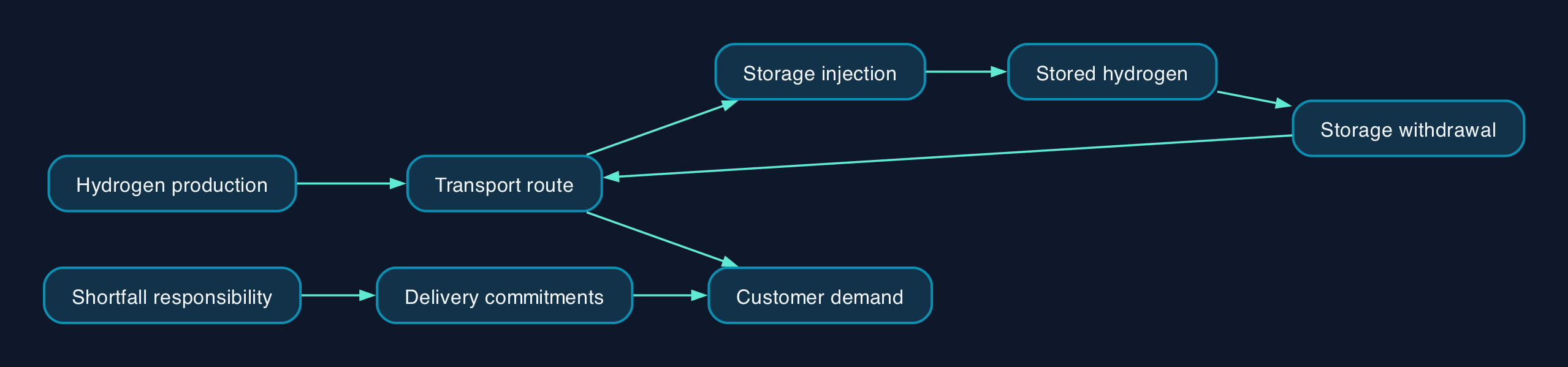
Consider a hypothetical British manufacturer assessing a hydrogen-fired process. Its procurement team should require a delivery map naming the producer, transport route, storage arrangement and party responsible for supplying any shortfall. The acceptance test is whether those commitments cover the factory’s operating pattern.
A small business considering entry into the supply chain needs a different test. An instrumentation supplier or software developer should identify a funded customer and a defined installation or operating requirement before treating a national infrastructure ambition as a sales forecast.
The decision should also retain a credible alternative. Where technically suitable, assess direct electrification, operational changes or postponing conversion alongside hydrogen. The supplied evidence does not establish comparative costs for those routes, so a universal recommendation would be unjustified.
Storage connects production schedules to customer demand
The physical mechanism is straightforward. Hydrogen produced during periods of abundance enters storage and can be withdrawn when supply is scarce. HyStock’s announced scope includes the caverns and the surface facilities needed to move hydrogen into and out of them. The Dutch announcement presents that balancing function as necessary to a functioning market.
The commercial mechanism needs equal attention. A buyer should distinguish the amount it can store from the amount it can receive within a particular period. Ask suppliers to specify usable inventory, withdrawal capability, transport availability and responsibility when any component is unavailable.
For UK technology firms, I would prioritise tools that make those commitments visible and testable. A proposed operating system could reconcile production forecasts, customer orders, storage inventory and maintenance schedules, then flag delivery commitments that cannot be met.
That is a product hypothesis, not evidence of an existing procurement programme. Validate it with operators before building it. A forecast has commercial value only if somebody has the authority and physical capacity to act on it.
Price the service that reaches the customer
The €450 million announcement is public support for a particular Dutch project, not a storage tariff or a basis for estimating a British customer’s bill. Its stated coverage of early utilisation and cushion-gas risks also shows why dividing the funding by the number of caverns would produce a misleading unit cost. The official funding explanation does not provide a customer price.
A British buyer should request quotations that separate fuel, transport, storage access, injection and withdrawal charges, and any minimum commitments. Ask explicitly which items are bundled and who pays for replacement supply during an interruption.
The investment model should also include process conversion, commissioning, staff training, maintenance and exit costs where applicable. Keep unknown inputs visible. An attractive fuel subtotal is insufficient evidence for approving a conversion.
The strongest objection is that storage could sit empty
The strongest counter-argument is that storage spending cannot create demand for hydrogen that remains too expensive or unsuitable for the intended job. Building infrastructure ahead of demand could commit capital to facilities with too few paying users.
The Dutch government itself recognises low initial utilisation as a funding risk. Nor does every early hydrogen project necessarily require access to a large shared store. In its December 2023 parliamentary evidence, DESNZ said production projects operating before separately supported storage became available would, by design, not depend on that storage.
Those points narrow the argument. They do not justify treating storage as an afterthought wherever a project does depend on it.
My recommendation is staged commitment. Establish credible users and their demand profiles, test the required balancing service, and link further investment to evidence of demand and infrastructure progress. Production and storage decisions should share assumptions about timing, volumes and interruptions.
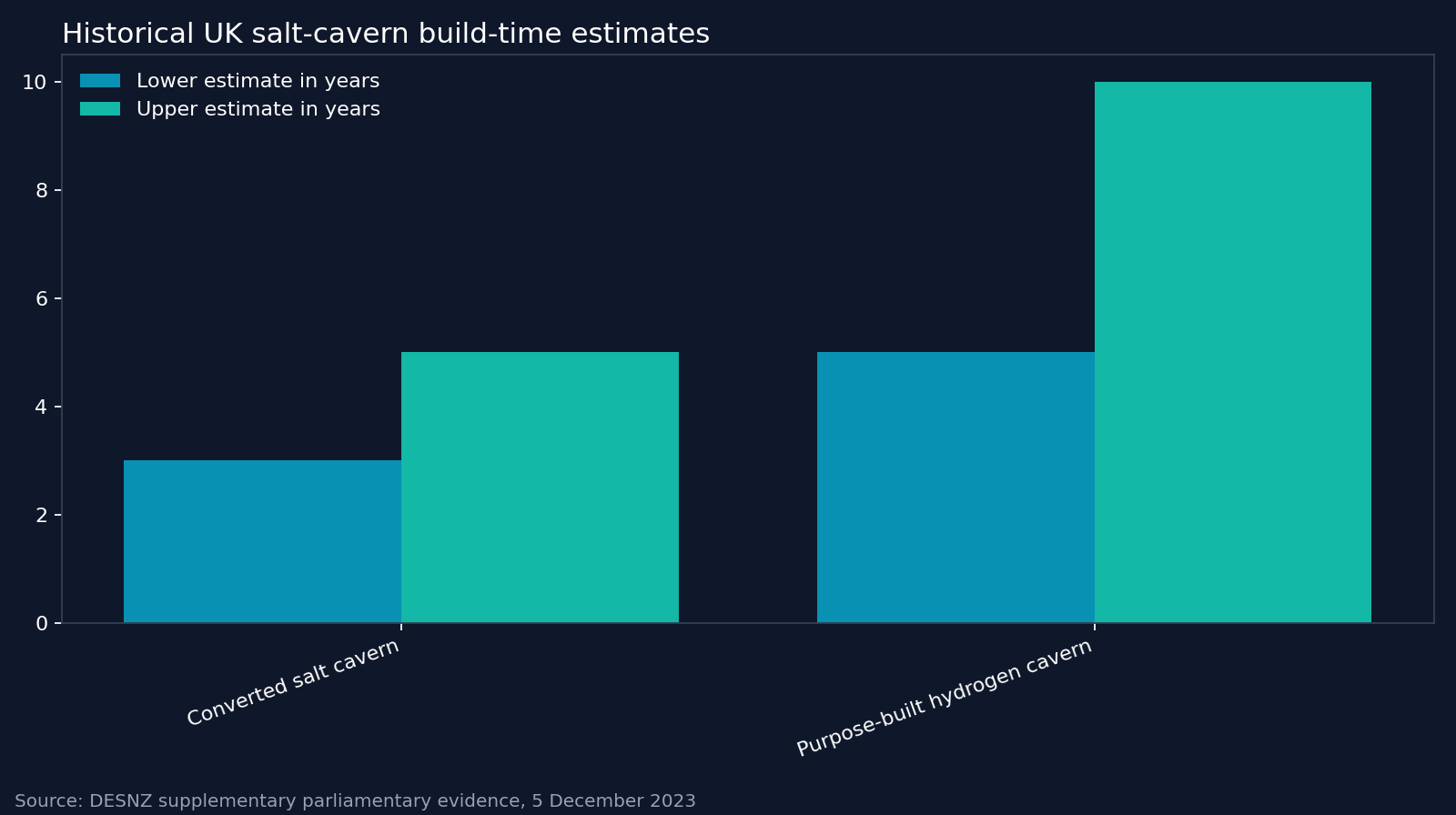
The historical UK build-time estimates underline the scheduling problem, but they are not current supplier quotations. They also describe build times, whereas the Dutch range covers initial planning through operation. Treating the figures as a country ranking would confuse different measures.
Editorial analysis
The measure I would put before a British board is contracted demand that the proposed system can reliably serve. Production capacity belongs beneath that measure, alongside storage access, transport capacity and the consequences of an outage.
For technology leaders, this changes what deserves investment. A useful modelling tool should expose an unsupported delivery commitment. A useful monitoring system should identify a shortfall early enough for an authorised operator to respond. Neither should conceal an infrastructure dependency behind an optimistic annual average.
Hydrogen storage deserves commercial attention now wherever future supply depends on it. The Dutch decision offers a concrete reason to ask who carries the waiting risk, who pays for unused capacity and what must be ready before a customer changes its plant.
FAQ
Does every hydrogen project need underground storage?
No blanket requirement follows from these sources. DESNZ’s December 2023 evidence explicitly described early production projects designed not to depend on separately supported storage. Buyers should establish how their own supply and demand will be balanced.
Does the Dutch commitment prove hydrogen will be affordable?
No. The funding announcement addresses specified investment risks and gives no customer tariff. Affordability still requires a project-specific delivered-cost assessment.
Can British companies assume a hydrogen network connection from 2031?
No. The October 2025 policy statement stated an intention for the first regional network to operate from 2031. A buyer still needs evidence of its own connection route, timetable and commercial terms.
What should a UK technology supplier do first?
Find an operator with a specific unresolved problem, such as reconciling storage bookings with delivery commitments. Agree who supplies the data, who acts on an alert and how the pilot will be accepted. Treat wider market demand as a hypothesis until customers substantiate it.
Sources
- Government of the Netherlands — €450 million for the first large-scale underground hydrogen-storage project, 3 July 2026
- Industrylinqs — HyStock secures a €450 million grant for the Zuidwending hydrogen storage project, 10 July 2026
- DESNZ — Supplementary written evidence LES0046, 5 December 2023
- DESNZ — Hydrogen infrastructure strategic planning policy statement, 7 October 2025