The future data-centre customer may need to arrive with its own power station
The next data-centre contract may depend as much on electricity infrastructure as connectivity. Britain should require credible power plans while holding developers and network companies accountable for delivery.

Britain should expect large data-centre developments to demonstrate how their electricity demand will be supplied and who will pay for the infrastructure. That should mean responsibility for delivery, not compulsory ownership of a power station. Ofgem is already considering greater developer involvement in high-voltage assets. For British technology buyers, my position is simple: a credible power plan should carry as much weight as a promised opening date.
Key pointers
- Ask whether the capacity you are buying is already powered or depends on unfinished electricity infrastructure.
- Require the supplier to identify who owns each connection milestone and bears the cost of delay.
- Separate electricity consumption charges from infrastructure contributions, financing costs and cancellation exposure.
- Compare an expansion at an operating facility with a new campus before accepting construction risk.
- Treat proposed connection fees as a scenario to assess, rather than an established charge.
- Keep a fallback location available until the supplier demonstrates that the contracted capacity can be delivered.
Australia shows where the bargain could change
The useful Australian signal is a change in what communities and governments expect a data-centre developer to bring.
In New South Wales, a fast-track assessment programme announced in August included funding additional water and energy supply among its conditions. The BBC describes that framework in its report on the withdrawal of Goodman Group’s Project Mars proposal. The withdrawal followed community opposition and changes in the policy environment; it does not establish that electricity costs alone killed the project.
For Britain, the interesting proposition is that access to infrastructure could become something a developer helps create before it asks customers to commit. Faster consideration would come with clearer responsibility for the resources a project needs.
The supplied evidence does not establish the detailed terms of Victoria’s reported proposal. The argument here therefore rests on the documented New South Wales example and Britain’s own published connection proposals.
My prediction is that energy delivery will become a more explicit part of data-centre procurement. A buyer may still sign one hosting contract, but the viability of that contract could depend on another party delivering a substation, a connection or additional electricity supply.
Britain is already asking harder questions
Britain’s connection queue makes a poor substitute for a construction forecast. A capacity reservation tells a buyer something about a project’s intentions; it cannot, by itself, prove that the facility will open.
The government’s strategic demand consultation explicitly connects the problem of speculative applications with the risk of delaying viable investment. Its proposals concern Great Britain, so they should not be presented as a description of Northern Ireland’s arrangements.
For a British technology leader, the practical response is to distinguish available capacity from a development pipeline. Ask the supplier to identify the infrastructure still required, the organisation responsible for delivering it and the evidence supporting the expected service date.
For a small business buying managed hosting, that request should remain proportionate. The customer needs a usable service commitment and an alternative if delivery slips. A large enterprise reserving substantial future capacity should expect a more detailed account of dependencies before committing its migration budget.
Bringing power means assigning responsibility
“Bring your own power station” is a provocative shorthand. My preferred model would allow a developer to demonstrate a credible supply and connection arrangement without requiring it to own every asset.
Ofgem’s Connect work programme makes a useful distinction between building and owning high-voltage assets, and building them before transferring them. Neither route is, by itself, proof of electricity generation or an uninterrupted supply.
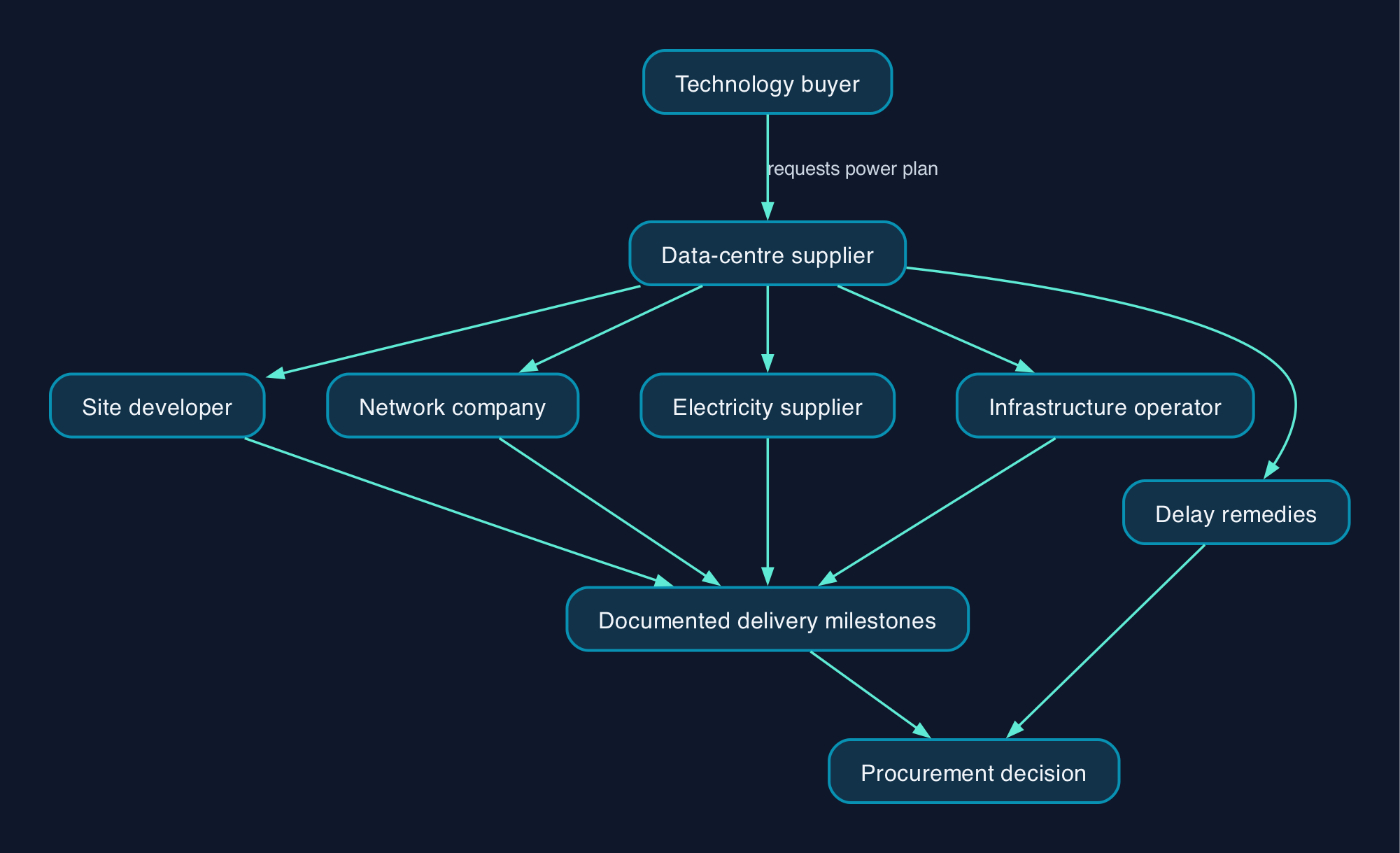
The buyer should therefore request a responsibility map covering the developer, network company, electricity supplier and any infrastructure operator. Each dependency needs an owner, a completion condition and a consequence if it fails.
That changes the supplier assessment. The question becomes whether the parties behind the service can deliver a working facility together, rather than whether one company has announced an impressive campus.
The bill will need more than an electricity rate
The proposed commitment fee illustrates why financing deserves attention alongside electricity consumption. Its potential refund does not remove the need to fund the payment or assess the consequences of an unsuccessful project.
The July announcement gave a consultation closing date of 16 September 2026. The supplied evidence contains no subsequent decision, so the fee remains a proposal for this analysis, rather than a confirmed charge.
A useful quotation should separate the recurring service price from connection works, infrastructure contributions, security payments, financing and cancellation terms. Ask which costs are fixed, which can change and which remain payable if the expected capacity arrives late.
There are no comparable supplier quotations in the evidence, so a defensible cost ranking is not possible. Instead, compare the commercial exposure under several delivery approaches.
An operating colocation facility should be asked to prove that the proposed expansion capacity is available. A new campus developer should disclose unfinished infrastructure and delivery dependencies. A managed hosting supplier should explain the alternative service it will provide if its chosen facility cannot deliver.
Apply those questions equally to international operators and UK specialists. The evidence supports scrutiny of delivery arrangements, not a winner selected by brand.
The strongest objection is that this makes investment harder
Requiring developers to finance more infrastructure could favour firms with large balance sheets and make smaller projects harder to fund. It could also place too much responsibility on developers for delays controlled by network companies.
That objection deserves a policy response. In its December 2025 reform announcement, Ofgem recognised an imbalance between the costs developers suffer from delays and the consequences networks face. It proposed stronger standards, enforcement and compensation.
Britain should therefore demand reciprocal commitments. Developers should substantiate demand and progress their projects; network companies should face meaningful obligations to deliver agreed work.
I would favour shared infrastructure and transparent contributions over a blanket requirement for every campus to become an isolated energy system. Any developer-funded arrangement should explain who benefits from the assets, who maintains them and whether later customers contribute.
The objective should be to make viable projects deliverable while assigning costs fairly. A large upfront payment is not sufficient evidence that a project serves either purpose.
Editorial analysis
The future data-centre customer probably will not arrive carrying the title deeds to a power station. It may, however, need to arrive with enough commercial commitment to help finance the power arrangements behind its chosen facility.
That is why energy suppliers and infrastructure partners could become as important to a project’s credibility as its network carriers. The buyer should assess the parties responsible for delivering electricity infrastructure alongside those responsible for connectivity.
For the next major procurement, I would make one question compulsory: what evidence shows that the electricity infrastructure will be ready when our contracted service starts?
A supplier that can answer with accountable parties, documented milestones and workable remedies has given the buyer something useful. An opening date alone has not.
FAQ
Will British data-centre customers have to own power stations?
The evidence does not establish such a requirement. Ofgem’s June update discusses developer involvement in high-voltage infrastructure, which is different from requiring customers to own generation. The headline describes a possible shift in commercial responsibility.
Is the proposed commitment fee already payable?
The supplied July consultation announcement does not establish that the fee has taken effect. Buyers should ask suppliers to identify any final decision and explain how the resulting obligations affect their quotation.
What should a small UK business ask its hosting supplier?
Ask whether the service depends on a facility that is operating or still awaiting infrastructure. Then request a clear start-date commitment, any rights to increase charges and the fallback if delivery slips. Those answers are more useful than asking a small customer to audit an electricity project.
Does a larger connection queue prove that Britain needs all that capacity?
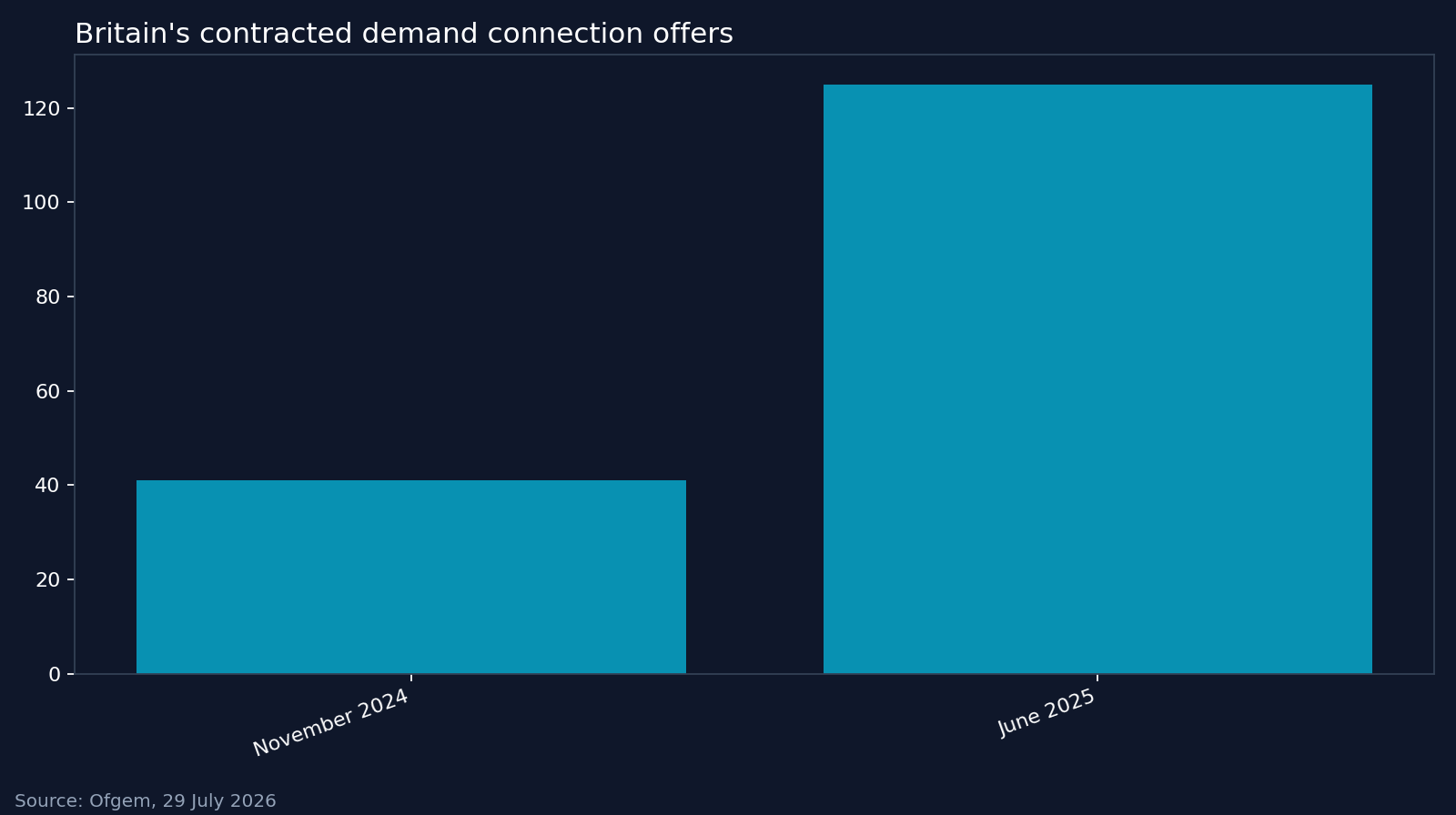
No. Ofgem identifies speculative and potentially non-viable projects as a reason for reform. Connection offers should not be treated as completed facilities or measured demand.
Sources
- BBC News, Plan for controversial Sydney data centre scrapped after push-back. Supplied extract dated 28 September 2026.
- Ofgem, Ofgem acts to free up grid capacity by tackling speculative data centre projects. Published 29 July 2026.
- Ofgem, Connect update — demand connections reform. Published 16 June 2026.
- Department for Energy Security and Net Zero, Accelerating electricity network connections for strategic demand. Consultation issued 11 March 2026; supplied extract covers its opening pages.
- Ofgem, Ofgem sets out major reform package in next step to accelerate grid connections. Published 8 December 2025.