Some of Britain’s future energy network may already be buried underground
Germany plans to build much of its hydrogen network from existing gas pipelines. Britain should investigate the same opportunity, while making every conversion answer to engineering evidence, supply commitments and real customers.

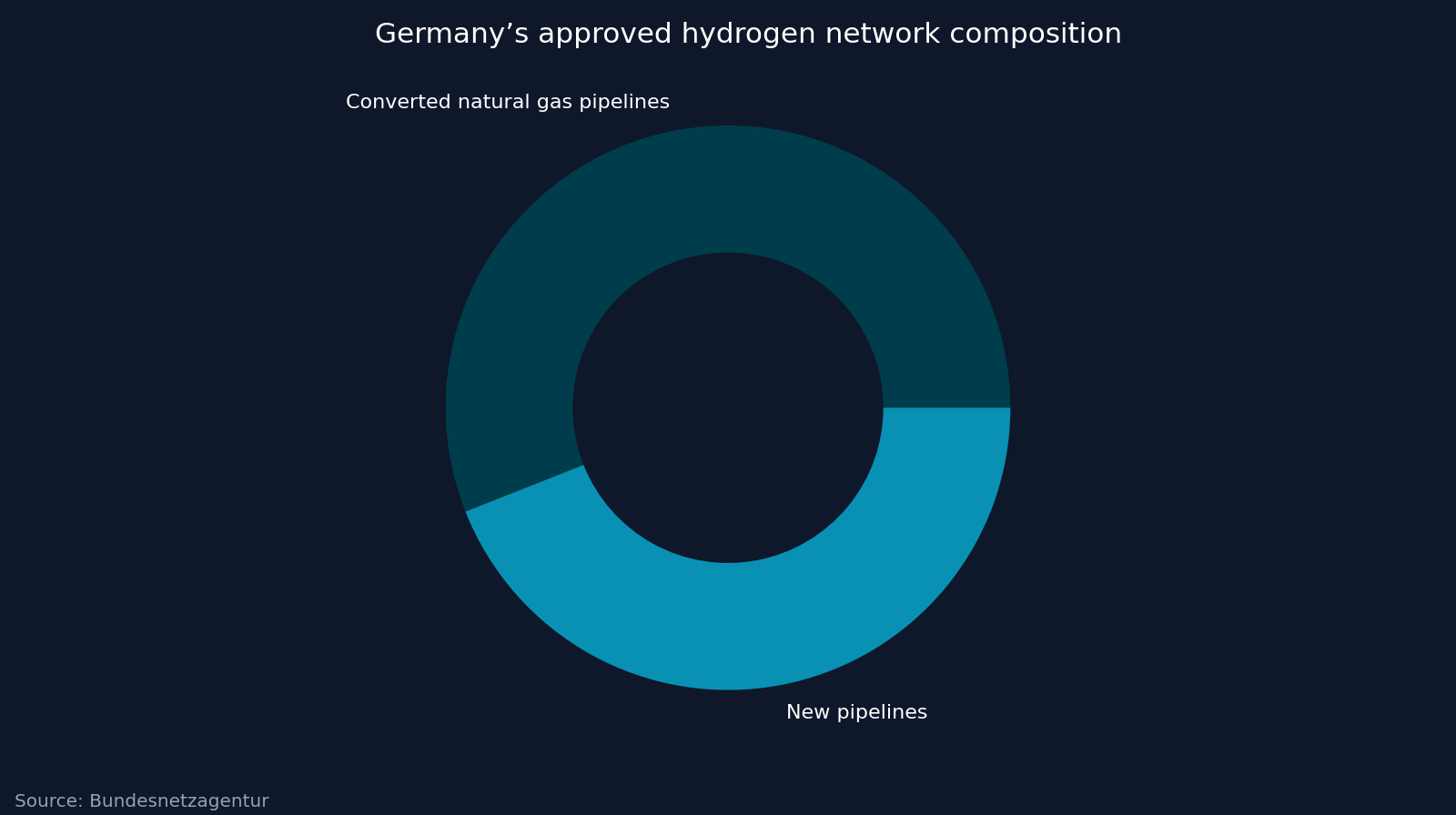
Germany’s approved hydrogen network makes a persuasive case for Britain to assess old gas pipelines before writing them off. British infrastructure owners should pursue selective reuse, with investment conditional on engineering evidence and credible customers. Germany’s approved scheme combines converted pipelines with new construction; it does not establish that every British pipe is suitable, or that transporting hydrogen will make it affordable.
Key pointers
- Ask which specific pipeline assets can be reused and what evidence supports that judgement.
- Separate a successful hydrogen trial from approval to operate a commercial network.
- Require credible production and customer commitments before backing a conversion.
- Compare reuse, new construction and electrification against the same industrial requirement.
- Include equipment changes, operational training and customer connections in the investment case.
- For technology suppliers, prioritise traceable asset records and engineering evidence over speculative software platforms.
Germany has made reuse an investment decision
The significant feature of Germany’s approach is the combination of existing assets, new connections and identified destinations. Its core network is intended to connect industrial centres, storage facilities, power plants and import corridors. Those connections give pipeline conversion a purpose beyond preserving the value of old infrastructure. The regulator describes that intended network.
The same approval record contains a useful warning for Britain. Part of Germany’s JAGAL pipeline could not be released for hydrogen because it remained necessary for natural gas. The amended application therefore required a new pipeline instead. Reuse was constrained by the job the existing asset still had to perform. The application history records this change.
British boards should adopt that discipline. An existing pipeline deserves an assessment, not an automatic extension of its commercial life. The relevant questions are whether it serves a credible future route, whether it can be converted safely and whether its present customers can still be supplied.
For a smaller manufacturer, the decision is narrower. Before buying hydrogen-dependent equipment, seek a site-specific connection proposal, a supply offer and a contingency for delay. A national network map cannot answer those questions.
Britain has evidence to build on
Britain’s reuse argument already extends beyond a German analogy. National Gas built FutureGrid from decommissioned National Transmission System assets to test hydrogen in a controlled, offline environment. Its reported Phase One results cover hydrogen transport, leak and flange integrity, fatigue testing and updated safety documentation. The programme page describes both the facility and its findings.
That is meaningful evidence for the tested equipment and conditions. It should not be read as blanket clearance for every operational pipeline, compressor or customer installation.
The British programmes also address different parts of the problem. National Gas links its transmission research to Project Union, while SGN’s local transmission research centres on a decommissioned pipeline between Grangemouth and Granton. In its 3 August 2023 announcement, SGN described inspection, cleaning and pressure testing before progression to the next trial stage. That dated announcement establishes the assessment work, not the project’s present completion status. SGN’s LTS Futures account
These are complementary programmes, not interchangeable suppliers competing to sell a standard hydrogen connection. Buyers should establish which network owner, engineering contractor and equipment provider would carry responsibility for their particular site.
The connection matters as much as the pipe
A useful hydrogen network must connect production or imports to customers, with storage and transport infrastructure supporting that relationship. Germany’s approved design explicitly links those functions. Its stated network purpose is a better starting point for British planning than the percentage of old pipe that can be retained.
For procurement, I would require a named owner for each dependency. Who provides the hydrogen? Who confirms its specification? Who operates the connection? Who carries the commercial consequence if the customer’s equipment is ready before the supply arrives?
Technology leaders should begin with the records needed to answer those questions. Commission an asset register that connects equipment identity, inspection findings, operating limits and engineering decisions. Require every suitability decision to point back to its supporting evidence.
There is a practical market here for British software and integration businesses, but it must be earned through a defined engineering task. A useful first contract might reconcile inspection records for one proposed conversion route. Acceptance should depend on engineers being able to trace each conclusion to the correct asset and test record.
Reused infrastructure still needs a complete cost case
Germany’s €18.9 billion investment estimate is not a British price benchmark. Nor does the supplied evidence establish a dependable conversion cost per kilometre for a UK buyer. Route conditions, retained equipment and the work required to maintain existing gas services need project-specific assessment.
The financing mechanism exposes another cost that a pipe-only estimate misses. KfW explains that early customers are expected to be too few to cover network costs through fees alone. An amortisation account bridges that gap, with later revenues intended to offset the initial shortfall by 2055. KfW’s explanation separates infrastructure delivery from revenue recovery.
A British investment proposal should therefore price assessment, conversion, replacement equipment, connections, commissioning, staff training, maintenance and financing during low utilisation. Unknown costs should remain visible rather than disappearing into an optimistic headline saving.
Require the same commercial comparison for three options. Conversion must justify the suitability of the retained assets. New construction must justify the additional investment and route. Electrification should be assessed where it can meet the industrial process requirement, using actual equipment and connection proposals.
The evidence here does not support a universal winner.
The strongest objection is a network without enough customers
The strongest objection to reuse is commercial. Preserving an asset can become an excuse to build infrastructure before enough producers and consumers are ready to use it.
Germany’s financing arrangements acknowledge that problem. The account described by KfW depends on later revenues offsetting early shortfalls. It manages the timing of expected income; its existence does not demonstrate that the expected demand will arrive. The financing model makes that dependency explicit.
There is movement towards more concrete commitments. FNB Gas reports that companies could begin reserving entry and exit capacity on 19 March 2026. A reservation is a more useful planning signal than general enthusiasm, although it does not by itself establish delivered hydrogen volumes or profitable operation. The network association describes the reservation process.
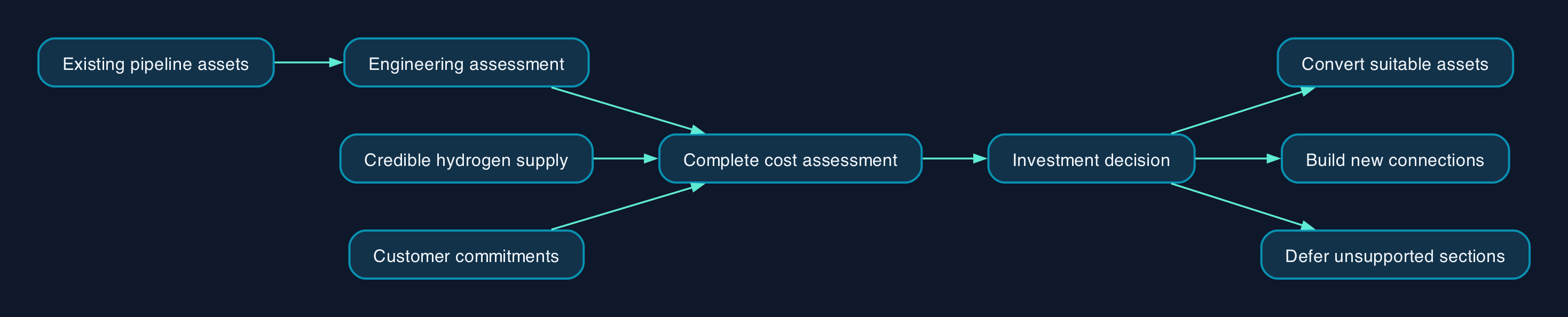
My answer is to make conversion conditional on staged evidence. Release investment as engineering suitability, supply arrangements and customer commitments become firmer. Preserve the ability to defer a section whose demand has slipped.
That approach also leaves room to reject a conversion. An old pipeline with no credible future customer is not made valuable by changing the gas it might carry.
Editorial analysis
Britain should fund the work that distinguishes reusable assets from liabilities. Germany has supplied a large-scale planning example; British testing supplies a developing technical basis. Together, they justify serious assessment without settling every investment decision.
For UK technology leaders, the immediate opportunity is to make those assessments auditable and usable. For business owners, it is to demand a connection and supply case before committing capital.
Some of the future network may already be underground. The investment case still has to be built above it.
FAQ
Does Germany’s approval mean its hydrogen network is complete?
No. The approval concerns a network intended to enter operation progressively towards 2032, with some individual measures potentially deferred until 2037. FNB Gas describes those implementation provisions.
Can Britain convert every existing gas pipeline?
The supplied evidence does not establish that. National Gas reports successful tests on repurposed assets at FutureGrid, but those results concern a controlled facility and its test programme. A buyer should require evidence for the particular assets and operating conditions proposed. FutureGrid’s scope and results
Does pipeline reuse guarantee cheaper hydrogen?
No. The German financing model anticipates early network revenue shortfalls even though much of the infrastructure will be reused. A British buyer still needs a delivered supply price, connection costs and contractual terms before judging affordability. KfW’s financing explanation
What should a British business do first?
Identify the industrial process that might use hydrogen, then request a site-specific assessment of supply, connection and equipment requirements. National Gas describes Project Union as beginning regionally around industrial clusters, so proximity to a proposed route should start a conversation rather than trigger an equipment order. Project Union’s stated approach
Sources
The following pages were supplied in the evidence pack on 28 September 2026; dates below identify dated material where available.
- Bundesnetzagentur — Hydrogen core network, including the approval of 22 October 2024
- FNB Gas — Hydrogen core network, including capacity reservation developments in March 2026
- KfW — Hydrogen core network and its financing mechanism
- National Gas — FutureGrid programme and reported testing results
- National Gas — Hydrogen and the Project Union overview
- SGN — LTS Futures progression announcement, 3 August 2023