Britain’s nuclear export opportunity lies in the supply chain
Canada’s nuclear ambitions extend beyond electricity. British firms should investigate exportable inspection, simulation and engineering capabilities, while making each first contract stand on its own economics.


Canada’s Darlington programme makes a strong case for British technology firms to pursue nuclear supply contracts, rather than wait for electricity exports to become their opportunity. Ontario Power Generation’s approval to begin the first of four planned small modular reactors creates a practical starting point. My position is that Britain should target repeatable engineering and technical services, while treating overseas orders as something to earn, not an inevitable dividend from building reactors.
Key pointers
- Choose a specific customer problem in inspection, simulation, controls or cyber security before developing a nuclear market strategy.
- Ask prospective buyers which qualification requirements apply to the exact work package.
- Separate a funded contract from a programme announcement when assessing your sales pipeline.
- Negotiate rights to reuse your own methods and software before accepting development work.
- Budget for assurance, specialist staff and delayed payments alongside product development.
- Test whether the business case survives without a second reactor order.
Canada is building an industrial proposition
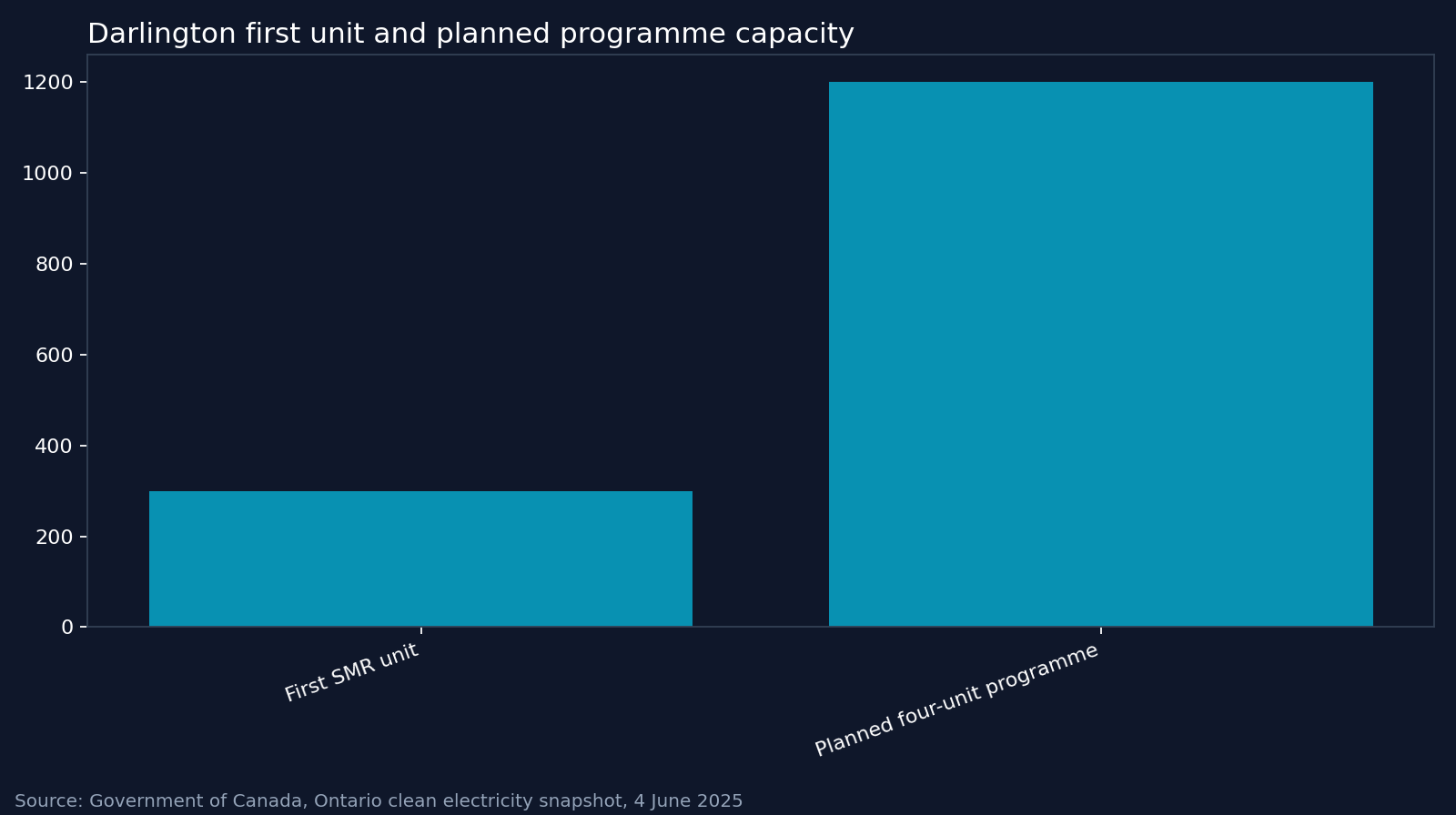
Darlington matters because it connects a reactor programme to a deliberate export ambition. In its May 2025 announcement, Ontario Power Generation, or OPG, described approval to begin construction of the first unit and targeted service by the end of 2030. That was a project timetable announced by its operator, not evidence of an operating reactor.
The industrial intention became explicit in April 2026. Canada’s energy minister set out a proposed strategy that included domestic construction and support for Canadian suppliers seeking overseas business. His published speech described an export effort across the supply chain, supported by trade and export-finance institutions.
For British companies, the useful question is which parts of that construction experience could become products or services sold repeatedly. A successful inspection method, simulation tool or engineering process might have customers beyond its first project. That is the commercial hypothesis worth testing.
It is also narrower than claiming that supply-chain exports will exceed the value of electricity. The available evidence does not establish that comparison. My argument concerns where a British technology business might find an accessible customer and a defensible margin.
The export is a capability another buyer can trust
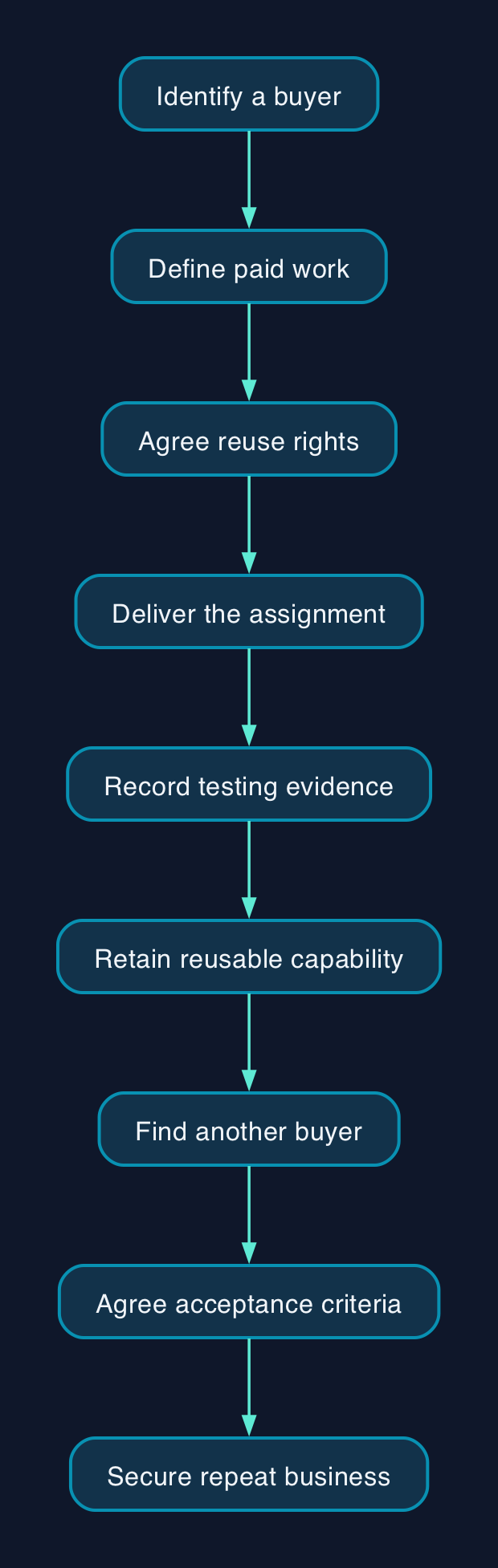
The proposed mechanism is straightforward. A supplier solves a defined problem on an initial project, records how the solution was tested, and seeks permission to reuse the resulting methods on subsequent work. Each step needs a buyer willing to accept the evidence and pay for the service.
Darlington illustrates why that evidence matters. Its construction licence requires additional information before specified activities can proceed, including installation of the reactor building foundation and reactor pressure vessel. The regulator’s decision describes these hold points as checks associated with safety analysis and the design of structures, systems and components.
That does not make every software supplier a nuclear safety contractor. It does suggest a better commercial pitch than promising generic digital transformation. An inspection specialist could propose a defined method for capturing and retrieving inspection records; a simulation firm could propose a bounded training application. These are possible offers to investigate, not confirmed Darlington procurement opportunities.
The customer should define the acceptance test. For a British cyber security firm, the initial conversation should establish the systems in scope, permitted access, response authority and responsibility for approving changes. A broad claim to “secure nuclear” is too vague to price or verify.
Several routes into the market deserve consideration
Britain’s smaller suppliers should compare customers and contract structures before choosing a reactor technology to follow.
An operator such as OPG represents one potential route, with the commercial discussion centred on a defined operational or project need. A reactor technology supplier represents another, where the question is whether a component or service can fit a repeatable design. An engineering delivery partner offers a third route, where a British specialist might contribute to a larger work package.
Canada’s programmes also span different technologies. Darlington selected GE Hitachi’s BWRX-300, as documented in the construction licensing decision. Separately, Canada announced a preliminary financing agreement with AtkinsRéalis for modernising large-scale CANDU technology. The government announcement identifies Atomic Energy of Canada Limited as the CANDU intellectual-property owner.
Those are different roles and programmes, not interchangeable suppliers. A British engineering business should assess where its existing expertise fits, rather than assume that an SMR label makes one programme the better commercial prospect.
For a small firm, my preference would be a paid, tightly scoped assignment with an established project participant. Direct contracting may offer greater control; subcontracting may provide a more practical introduction to project requirements. Neither route deserves investment until the prospective customer explains qualification, payment, liability and handover terms.
Price the work before pricing the opportunity
The relevant financial model for a British entrant is the cost of winning and delivering its first contract. A national reactor budget says little about the margin available to an inspection or software business.
Build that model around specialist recruitment, qualification work, testing, documentation, travel, insurance, integration and ongoing support. Ask who pays when the design changes, who funds repeated testing and when invoices become payable. Include the working capital needed if delivery or acceptance slips.
Intellectual-property terms deserve the same attention as the headline fee. If a customer owns every reusable element of the work, the supplier may earn a worthwhile project payment without acquiring an exportable product. Conversely, retaining reusable methods has little commercial value unless another buyer wants them.
A practical investment test is to assess the first contract on its own economics, then assess repeat sales separately. Do not use an unsigned international pipeline to conceal a loss-making initial assignment.
The strongest objection is that export ambition cannot rescue poor delivery
The counterargument is substantial. If the first projects prove expensive, slow or difficult to reproduce, there may be fewer follow-on customers than suppliers expect. Governments can announce export strategies; they cannot turn those announcements into a profitable order book by declaration.
Darlington’s regulatory record reinforces the distinction between progress and completion. The April 2025 decision authorised construction, while stating that operation would require a separate licensing decision. It provides no basis for claiming that repeat deployment costs or export returns have already been demonstrated.
This objection should change how British companies invest. Commit money against a defined work package, an identifiable budget holder and agreed acceptance criteria. Treat additional countries and reactors as potential expansion until there is contractual evidence behind them.
Domestic delivery and exports also depend on each other in this argument. The strongest export proposition would be a capability whose usefulness has been demonstrated on real work. Export ambition is therefore a reason to make delivery measurable, not a reason to overlook its economics.
Editorial analysis
Britain should pursue the part of nuclear industrial policy that a specialist business can act on. That means identifying a customer, solving a bounded problem and retaining something useful for the next assignment.
The most valuable question for a technology leader is whether the proposed investment produces reusable knowledge, software or methods. A bespoke engagement can still be profitable, but it should not be valued as a repeatable export business without evidence of another buyer.
Canada has made its industrial ambition visible through construction approvals and an explicit export policy direction. British firms should respond with specific offers and disciplined contract decisions. The prize is a customer willing to buy the capability again.
FAQ
Could a small British technology company enter this market?
My recommendation is to investigate a narrow subcontract before committing to a broad nuclear offering. Ask the prospective buyer for the exact qualification requirements, acceptance criteria and funded scope before hiring or developing a product.
Does Darlington already prove that SMRs create export businesses?
No, the cited material establishes project approvals and export ambition, rather than realised SMR export returns. The construction licensing decision also explicitly separates construction permission from permission to operate.
Should British suppliers focus only on small modular reactors?
Not automatically, because Canada’s investment programme also includes modernisation of large-scale CANDU technology. Compare the fit with your existing skills, the cost of qualification and the actual customer opportunity before choosing a programme.
What should a business owner ask before funding a nuclear sales effort?
Ask who will buy the work, what evidence they require and whether the first contract can support its own delivery costs. Then establish which methods or software you can reuse, and what would happen financially if the next order never arrived.
Sources
- Ontario Power Generation — OPG ready to begin building North America’s first Small Modular Reactor, 8 May 2025
- Government of Canada — Ontario clean electricity snapshot, 4 June 2025
- Canadian Nuclear Safety Commission — Decision authorising construction of one BWRX-300 reactor at Darlington, 4 April 2025
- Natural Resources Canada — Tim Hodgson’s Canadian Nuclear Association Conference speech, 29 April 2026
- Natural Resources Canada — Investment in Canadian nuclear energy development, 5 March 2025