British technology buyers should start asking about water
Water should enter British technology procurement, but a litre needs context. Canada’s development principles and customer reporting offer a starting point for questions about location, workload allocation and seasonal demand.


Canada’s new data centre principles should prompt British buyers to ask for water evidence at their next cloud renewal. My position is that litres per unit of compute belongs in procurement, provided suppliers disclose what they counted, where and when. Canada’s framework links expansion to lower water use and local transparency. British companies should turn that expectation into a supplier question before turning it into a purchasing score.
Key pointers
- Ask your cloud or AI supplier for water data attributable to the service you buy.
- Require suppliers to distinguish water withdrawn from water consumed.
- Compare equivalent workloads using the same reporting period and measurement boundaries.
- Ask about summer demand and local water conditions alongside annual totals.
- Request the allocation method behind a customer figure, rather than assuming it represents direct measurement.
- Keep price, service reliability, energy use and migration costs alongside water in the decision.
Canada has made water part of the expansion bargain
Canada’s announcement matters because it places water alongside electricity costs, community benefits and domestic computing capacity. Its principles are intended to complement provincial, territorial, municipal and Indigenous regulatory processes. They establish expectations for development, rather than a customer metric for comparing individual cloud workloads. The government’s explanation makes that local decision-making context explicit.
The procurement implication is an editorial judgement. If a supplier commits to transparency towards a host community, a business buying its computing services has a reasonable basis for asking how those commitments translate into operational evidence.
British buyers should start with their next renewal questionnaire. Ask which water figures describe the contracted service, what remains unmeasured and who will answer follow-up questions. A small business can make that request through its managed service provider; a larger organisation can assign it to the team already assessing cloud costs and supplier resilience.
Neither needs to commission a national water study before asking.
A litre needs a location and a denominator
“Litres per unit of compute” sounds precise until someone asks what the unit means. For procurement, I would define it around a repeatable business task, with agreed output quality and service requirements. An accepted document extraction or a completed processing job could be a candidate. These are proposed comparison units, not established water-accounting standards.
The numerator needs equal care. AWS distinguishes water withdrawn from sources, water discharged back to the environment and water consumed, typically through evaporation. Its customer reporting concerns withdrawals. Those definitions prevent a buyer from treating every reported litre as permanently consumed.
Attribution also matters. AWS’s published methodology allocates total operational withdrawals using proportional service usage. A customer allocation should therefore be described as an allocation, rather than presented as a meter attached to an individual application.
For any proposed ratio, ask whether the water figure and workload count cover the same services and period. Require suppliers to state whether electricity generation and hardware manufacturing sit inside or outside the calculation. Do not combine differently bounded figures into a league table.
Finally, retain the local context. Dr Yi He’s parliamentary submission argues that environmental risk depends on where demand occurs, its timing and the source of supply. A low annual ratio cannot, by itself, answer a question about peak demand during a dry summer.
Turn the metric into a procurement process
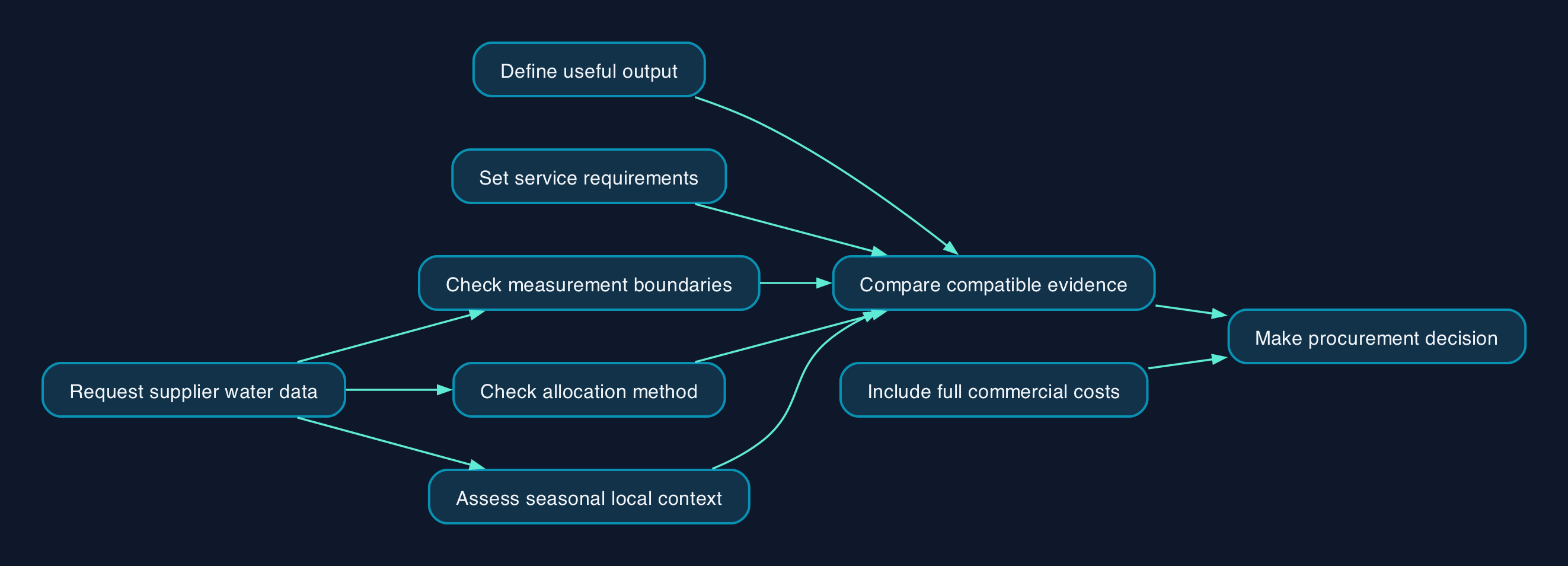
My proposed process connects the application owner, supplier and procurement team.
The application owner defines useful output and minimum service quality. The supplier provides the water figure, reporting boundary and allocation method. Procurement checks whether competing offers use compatible definitions, then considers the result alongside cost and operational requirements.
Start with an existing service and a manual report. AWS already documents annual reporting by region, service and account, so its customers have a concrete starting point. The supplier’s announcement supports that reporting capability, without establishing that it answers every site-specific risk question.
For a small British company, the first useful deliverable might be a written supplier response explaining the hosting arrangement and available evidence. For an enterprise tender, I would request a sample report, methodological exclusions, a named reporting owner and an explanation of drought-related operational dependencies.
Missing data should remain visibly missing. Recording an unknown value as zero would reward the least informative response.
Keep the commercial case complete
AWS says its Sustainability console is available at no additional cost. That does not price the customer’s work of interpreting reports, reconciling definitions or changing an application. The published availability statement supports the console charge only.
Any proposal to move a workload should include engineering time, testing, data transfer, staff training, support and exit costs. Ask for quotations where these inputs are unknown. The evidence here does not establish a standard water surcharge or a reliable financial saving from choosing a lower-water service.
My recommendation is to improve the existing arrangement first when it meets business needs. Request better disclosure, investigate avoidable processing and test alternatives before approving a migration. Water evidence should strengthen the investment case, not excuse an incomplete one.
Compare suppliers without inventing a winner
AWS provides a documented customer reporting mechanism. Google, OVHcloud and Equinix join AWS on Canada’s signatory list, but signing that framework does not establish equivalent customer reporting or comparable water performance. The Canadian record supports participation, not a supplier ranking.
For AWS, examine whether its annual allocation is detailed enough for the decision. For Google and OVHcloud, request equivalent evidence for the actual service under consideration. Where Equinix or a UK provider is being considered for a different delivery arrangement, first establish which responsibilities belong to the facility operator and which remain with the customer.
Apply the same questions to every candidate. Can it identify the relevant reporting boundary? Distinguish drinking water from reclaimed supplies? Explain seasonal demand? Show how a customer share was calculated?
The available evidence does not support declaring any of these suppliers the lowest-water choice. A fair comparison starts by establishing what each offer can substantiate.
The strongest objection is that this adds bureaucracy
The objection deserves a serious answer. British businesses already assess price, reliability, security and support. Adding an immature metric could create paperwork and misleading rankings, especially if national water totals exaggerate the importance of an individual service.
There is evidence against treating every facility as water-intensive. The industry association’s evidence page puts data centres at roughly 0.2% of England’s non-household water use. It also acknowledges concentration of demand, summer peaks and limitations in voluntary survey coverage.
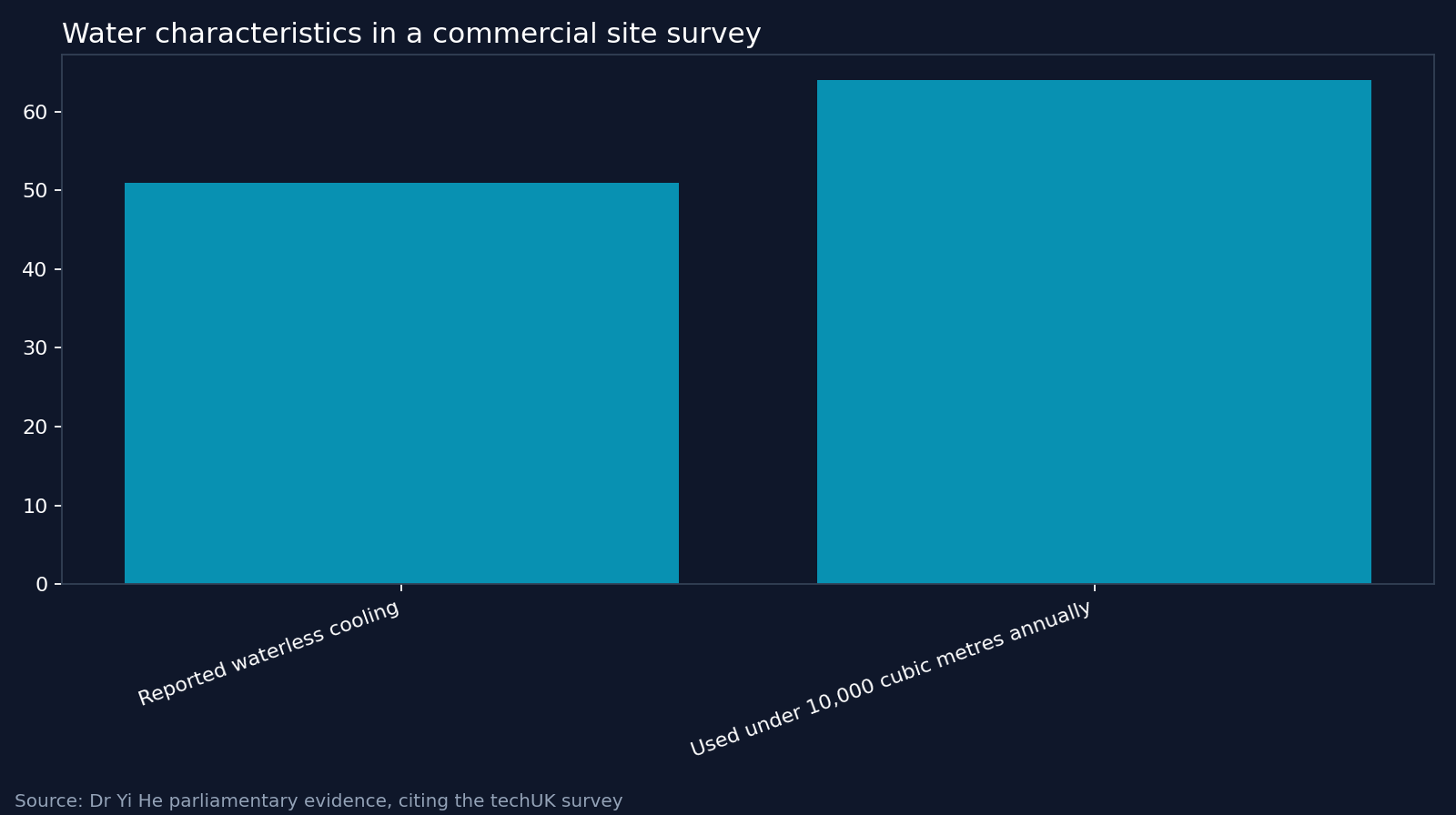
The parliamentary submission provides useful detail. In the 73-site commercial survey, 51% reported waterless cooling and 64% used less than 10,000 cubic metres annually. Those percentages describe overlapping characteristics of the sample, not the whole UK estate. The submission notes that the voluntary, anonymous survey did not capture the wider population of on-premises and enterprise facilities. Its assessment supports caution in both directions.
That is why I favour proportionate disclosure before mandatory purchasing scores. A small software renewal may warrant a supplier questionnaire. A major computing commitment warrants deeper evidence about the facilities and dependencies behind it.
Editorial analysis
Water could become a useful technology buying metric, but the first competitive advantage should belong to suppliers that explain their numbers clearly.
I would give more weight to a bounded, reproducible disclosure than a striking figure whose denominator cannot be checked. A supplier that identifies exclusions gives procurement something to investigate. A supplier that offers only an aspiration leaves the buyer unable to compare.
Canada has supplied a policy signal. Customer reporting supplies an operational opening. British buyers should connect the two by asking for evidence at renewal, then decide whether that evidence is strong enough to influence the award.
FAQ
Can British buyers compare litres per AI query today?
The evidence here does not establish a standard, comparable figure across suppliers. Begin with equivalent tasks, output quality, reporting periods and water-accounting boundaries. Treat unmatched figures as separate disclosures rather than a ranking.
Does waterless cooling mean a service has no water footprint?
No. Dr Yi He’s submission distinguishes direct cooling demand from an additional indirect component associated with electricity generation. Ask which activities a waterless claim covers.
What should a small business ask its supplier first?
Ask for the water reporting available for your service, its coverage period and an explanation of how any customer share is calculated. AWS’s allocation methodology illustrates why that last question matters. Request a written explanation of gaps if a service-specific figure is unavailable.
Should lower water use outweigh price and reliability?
My view is that it should inform the decision alongside them. Where local water conditions create a material dependency, investigate the supplier’s operational response before assigning a score. Do not approve a costly migration on an unverified environmental comparison.
Sources
- Government of Canada, Government of Canada launches Canada’s Responsible Data Centre Development Principles, 3 September 2026.
- AWS, Advancing Water Stewardship at AWS — New Water Withdrawals Data Now Available in the AWS Sustainability Console, 16 July 2026.
- AWS documentation, Water withdrawals, supplied evidence retrieved 28 September 2026.
- UK Parliament, Written evidence from Dr Yi He — Water risks and opportunities for the sustainability of UK data centres, supplied evidence retrieved 28 September 2026.
- techUK, Data centre water use, supplied evidence retrieved 28 September 2026.