UK cloud buyers should refuse to underwrite a supplier’s power gamble
A London postcode cannot make an unfinished electricity connection deliver on time. CTC argues that suppliers should commit to a usable, priced fallback before UK buyers accept deadline-critical capacity.


Opinion. UK cloud buyers should reject deadline-critical capacity that depends on an unfinished electricity connection unless the supplier commits to a usable, priced fallback. The buyer should not absorb that delivery risk merely because the proposed site has a London address. Ofgem’s warning that speculative projects can delay viable developments justifies tougher procurement terms, not a retreat from London or a migration away from services that already work.
Key pointers
- Make deliverable capacity a condition of selection when a missed launch date would damage the business.
- Ask whether the quoted service uses operational infrastructure or depends on a future electricity connection.
- Require a fallback location, price and accountable delivery owner before accepting a connection-dependent proposal.
- Keep an existing London service if it meets your performance, recovery and support requirements.
- Compare Google Cloud, AWS and Azure at service level rather than treating their regional maps as delivery guarantees.
- Separate evidence of available capacity from evidence that your application can recover after failure.
The procurement mistake is accepting the dependency without assigning the risk
CTC’s position is that a supplier’s future connection should remain the supplier’s delivery problem. A buyer with a fixed launch date should not sign on the assumption that someone else’s infrastructure milestone will arrive on time.
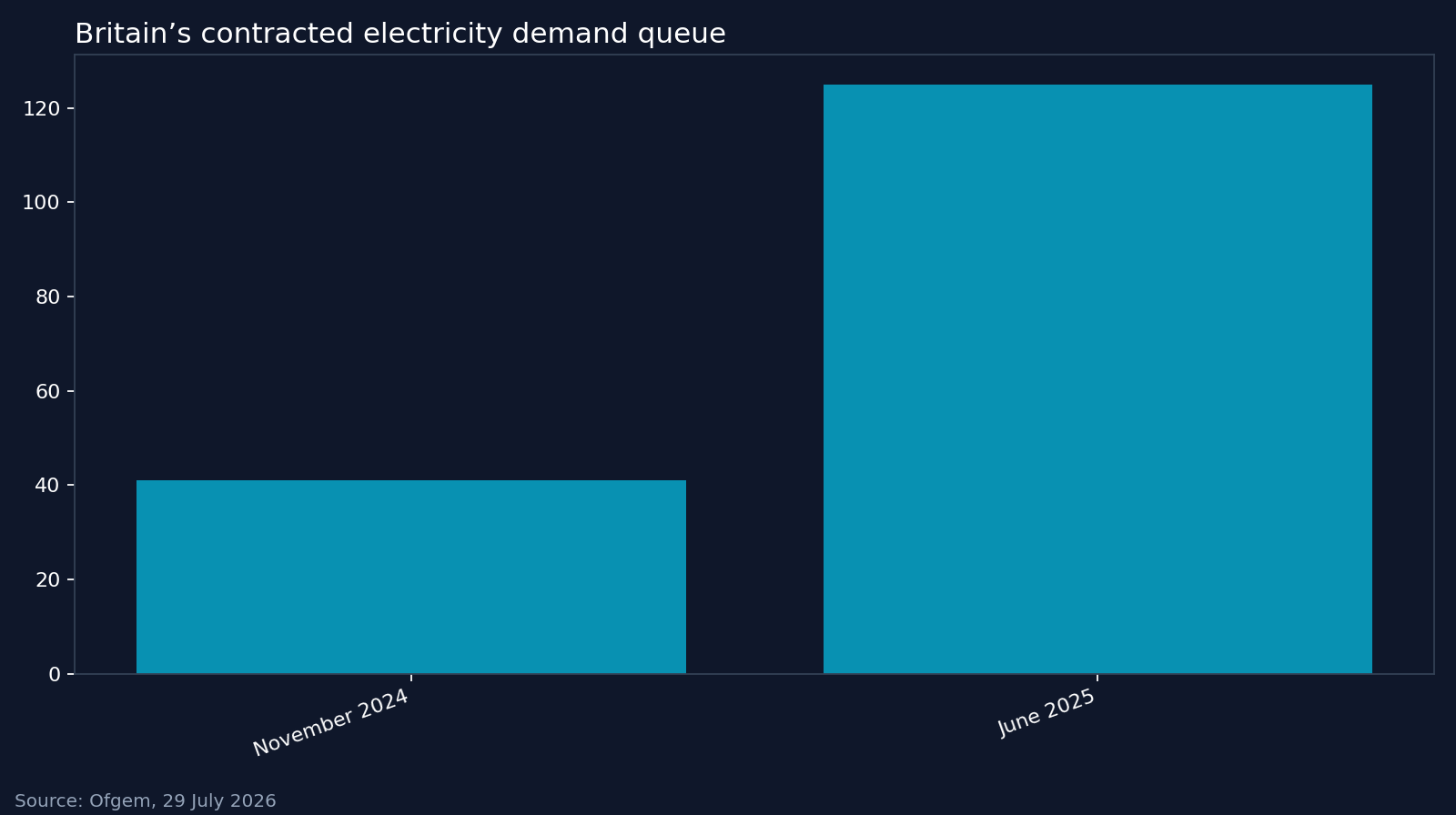
Ofgem supplies the reason to challenge that assumption. It warns that speculative projects can occupy scarce network capacity, delay viable developments and distort signals about future network investment. That is a specific delivery dependency, not a prediction that every proposed facility will fail. Ofgem’s explanation of the queue problem
The distinction matters commercially. A proposal offering capacity on operational infrastructure and one depending on a future connection are asking the buyer to accept different risks. Procurement should make that difference visible before comparing their headline prices.
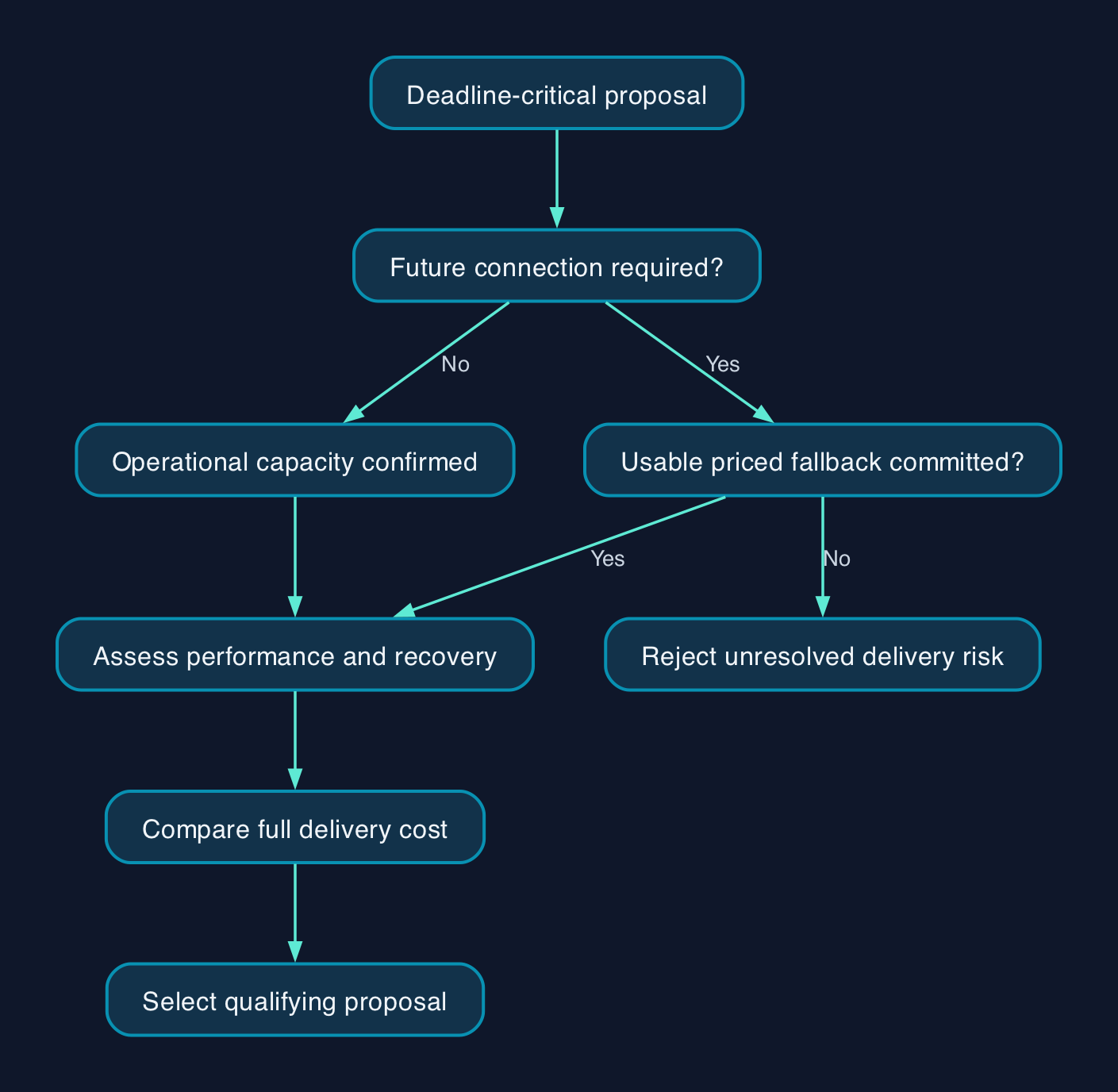
Our recommendation is simple. If the supplier cannot deliver from the proposed site by the required date, it should identify what it will provide instead, who will move the workload and what the buyer will pay. An unspecified alternative is not a fallback worth accepting.
London is incidental to that rule. Apply it equally to a proposed site elsewhere in Britain.
Ofgem’s proposal exposes the value of a credible commitment
The most useful part of Ofgem’s announcement is its proposed mechanism. A developer would pay a commitment fee when accepting a connection offer, recover it when the project reaches energisation and forfeit it if the project leaves the queue early. Proposed milestones would also require evidence of financial capability, commercial maturity and procurement activity. Ofgem’s proposed fee and milestones
The editorial lesson is that an intention to connect and a commitment backed by consequences deserve different weight. Buyers should apply that distinction to delivery promises without pretending that a cloud contract is a grid connection agreement.
We would make acceptance of a connection-dependent proposal conditional on written answers to these questions.
- Which infrastructure milestone must happen before our capacity becomes usable?
- Who reports progress and takes responsibility if that milestone slips?
- What operational alternative will meet our workload and location requirements?
- Who pays for migration, testing and any additional service charges?
- What evidence must we accept before the supplier declares delivery complete?
These are proposed buying conditions, not claims about rights already present in a supplier’s contract. Their purpose is to expose the unresolved dependency while the buyer can still choose another offer.
The strongest objection is that power planning belongs to the provider
That objection is right for many purchases. A small business buying a hosted application should not have to audit substations, negotiate grid milestones or inspect a provider’s construction programme. Requiring that work would make procurement heavier without necessarily producing a better service.
Our position is narrower. Escalate the power question when the supplier’s delivery promise depends on new infrastructure. For an existing service, concentrate on continuity, expansion commitments and recovery; require the provider to explain any material dependency affecting the capacity being purchased.
Nor does the connections queue justify moving a working London application. Ofgem’s evidence concerns connection applications and potentially delayed developments, not a finding that existing London cloud services are unreliable. Scope of Ofgem’s announcement
A London deployment may also meet the application’s needs better than an alternative. Google’s guidance identifies latency, availability and durability as location-selection considerations. A buyer should test those requirements rather than sacrifice them to a rule that everything outside London must be preferable. Google Cloud location guidance
The objection therefore defeats postcode-driven migration. It does not justify accepting an unresolved delivery dependency for a launch that cannot slip.
Usable power is the first condition, not the whole decision
A supplier that passes the capacity test must still demonstrate that its proposed service fits the workload. The documentation from Google Cloud, AWS and Microsoft makes clear why a location label cannot settle that question.
| Platform | What the evidence establishes | What we would require from the proposal |
| --- | --- | --- |
| Google Cloud | Zones are failure domains; regional loss requires a disaster recovery plan beyond protection against a zonal failure. [Geography guidance](https://docs.cloud.google.com/docs/geography-and-regions) | A deployment and recovery design matched to the application’s requirements |
| AWS | The archived EC2 guide says resources are not automatically replicated across regions. [September 2024 guide](https://cdn.threerivers.gov.uk/files/2024/10/fa054600-8232-11ef-8eef-d53c007498ce-I53%20-%20Regions%20and%20Zones%20-%20Amazon%20Elastic%20Compute%20Cloud.pdf) | Current confirmation of the replication, recovery and capacity arrangements being offered |
| Microsoft Azure | Regional availability-zone support does not guarantee support for each service. [Azure regions list](https://learn.microsoft.com/en-us/azure/reliability/regions-list) | Confirmation for the exact services and configurations in the quotation |
UK managed hosting and private-cloud bids should face the same acceptance conditions. The supplied evidence does not verify a named UK provider’s spare capacity or delivery scope, so it cannot support a preferred-provider recommendation.
For a buyer with limited IT staff, we would also require one named party to coordinate recovery across the facility, platform and application. A technically plausible fallback is of little use if the contract leaves the customer to organise it.
Price the fallback before calling the proposal cheaper
The evidence does not establish a reliable price ranking between London and other UK locations. CTC should not replace an unsupported preference for London with an unsupported promise of regional savings.
Request comparable GBP quotations for the same workload, delivery date, support coverage and recovery requirements. Specify VAT treatment, billing commitments and exclusions, then include migration, connectivity, data transfer, testing, staff time and exit work.
For a connection-dependent offer, price the fallback alongside the preferred deployment. A lower initial quote should not win while the cost of making it usable remains unresolved.
Our judgement is that deadline-critical procurement should reject that uncertainty before scoring price. Once suppliers have demonstrated deliverable capacity, let application performance, operating responsibility and full cost decide the winner. London can win that comparison; a postcode should never substitute for it.
FAQ
Should UK businesses stop buying cloud services in London?
No. The evidence concerns pressure on future electricity connections, not a general failure of operating London services. Keep a service that meets the business’s requirements and challenge specific expansion dependencies when they arise. Ofgem’s announcement
Does the connections queue measure electricity consumption?
No. Ofgem’s figures describe contracted demand offers, and the regulator warns that some projects may never proceed. They should not be presented as measured consumption by operating data centres. Ofgem’s queue assessment
What should a small business ask its hosting supplier?
Ask whether the capacity being purchased depends on infrastructure that is not yet operational. If it does, request the alternative service, delivery owner and additional charges in writing before accepting the proposal.
Is Ofgem’s proposed commitment fee already a requirement?
The supplied July announcement establishes that Ofgem launched a consultation. It does not establish subsequent adoption, so this article does not treat the fee as a current contractual obligation. Ofgem’s consultation announcement
Do multiple availability zones solve regional failure?
No. Google distinguishes deployment across zones from planning for the loss of an entire region. Require the supplier to explain which failure scenarios its recovery design covers. Google Cloud resilience guidance
Should the cheapest quote win once capacity is confirmed?
Only if it also meets the workload, support and recovery requirements. Our recommendation is to compare the complete delivery proposal, including fallback, migration and exit work, rather than the initial service charge alone.
Sources
- Ofgem - Ofgem acts to free up grid capacity by tackling speculative data centre projects, published 29 July 2026
- Google Cloud - Geography and regions
- Microsoft Learn - Azure regions list
- AWS - Regions and Zones, Amazon EC2 guide captured on 30 September 2024 and hosted by Three Rivers District Council