Clean steel will make software a production decision
Sweden’s HYBRIT programme reveals a practical software opportunity in industrial decarbonisation. British firms should focus on reliable scheduling and integration, with savings tested against real operating constraints.

Yes. Clean steel could make industrial software part of the production decision because hydrogen storage lets operators shift hydrogen production around electricity prices while meeting the ironmaking process’s needs. Sweden’s HYBRIT programme illustrates the opportunity. Its partners report lower hydrogen production costs from operating storage against electricity markets. British suppliers should pursue that coordination problem, while buyers demand evidence of reliable operation before accepting promises of savings.
Key pointers
- Treat energy scheduling, production planning and equipment control as one procurement problem with clearly assigned responsibilities.
- Ask whether a savings claim comes from operating trials or a simulation.
- Require suppliers to explain what happens when forecasts, communications or individual assets fail.
- Compare extending existing controls with buying specialist optimisation software before commissioning a replacement platform.
- Give plant engineers authority over the operating limits that commercial optimisation must respect.
- Start with a bounded operational problem rather than a contract to automate the entire factory.
Sweden has demonstrated the process, not the headline
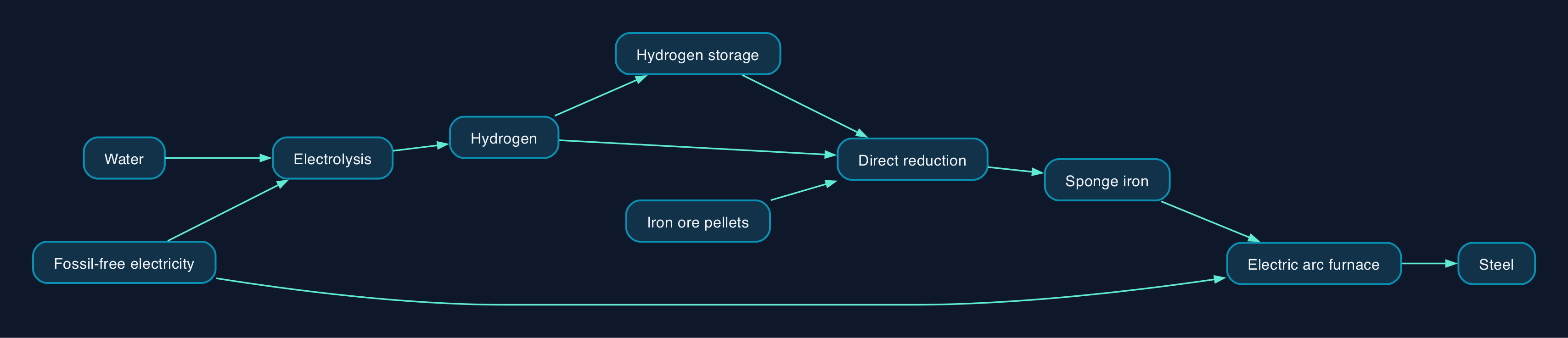
HYBRIT provides a concrete starting point for an industrial software argument. In its announcement dated 27 August 2024, LKAB reported that the Luleå pilot had produced more than 5,000 tonnes of hydrogen-reduced iron. The research covered hydrogen production, direct reduction and melting the resulting sponge iron in an electric arc furnace. These were reported pilot achievements, rather than evidence that the planned commercial production chain was already operating. LKAB’s research announcement makes that distinction consequential.
The proposed demonstration chain also spans locations. HYBRIT describes hydrogen production and direct reduction in Gällivare, with sponge iron supplying electric arc steelmaking in Oxelösund. Thinking about this as a single software-controlled building would miss the logistics and organisational boundaries in the published project design.
Calling it potentially one of the most software-dependent factories ever built is a provocative hypothesis. The supplied evidence contains no comparison of software dependence across factories, and no detailed inventory of HYBRIT’s control systems. The defensible position is narrower and more useful. Hydrogen-based steelmaking creates a coordination problem that British technology businesses should investigate.
The evidence also contains differing historical commissioning expectations. Those forecasts do not establish today’s construction or operating status, so the opportunity should be assessed through demonstrated mechanisms rather than an assumed launch date.
Storage turns an electricity bill into an operating decision
The critical mechanism is the separation of hydrogen production from hydrogen consumption.
HYBRIT explains that hydrogen produced beside the direct reduction plant can be used immediately or stored. Storage creates the option to produce hydrogen when electricity is plentiful and draw on that stock when the electricity system is under strain. Its hydrogen storage description therefore describes a buffer between electricity supply and the ironmaking process.
My inference is that this buffer creates a valuable scheduling problem. An operator must decide when to produce hydrogen, how much to retain and how to meet the reduction plant’s needs. Electricity prices matter, but a commercially attractive schedule must remain physically workable.
For a British buyer evaluating such a system, I would separate three responsibilities.
First, equipment controls should keep each asset within its permitted operating conditions. Second, a scheduling layer should propose how electrolysis and storage meet the production plan. Third, commercial analysis should measure whether those decisions improve costs after their operational consequences are included.
That is a proposed procurement model, not a description of HYBRIT’s installed software. Its purpose is to prevent a supplier from treating a cheaper electricity purchase as success when the resulting schedule disrupts production.
The savings case needs careful boundaries
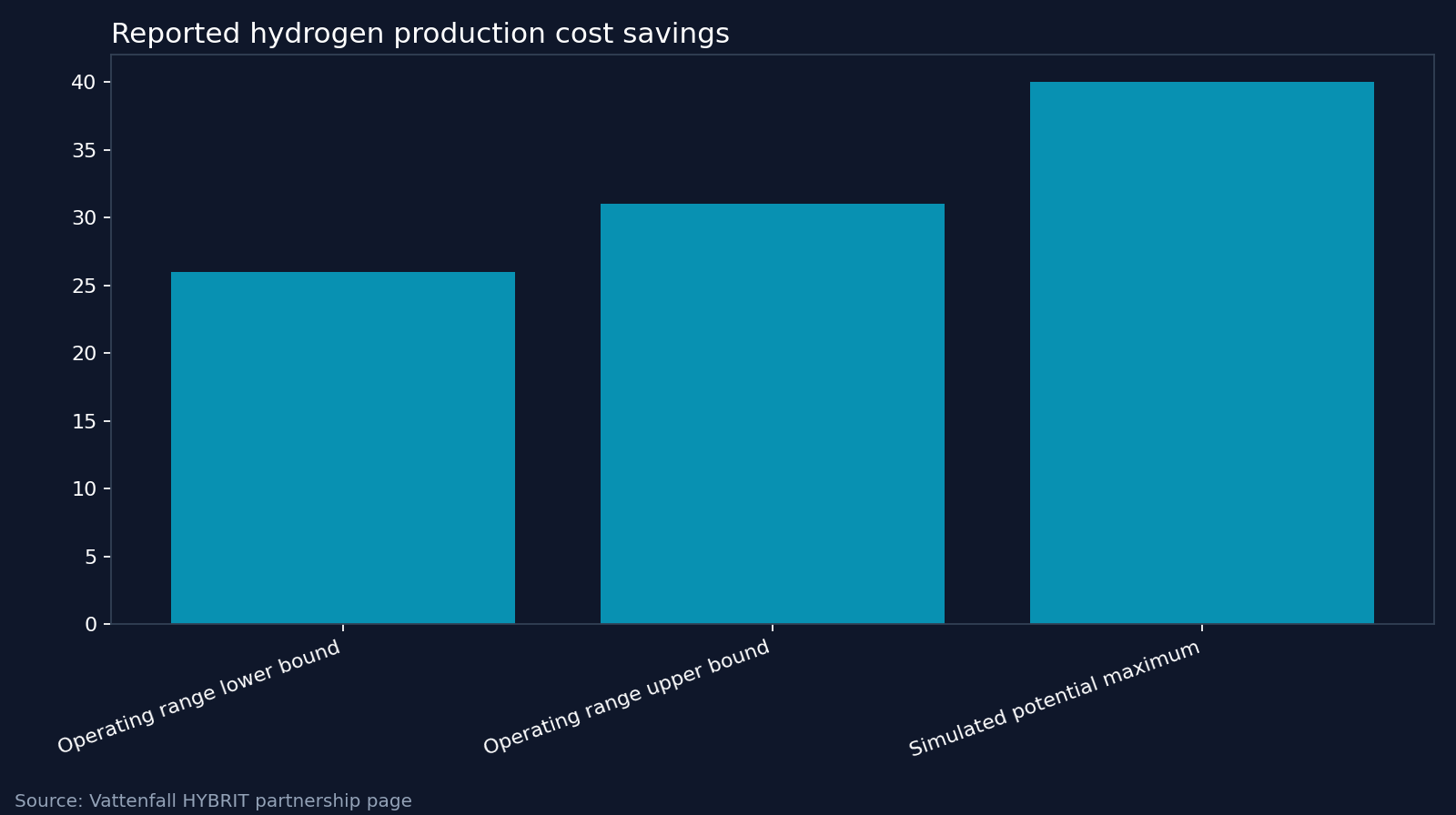
Vattenfall’s account distinguishes observed operation from modelling. It reports savings between 26% and 31% from real-time operation against spot and intraday electricity markets, with simulations indicating potential savings of up to 40%. Those figures concern the hydrogen production cost benefit associated with storage operation. They are not equivalent to reductions in the total cost of steel. The partnership page is the source for both the range and that distinction.
Nor do these results isolate the contribution of software. The benefit depends on physical storage, flexible hydrogen production and operating decisions together. Selling the headline percentage as the return on an optimisation licence would go beyond the evidence.
For British procurement teams, the useful response is to demand a complete cost model. It should include instrumentation, connections to existing controls, engineering validation, commissioning, software charges, operational support, staff training and eventual handover. If the proposal requires new storage or changes to equipment, their costs belong in the investment case too.
The supplied material provides no UK software quotations or complete project cost model. A credible purchasing decision therefore starts with site-specific inputs, rather than a borrowed percentage.
Ask bidders to show which costs they can influence, what baseline they use and which operating constraints they assume. Require the same assumptions from every bidder so the comparison survives beyond the sales presentation.
British suppliers should sell a bounded capability
The opportunity for UK technology companies is to make a particular operating decision more reliable and measurable.
An industrial software business could investigate scheduling electrolysers around a production requirement. An integration specialist could focus on reconciling measurements and commands across equipment boundaries. A support provider could offer ongoing model maintenance and investigation when predicted savings fail to appear.
These are prospective opportunities inferred from the process, not verified contracts or evidence of an established market size.
Buyers should compare delivery approaches before selecting a platform.
| Approach | When I would consider it | What I would require |
| --- | --- | --- |
| Extend the existing control supplier’s scope | The plant wants to preserve established interfaces and support arrangements | Clear responsibility for optimisation, measurable acceptance criteria and usable data export |
| Add an independent optimisation specialist | The scheduling problem crosses equipment or supplier boundaries | Demonstrated connections, explicit operating limits and a tested fallback |
| Retain an operator-led engineering team | The business can maintain the necessary process and software expertise | Documentation, succession planning and a funded support commitment |
These are procurement alternatives, not ratings of named suppliers. The evidence does not identify HYBRIT’s software suppliers or support a product shortlist.
For a smaller British business, the practical entry point is a narrow service with a recognisable acceptance test. “Produce a feasible schedule using the plant’s agreed constraints” is a better starting specification than “deliver an intelligent factory”.
The strongest objection is that the bottleneck is physical
A sceptic can reasonably argue that power availability, hydrogen equipment, storage and metallurgy determine whether this production route succeeds. Software cannot provide a missing electricity connection or make an unsuitable process economical.
HYBRIT’s own demonstration description supports the scale of that objection. Its planned electrolysis capacity and changes to ironmaking and steelmaking are substantial physical investments. The project’s foundations are industrial plant and energy supply, not a software subscription.
That objection should discipline the software case, but it does not eliminate it. Once storage allows hydrogen production to move relative to electricity prices, deciding how to use that flexibility becomes commercially relevant. Vattenfall’s reported market-operation results provide evidence for the value of the combined arrangement.
The right question is how much additional value a proposed software system delivers within those physical limits. The answer could favour a modest extension to existing controls. Procurement should allow that outcome.
Editorial analysis
British technology leaders should treat industrial decarbonisation as a source of specific control and integration problems, each requiring process expertise and a measurable business case.
My recommendation is to begin with a trial in which the proposed optimiser produces schedules without issuing plant commands. Operators can examine whether those schedules respect actual constraints, then investigate discrepancies before granting greater authority. Acceptance should cover feasible production, recoverable failures and explainable decisions alongside any projected savings.
The strongest opportunity is software that plant operators can trust with a defined responsibility. HYBRIT gives British businesses a reason to investigate that market. It does not give them permission to skip the engineering.
FAQ
Has HYBRIT already proved full commercial steel production?
The cited research announcement reports successful work at pilot and semi-industrial scale, including more than 5,000 tonnes of hydrogen-reduced iron. It describes industrial implementation as a subsequent phase, so it should not be read as proof that the planned commercial chain is operating. See LKAB’s research results.
Does hydrogen storage reduce steelmaking costs by 40%?
That is not what the cited evidence establishes. Vattenfall reports a 26% to 31% range from real-time market operation and potential savings of up to 40% in simulations concerning hydrogen production, not total steelmaking costs. Its HYBRIT overview distinguishes those results.
What should a British business ask an optimisation supplier first?
Ask which operational decision the system will change, who authorises that change and how success will be measured. Then require a demonstration of feasible schedules and failure recovery using agreed plant constraints. A savings forecast alone would not satisfy my acceptance criteria.
Is artificial intelligence essential to this opportunity?
The supplied evidence does not establish that artificial intelligence is necessary or identify an AI system responsible for the reported results. Buyers should specify the scheduling, reliability and explanation requirements before selecting a technique. I would favour the simplest approach that meets those requirements and can be maintained by the team responsible for the plant.
Sources
- HYBRIT — Demonstration project design
- HYBRIT — Positive decision on support for LKAB and HYBRIT
- HYBRIT — Hydrogen storage
- LKAB — Six years of research towards industrial-scale fossil-free iron and steel production — published 27 August 2024; updated 06 August 2026.
- Vattenfall — HYBRIT partnership and hydrogen storage results