UK SMEs should make software earn its renewal
A renewal discount cannot prove that software serves the business. CTC argues UK SMEs should assess the complete workflow, assign responsibility and compare support, implementation and exit costs before committing.


UK SMEs should renew software only when the complete business process justifies its cost. CTC’s position is that the application owner and finance lead should assess subscriptions, implementation, support and exit together. The government’s digital adoption taskforce identifies switching costs and implementation expertise as barriers. A higher bill can be worthwhile when the workflow delivers better results, but a renewal discount alone cannot establish that.
Key pointers
- Start with the next renewal and name the person accountable for the business process it supports.
- Ask the application owner to demonstrate a completed task before approving another commitment.
- Compare keeping, improving and replacing the existing setup against the same requirements.
- Request implementation, training, connection maintenance and exit costs alongside the subscription quote.
- Keep any cost without a quotation visible as an unknown.
- Give each trial a spending limit, an intended result and a review date.
Buy a working process
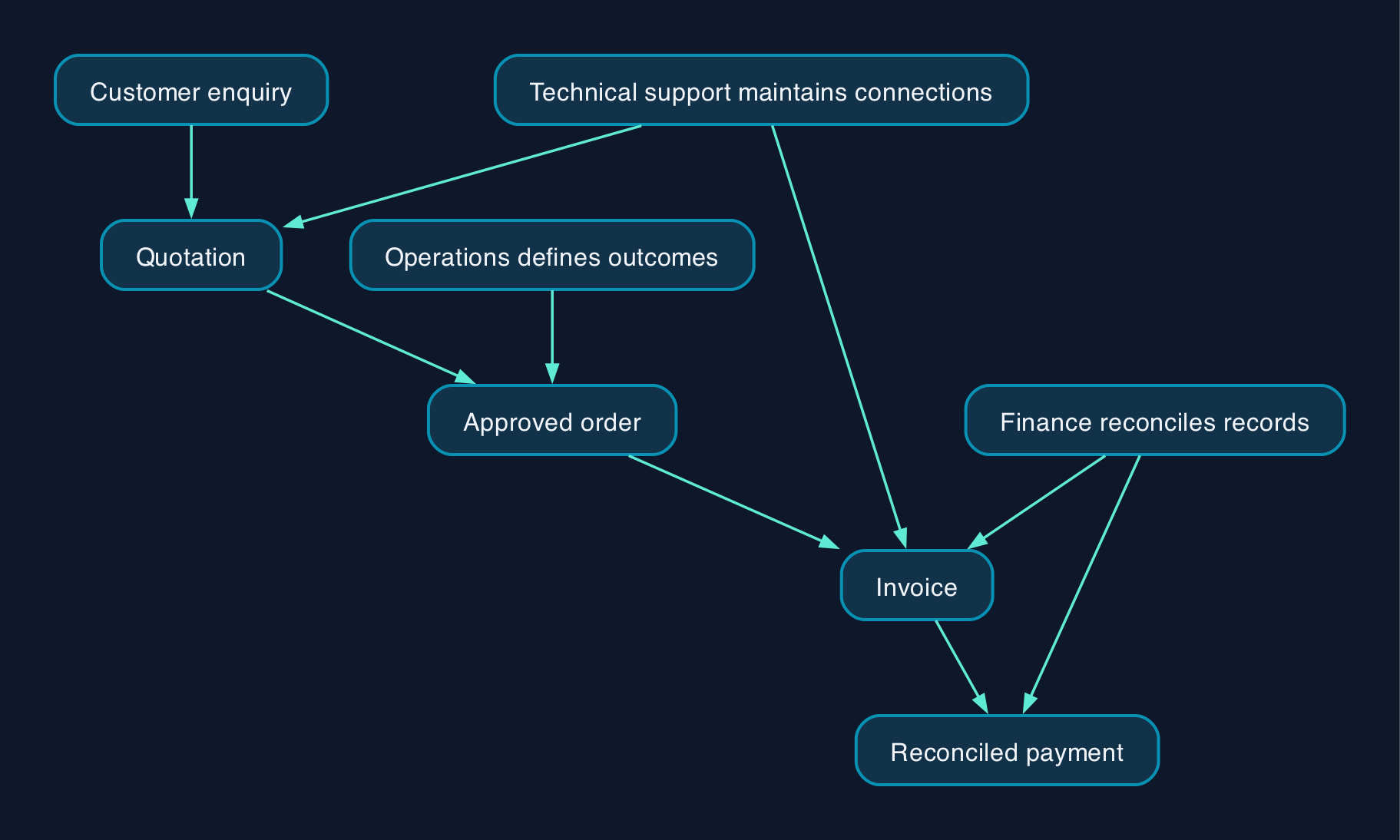
A hypothetical British wholesaler provides a useful purchasing test. An enquiry becomes a quotation, then an approved order, an invoice and a reconciled payment. CTC would judge the software against that complete journey, rather than approve each departmental subscription in isolation.
Ask the operations lead to demonstrate a representative order. Can finance match it to the resulting invoice? Who investigates a failed transfer? What work remains manual? These questions give the renewal decision something more substantial than a feature list.
The software spending framework recommends distinguishing user-based and consumption-based charges, recording contract terms and relating spending to business measures such as cost per order. Applied to the wholesaler, that means examining what changes when staff numbers or order volumes grow.
Our judgement is that lower spending should be one possible outcome of this review, not its predetermined target. A pilot that demonstrates fewer order errors could justify a higher recurring charge. A cheaper subscription that requires more manual reconciliation should face the same test.
The supplied research does not establish a national forecast for UK SME software bills. There is no need to invent one to justify checking whether the next renewal serves the business.
Give the connections an owner
For the illustrative wholesaler, CTC proposes a clear division of responsibility. Operations defines the required result, technical support maintains the connections, and finance checks that records and charges reconcile.
| Responsibility | Proposed owner | Acceptance evidence |
| --- | --- | --- |
| Define the workflow | Operations lead | A representative order reaches invoicing with the required information |
| Maintain access and connections | Internal IT lead or contracted provider | Permissions are recorded and failed transfers are visible |
| Reconcile business records | Finance lead | Sample orders match their invoices |
| Review recurring charges | Finance lead and application owner | Charges match agreed subscriptions and required usage |
| Prepare for replacement | Business owner and technical support | Export and handover procedures have been tested |
This is a proposed operating model, not a claim that particular products connect automatically.
Ask the application supplier and any implementation provider to identify their responsibilities separately. The quotation should say who investigates a failure, when support is available and which changes attract additional charges.
Buying support deserves consideration where internal expertise is missing. The taskforce’s findings support taking that skills gap seriously; they do not establish that outsourcing is always the better choice. Implementation barriers identified in the final report
Compare the commitment before the discount
The evidence pack contains no comparable current GBP price lists for the options discussed here. The useful comparison is therefore between cost components and quotation requirements.
For a UK purchasing exercise, request prices in pounds, with VAT treatment, billing frequency, commitment period and minimum quantities stated separately. Record an annual commitment as such, even when the supplier presents a monthly equivalent.
| Cost component | What the buyer should establish |
| --- | --- |
| Subscription | Exact edition, charging unit, required quantity and included capabilities |
| Consumption | Metered activity, allowances and charges above them |
| Implementation | Configuration, data preparation, migration and training |
| Connections and support | Setup, maintenance, escalation and change charges |
| Internal work | Administration, exception handling and supplier management |
| Exit | Export, replacement setup, overlapping subscriptions and handover |
Choose an evaluation period and request costs across that period. An unpriced migration or support requirement belongs on the comparison as an unresolved item, rather than disappearing from the total.
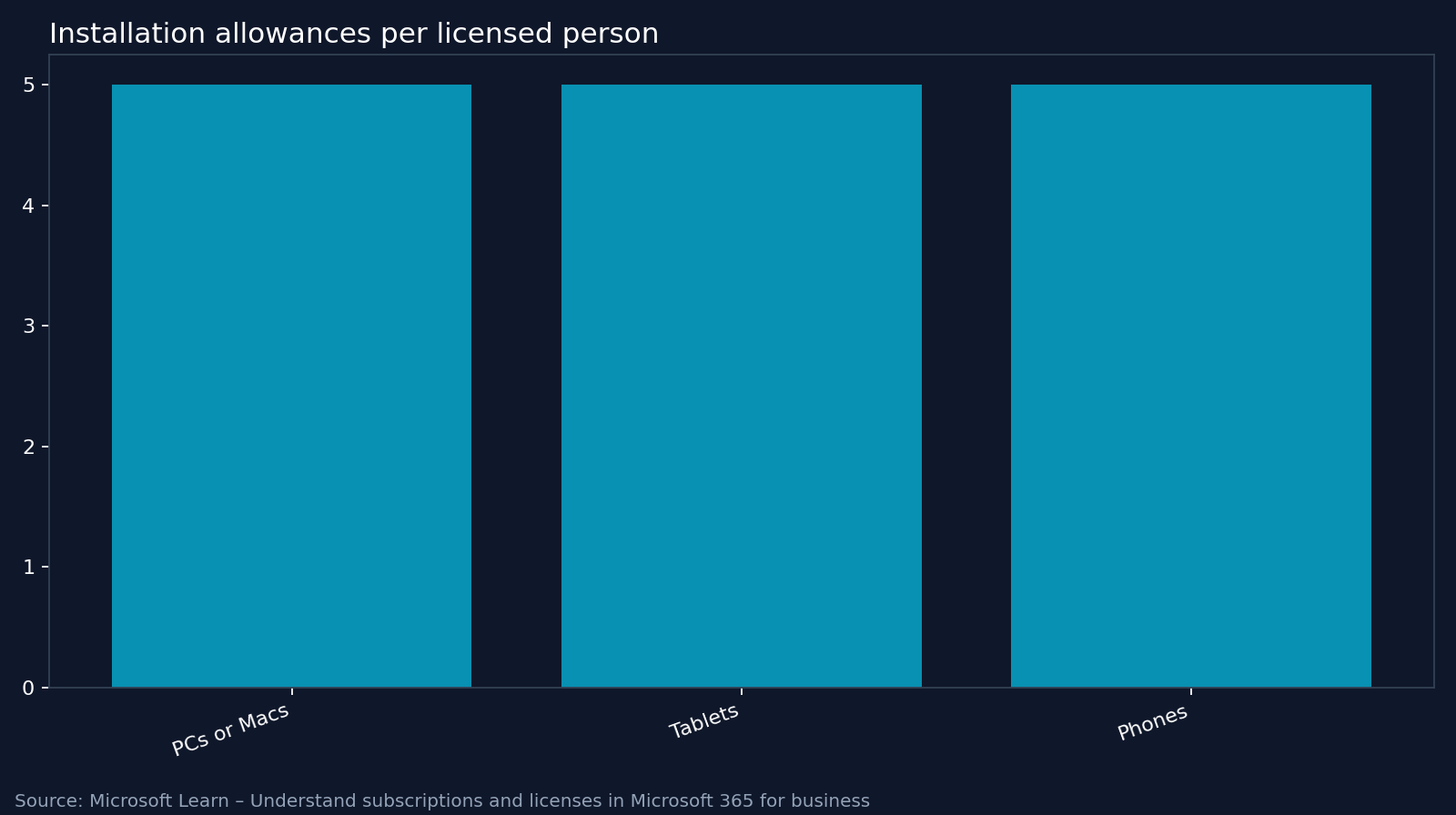
Licence arithmetic also needs the right unit. The device allowances in the Fast Facts apply per licensed person to specified subscriptions. Counting every laptop, tablet and phone as another user would therefore be the wrong starting point for those plans.
Give suppliers the same purchasing test
CTC would put retaining and improving the existing setup alongside replacement. Require each proposal to demonstrate the same task, identify the same responsibilities and disclose the same cost categories.
| Supplier or approach | Decision to test | Evidence needed before selection |
| --- | --- | --- |
| Google Workspace | Could an included collaboration tool meet a requirement currently served separately? | A demonstration using the team’s documents, meetings and sharing requirements, with the edition confirmed |
| Microsoft 365 | Do assigned licences and required capabilities match the work people perform? | Licence records, task requirements and the applicable subscription terms |
| Sage | If already used or shortlisted, could the proposed configuration support the required workflow? | Exact product details and an itemised implementation and support proposal |
| Xero | If already used or shortlisted, does the complete proposal justify its cost? | Exact product details, required connections and named support responsibilities |
| A maintained open-source option | Would taking responsibility for hosting and maintenance suit the team? | Verified licence terms, operating requirements and an accountable maintainer |
| A UK support provider | Would paid implementation or ongoing support address a demonstrated skills gap? | Scope, exclusions, escalation, customer responsibilities and handover terms |
The published collaboration and licensing documentation supports the first two examples. The supplied evidence does not verify current editions, prices or integrations for the other software candidates, or identify a particular open-source project or UK provider. Those rows are procurement questions, not product endorsements.
The strongest objection is the time this takes
A small business could reasonably object that reviewing every application consumes the very staff time automation is meant to save. CTC agrees that requiring a full tender for every trial would be disproportionate.
The answer is to scale the review to the commitment. For a limited trial, record the owner, spending boundary, intended result and review date. Before a longer commitment, require evidence from the actual task and agreement on support and exit.
An application that removes avoidable work should not fail merely because the subscription bill rises. Equally, enthusiasm after a demonstration should not settle who repairs the connection or handles failed transactions.
Start with the next renewal. Ask its owner to show what the application achieves, reconcile the charge to the requirement and identify the work needed to keep it useful. That is a manageable purchasing decision with an accountable owner.
FAQ
Will connected software definitely increase our spending?
The supplied evidence does not establish that outcome for every UK SME. Compare the complete commitment with the result you need, including implementation, support and internal work.
Is consolidating with one supplier always better?
The evidence does not establish a universal saving or operational advantage. CTC recommends testing whether existing capabilities meet the requirement before comparing the cost and disruption of consolidation.
What should we review first?
Start with the next renewal and its notice deadline. Identify the application owner, required users, business task, support arrangements and any unresolved costs before approving another commitment.
Should we pay a provider to manage the software?
Consider a provider when the required work exceeds the team’s available skills or time. Ask for explicit delivery, support and handover responsibilities, then assess the fee against the gap the provider would fill.
How should we compare a subscription with an open-source option?
Request the operating requirements and assign responsibility for hosting, maintenance, support and recovery. Compare those commitments over the same period as the subscription, leaving unknown costs visible.
What would justify a higher software bill?
CTC would look for demonstrated improvements in the task, such as fewer order errors or less manual reconciliation. Include the work needed to operate the new setup before deciding whether the improvement earns its cost.
Sources
- Department for Business and Trade – Understanding technology adoption among UK SMEs, published 31 July 2025
- SME Digital Adoption Taskforce – Final report, dated 31 July 2025
- FinOps Foundation – Software spending framework for SaaS
- Google – Small business collaboration software and tools
- Microsoft – Understand subscriptions and licences in Microsoft 365 for business, updated 3 September 2026