

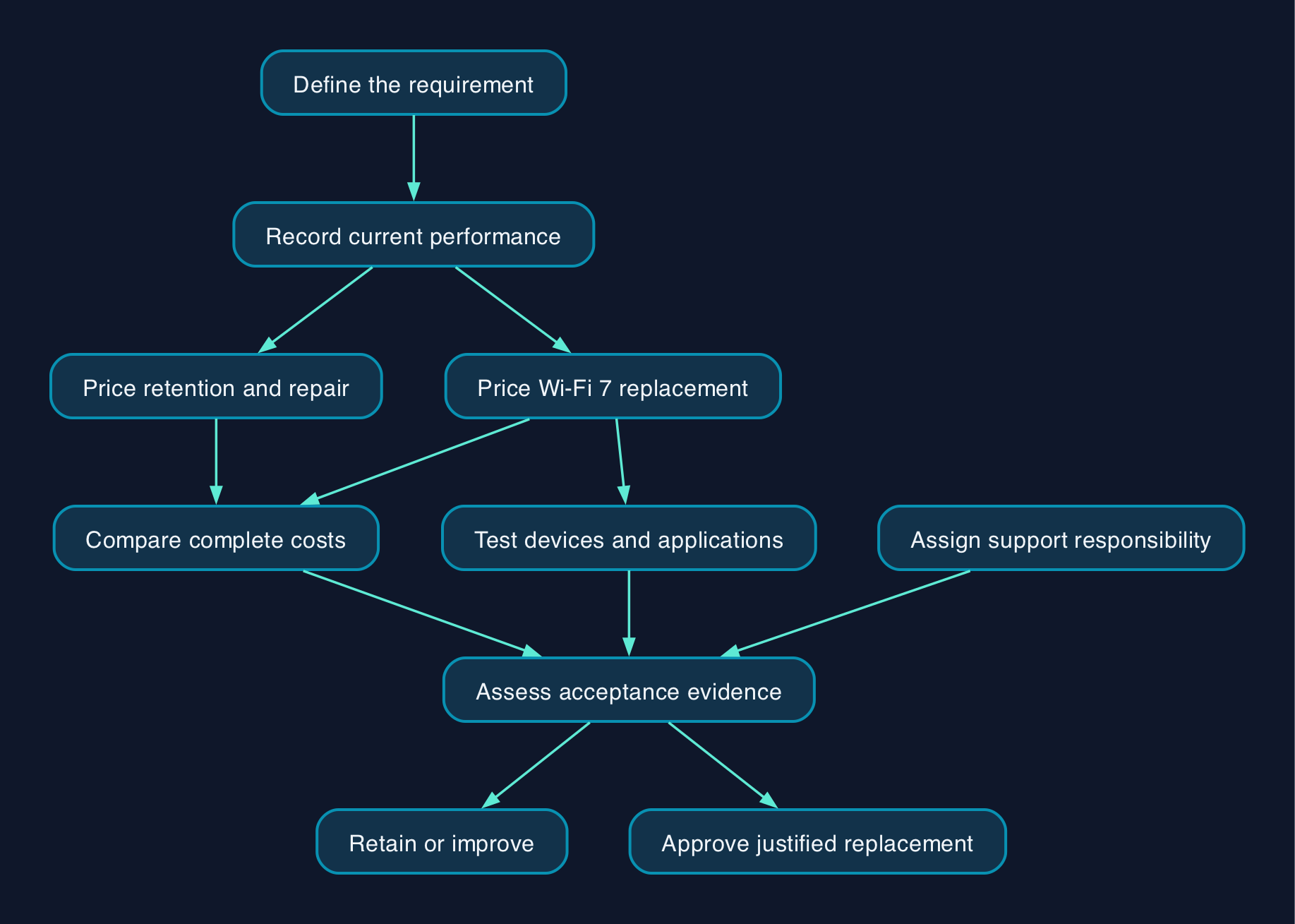
UK offices should keep a supported Wi-Fi 6 or Wi-Fi 6E network that meets staff needs, and require a tested business case before replacing it. Wi-Fi 7 deserves consideration during a planned refresh or when a pilot demonstrates a useful improvement. The purchasing decision should turn on application performance, complete installation costs and support responsibility, with an acceptance test agreed before anyone orders access points.
Key pointers
- Record which applications, rooms and devices have problems before asking for replacement quotes.
- Give the incumbent supplier a chance to price diagnosis and repair.
- Ask bidders to test your staff devices in occupied working areas.
- Require a GBP quotation covering installation, subscriptions, support and VAT treatment.
- Name the organisation responsible for faults after handover.
- Make acceptance depend on agreed application tests, with a rollback route if the pilot fails.
Start with the failed task
Compare the Cloud’s position is that replacement should answer a specific operational need. “The meeting room loses calls when occupied” gives an installer something to investigate. “We need the latest wireless standard” gives procurement a shopping list without an acceptance condition.
For a small UK business, ask the support provider to record the affected rooms, devices and applications. Require a diagnosis before approving equipment. A proposal should explain how each recommended change addresses the recorded problem and how the supplier will demonstrate that it worked.
An existing Wi-Fi 6E installation deserves particular scrutiny before replacement. It already extends Wi-Fi operation into 6 GHz using IEEE 802.11ax; Wi-Fi 7 uses IEEE 802.11be, as Cisco’s generation comparison explains. A proposal that sells access to 6 GHz as the principal benefit may therefore be answering a question the business has already settled.
Retention needs an owner, too. Before deciding to keep the network, confirm its support position, update arrangements and ability to meet the business’s requirements. Keeping equipment should be an explicit maintenance decision.
Wider channels need a useful outcome
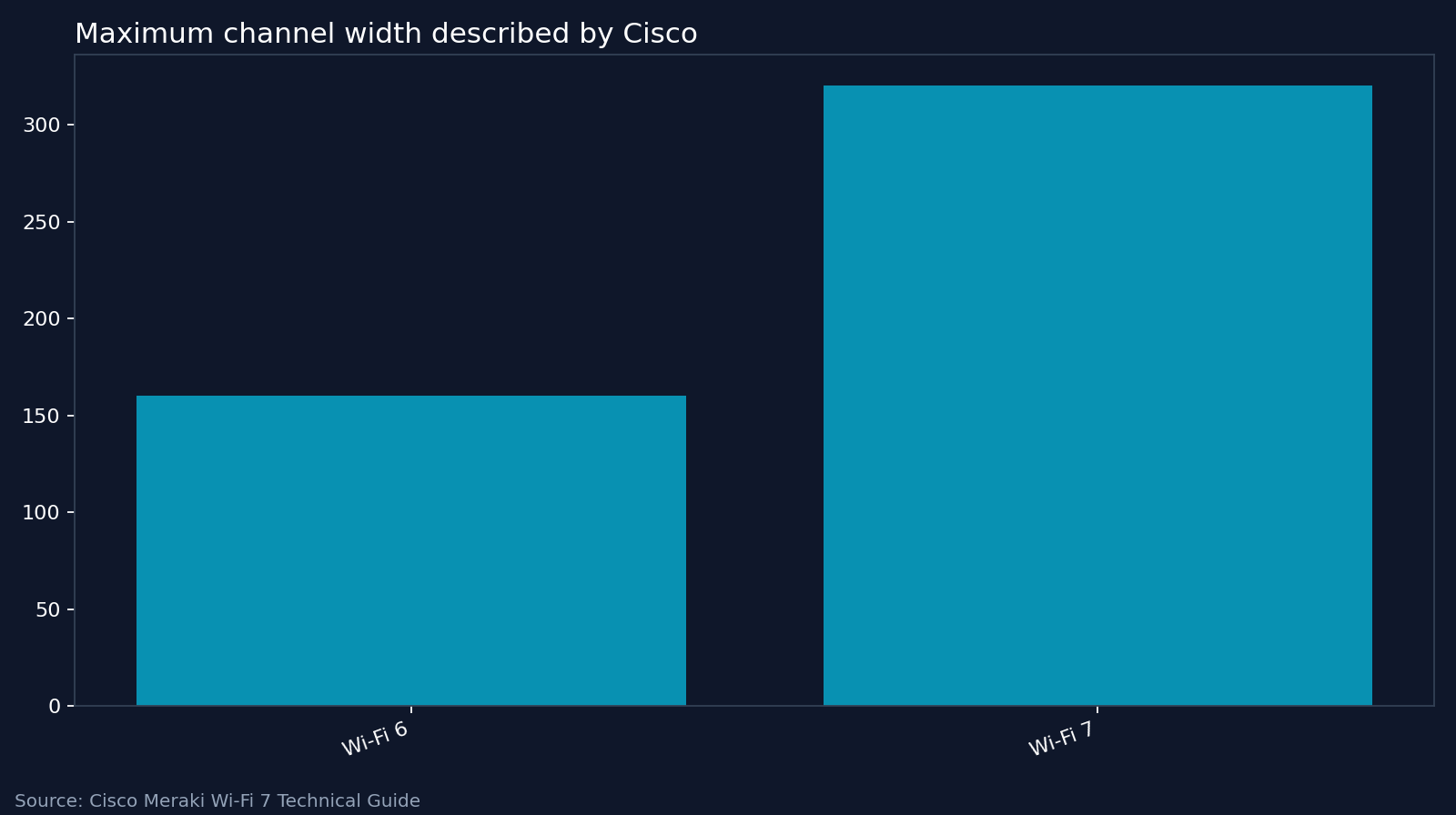
Cisco’s documented channel-width comparison provides a concrete example of the gap between a specification and a purchasing case.
| Radio capability | Wi-Fi 6 | Wi-Fi 7 |
| --- | --- | --- |
| Maximum channel width described by Cisco | 160 MHz | 320 MHz |
| Qualification | A maximum channel-width specification | The 320 MHz option operates at 6 GHz |
| Evidence still needed before purchase | Performance on the existing installation | Performance on the proposed installation |
The figures come from [Cisco’s technical guide](<https://documentation.meraki.com/Wireless/Design_and_Configure/Architecture_and_Best_Practices/Wi-Fi_7_(802.11be)_Technical_Guide>). They describe radio channel width. They do not establish how quickly a particular office application will complete its work.
Peak modulation also carries conditions. Cisco says 4K-QAM requires a very high signal-to-noise ratio, meaning a strong signal relative to background noise, and that clients must be close to the access point to achieve its high data rates. Its [explanation of those requirements](<https://documentation.meraki.com/Wireless/Design_and_Configure/Architecture_and_Best_Practices/Wi-Fi_7_(802.11be)_Technical_Guide>) gives buyers a reason to challenge promises that apply peak performance across an entire building.
For a UK installation, require a channel plan appropriate to the deployment and the exact proposed equipment. Do not let a bidder substitute overseas spectrum examples for that design.
The acceptance test should use your devices, your applications and the rooms where staff work. Agree the baseline and the required result before the pilot begins.
Buy an installation with an accountable owner
Cisco’s migration guidance identifies configuration, security prerequisites and radio design as part of adopting 6 GHz and Wi-Fi 7. Its deployment guide supports treating the project as more than an access point order.
Make the following checks contractual deliverables.
| Area | What the supplier should deliver | Responsibility to assign |
| --- | --- | --- |
| Staff devices | Capability inventory and successful application tests | Internal IT or device support provider |
| Wireless coverage | Proposed locations and tests in occupied areas | Wireless installer |
| Switching, cabling and power | Model-specific checks and an explanation of each required change | Network maintainer |
| Staff and guest access | Successful access tests against agreed boundaries | IT administrator |
| Handover and operation | Configuration records, update ownership and fault escalation | Internal IT or managed service provider |
For a business without a network specialist, the handover question is simple. Who owns the investigation when a connection fails after installation?
Require the quotation to identify that organisation, its response commitment and its exclusions. Ask how it handles a fault involving equipment or services supplied by someone else. A support badge does not answer those contractual questions.
Compare the complete cost over the same period
The supplied evidence does not establish comparable current UK prices or measured office performance across the shortlisted suppliers. It therefore cannot support a numerical savings claim or a universal price winner.
Request dated, itemised GBP quotations with VAT treatment, quantities, exact models, subscription tiers and billing commitments. Use the same ownership period for every option.
| Cost component | Retain and improve | Replace with Wi-Fi 7 |
| --- | --- | --- |
| Investigation | Diagnosis and coverage review | Survey, design and acceptance planning |
| Equipment | Changes justified by the diagnosis | Access points and any justified infrastructure changes |
| Recurring services | Existing renewals and support | Management subscriptions and agreed support |
| Deployment | Configuration changes and testing | Installation, migration, testing and rollback provision |
| People and handover | Administrator time and updated records | Training, documentation and support transition |
| Exit | Existing contractual obligations | Export, removal and supplier transition arrangements |
This is a quotation framework, not a completed total cost of ownership calculation. Keep unpriced work visible rather than assigning it an implicit zero.
Check the licence against the proposed hardware. Cisco’s Wi-Fi 7 subscription documentation identifies the covered models and distinguishes Essential from Advantage. Ask the bidder to show which requested functions need each tier and separately state the installer’s responsibilities.
Give competing suppliers the same brief
Cisco, HPE Aruba Networking, Ruckus and Extreme Networks deserve consideration where their offerings fit the requirement. HPE’s 730 series, Ruckus R770 and Extreme AP5020 appeared in Wi-Fi NOW’s April 2024 market overview. That historical evidence identifies alternatives to investigate; it does not establish present UK availability or commercial terms.
Ask each bidder to propose an exact UK model, management arrangement, support scope and complete installation price. Apply the same pilot and acceptance criteria to every proposal.
Include retaining or improving the incumbent installation in that comparison.
| Option | Case for consideration | Reason to withhold approval |
| --- | --- | --- |
| Retain Wi-Fi 6 or Wi-Fi 6E | Applications work and support remains suitable | Unresolved faults or an unacceptable support position |
| Improve the existing installation | Diagnosis identifies a specific correctable problem | The supplier cannot connect the change to the fault |
| Replace selected areas | A local requirement justifies a limited pilot | Transition between retained and new equipment remains untested |
| Replace the office with Wi-Fi 7 | A refresh or demonstrated requirement justifies the complete cost | The proposal offers specifications without acceptance evidence |
Our editorial judgement is that familiarity with an existing platform can deserve weight when it reduces migration and training work. Require bidders to make that work visible so familiarity does not become an unexamined reason to renew.
The strongest case for buying now
The strongest counterargument is an office already facing a necessary refresh. Choosing Wi-Fi 7 during that project could avoid another installation later, even if today’s workload does not require every capability.
That is a credible planning argument. It becomes a purchasing case when the proposed equipment passes current acceptance tests, the quotation covers the intended ownership period and the business can explain which future requirements it expects to serve.
Do not insist that a buyer wait for the existing network to fail before considering Wi-Fi 7. Equally, do not assign a financial value to avoiding a future replacement without stating the assumptions behind it.
The decision should survive a direct question from the budget holder. What useful result are we buying, and what evidence will show that we received it?
FAQ
Should we replace Wi-Fi 6E to get access to 6 GHz?
No. Wi-Fi 6E already operates in that band, as Cisco’s migration guide explains. Require an additional, testable reason for replacement.
Will Wi-Fi 7 double our office speed?
The evidence does not establish that outcome. Cisco’s maximum channel widths of 160 MHz and 320 MHz describe radio capabilities, not measured application performance, in its [technical guide](<https://documentation.meraki.com/Wireless/Design_and_Configure/Architecture_and_Best_Practices/Wi-Fi_7_(802.11be)_Technical_Guide>). Test the proposed installation against your workload before accepting a performance promise.
Must we replace our switches and cabling?
Require model-specific checks before approving either change. Ask the installer to document the proposed equipment’s requirements, assess the existing infrastructure and justify every replacement in the quotation.
What should a UK office require before signing?
Request an itemised GBP quotation with VAT treatment, exact hardware, subscription commitments and named support responsibilities. Agree a pilot, measurable acceptance conditions and a rollback route. Compare the result with a priced proposal to retain or improve the existing network.
Sources
- Cisco Meraki - Cisco Wireless Access Point Wi-FI Generation and Standards
- Cisco - Migrate to 6 GHz and Wi-Fi 7 with Cisco Wireless, updated 22 July 2026
- [Cisco Meraki - Wi-Fi 7 technical guide](<https://documentation.meraki.com/Wireless/Design_and_Configure/Architecture_and_Best_Practices/Wi-Fi_7_(802.11be)_Technical_Guide>)
- Cisco Meraki - Subscription and unified licensing for Wi-Fi 7 access points
- Wi-Fi NOW - Enterprise Wi-Fi 6E and Wi-Fi 7 solutions with AFC and standard power, 29 April 2024