British steel buyers need carbon specifications alongside grade and strength
British manufacturers should prepare to specify steel production emissions alongside grade and strength. HYBRIT supports the case, but purchasing commitments still need qualified material, traceable evidence and dependable delivery.

Yes, steel purchasing should acquire a carbon specification alongside grade and strength, and British manufacturers should prepare their supplier records now. UK technology leaders should make production-emissions evidence traceable to the material in a finished component, while keeping purchasing commitments conditional on engineering approval and dependable supply. HYBRIT’s reported pilot results and customer applications justify that preparation, without establishing a UK supply guarantee.
Key pointers
- Request a production-emissions figure with its measurement boundary and exclusions.
- Keep carbon requirements alongside the engineering checks that qualify the material.
- Ask suppliers how their emissions evidence connects to your order.
- Compare hydrogen-based and scrap-based offers against the same purchasing requirements.
- Separate demonstrated production from planned capacity and promised deliveries.
- Test the evidence trail on one component before committing to wider system changes.
Sweden gives British buyers a reason to change the specification
HYBRIT changes how iron is extracted from ore. Fossil-free hydrogen removes the oxygen, leaving sponge iron and producing water. An electric arc furnace then melts that iron into steel, as described in the INCITE technical record.
For British vehicle and equipment manufacturers, the purchasing implication deserves attention. If otherwise suitable materials come with different production-emissions evidence, a buyer can make that difference part of the specification.
My position is that manufacturers should prepare for that choice now. HYBRIT’s August 2024 results describe steel already used in vehicles and heavy machinery. That gives the argument a basis in manufactured products, although it does not prove routine availability for a British customer.
Consider a hypothetical automotive tender requiring both an approved steel grade and a defined production-emissions limit. A component supplier could meet the physical specification yet be unable to substantiate the carbon requirement. Its immediate problem would be missing evidence attached to an otherwise acceptable part.
That is the future purchasing change worth preparing for. Whether individual customers adopt such requirements remains uncertain. Ask them which components they would prioritise and what evidence they would accept before spending money on a wider programme.
Put the measurement boundary on the purchase order
A usable carbon specification needs to say what was measured. Require the production stages covered, the unit used, the calculation method and any exclusions.
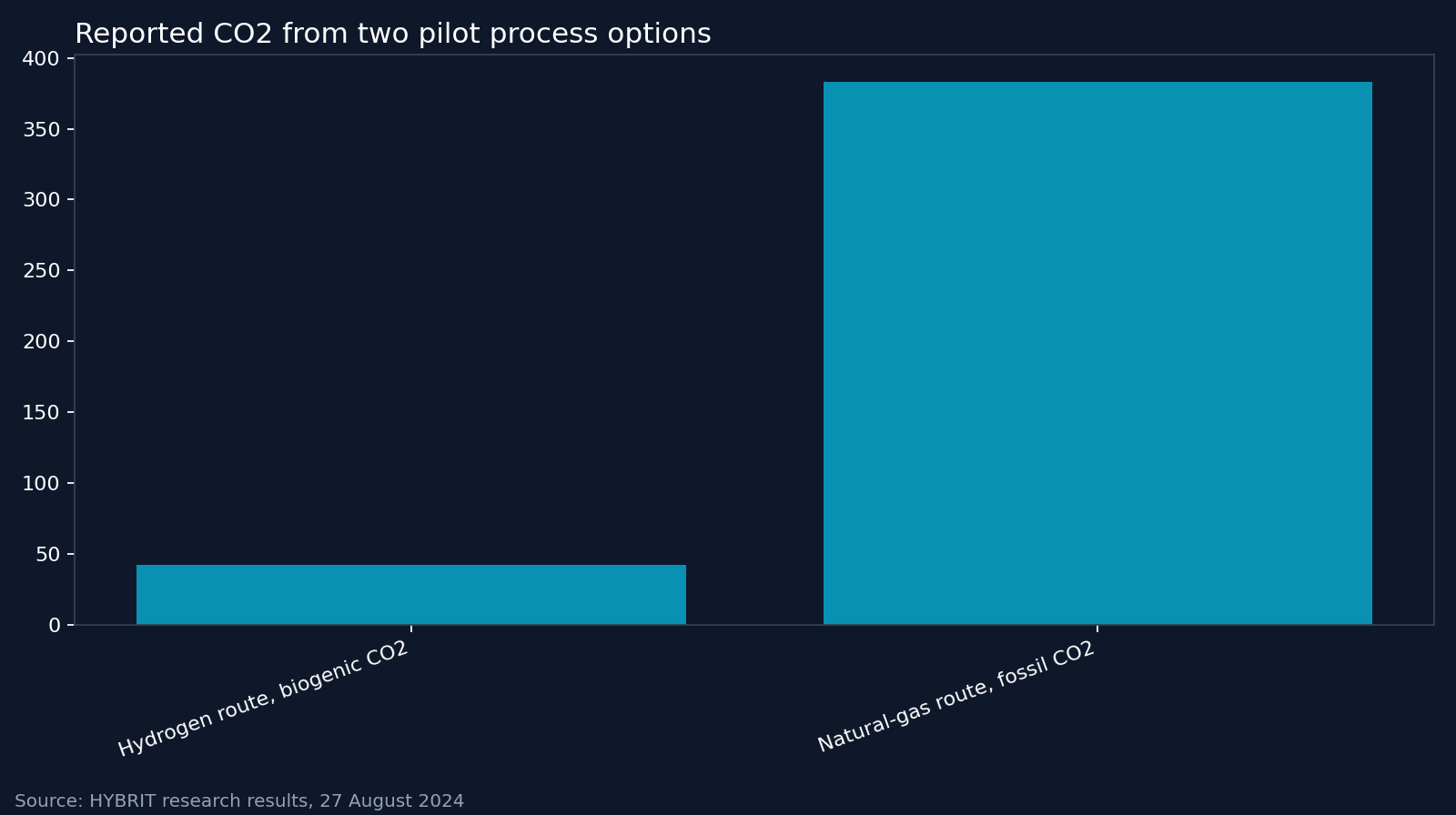
HYBRIT’s own comparison shows why. Its published research results report 42 kg of biogenic CO2 per tonne of directly reduced iron for hydrogen reduction and electric-arc melting, compared with 383 kg of fossil CO2 for the conventional natural-gas process. Reduction-gas heating is excluded from that comparison.
Those figures describe particular process options. They are not complete lifecycle footprints, and the distinction between biogenic and fossil carbon belongs beside the numbers whenever they are reused.
Likewise, the programme’s rounded zero does not mean every associated emission disappears. HYBRIT explicitly acknowledges residual emissions from furnace electrodes and slag-forming additions. A supplier’s headline figure needs its footnote.
For purchasing purposes, ask whether the evidence applies to the delivered material or a production average. Then ask how the supplier connects that evidence to the order. Keep engineering acceptance separate, so an attractive emissions figure cannot substitute for proof that the steel meets the component specification.
Give the evidence an owner and a route to the finished part
UK technology leaders can make a useful contribution by designing a retrievable material record.
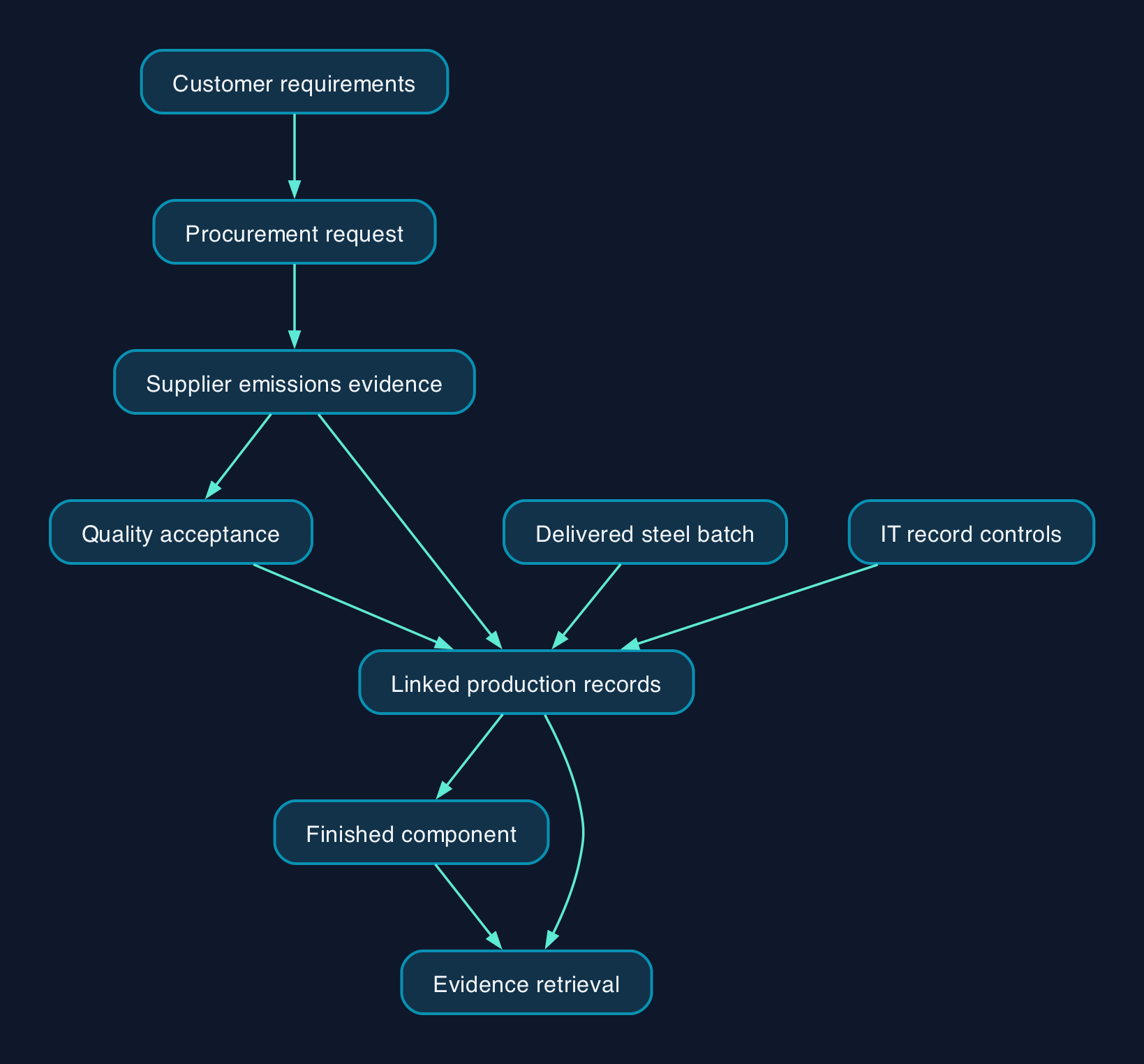
In a proposed workflow, procurement requests emissions evidence with the quotation. Quality staff assess the material documentation and record acceptance. Goods-receiving staff connect the delivered batch to that approval, while production records preserve the connection as steel becomes components. IT makes the records retrievable and controls changes to accepted evidence.
For a hypothetical British bracket manufacturer, the first test is straightforward. Pick a dispatched bracket and ask staff to recover the carbon evidence for the steel used to make it. Record where the connection breaks or depends on someone’s memory.
Use that result to decide what needs changing. Existing software may need additional fields or better document controls; its capabilities must be checked before assuming a replacement is necessary.
Procurement owns the supplier requirement. Quality owns material acceptance. IT owns the connection between records. This proposed division makes a disputed figure or missing document someone’s responsibility.
Ask for a delivered price before discussing a premium
The evidence supplied here does not establish a UK delivered price for HYBRIT-based steel. A British purchasing decision needs an actual quotation.
Ask for material price and delivery charges, minimum quantities and lead times. Make the quotation currency and VAT treatment explicit. Add the cost of qualification work, document assessment, staff training and handling rejected material or evidence.
Hydrogen-production savings cannot fill those gaps. Vattenfall’s storage account describes storing hydrogen when electricity is cheaper and using it during expensive periods. Its reported savings concern hydrogen production, not a discount promised to a steel buyer.
A supplier therefore needs to explain the commercial offer independently of the production claim. Lower reported emissions can justify consideration without settling what the customer can afford.
The strongest objection is spending before supply is dependable
A British manufacturer could pay to qualify material and change its records, then discover that suitable volumes or delivery dates remain uncertain. Customer willingness to pay might also fail to materialise. That is a serious objection to an early switch.
The supplied evidence leaves that concern unresolved. LKAB’s project description presents the full-scale reduction plant as planned, while HYBRIT says its pilot results and specifications apply to Swedish conditions. Neither establishes a firm UK supply commitment.
The answer is to limit the initial commitment. Agree a component trial with a customer, obtain a supplier quotation and retain an approved alternative. Expand only after material acceptance and dependable deliveries have been demonstrated.
Hydrogen-based steel must also compete with suitable material from other routes. Swedish steel industry body Jernkontoret explains that scrap-based electric steelmaking avoids ore reduction, while arguing that available scrap cannot meet global steel demand. Its account supports considering both routes, rather than treating hydrogen as the only purchasing option.
Invite competing producers, including the incumbent supplier, to meet the same requirements for grade, emissions evidence, price and delivery. This research does not support a supplier ranking.
Editorial analysis
Carbon belongs in the specification when the customer can define an acceptable result and the supplier can substantiate it.
That position asks something concrete of UK technology teams. A material claim must remain connected to the component after quotation, receiving and production. Buying a larger system before testing that connection would leave the purchasing question unanswered.
HYBRIT provides evidence that deserves a place in supplier discussions. The unresolved commercial question is whether a British buyer can obtain qualified material, with usable evidence, on terms its customer will support.
FAQ
Should British manufacturers add carbon to steel specifications now?
Yes, begin by agreeing the requirement and acceptable evidence with the customer. HYBRIT’s reported pilot production and customer applications justify investigating the option. Make purchasing commitments conditional on material qualification and dependable supply.
Does fossil-free steel have a zero product footprint?
That conclusion cannot be drawn from HYBRIT’s headline number. Its research announcement specifies a Scope 1 and Scope 2 boundary and acknowledges residual emissions rounded to zero. Request the measurement boundary applicable to the material you are buying.
Could recycled steel satisfy the requirement?
Include it where the offer meets the engineering and emissions criteria. Jernkontoret’s explanation of steel production routes notes that scrap-based production avoids the ore-reduction stage. Compare the evidence accompanying each offer.
What should a small manufacturer ask its IT provider to demonstrate?
Ask it to connect one delivered steel batch to its supporting documents and a finished component. Require staff to retrieve the evidence and identify who accepted it. Use that exercise to decide which changes the existing system needs.
Do hydrogen storage savings mean cheaper steel?
The cited results do not establish that. Vattenfall reports savings associated with hydrogen production, rather than a quoted reduction in finished-steel prices. Obtain a delivered quotation before calculating the business case.
Is the Swedish demonstration evidence enough to promise UK deliveries?
No, it does not establish a UK supply commitment. LKAB’s demonstration description identifies a planned plant. Ask the supplier to confirm available grades, quantities and delivery dates for the actual order.
Sources
- HYBRIT research results and emissions qualifications, 27 August 2024
- European Commission INCITE technical record for HYBRIT
- LKAB HYBRIT Demonstration Project
- Vattenfall HYBRIT partnership and hydrogen storage results
- HYBRIT fossil-free steel production ready for industrialisation
- Jernkontoret explanation of scrap-based and ore-based steel production