Make local contracts a test of AI Growth Zone success
AI Growth Zones can deliver national computing capacity without creating an accessible regional services market. CTC argues operators must publish buying routes and report awarded work so smaller firms can judge the opportunity.


UK AI Growth Zones should have to demonstrate contracts accessible to regional suppliers before being credited with creating a regional technology market. Compare the Cloud’s position is that operators must publish buying routes and report awarded work alongside infrastructure progress. Government policy explicitly promises locally anchored growth; delivering compute capacity alone cannot establish that result. Smaller firms should prepare bids, but expand against customer commitments.
Key pointers
- Ask zone operators to publish forthcoming service contracts and identify who awards them.
- Judge regional supplier participation through awarded work, with bidding opportunities reported separately.
- Require site-specific infrastructure evidence before committing staff or equipment to a delivery date.
- Treat electricity support as an operator cost measure until a customer quotation demonstrates a saving.
- Compare international providers, UK operators and regional managed services against the same workload.
- Keep improving the existing service among the options when assessing a move.
A regional address does not establish a regional market
Count the contracts available to regional businesses. That is the missing test I would put beside the infrastructure measures when judging Growth Zones.
The government’s policy paper gives the programme more than a capacity-building purpose. It argues that clustering investment will develop the workforce, encourage adoption and anchor growth locally. Those are distinct promises. A completed facility can demonstrate infrastructure delivery; evidence of a regional services market requires identifiable customers buying from suppliers.
Consider a hypothetical campus whose network installation and ongoing support are purchased through national agreements. Its location might still bring employment and other local benefits. Yet a nearby technology business has no basis for treating the campus as an addressable customer until it can establish a route into those agreements.
That distinction matters to a small managed service provider deciding whether to recruit. An announced development is a sales lead. Recruitment needs a clearer basis in expected work and the commercial commitment behind it.
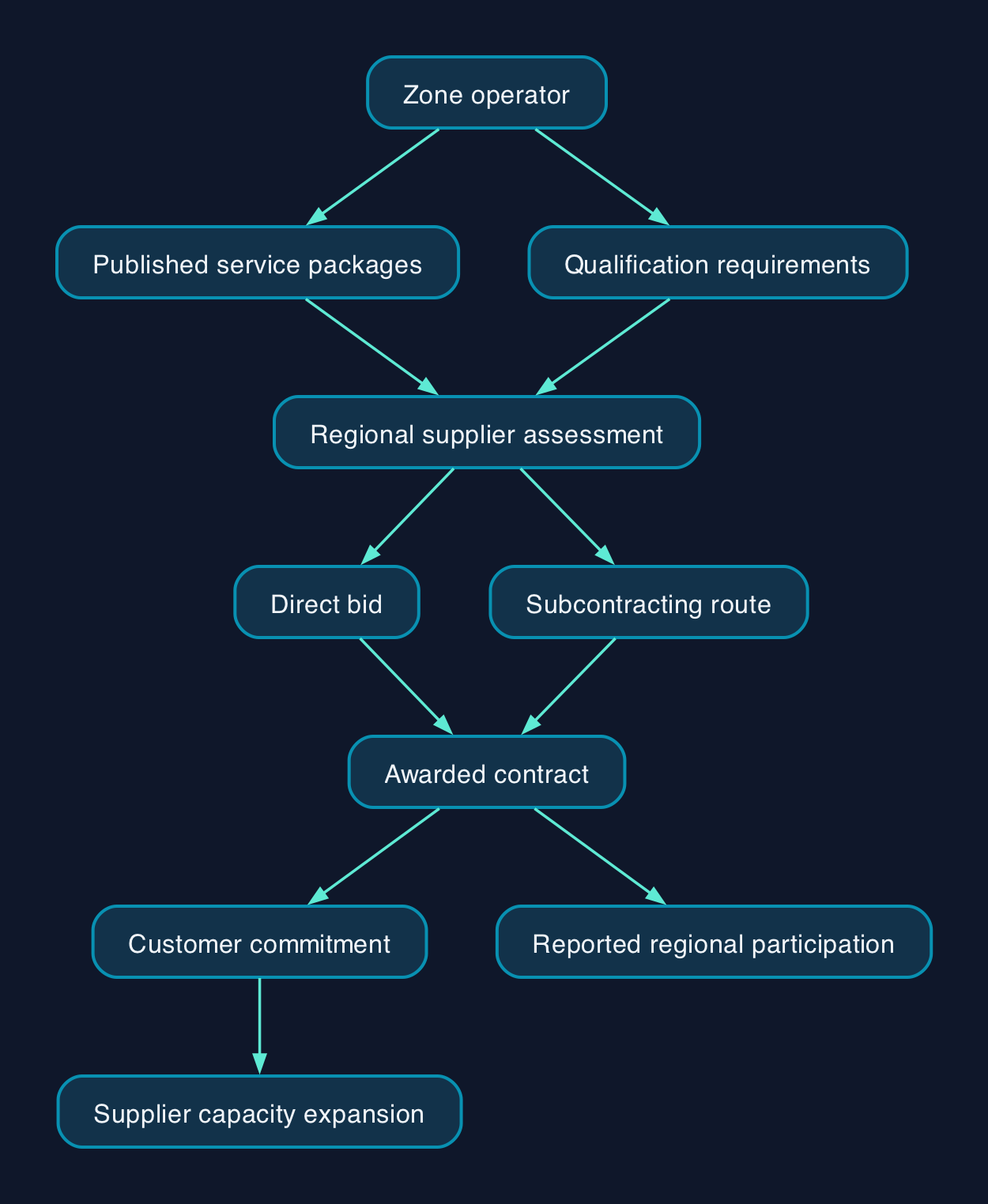
Operators can make the opportunity assessable by publishing contract scope, qualification requirements, buying dates and the organisation making each decision. Reporting subsequent awards would distinguish an invitation to participate from business actually won.
Electricity support is not a customer price
The proposed regional energy support illustrates why infrastructure economics and customer benefits need separate evidence.
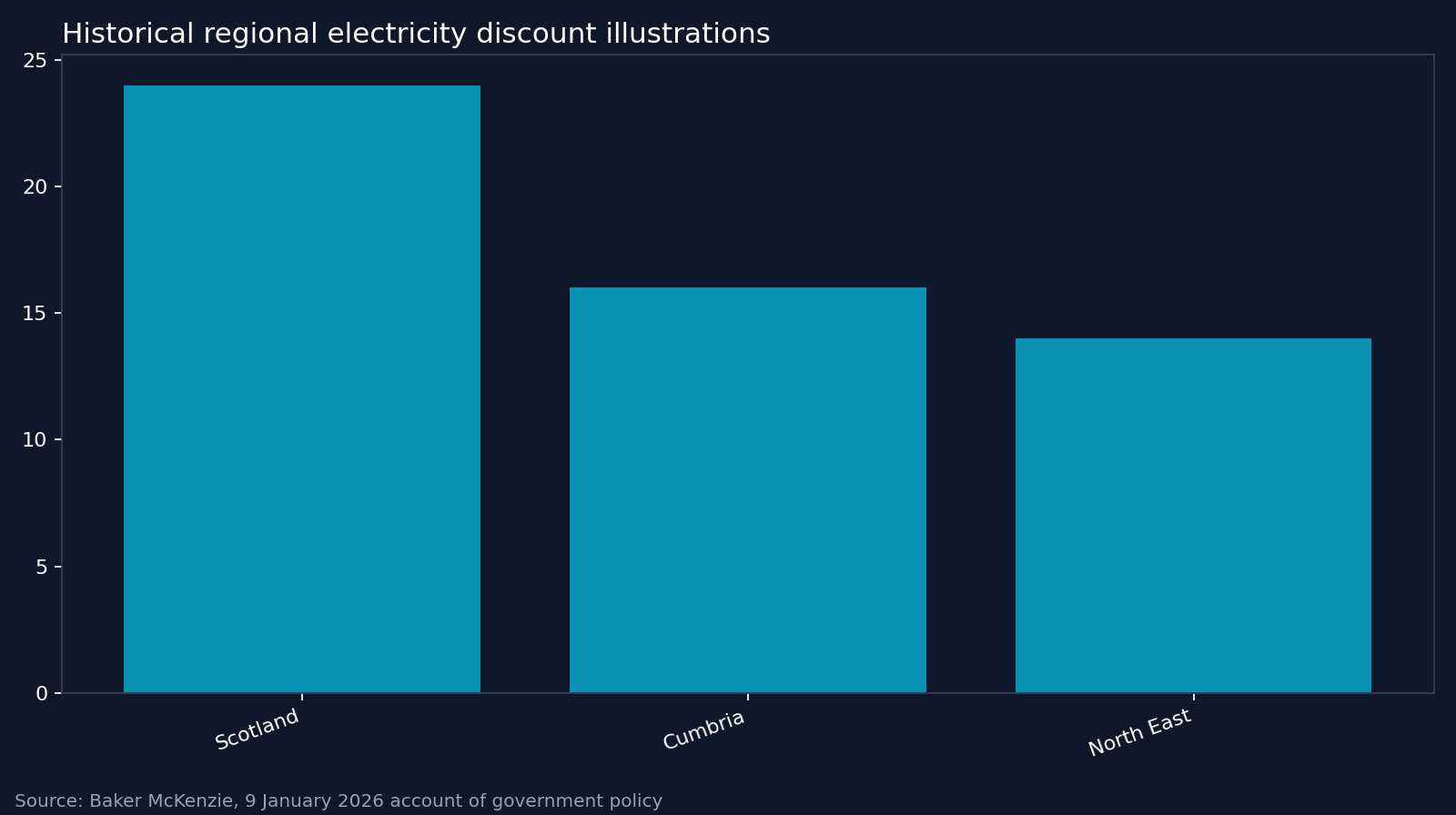
In its 9 January 2026 account of the government policy, Baker McKenzie describes electricity discounts for a 500 MW data centre of £24 per megawatt-hour in Scotland, £16 in Cumbria and £14 in the North East. These are historical policy illustrations, potentially outdated as commercial assumptions, rather than verified current tariffs or customer savings; the examples also do not establish Growth Zone designation for every region named.
| Regional illustration | Reported electricity discount |
| --- | --- |
| Scotland | £24 per MWh |
| Cumbria | £16 per MWh |
| North East | £14 per MWh |
Those figures describe a potential reduction in an operator’s electricity costs. They cannot tell a manufacturer what it will pay for hosting, or establish whether migration will leave it better off.
My buying test would be a GBP quotation for the complete service over an agreed period, with VAT treatment stated. Include connection costs and migration work, then ongoing support and eventual exit. Keep unpriced items visible. Without those inputs, a claimed customer saving remains unproven.
For a regional supplier, the corresponding question is who will pay for its work. A developer’s improved energy economics cannot substitute for a purchase order covering an installation or support commitment.
Publish enough detail for smaller suppliers to decide
I would require a short commercial delivery record from each zone claiming regional supplier benefits. This is an editorial proposal, not a description of an existing reporting requirement.
| Proposed disclosure | Decision it enables |
| --- | --- |
| Upcoming service packages and purchasing contacts | A supplier can identify a buyer and relevant work |
| Qualification requirements and subcontracting routes | A smaller firm can assess whether to bid directly or join another supplier |
| Awarded scope and regional supplier participation | Local partners can distinguish accessible opportunities from completed transactions |
| Delivery dependencies and accountable organisations | Suppliers can judge when additional capacity is justified |
Publishing opportunities alone would be insufficient. An operator could advertise work without awarding any to regional firms. Equally, a low initial level of local participation would not prove misconduct or poor delivery. It would establish what the programme has achieved so far and expose where its regional ambitions need further work.
Councils already identify an evidence problem in another part of the same development process. The Local Government Association reports that corporate-level disclosures do not supply the site-specific information needed to assess energy use, water consumption and local effects. It also describes pressure on electricity networks and digital connectivity.
Commercial reporting would answer a different question, but the principle is useful here. A claim about one place needs evidence about that place. Neither a group-wide sustainability statement nor a national investment announcement can settle a local delivery question.
The strongest objection is that extra requirements could slow construction
The strongest objection to this position is practical. Requiring more reporting and smaller contract packages could consume delivery time. Developers may reasonably prefer fewer counterparties and established suppliers capable of accepting responsibility for a large project. A policy intended to accelerate infrastructure could become harder to execute if local participation becomes another condition to negotiate.
There is also a substantive objection. Domestic computing capacity can have national value even where regional firms win little work. The government’s policy makes a case for onshore capacity in terms of resilience and the ability to act independently where necessary. Local supplier revenue cannot be the sole measure of that purpose.
I accept both limits. I would not require every contract to be divided, or make a supplier’s postcode override delivery capability. Some work may remain best suited to a large national or international provider.
My proposed requirement is narrower. Publish how buying works, make suitable opportunities visible and report the resulting participation. Where direct contracting is impractical, explain whether regional businesses can participate through subcontracting. Where they cannot, account for regional benefits through the outcomes actually being delivered.
That still imposes work on operators. It is a justified cost of making a specific claim about regional growth. Capacity delivery can succeed on its own terms while the local services ambition remains unfulfilled.
Buyers need an offer they can compare
For a smaller business buying technology, the commercial test is a service it can use at an acceptable total cost. The government reports more than 520 existing UK data centres. A Growth Zone offer therefore needs to earn its place among existing alternatives.
Invite proposals from several suitable suppliers, including international cloud providers and UK operators, with regional managed services considered where they fit. Give each the same workload and recovery requirements. Compare support responsibilities and exit arrangements alongside price, and include a proposal to improve the current service.
The supplied evidence does not establish particular vendors’ participation in individual zones or provide equivalent service quotations, so it cannot support a named supplier ranking.
For regional technology firms, I favour preparation before expansion. Establish which purchasing organisation needs a service you can already deliver, then agree its scope and acceptance conditions. Investment in additional staff or equipment should follow a credible customer commitment.
A zone that attracts a major facility has achieved something concrete. Whether it has created a regional technology market remains a separate question, answerable through the work businesses can actually buy and sell.
FAQ
Should regional firms wait before pursuing Growth Zone work?
No, they can identify buyers and prepare bids before contracts are awarded. My recommendation is to separate that preparation from commitments to additional staff or equipment. Confirm scope, dependencies and purchasing authority before expanding delivery capacity.
Would this mean reserving contracts for local companies?
The proposal is to publish buying routes and report participation, rather than impose a local purchasing quota. Delivery capability must remain part of supplier selection. Where a large contract is appropriate, a published subcontracting route could still make suitable work visible.
Will lower electricity costs make nearby businesses’ IT cheaper?
The government policy proposes geographically targeted operating-cost support, but that does not establish a customer’s hosting price. Request a complete quotation and compare it with the existing arrangement. Include migration and ongoing management costs before judging any saving.
Can a Growth Zone succeed without a large local services market?
Yes, national infrastructure objectives and regional supplier participation deserve separate assessments. The policy argues for domestic capacity to support resilience, while also promising locally anchored growth. Success against the first objective does not provide evidence for the second.
Sources
- Department for Science, Innovation and Technology, Delivering AI Growth Zones, published 13 November 2025.
- GOV.UK, AI Growth Zones collection.
- UK government, AI and data centres investment overview.
- Local Government Association, Local government response to the sustainability of data centres in the UK, published 6 July 2026.
- Baker McKenzie, United Kingdom government policy paper on delivering AI Growth Zones, published 9 January 2026.