Energy suppliers should earn a software role with British fleets
Energy retailers are moving into charging automation, payments and fleet administration. British businesses should assess them as software partners, with vehicle readiness and the freedom to switch written into the deal.


Australia’s expansion of automated electric vehicle charging gives British fleet managers a reason to assess energy suppliers as software partners, but it does not prove they can run commercial fleets. Retailers should compete to manage charging and energy only within fleet-set departure requirements. ARENA’s trial is expanding to 1,000 households, while Octopus Fleet publishes UK charging services from £4.50 per driver per month. Buyers should test operational performance, costs and switching before expanding supplier control.
Key pointers
- Assess an energy supplier’s software, support and exit arrangements alongside its electricity tariff.
- Make departure times and minimum battery levels binding requirements for any charging automation.
- Start with a measurable charging or administration problem before budgeting for grid-export income.
- Ask who resolves failures spanning the vehicle, charger, software and electricity connection.
- Require separate figures for subscription fees, electricity, installation, integration and ongoing support.
- Test whether charging records and operating settings can move to another provider.
Australia is testing a software business as well as a charging system
The important development in Australia is the combination of an electricity retailer, automated decisions and equipment outside the supplier’s direct control. ARENA describes Amber’s project as software that coordinates charging and discharging against wholesale electricity prices. Its SmartShift platform is intended to manage the expanded household programme. ARENA’s project description
Smart charging changes when a vehicle draws electricity. Vehicle-to-grid, or V2G, adds the ability to export stored electricity back to the network. Amber’s programme covers both, but their commercial significance differs. Charging automation can seek lower purchasing costs; export adds a further decision about whether releasing stored energy is worthwhile. Programme explanation
For a British fleet, that second decision should begin with the transport schedule. A parked vehicle may have energy available, but the operator must decide how much can be used without jeopardising its next assignment.
Consider a hypothetical maintenance business whose vans return to a depot each evening. Its requirement would be a minimum battery level by each departure time, with a dispatcher able to override the schedule for an urgent call-out. An energy service should optimise within those limits. The business should reject a proposal that measures success through export receipts while leaving vehicle readiness unmeasured.
That creates a plausible software role for energy retailers. It also creates an integration requirement for fleet platforms, because charging decisions need an agreed view of tomorrow’s work.
Britain already has part of this model
Octopus Fleet provides a concrete UK example of an energy business moving into operational software. Its launch announcement describes home-charging reimbursement in which drivers identify business and personal charging, with business charges credited to their energy accounts monthly and charging information consolidated into a fleet invoice. Octopus’s description of the reimbursement service
Its public-charging service also offers driver records, charging summaries and downloadable reports. Those are functions a technology leader can evaluate through an ordinary software procurement process. Fleet reporting and administration features
The Australian market suggests several possible commercial approaches. Amber’s documented project centres on wholesale-price automation. EV Infrastructure News also reports an AGL residential trial involving several vehicle manufacturers and an Origin Energy trial combining a vehicle arrangement, bidirectional charger and charging tariff. These are different propositions, not equivalent products with interchangeable terms. Reporting on the Australian trial alternatives
The useful comparison is therefore between responsibilities. Amber illustrates energy optimisation; AGL’s reported trial explores a broader manufacturer mix; Origin’s reported approach bundles more of the vehicle and charging arrangement. Octopus’s UK offering addresses charging access, reimbursement and payments.
These examples do not establish that the Australian services are available to British fleets, or that Octopus Fleet includes equivalent V2G functionality. They show different ways suppliers could package the relationship.
Keep the fleet operator in charge of departures
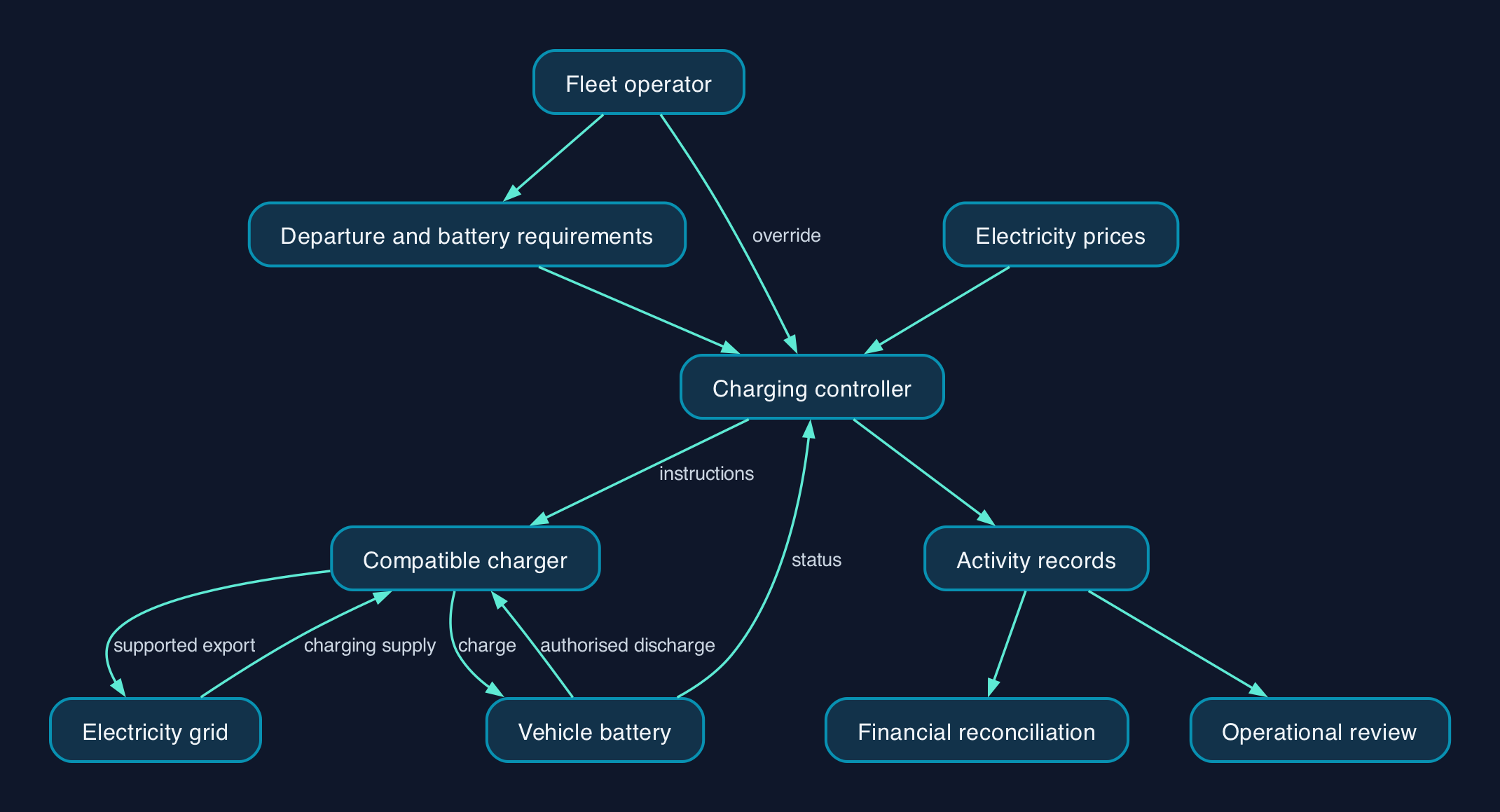
A proposed fleet workflow should start with departure requirements and minimum battery levels supplied by the fleet operator. A charging controller would combine those requirements with vehicle status and electricity-price information, then issue charging instructions within the agreed limits.
Where export is supported and authorised, the same controller could permit discharge through a compatible charger. The operator should retain an override, while an activity record feeds operational review and financial reconciliation.
That division gives each participant a testable responsibility. The fleet manager owns readiness requirements. The energy partner explains its scheduling decisions and charges. The installer and equipment suppliers identify which vehicle and charger combinations they support.
Interoperability deserves particular scrutiny. Amber’s funded work includes a charging-communication standard pilot, battery-degradation research and a home-energy-management system intended to conform to specified protocols. Those are planned technical workstreams, not proof that every combination already works. ARENA’s technical project scope
A British buyer should require a demonstration using its proposed equipment, including a lost connection, a changed departure time and a manual override. Each test needs a named person responsible for resolving failure.
Price the service before counting export income
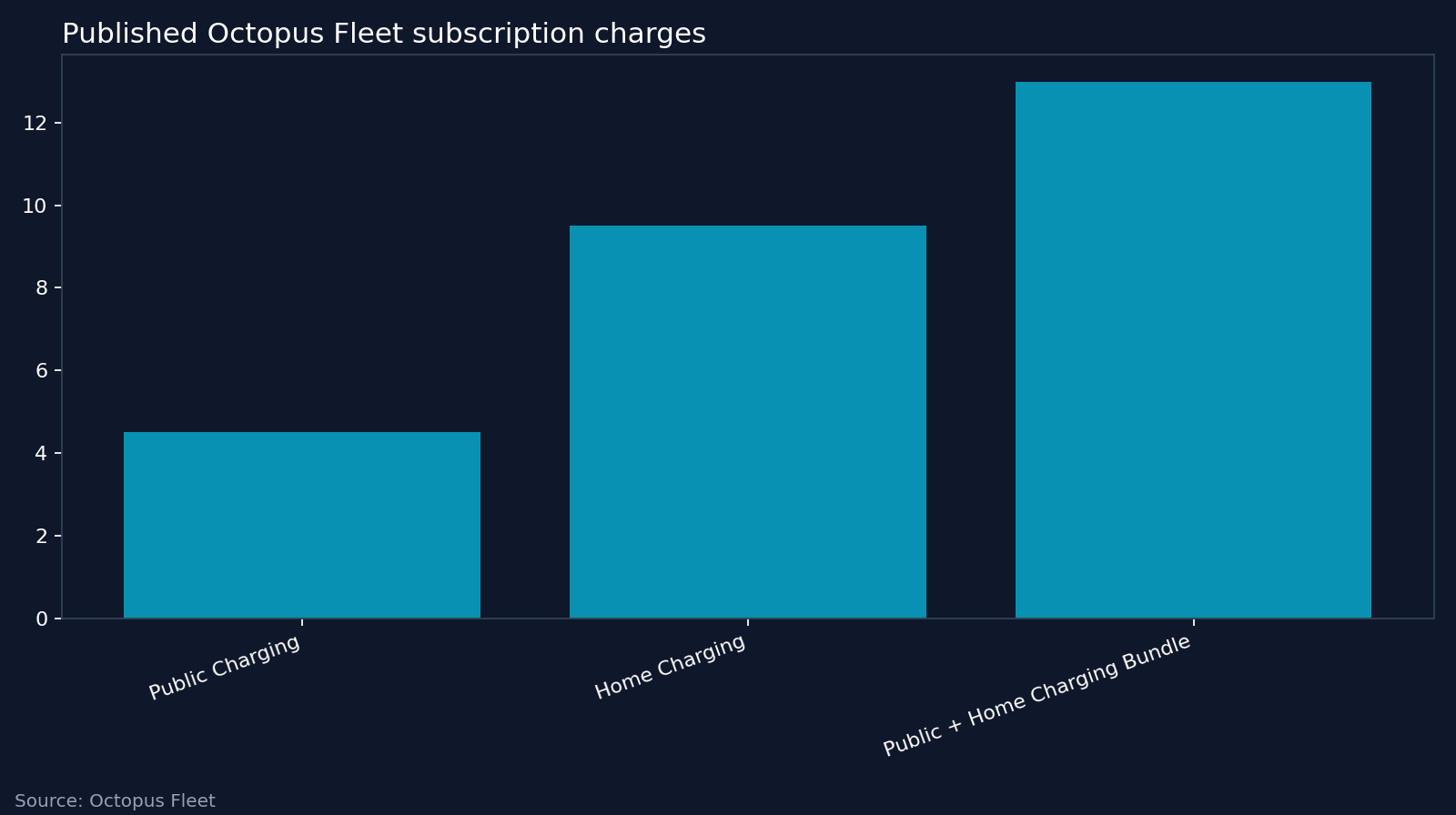
Published software charges provide a firmer starting point than hypothetical V2G earnings. The Octopus Fleet pricing page supplied for this article on 28 September 2026 lists the following UK charges. Published subscription prices
| Service | Published charge per driver per month | What the buyer is pricing |
| --- | --- | --- |
| Public Charging | £4.50 excluding VAT | Public-charging access and administration |
| Home Charging | £9.50 excluding VAT | Business home-charging reimbursement |
| Public + Home Charging Bundle | £12.99 excluding VAT | Both services together |
These are service subscriptions, not an all-inclusive electricity price or a V2G package. The public-charging page separately describes charging expenditure and says customers can leave without a fixed contract, paying outstanding charging and subscription costs. Confirm the applicable terms for each selected component before signing. Pricing and contract explanation
For a wider charging project, request separate costs for equipment, installation, any connection work, software integration, training, maintenance and support. Include the staff time needed to resolve exceptions and reconcile bills. Ask what happens to installed equipment and historical records when the service ends.
The business case should distinguish avoided electricity spending, reduced administration and export income. Combining them into a single savings figure makes it harder to identify which benefit survives when a tariff changes or vehicles spend less time plugged in.
The available evidence does not establish a dependable British fleet V2G return. Treat export income as a separate scenario until a supplier can substantiate it against the fleet’s actual operating pattern.
The strongest objection is that fleets are not households
The strongest objection to this argument is practical. Amber’s expansion concerns homes, while a commercial fleet must deliver journeys to a schedule. A household trial cannot establish that a depot will achieve the same availability, costs or financial returns.
That objection is supported by the project’s unfinished work. ARENA is funding further investigation into battery use, manufacturer confidence and interoperability. The expansion is intended to generate evidence about operation at greater scale. Purpose of the expanded trial
The answer is to narrow the first procurement. A business struggling with home-charging expenses can test reimbursement and reporting. A depot can assess charging schedules against departure requirements before considering export.
There is also a credible case for retaining the existing fleet platform and adding a limited energy service. Replacing dispatch, maintenance or vehicle records would need its own justification. A supplier that handles charging well has not thereby demonstrated that it should own every fleet workflow.
Editorial analysis
Energy suppliers should earn a larger software role through operational performance. British buyers should judge them on vehicles ready for work, intelligible bills, exception handling and the ability to leave.
For a small business, a sensible first step is to select one recurring problem and establish its current cost. Trial the proposed service against that baseline, with finance and the person scheduling vehicles agreeing the acceptance criteria.
For UK technology companies, the opportunity is to connect energy decisions to fleet requirements without surrendering the customer’s control. A useful integration would make departure constraints, charging status and financial records available to the people who need them.
The supplier worth keeping will be the one that can explain a charging decision, recover from a failure and hand over usable records at exit. Those are concrete software obligations that British fleets can demand now.
FAQ
Does smart charging require vehicle-to-grid capability?
No. Amber’s programme distinguishes automated charging from bidirectional operation, which adds electricity export. A buyer can assess charging schedules without making export part of the project. ARENA’s programme description
Is an energy supplier already offering fleet software in the UK?
Yes. Octopus Fleet’s documented offering includes charging services, payment tools and home-charging reimbursement. Its public-charging page also describes reporting and driver administration, although those functions do not establish that it can replace a complete fleet-management system. UK launch and product functions.
Can a British fleet use the Australian trial to forecast V2G income?
It should not treat the trial as a British revenue forecast. The programme concerns Australian households, and ARENA identifies further work on battery use, interoperability and market integration. Build any forecast from the proposed UK contract, compatible equipment and actual vehicle schedules. Trial scope and outstanding work
What should a fleet manager ask before granting charging control?
Ask how the service enforces departure times and minimum battery levels, who can override it, and what happens when communications fail. Require a named support owner across the software and equipment suppliers. Make data export and continued charging after termination part of the acceptance test.
Sources
- ARENA — Expansion of Amber’s vehicle-to-grid and smart-charging programme — published 29 May 2026, updated 1 June 2026.
- ARENA — Amber’s automated charging project and technical workstreams — updated 29 May 2026.
- Octopus Energy — Launch of Octopus Fleet — dated 18 February 2026.
- Octopus Fleet — Public charging, subscriptions and contract questions — undated page, evidence supplied 28 September 2026.
- EV Infrastructure News — Australian V2G expansion and competing trial approaches — dated 1 June 2026.