Canada’s new data centre principles put electricity costs, water use and local benefits into the development bargain. Britain should give northern locations a stronger place in compute procurement, with power availability carrying more weight than habit or proximity to London. That is a case for testing suitable workloads elsewhere, not predicting a wholesale migration. Cooler conditions strengthen the argument only when a particular facility can demonstrate the savings.
Key pointers
- Include northern sites when tendering for workloads that can tolerate greater distance from users.
- Ask for an evidenced electricity connection date before comparing promised capacity.
- Require cooling electricity and water figures for the proposed facility and workload.
- Compare migration, connectivity, support and exit costs alongside the hosting quote.
- Keep latency-sensitive services where measured performance justifies their location.
- Make local benefits specific enough to check after construction.
Canada’s lesson is about the terms of growth
Canada’s principles make a useful starting point because they ask what the host community receives and what it must absorb. The framework covers protecting electricity customers, reducing environmental impacts and making local consequences visible. Its official update supports those expectations; it does not establish that Canadian facilities are cheaper than British ones.
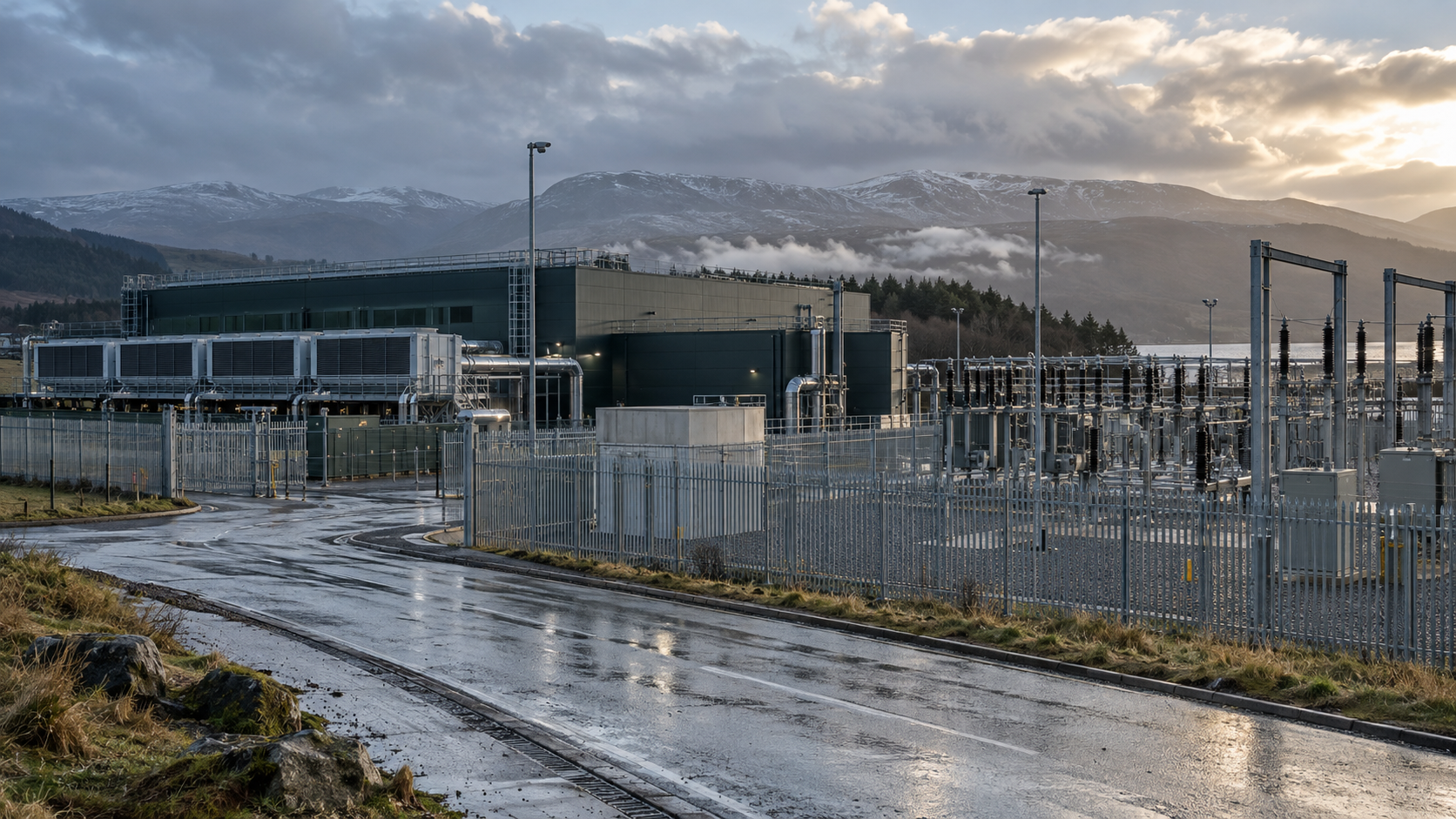
Britain should adopt that discipline when assessing regional investment. A proposed northern campus deserves scrutiny of its power connection, water demand and delivery commitments. A southern expansion deserves the same scrutiny. Neither a cold-weather photograph nor a London postcode answers those questions.
My position is that UK buyers should make location earn its place in the specification. Where a workload can move without damaging service, the shortlist should follow demonstrable infrastructure advantages.
Northern Britain has a power argument to test
The strongest evidence for reconsidering location concerns electricity. In its written submission to Parliament, the energy department explicitly contrasts West London congestion with opportunities to use Scottish renewable generation north of the B6 electricity transmission boundary between Scotland and England.
That is a meaningful planning signal. It is not a quotation for cheaper electricity, a guaranteed connection or a claim that every Scottish site has spare capacity.
For a technology leader commissioning substantial compute, I would put the deliverable power supply ahead of the regional investment brochure. Require the supplier to identify available capacity, connection dependencies, backup arrangements and the consequences of delay. Then assess whether those conditions suit the workload.
For a small business buying a hosted application, the practical request is narrower. Ask the provider about service location, continuity and contractual performance. There is little value in demanding control over a building when the purchasing decision concerns the application service.
Cooling strengthens the case only when measured
The department’s evidence says cooling choices depend on local climate, energy availability, water resources, cost and operating requirements. It also describes different water and electricity demands across cooling approaches, with operators using hybrid systems to balance conditions.
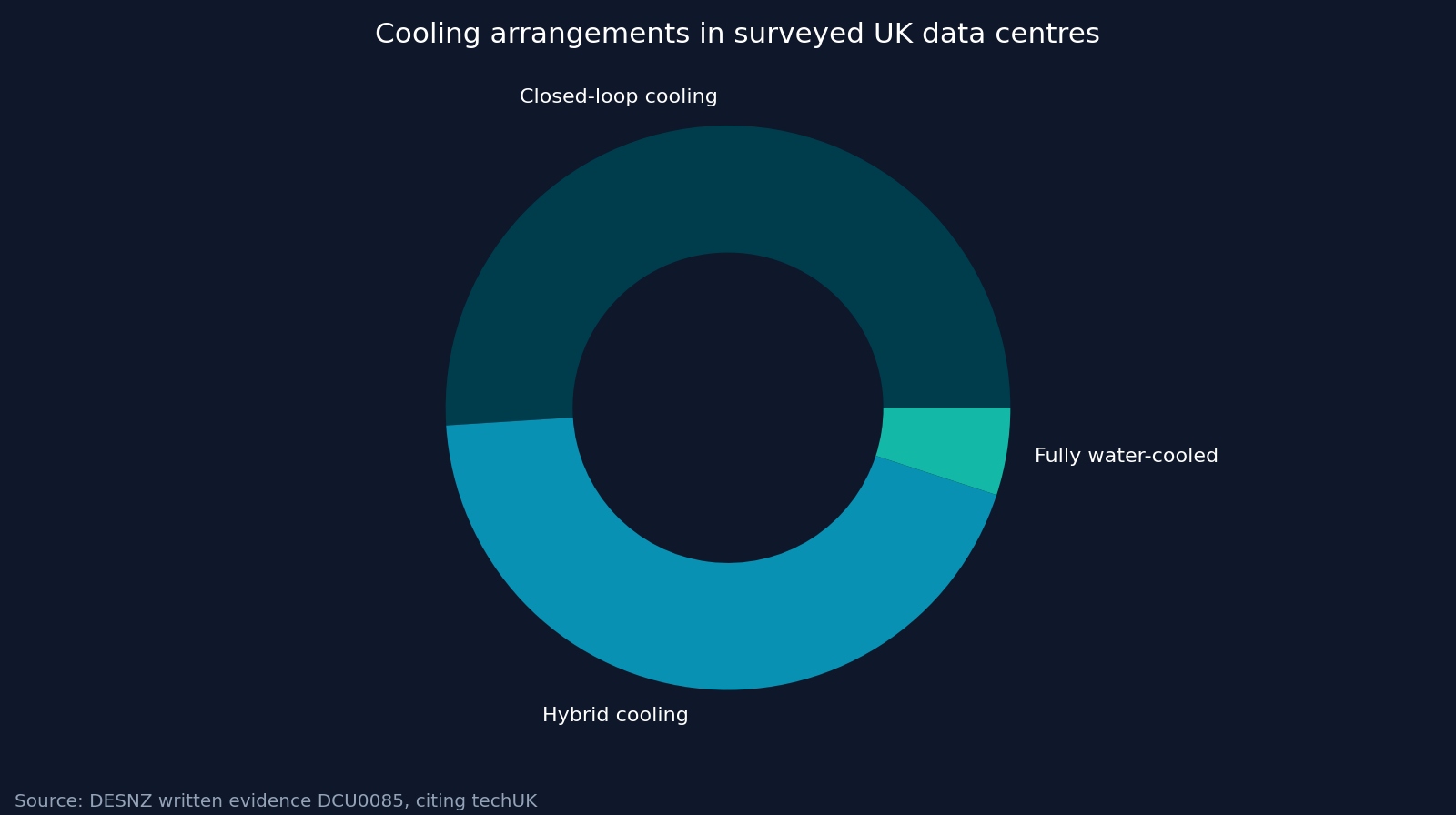
The survey figures illustrate why a simple latitude ranking would mislead. The reported split is 51% closed-loop cooling, 44% hybrid cooling and 5% fully water-cooled. These are shares of surveyed facilities using the submission’s categories, not shares of cooling energy or measured regional efficiency.
A colder location is therefore a hypothesis to investigate. Ask the operator to show how local conditions affect the proposed cooling design across the year, including warmer periods. Compare electricity and water together, at an equivalent computing load.
The supplied evidence does not quantify a northern cooling-cost advantage over London. The defensible prediction is conditional: northern regions could attract more workloads where facility-level savings and available power outweigh the costs of distance.
Place workloads before relocating whole systems
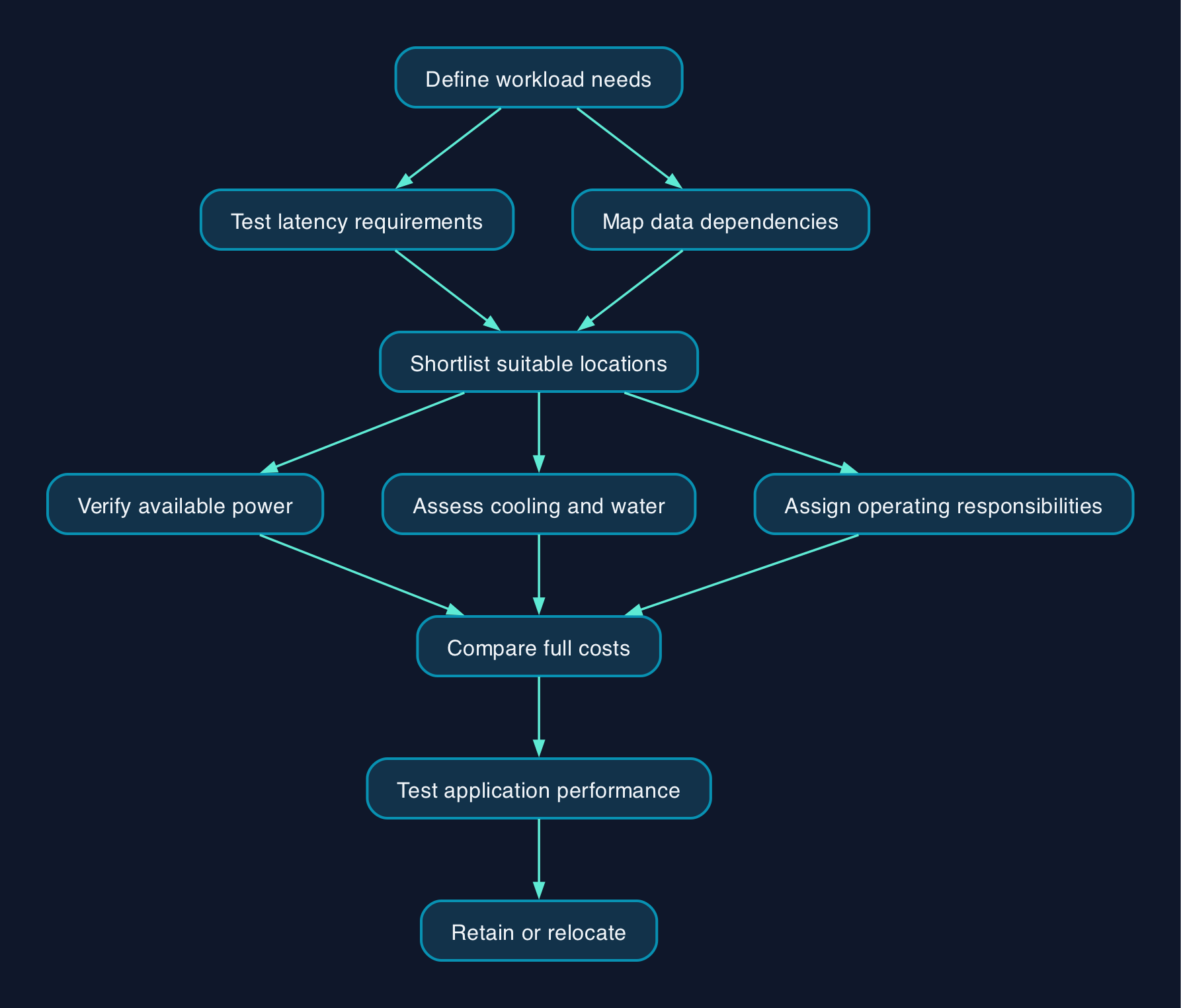
A useful procurement design would separate work by its tolerance for delay and its dependencies. Consider scheduled processing as an initial candidate for location testing, while retaining demanding interactive services where the application requires them. This is a proposed evaluation approach, not a claim that every batch job is easy to move.
Map where the data begins, where processing happens and where the result is consumed. Include the staff or service provider responsible for monitoring and recovery. A location decision should survive that dependency map before anyone signs a migration order.
This follows the distinction in the recommendations: major facilities that can operate away from customers offer an opportunity to coordinate compute with network capacity and low-carbon electricity.
The likely opportunity is selective expansion. British organisations can test new placements at a renewal or capacity increase without treating their entire existing estate as obsolete.
Compare the bill and the delivery model
I would require competing proposals to use the same workload, service requirements and contract period. Each should identify computing charges, electricity treatment, connectivity, data transfers, migration, support, recovery testing and exit work. Unknown costs should remain visible rather than disappearing into an apparently cheap hosting subtotal.
For proposals involving AWS, Google or OVHcloud, compare the specified service and location against those requirements. For a UK colocation proposal, also establish who supplies and maintains the computing equipment. The Commons Library describes colocation as third-party facilities renting space to customers, which makes the allocation of operational work a central comparison point.
Apply the same evidence standard to each supplier. Ask who carries a power-price increase, who resolves a connectivity failure and what assistance is included when the contract ends. A brand name cannot settle those responsibilities.
For buyers with limited technical staff, I would favour an accountable service arrangement over a lower facility price that leaves essential operating work unassigned.
The strongest counterargument is that distance still matters
London proximity can remain the right choice for a particular application. The Commons Library briefing identifies proximity to users as relevant to applications requiring real-time decisions. It also describes the concentration of UK data centres in Greater London.
Moving an application solely to pursue a cooling advantage could fail if its performance depends on systems that remain elsewhere. That objection deserves a measured response: test the complete application, including its data exchanges and failure behaviour, before accepting a new location.
The answer is to make proximity a requirement that buyers can explain and test. If a workload needs it, retain it. If it does not, an established London deployment should face the same cost and resilience comparison as a proposed northern one.
Nor should Britain replace one geographical assumption with another. South Wales already features among the emerging hubs identified by the Commons Library. The procurement principle should reward a suitable site wherever the evidence supports it.
Editorial analysis
Britain’s next compute investments should be easier to place outside the established London concentration. Canada’s contribution is a clearer set of questions about who benefits and who bears the resource costs; the British evidence supplies a specific reason to investigate alternative electricity locations.
For buyers, the next step is concrete. At the next capacity decision, request a credible alternative location and compare it against the existing arrangement. Award the work on delivered power, application performance, operating responsibilities and full cost. Northern Britain should compete on those terms.
FAQ
Does a northern location guarantee cheaper computing?
No. The supplied evidence contains no comparable northern and London tariff or facility-cost dataset. Request a quotation covering the workload and all associated operating costs before treating location as a saving.
Can cooler weather remove the need to assess water use?
No. The energy department describes several cooling approaches with different water and electricity requirements, and says the choice depends on local conditions and operational needs. Ask for the proposed facility’s seasonal requirements rather than inferring them from its postcode.
Should a small business move its existing cloud services?
My recommendation is to start at renewal or when adding capacity. Require evidence of a service or cost improvement that justifies migration, testing and staff time. A regional development announcement alone is not a business case.
Has Canada proved that Britain’s compute industry will move north?
No. Canada’s development principles establish expectations for projects, not a forecast of British investment. The northward argument here is an editorial judgement conditional on power availability, cooling performance and workload suitability.
Sources
- Innovation, Science and Economic Development Canada — launch announcement reproduced by The AI Journal, 3 September 2026
- Government of Canada — additional signatories and development expectations, 22 September 2026
- Department for Energy Security and Net Zero — written evidence DCU0085
- House of Commons Library — Data centres, planning policy, sustainability and resilience, 27 May 2026
- Energy UK — Powering the Cloud, 4 July 2025