The British farm of the future may need a network engineer as much as a mechanic
Connected machinery needs someone to maintain its digital dependencies. South Korea’s agricultural investment points towards a British opportunity in integration and support, provided the economics work for the farm.

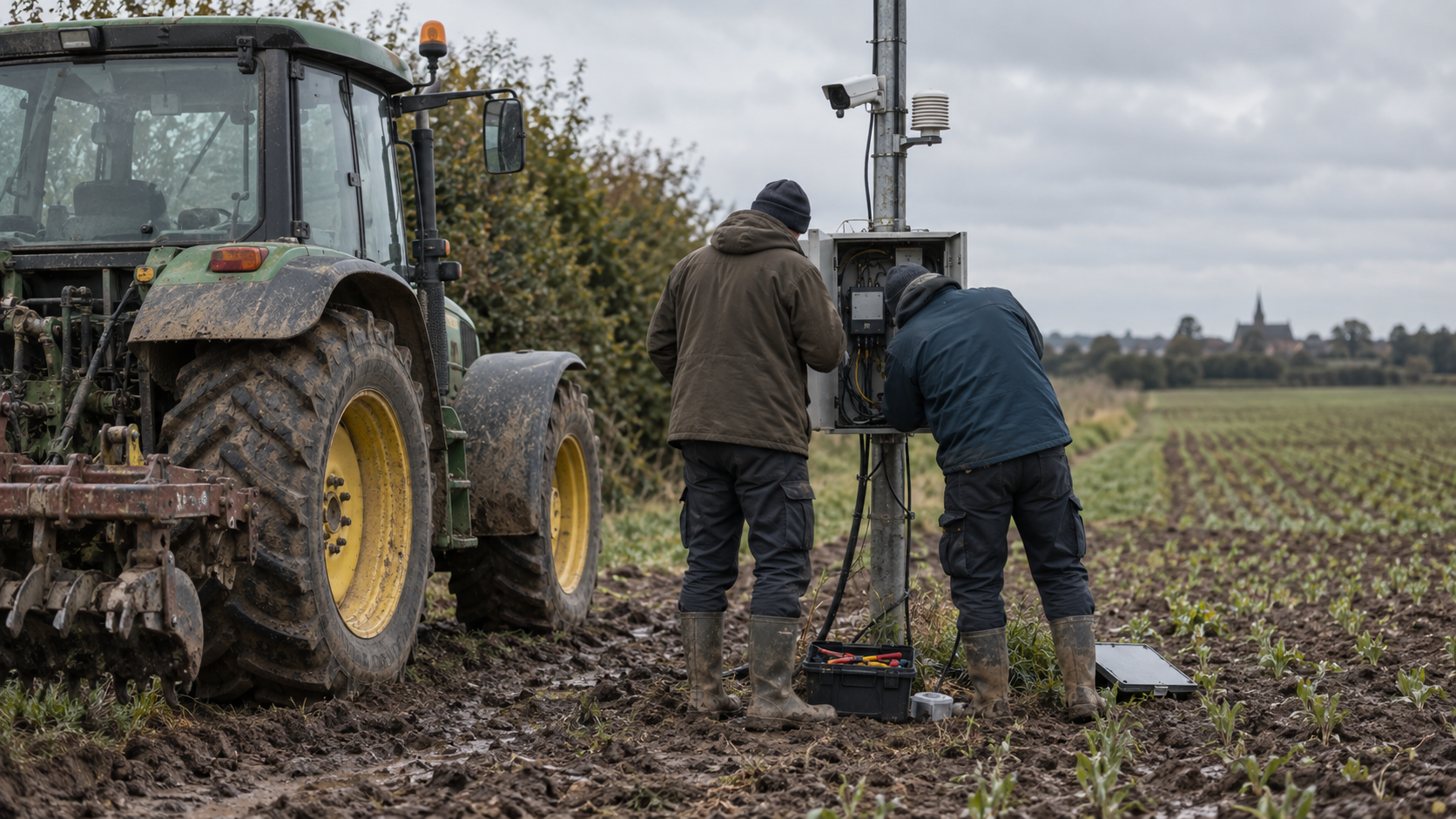
British farms adopting connected machinery should budget for network engineering alongside mechanical maintenance. South Korea’s 2026 agricultural research programme supports the direction of travel, with work on intelligent agricultural operations and outdoor smart-farming models. My position is that British technology companies should make these systems dependable and repairable before selling greater autonomy, with investment justified by a specific farm task.
Key pointers
- Ask who owns fault diagnosis when the machine, connection and software come from different suppliers.
- Require a demonstration of what happens when connectivity fails before accepting automated equipment.
- Start with one measurable farming task and retain a workable fallback.
- Compare a managed service with buying equipment and arranging support separately.
- Include installation, training, seasonal support and eventual data export in the business case.
- Treat overseas funding announcements as evidence of investment, not proof of commercial success.

South Korea is building more than smarter machinery
South Korea’s agricultural investment deserves attention because it connects machinery development with the data needed to operate it. The January research programme included outdoor smart-farming models; the April GPU programme described demand for processing terrain and environmental data, alongside shared models for autonomous agricultural operations. These were development activities and proposals, rather than evidence of widespread deployment. Research programme, GPU programme
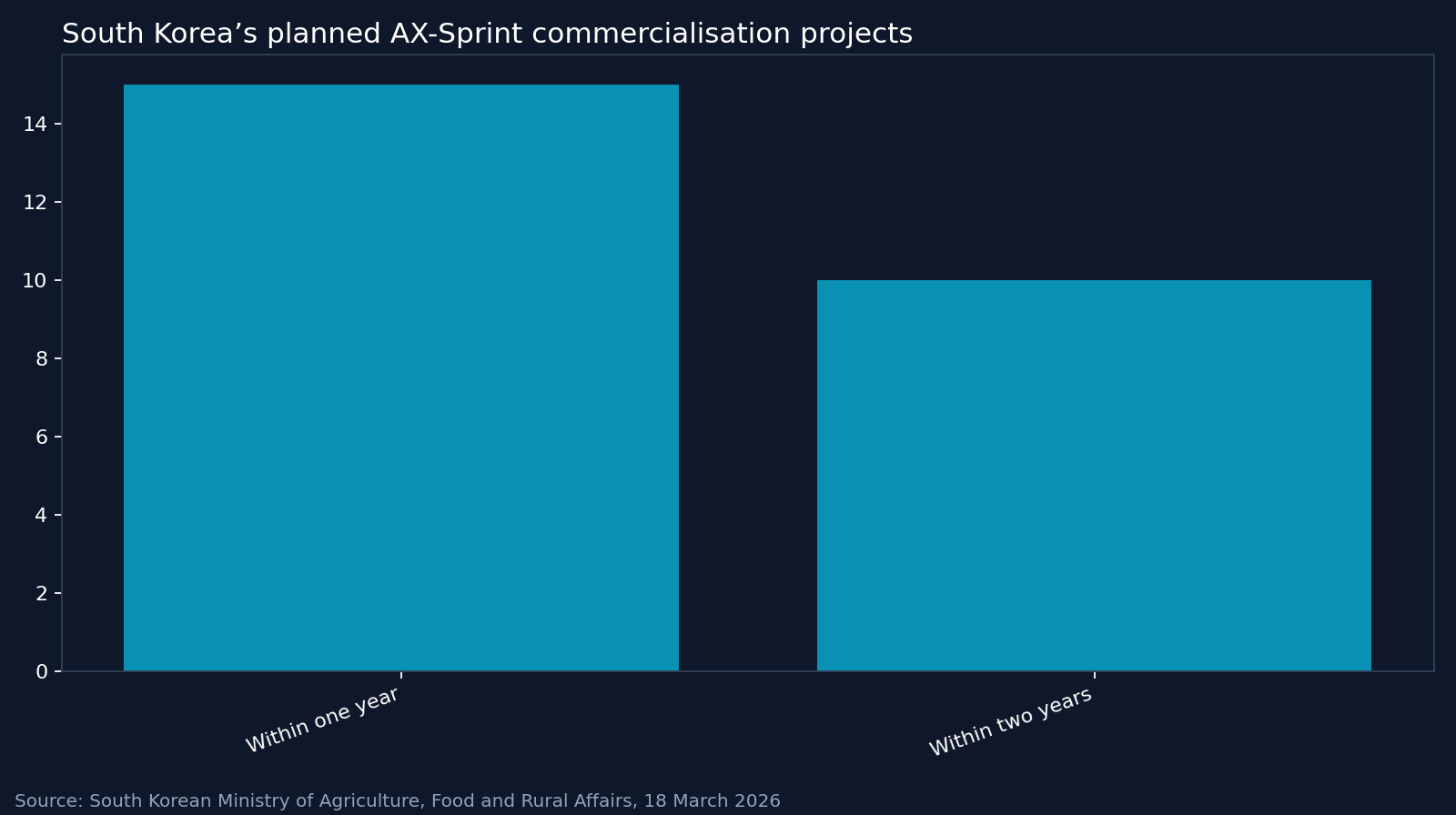
The commercialisation timetable is also revealing. The ministry’s AX-Sprint announcement divided its proposed portfolio into 15 projects capable of reaching commercialisation within one year and 10 within two years. Those counts cover a broader agricultural and food programme, not just outdoor robots. They show the intended pace of development, not completed products or successful farm businesses. AX-Sprint project scope
For British technology leaders, the useful inference is that agricultural automation needs an operating system in the organisational sense. Someone must connect observations, software recommendations, machinery and people, then take responsibility when those connections fail.
A robot demonstration can show that a machine completes a task. A purchasing decision should establish who keeps that task running through an entire season.
The British opportunity is responsibility for the whole system
Consider an illustrative British grower evaluating camera-assisted crop inspection. Images move from the field to processing software, which produces a recommendation for a farm manager. The manager authorises an action, and the result is recorded for later assessment.
I would make that chain the unit of procurement. The buyer should specify how old an image may be before it becomes unusable, who checks an uncertain recommendation and what work can continue without the external connection. These are proposed acceptance criteria, not claims about any particular product.
The network engineer’s contribution would extend beyond installing a router. The contract should assign responsibility for coverage testing, device access, monitoring, updates and fault diagnosis. The machinery specialist should retain responsibility for mechanical condition and the equipment’s documented operating procedures. The farm manager should retain authority over the agricultural decision.
For a smaller business, those responsibilities need not become separate jobs. A contractor or shared service could provide technical support. What matters is that the farmer can identify the person responsible for restoring the service without mediating an argument between suppliers.
That is where I would place a British technology company’s bet: dependable integration and support tied to a farming outcome.
Price the season, including the failures
The investment case should compare the proposed service with the farm’s existing method over a stated period. An equipment price alone cannot answer whether the change is worthwhile.
For a seasonal pilot, I would request the following breakdown.
| Cost component | What the buyer should require |
| --- | --- |
| Equipment and installation | Hardware, mounting, power, commissioning and replacement arrangements |
| Connectivity and processing | Coverage work, recurring charges, storage and any usage limits |
| Integration and training | Connections to existing records, staff instruction and time spent configuring the service |
| Support and recovery | Support hours, response commitments, site visits and the cost of fallback working |
| Exit | Data export, removal costs and whether equipment remains usable after cancellation |
These are quotation requirements, not published prices. The available evidence does not establish comparable UK commercial tariffs, so a credible business case must use supplier quotations and the farm’s own operating figures.
Measure the current task before the pilot begins. Record staff time, interventions and completed work, then include the time spent checking the new system’s output. A saving that disappears once supervision is counted should fail the purchasing test.
Compare delivery models before choosing suppliers
The Korean platform announcement illustrates one approach to integration. Its preferred consortium brought together Daedong, LG CNS, public bodies and farming participants, with different responsibilities for land, technology, agricultural services and production. The announced production and validation setting included a greenhouse, so it should not be presented as proof of an outdoor autonomous farm. Platform responsibilities
Britain’s 5GRIT record shows another division of work. Quickline led the project, Broadway Partners supplied broadband services, and Blue Bear Systems participated in precision farming services. Those organisations occupied different positions in the delivery chain. 5GRIT project partners
These records establish project roles, not a verified current supplier shortlist. They nevertheless suggest useful questions for procurement.
An integrated service offers a buyer the possibility of one accountable lead. I would favour that arrangement where the farm has little technical capacity, provided the contract covers subcontractors, service failures and exit.
Buying connectivity, machinery and software separately gives the farm more direct choices. I would favour that route only where someone has the skills and paid time to manage compatibility and disputes between suppliers.
Keeping the existing machinery and adding a limited monitoring service should remain an option. The buyer should reject a wholesale replacement proposal if a smaller intervention can answer the same operational question.
The strongest objection is that the economics may never work
The case against this vision is substantial. A farm can have a technically successful installation that costs more than the work it saves.
Britain already has a relevant warning. The government’s 5GRIT case study, updated in August 2021, reported that drone monitoring could save farmers time, but that costs outweighed benefits in the low-margin sheep-farming use case examined. It also said the cost benefit of its successful rural mesh connectivity had not been explored. 5GRIT economic limitations
That finding should shape purchasing decisions. It does not establish that agricultural connectivity always fails financially, but it rules out assuming that better information automatically pays for the infrastructure delivering it.
My answer is to make engineering support proportional to the task. Test whether shared support, periodic data collection or a narrower installation can meet the requirement. Compare each proposal with retaining the current process.
If the economics still fail, retain it. A farm owner should be able to reject an automation project without being accused of resisting the future.
Editorial analysis
The headline describes a change in the maintenance burden, not a forecast that every farm will recruit an IT department. Where a farming task depends on data arriving and software interpreting it, the buyer should treat those dependencies as part of the equipment.
British technology companies should sell a defined responsibility: keep this inspection, monitoring or machinery workflow usable under agreed conditions. Their proposals should explain how faults are detected, who responds and how the farmer continues working.
The most revealing supplier demonstration may therefore be an interrupted connection, followed by a controlled recovery. I would put that demonstration ahead of another presentation about autonomy.
FAQ
Does every British farm need a network engineer?
No. The argument is for access to the skills needed by the chosen system, which could come through a contractor or shared service. A farm retaining a largely manual process should not acquire technical overhead without a measurable benefit.
Does connected farming require 5G?
A buyer should require the supplier to justify the connection against the task, rather than specify 5G by default. The historical 5GRIT project explored several wireless approaches and found different limitations in the technologies tested. Those findings support site-specific testing rather than a universal network choice. 5GRIT connectivity findings
Has South Korea proved that outdoor AI farming is commercially successful?
The cited announcements establish research support, commercialisation plans and infrastructure commitments. They do not establish profitable, widespread outdoor deployment or returns transferable to British farms. The January programme is evidence of development activity, not a completed commercial assessment. Agricultural research announcement
What should a British business test first?
Choose one task with a measurable baseline, such as inspection time or the number of manual interventions. Agree the acceptance criteria, support responsibilities and fallback before installation. Expand only after the pilot demonstrates enough value to cover operation, supervision and recovery.
Sources
- South Korean Ministry of Agriculture, Food and Rural Affairs — 2026 agricultural research funding announcement, 4 January 2026
- South Korean Ministry of Agriculture, Food and Rural Affairs — AX-Sprint commercialisation support announcement, 18 March 2026
- South Korean Ministry of Agriculture, Food and Rural Affairs — Smart-agriculture data and GPU programme, 22 April 2026
- South Korean Ministry of Agriculture, Food and Rural Affairs — Preferred consortium for the national agricultural AI platform, 28 April 2026
- UK Government — 5G Rural Integrated Testbed case study, published 23 July 2018 and updated 2 August 2021