Copilot Chat is enough until the work proves otherwise
Copilot Chat can be a sensible starting point for UK businesses. Paid licences should follow evidence that broader work context or specific app capabilities improve completed work enough to justify the cost.


Yes, for a UK business whose AI needs centre on drafting, web research and working with selected documents, Copilot Chat is a sensible starting point. Microsoft includes it at no additional cost with eligible Microsoft 365 subscriptions. Our view is that paid licences should follow a demonstrated need for broader access to work content or specific app capabilities, supported by a measurable improvement in completed work.
Buy against a task your staff actually perform
Our editorial position is to start with included Chat and make each upgrade earn its place. A small business should be able to name the recurring task that a paid licence improves before committing to it.
Consider a hypothetical UK wholesaler whose operations manager wants help rewriting supplier emails and extracting questions from a delivery document. Those are sensible tasks to test with Chat because the manager can provide the relevant material directly. Microsoft documents that user-supplied content can form part of a Chat conversation. Whether the results meet that wholesaler’s standards remains a pilot question.
The decision changes when preparing an answer requires finding material across several conversations and documents. Paid Copilot’s documented ability to combine organisational content with the user’s working context gives it a stronger case for that job. The commercial question is whether it reduces preparation and checking enough to justify the extra cost.
Microsoft’s naming also needs care. Its documentation says Microsoft 365 Copilot is now called Microsoft Copilot, while some licences and experiences retain the older name during the transition. This article uses “paid Copilot” for the licensed offering and “Chat” for the included experience; the pricing table retains the published plan names. Microsoft’s naming notice
Work context is the boundary to test
It would be misleading to tell buyers that Chat cannot use company information. Microsoft describes its general chat experience as web-grounded, meaning it uses web information to inform responses, but also documents supplied files, Outlook context and agents as routes to organisational content. Microsoft’s explanation of Chat grounding
Nor is app presence alone a reliable purchasing test. Microsoft’s enterprise pricing page lists Chat in selected Microsoft 365 apps, while the paid offering adds work-grounded chat and capabilities across Word, Excel, PowerPoint, Outlook and Teams. The useful comparison is the specific task available to a particular user. Microsoft’s plan comparison
Ask a pilot user to complete a real task in their existing setup, then repeat an equivalent task with the proposed paid capability. Record time spent finding information, preparing prompts, correcting the answer and producing an acceptable result. A quicker first response is weak purchasing evidence if the finished work takes just as long.
Who supplies the information and checks the answer
In Chat, Microsoft describes a flow from the user’s prompt through processing, optional Bing web searches and a language model, with prompts and responses logged within Microsoft 365. Paid Copilot also draws on permitted organisational content through Microsoft Graph, the interface connecting Microsoft 365 information. Chat processing and paid Copilot’s use of Microsoft Graph explain these different routes.
For a small or mid-sized business, the following is a proposed responsibility split.
| Responsibility | Suggested owner | Evidence that the job is done |
| --- | --- | --- |
| Confirm eligibility and available capabilities | Microsoft 365 administrator or retained IT provider | Pilot users can complete the named tasks in their actual accounts |
| Approve information sources and access | Business information owner, supported by IT | The permitted documents and user groups are recorded |
| Check generated work | Employee producing the final output | Figures, statements and proposed actions have been checked against source material |
| Approve paid seats and agent spending | Budget owner | Each purchase has a named use case and a review point |
Paying for Copilot does not repair excessive access permissions. Microsoft says it surfaces organisational information that the user is authorised to view, making existing permissions a prerequisite for a controlled rollout. Microsoft’s access-control explanation
The practical implication is to review who can read sensitive material before expanding AI-assisted discovery. The subscription decision and the permissions review need different owners, even if the same IT provider helps with both.
Compare the actual UK purchasing routes
The supplied Microsoft UK pricing pages, retrieved on 28 September 2026, show several routes. These are published licence figures, not complete operating costs.
| Route | Published UK price excluding VAT | Commitment and material conditions |
| --- | --- | --- |
| Included Copilot Chat | No additional Chat charge | Eligible Microsoft 365 subscription and Microsoft Entra account required. [Business services pricing](https://www.microsoft.com/en-gb/microsoft-365/business/additional-services-plans-and-pricing) |
| Microsoft 365 Copilot Business add-on | From £13.80 per user per month, shown as an offer against £16.10 | Paid yearly, annual subscription with automatic renewal; eligible subscription required; up to 300 users. [Business add-on pricing](https://www.microsoft.com/en-gb/microsoft-365/business/additional-services-plans-and-pricing) |
| Microsoft 365 Copilot enterprise add-on | £23.10 per user per month | Paid yearly, annual subscription with automatic renewal; qualifying Microsoft 365 licence purchased separately. [Enterprise pricing](https://www.microsoft.com/en-gb/microsoft-365-copilot/pricing/enterprise) |
| Microsoft 365 Business Standard with Copilot | £18.10 per user per month paid yearly, or £21.72 with a monthly subscription | A combined Microsoft 365 and Copilot package, rather than an AI-only add-on; the annual option automatically renews. [Business Standard bundle pricing](https://www.microsoft.com/en-gb/microsoft-365/business/microsoft-365-business-standard-with-copilot) |
The supplied extracts do not include all offer footnotes, promotional eligibility, expiry details or minimum purchase quantities. Obtain a quote confirming those points, the required Teams variant and the renewal price before budgeting.
For an existing customer, compare the proposed total subscription bill with the current bill. Do not add the entire Business Standard bundle price to an existing subscription and call the result the cost of upgrading: establish which licences it would replace.
The operating budget should also include configuration, permissions work, training, support and checking generated outputs. For an agent project, add development, testing, maintenance and consumption charges. No additional Chat licence charge makes a pilot easier to justify; it does not make staff time free.
Agents can change the economics
A focused agent may deserve consideration when staff repeatedly need a defined set of company information. Microsoft documents pay-as-you-go agents as a route to organisational content within Chat. That creates an alternative to buying a paid seat solely for one narrow information task.
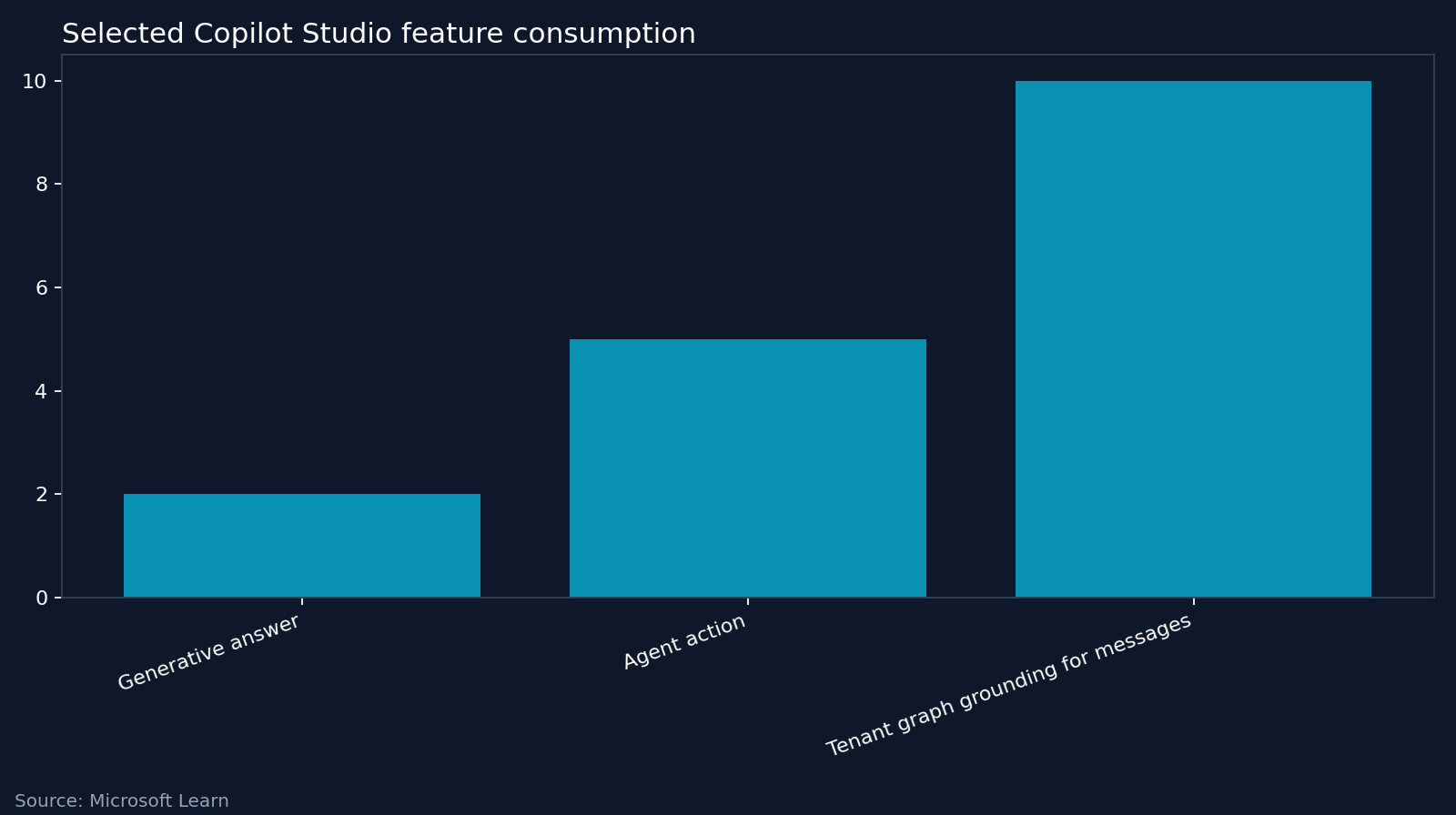
However, consumption is more complicated than counting conversations. Microsoft’s billing documentation lists these standard-harness feature rates:
| Agent feature | Published consumption |
| --- | --- |
| Generative answer | 2 Copilot Credits |
| Agent action | 5 Copilot Credits |
| Tenant graph grounding for messages | 10 Copilot Credits |
These are feature rates, not complete prices per question. Microsoft identifies exceptions, including certain Agent Builder responses without tenant graph grounding, and separately billed bring-your-own-model configurations. Copilot Studio billing rates and qualifications
The same documentation includes qualifying employee-facing usage for authenticated paid Copilot users, subject to conditions and fair-use limits. It also excludes computer-using agent usage from that licence inclusion and limits which agent-flow triggers qualify. “Paid Copilot includes agents” is therefore too broad a budgeting assumption.
Our recommendation is to assess an agent as a small software service. Give it a maintenance owner, test representative requests and establish its actual consumption before treating it as the cheaper option.
Editorial analysis
The strongest argument for Chat is that a business can investigate useful AI tasks without first buying an additional licence for every participant. Its documented access to supplied material makes it a credible starting point for bounded document and drafting work.
The strongest argument for paid Copilot is the effort involved in assembling context. If staff repeatedly collect information that the paid service can retrieve and use effectively, the upgrade deserves a measured trial. If the real bottleneck is checking an uncertain answer or finding missing business information, additional licences may leave that problem intact.
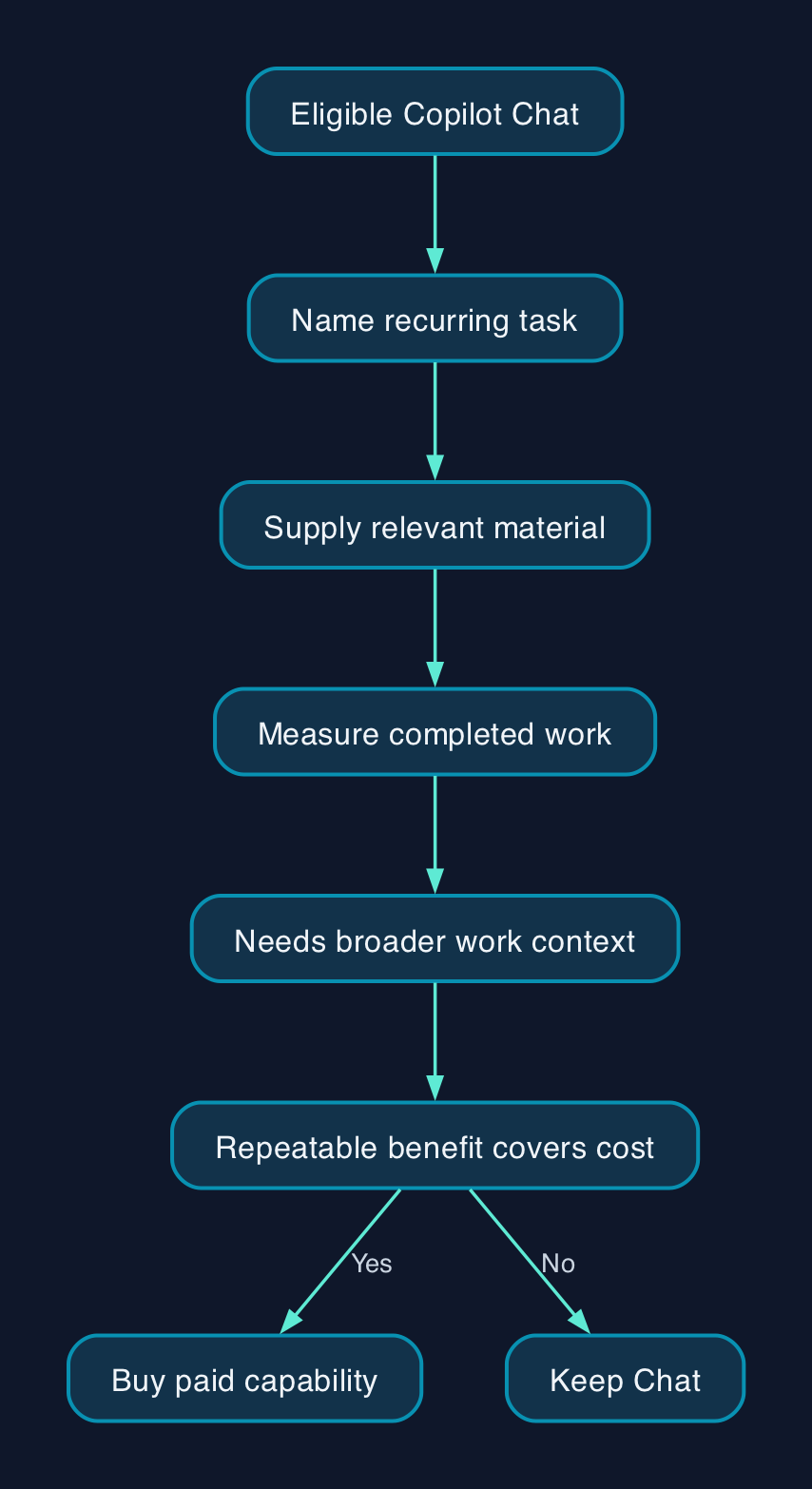
For a UK owner-manager, the next step is a task-based pilot with a recorded cost and quality baseline. Keep Chat where it produces acceptable finished work. Purchase paid capability where the pilot shows a repeatable benefit, and review whether that benefit survives routine use.
FAQ
Can employees use Copilot Chat without a paid Copilot licence?
Yes, Microsoft lists Chat at no additional cost for Microsoft Entra account users with an eligible Microsoft 365 subscription. That eligibility condition matters, so the administrator should confirm the organisation’s existing plan before rollout. Microsoft’s UK business services page
Can Copilot Chat read our company documents?
Users can supply company material through prompts and file selection or uploads. Microsoft also documents organisational context in Outlook and access through pay-as-you-go agents, so it would be inaccurate to describe Chat as incapable of using work information. These routes are distinct from paid Copilot’s broader work grounding. Copilot Chat privacy and protections
Do we need paid Copilot to stop our prompts being used for training?
Microsoft says prompts and responses in organisational Copilot Chat are not used to train foundation models, and enterprise data protection applies to both Chat and paid Copilot. Buying the paid licence solely for that stated protection is therefore not justified by the documentation. The specific administrative controls still depend on the underlying subscription. Enterprise data protection
When should a small business pay for Copilot?
Pay when a pilot demonstrates that the required work-grounded or app capability improves completed work enough to cover its additional cost. Microsoft documents broader organisational context for paid Copilot, but that feature description does not establish a return for your business. Measure preparation, checking and correction time alongside the subscription cost. Microsoft Copilot’s use of organisational information
Sources
The following Microsoft pages were supplied in the research snapshot retrieved on 28 September 2026.
- Microsoft Learn — Enterprise data protection in Microsoft Copilot and Microsoft Copilot Chat
- Microsoft Learn — Microsoft Copilot Chat privacy and protections
- Microsoft Learn — Data, privacy and security for Microsoft Copilot
- Microsoft — Microsoft 365 Business additional services and pricing
- Microsoft — Microsoft 365 Copilot enterprise plans and pricing
- Microsoft — Microsoft 365 Business Standard with Copilot
- Microsoft Learn — Copilot Studio billing rates and management