Compute sovereignty belongs on the ordinary company’s buying checklist
Compute sovereignty could become an ordinary procurement question. British businesses should start with critical AI workloads, demand evidence about operational control and compare the full cost of staying, changing or leaving.


British companies should make control over critical AI workloads a procurement question now. That means asking who operates the service, where processing happens and how the business would recover or leave. The UK Compute Roadmap places Canada among countries committing multibillion-dollar investments to public compute. My view is that ordinary buyers should translate this national concern into proportionate supplier checks, with extra spending justified workload by workload.
Key pointers
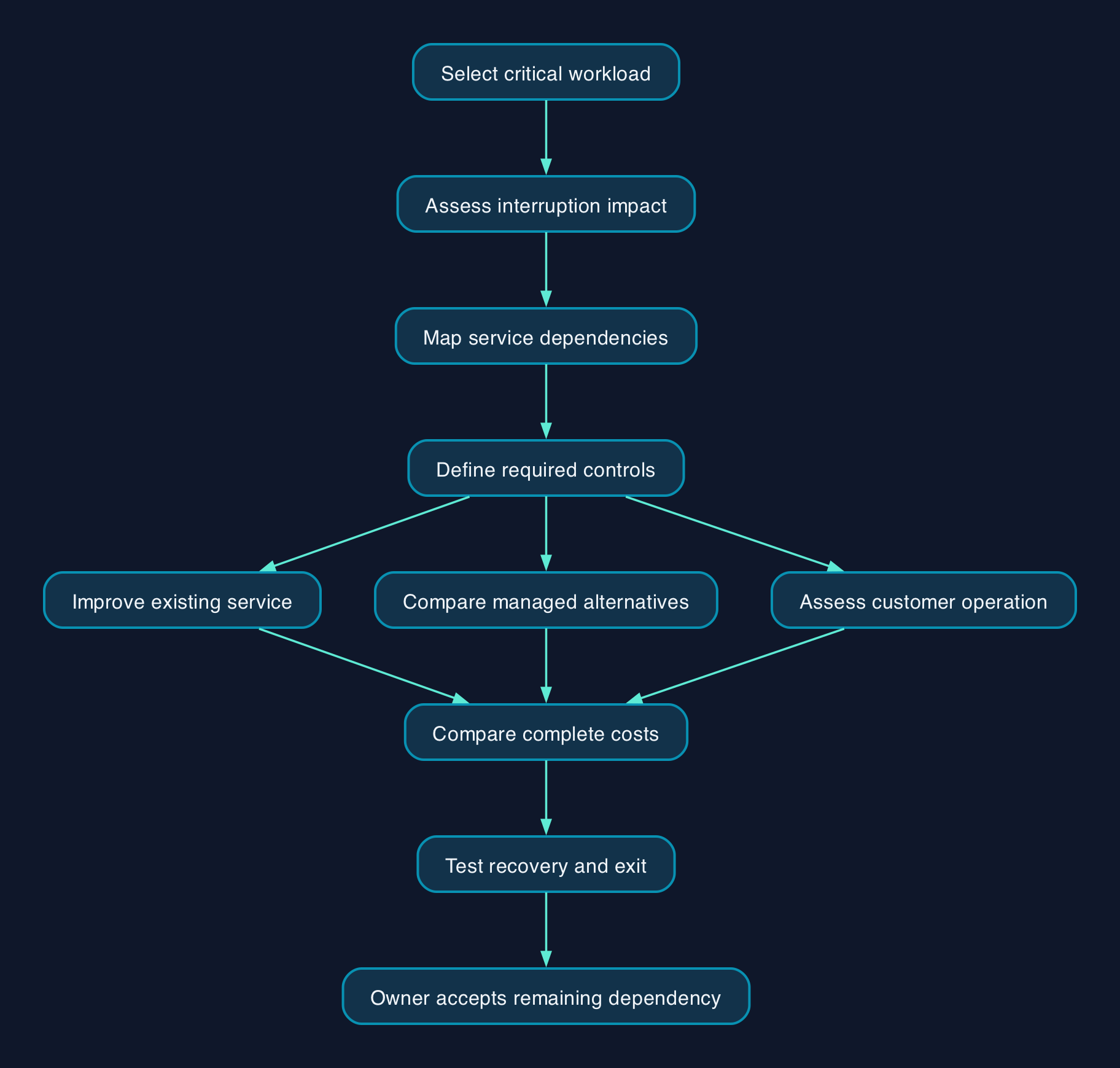
- Start with the AI service whose loss would interrupt customer orders, production or another essential activity.
- Ask suppliers to distinguish processing location, storage location and operational access.
- Request evidence for each sovereignty commitment before putting it into a customer contract.
- Compare improving your existing service with moving the sensitive workload.
- Include migration, support, recovery testing and exit in the cost assessment.
- Give a named business owner responsibility for accepting the remaining dependency.
Canada’s investment raises a British buying question
Canada offers a starting point for this argument. The UK government’s international assessment of compute investment identifies Canada, the United States and the United Arab Emirates as countries making multibillion-dollar commitments to public computing capacity. That establishes an international infrastructure trend without assuming every country is pursuing the same rules or operating model.
For a British business owner, the useful question is what happens when a service becomes essential enough that its underlying infrastructure matters to the contract.
Consider a hypothetical UK manufacturer using AI to interpret incoming orders. If staff can check orders manually during an outage, its dependence may be manageable. If production scheduling stops when the model becomes unavailable, the buyer should demand a more convincing continuity plan.
My prediction is that compute sovereignty will reach ordinary firms through such customer and supplier conversations. A customer may want evidence about where its technical drawings are processed. A board may want to know who can restore an essential service. Neither conversation requires the company to work in defence.
The commercial threshold should be the consequence of losing control.
The procurement unit should be the workload
For this article, compute sovereignty means the control a buyer needs over processing, operational access, dependencies and continued service. It is a procurement framework, rather than a claim that every component can be nationally self-sufficient.
Start by mapping the workload from input to output. Identify the application, model service, hosting infrastructure, identity system, logs and backups. Then record who administers each component and who responds when it fails.
This approach follows a distinction already visible in supplier descriptions. Oracle describes its UK sovereign service in terms of self-contained control and monitoring systems, as well as restrictions on authorised operating personnel. Those are different commitments from the location of stored data.
The buyer should turn each important commitment into an answerable question. Where does processing occur during normal operation and recovery? Who can obtain privileged access? Which subcontractors are involved? What could prevent the customer from moving the workload?
A small company can begin with a dependency map and a supplier questionnaire. Buying infrastructure before identifying the dependency reverses the decision.
Compare the operating promises behind the label
The available supplier evidence describes different propositions, so a fair comparison must preserve their boundaries.
Civo describes a UK-hosted and operated range spanning public, private and AI services. It is a candidate for buyers exploring those deployment choices, subject to checking the specific model, capacity, support and contractual commitments required.
Redcentric describes managed sovereign environments with controlled operational access, backup and disaster recovery. That makes the division of responsibilities especially important. A buyer should establish which recovery tasks the provider performs, what the customer retains and what the quotation includes.
Oracle’s UK sovereign offering describes geographically separate London and Newport regions and restricted operating personnel. Its customer eligibility rules mean it cannot simply be placed on every ordinary business’s shortlist.
These pages establish suppliers’ stated offerings. They do not establish comparative performance, complete prices or suitability for a particular AI application.
Keep the existing provider in the assessment, too. Ask it to address the same requirements before assuming that migration is necessary. Compare a revised configuration or contract against a managed alternative and, where skills permit, customer-operated infrastructure.
The decision is which arrangement supplies the required control at an acceptable operating cost.
Price the responsibility as well as the processing
The supplied evidence does not establish comparable prices or a defensible percentage premium for sovereign compute. A buyer should therefore request quotations against the same workload and service expectations.
Specify the model or application, expected usage, peak demand, storage, connectivity, support hours and recovery requirements. Require suppliers to identify minimum commitments, exclusions, VAT treatment and charges for changes or exit.
Then add the buyer’s own work. Migration involves application changes and acceptance testing. Running the service requires monitoring, security maintenance and incident ownership. Leaving requires data export, replacement capacity and another round of testing.
For customer-operated infrastructure, include hardware, hosting, power, maintenance and staff cover. For a managed service, establish which of those responsibilities the fee actually transfers.
Compare both alternatives with the cost of retaining and improving the current setup over the same period. A cheaper infrastructure quote is insufficient if the business must recruit the people needed to operate it.
The strongest objection is that ordinary firms cannot afford this
The strongest objection is practical. Most small businesses want working software and reliable support. Requiring them to audit infrastructure ownership, duplicate applications and maintain spare capacity could consume the budget intended for useful AI adoption.
That objection should defeat an indiscriminate sovereignty policy.
The UK Compute Roadmap itself envisages a diverse mix of public and private infrastructure and cooperation with other countries. Domestic capability does not imply that every business should recreate its supplier’s platform.
My recommendation is to reserve expensive controls for workloads whose failure or loss of access would cause material harm. A non-essential drafting assistant may need basic contractual checks and a manual alternative. An AI service embedded in order processing may justify tested recovery, stronger access commitments or an alternative deployment.
Existing arrangements should remain an acceptable outcome when they meet the requirement. Procurement earns its cost by exposing a dependency and deciding what to do about it.
Editorial analysis
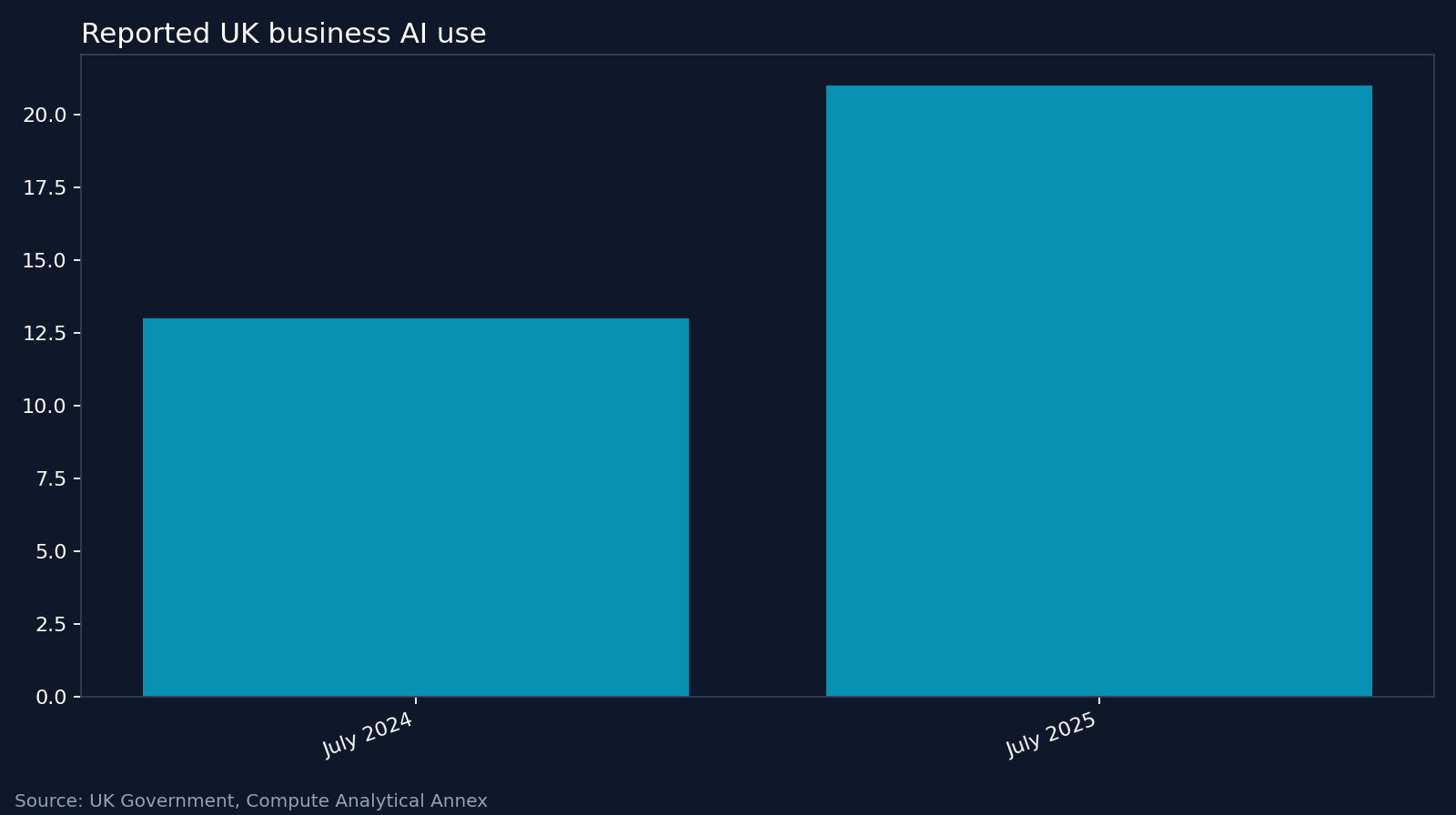
The adoption figures explain why this question can move beyond specialist buyers. The government’s Compute Analytical Annex reports business AI use rising from 13% in July 2024 to 21% in July 2025. These are historical adoption figures, not a measure of demand for sovereign services.
My inference is narrower. As more businesses use AI, more will need to decide which applications they can afford to lose temporarily and which require stronger continuity arrangements.
The opportunity for UK technology providers is to make their operating commitments checkable. Buyers should reward clear answers about access, recovery and exit rather than an unqualified sovereignty claim.
At the next renewal, select one important AI workload and require the supplier to explain how it continues operating, who controls it and how it can be replaced. That is a proportionate first purchase of greater control.
FAQ
Does this mean every UK business should move to a sovereign cloud?
No. My recommendation is to assess important workloads individually and move only where the alternative addresses a material requirement. Improving the current contract, configuration or fallback may be sufficient.
Is UK hosting enough to answer the sovereignty question?
It answers only part of the procurement assessment proposed here. Buyers should also examine operational access, dependencies and recovery arrangements. Oracle’s description of its UK sovereign service illustrates how operating personnel and control systems can form separate commitments.
Can ordinary companies buy every service labelled sovereign?
No. Eligibility must be checked before technical evaluation. Oracle UK Sovereign Cloud explicitly restricts access to government, defence and government-sponsored third parties, so an ordinary commercial buyer should not assume it qualifies.
What should a small business do first?
Choose the AI-enabled process whose interruption would hurt most. Ask the application supplier to identify its processing locations, operational responsibilities and recovery arrangements, then test the business’s fallback. Use the gaps to define a buying requirement before requesting migration proposals.
Sources
- Department for Science, Innovation & Technology and UK Research and Innovation — UK Compute Roadmap, updated 23 April 2026
- UK Government — Compute Analytical Annex
- Civo — UK Sovereign Cloud
- Redcentric — Managed UK Sovereign Cloud Services
- Oracle — UK Sovereign Cloud