Britain’s next robot fleets could belong to hospitals and campuses
British hospitals and campuses could become major buyers of shared service robot fleets. Singapore offers a model worth examining, but the business case depends on building integration, human support and clear accountability.

British hospitals and campuses should prepare to run shared fleets of service robots. My bet is that estate operators will become important robotics buyers because they can organise cleaning, deliveries and building access around the same premises. Singapore’s planned multi-operator robotics testbed points towards that model. The opportunity for Britain depends less on buying impressive machines than on making their daily work reliable, affordable and accountable.
Key pointers
- Assess recurring cleaning and delivery tasks together before departments commission separate robot pilots.
- Appoint an estate-level service owner with authority over routes, building access and supplier escalation.
- Ask suppliers to demonstrate their machines on your premises with your staff and normal pedestrian traffic.
- Compare buying equipment with purchasing a managed service, including retained staff time in both.
- Keep existing transport and cleaning arrangements available until the replacement passes agreed acceptance checks.
- Require evidence of interoperability before assuming robots from different manufacturers can share infrastructure.
Singapore is testing the estate as the operating unit
Singapore’s useful contribution to this debate is the decision to test different services in a shared place.
At Punggol Digital District, IMDA, JTC and the Singapore Institute of Technology announced a testbed bringing multiple operators into a mixed-use public area. The intended work includes deliveries, cleaning and patrols. That is an attempt to organise robotics around an estate’s daily activities, with commercial viability among the stated objectives. JTC’s announcement does not yet establish that the model works at scale.
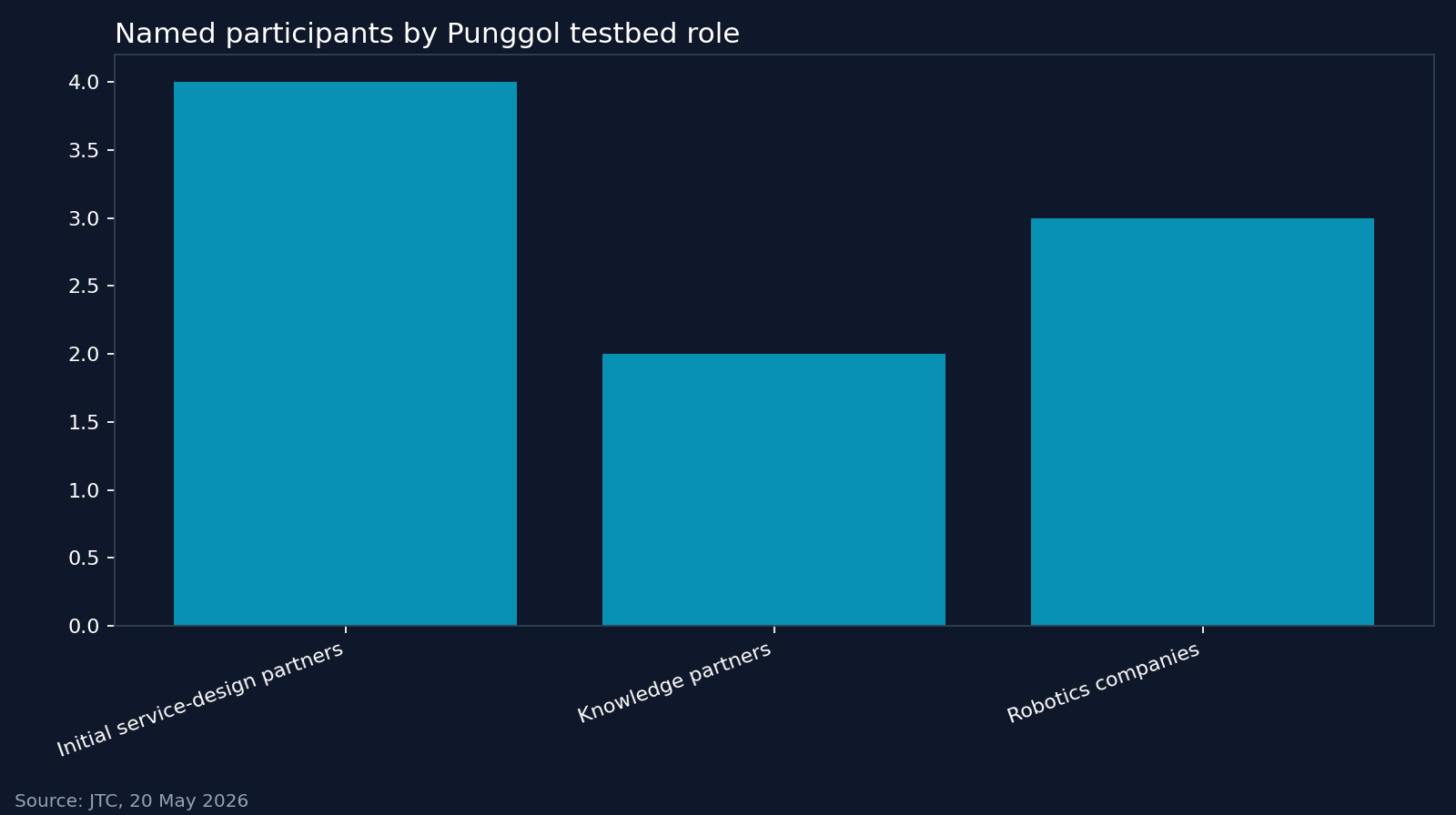
The partnership structure is revealing. JTC names 4 initial service-design partners, Certis, DHL, Grab and QuikBot; 2 knowledge partners, FieldAI and Thoughtworks; and 3 robotics companies, Slamtec, Unitree and QuikBot. These are counts of named participants in each role, not robot counts or mutually exclusive groups. QuikBot appears in two categories.
An earlier project made the division of responsibilities particularly clear. In a 2021 trial announcement, M1 was responsible for network infrastructure, Continental for its Corriere LM delivery robot, and JTC for trial spaces and engagement with tenants and operators.
For British buyers, the lesson is to procure the whole service. A machine supplier cannot, by itself, settle who controls the lift, who receives the delivery or who rescues a stopped robot.
Why hospitals and campuses deserve attention
My argument rests on a buying hypothesis. An organisation controlling several buildings may be able to spread integration and support work across several recurring services.
Consider an illustrative university campus. Its estates team could assess parcel movement, floor cleaning and routine facilities deliveries under one programme. Each task would still need its own equipment and acceptance criteria. The shared investment would be in route assessment, access arrangements, support procedures and operational oversight.
A hospital could apply the same approach, starting with a tightly bounded facilities task. The British evidence already includes practical activity. Health Innovation North West Coast’s May 2025 account of its HART initiative described Royal Liverpool University Hospital exploring robots for glass cleaning and portering, alongside the partly operational cleaner at Royal Lancaster Infirmary. Exploration and partial operation are useful starting points, rather than proof of a mature fleet market.
Hospitals and campuses are therefore credible candidates for expansion. The supplied evidence is stronger for British hospitals than for British campuses; the campus proposition remains an inference from estate organisation and Singapore’s mixed-use model.
For smaller businesses, ownership may be unnecessary. A tenant could ask its landlord or facilities contractor whether a shared delivery or cleaning service would meet its needs. The commercially interesting buyer might be the organisation aggregating demand across the estate.
A shared fleet needs a named service owner
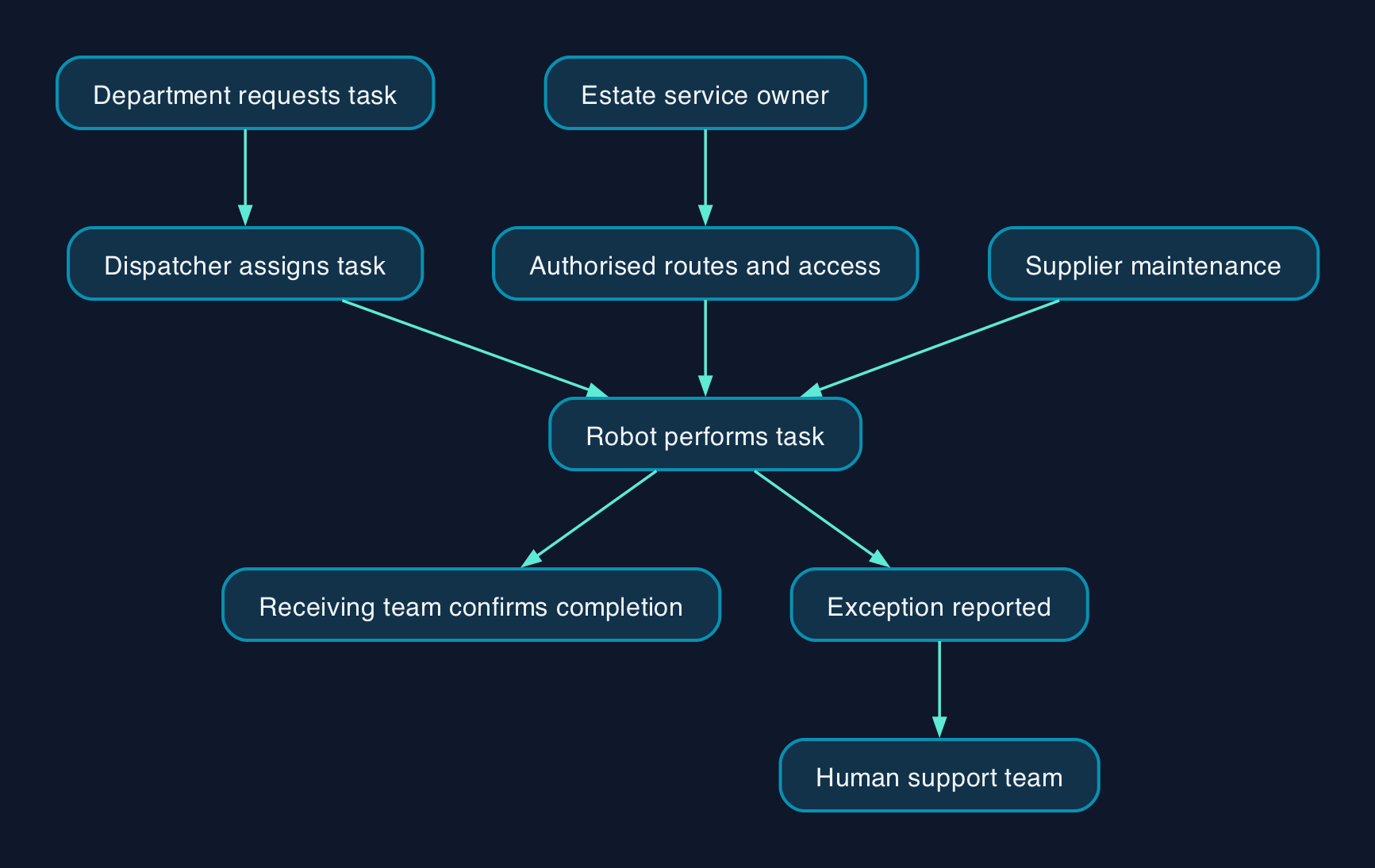
I would organise an initial deployment around a simple workflow. A department requests a task, a dispatcher assigns it, the relevant robot performs it using authorised routes and building access, and the receiving team confirms completion. An exception goes to a named human support team.
That is a proposed operating model, not a claim that the products in this article already connect to one another.
The estate service owner should approve routes and access permissions. The robot supplier should document operating limits and maintenance responsibilities. The receiving department should define what successful delivery or cleaning means. Staff should know how to stop the service and obtain help.
Before procurement, require demonstrations of blocked routes, lost connectivity, unavailable lifts and failed handovers. Specify the expected response for each event and test it on site.
The business case should include the people performing those interventions. Medirest’s hospital cleaning account explicitly describes a companion person working alongside each robot, handling tasks such as pre-sweeping and surface cleaning. Buyers should measure the combined service, including the human work that remains.
Price the completed service
The evidence supplied contains no comparable UK quotations from which to calculate a fleet budget. A credible procurement should therefore request itemised costs against an agreed workload and contract period.
Include equipment purchase or rental, software, building modifications, connectivity work, deployment, staff training, maintenance, consumables and replacement batteries where applicable. Add internal supervision, recovery from failures and the cost of maintaining a fallback service. Ask separately about removal, data export and restoring building interfaces when the contract ends.
Compare those costs with keeping and improving the existing operation. Better delivery scheduling or revised cleaning routes should remain eligible alternatives.
For transport, I would measure cost per successfully completed task alongside delays and human interventions. For cleaning, I would assess cost against an agreed cleaning outcome and usable area, with quality checked by the customer. Neither measure should reward a machine for completing easy work while leaving staff with an unrecorded backlog.
Time released is only a financial saving when the organisation can explain what changes in its budget. Otherwise, it may still be valuable additional capacity, but the business case should call it that.
Compare suppliers by the responsibility they accept
The available evidence points to several delivery approaches, rather than a defensible ranking of robot brands.
A facilities-led approach combines equipment with the existing cleaning operation. Medirest’s work with Killis illustrates this model. A buyer considering it should ask whether the contract covers a cleaning outcome, equipment availability or simply access to machines.
A product-led approach leaves the customer to assemble more of the operating arrangement. United Robotics Group describes uClean products for cleaning and uLog products for transport. Those descriptions establish intended applications, but they do not establish equivalent UK support coverage, interoperability or comparative performance. Request those details against the actual site.
An integration or repair approach starts with infrastructure already installed. Aerocom’s account of hospital logistics says it restored an automated guided vehicle installation at Southmead Hospital. The supplied page provides insufficient detail to assess that project’s results, but it raises a sensible procurement question: could restoring an existing system outperform replacing it?
These are different allocations of work and risk. A buyer with limited engineering capacity should favour a contract that makes responsibility explicit, while retaining enough operational knowledge to challenge the supplier and change provider.
The strongest objection is that factories have the better conditions
The case against my forecast is substantial. Where a factory can separate people from machines, standardise loads and repeat the same movement, its robot project may be easier to define than a hospital service sharing space with patients, visitors and urgent deliveries.
A campus programme can also stall between departments. Cleaning, security, IT and estates may agree that robotics is useful while disagreeing over who pays for integration or answers an overnight call.
Nothing in the supplied evidence establishes that hospitals or campuses will overtake manufacturing in fleet size, or that they will own Britain’s first large robot fleets. That stronger claim would require comparative deployment and ownership data.
The case I would defend is narrower. Hospitals and campuses could become important buyers of fleets spanning several everyday services, provided they can coordinate premises, workloads and accountability. Ownership may sit with a facilities contractor rather than the institution using the robots.
The forecast fails wherever integration costs exceed the value of the work transferred, or human intervention remains too frequent. Buyers should make those failure conditions explicit before a pilot starts.
Editorial analysis
Britain’s opportunity is to build competence in operating robots across real estates. I would prioritise companies that can integrate building access, maintain equipment, train staff and demonstrate reliable task completion.
For an NHS trust or university, the next decision should be a funded trial on a bounded route or cleaning area, with a named owner and an agreed comparison against the existing service. Expansion should follow evidence that the complete operation works.
A fleet deserves its budget when the institution can depend on the work it completes.
FAQ
Are British hospitals already using service robots?
There is evidence of use and trials, although it does not establish national fleet totals. Health Innovation North West Coast reported a partly operational cleaner at Royal Lancaster Infirmary and exploratory work at Royal Liverpool University Hospital in May 2025.
Does a shared fleet mean buying every robot from one manufacturer?
No, that is not the model proposed here. Shared oversight could cover several specialist machines, but buyers must verify how dispatch, access and support would work across suppliers. A common management requirement does not prove that a compatible product combination exists.
Should an organisation buy robots or purchase a service?
Choose according to the responsibility the organisation can sustain. Compare ownership with a managed contract over the same workload and period, including internal staffing, maintenance, failures and exit costs. Require the service supplier to identify what remains the customer’s responsibility.
Does a robot fleet require 5G?
The evidence does not establish 5G as a universal requirement. The M1, Continental and JTC project was specifically a 5G standalone trial. Buyers should instead require each supplier to specify its connectivity needs and demonstrate safe behaviour when the connection fails.
Sources
The following pages were supplied as evidence extracts for 28 September 2026. Dates below are publication or update dates visible in those extracts.
- Smart Nation Singapore — Smart City solutions, updated 18 August 2026.
- JTC — Singapore Government and Eight Industry Leaders to Research, Test and Deploy Physical AI in Punggol Digital District, 20 May 2026.
- Keppel — M1, Continental and JTC advance Singapore’s Smart Nation ambition through 5G standalone network and robotics, 20 January 2021.
- Medirest — Robots boost hospital cleaning power, publication date not shown.
- Health Innovation North West Coast — Initiative explores potential of robotics in health, 28 May 2025.
- United Robotics Group — Healthcare, publication date not shown.
- Aerocom — How Autonomous Mobile Robots Are Transforming Hospital Logistics, publication date not visible in the supplied extract.