AI coding agents can justify a trial in a UK software company, but a promise of lower costs without extra review or testing is not established by the evidence available here. Our view is to buy against the cost of an accepted, working change. Require any saving in implementation time to survive human review, testing, rework and operating costs before expanding adoption.
The UK buying decision is about accepted work
For a small software company, the useful unit of output is a change that meets its requirements and can be supported after release. A generated patch awaiting a senior developer’s attention is unfinished work.
Consider a hypothetical UK software supplier whose technical director also reviews changes and handles customer escalations. An agent might finish an implementation while that director is on a customer call. The commercial question is whether the director subsequently spends less time getting it safely into production, including explaining the task again and correcting mistakes.
That distinction matters when interpreting supplier evidence. OpenAI’s account of increased pull-request volume also identifies review as a potential bottleneck as more changes arrive. It supports investigating the queue between writing and acceptance, rather than treating code production as the final outcome. OpenAI’s discussion of the review bottleneck
Separate two purchasing objectives. Reducing cost per accepted change can be worthwhile even if the company chooses to ship more changes and therefore does more testing overall. Keeping the total review and testing workload unchanged is a stricter requirement.
For this query, I would make both visible. Record review and testing hours per accepted change, and the team’s total review and testing hours. Otherwise, an improvement in unit cost could conceal a workload increase that the business explicitly wanted to avoid.
Keep implementation, verification and release ownership separate
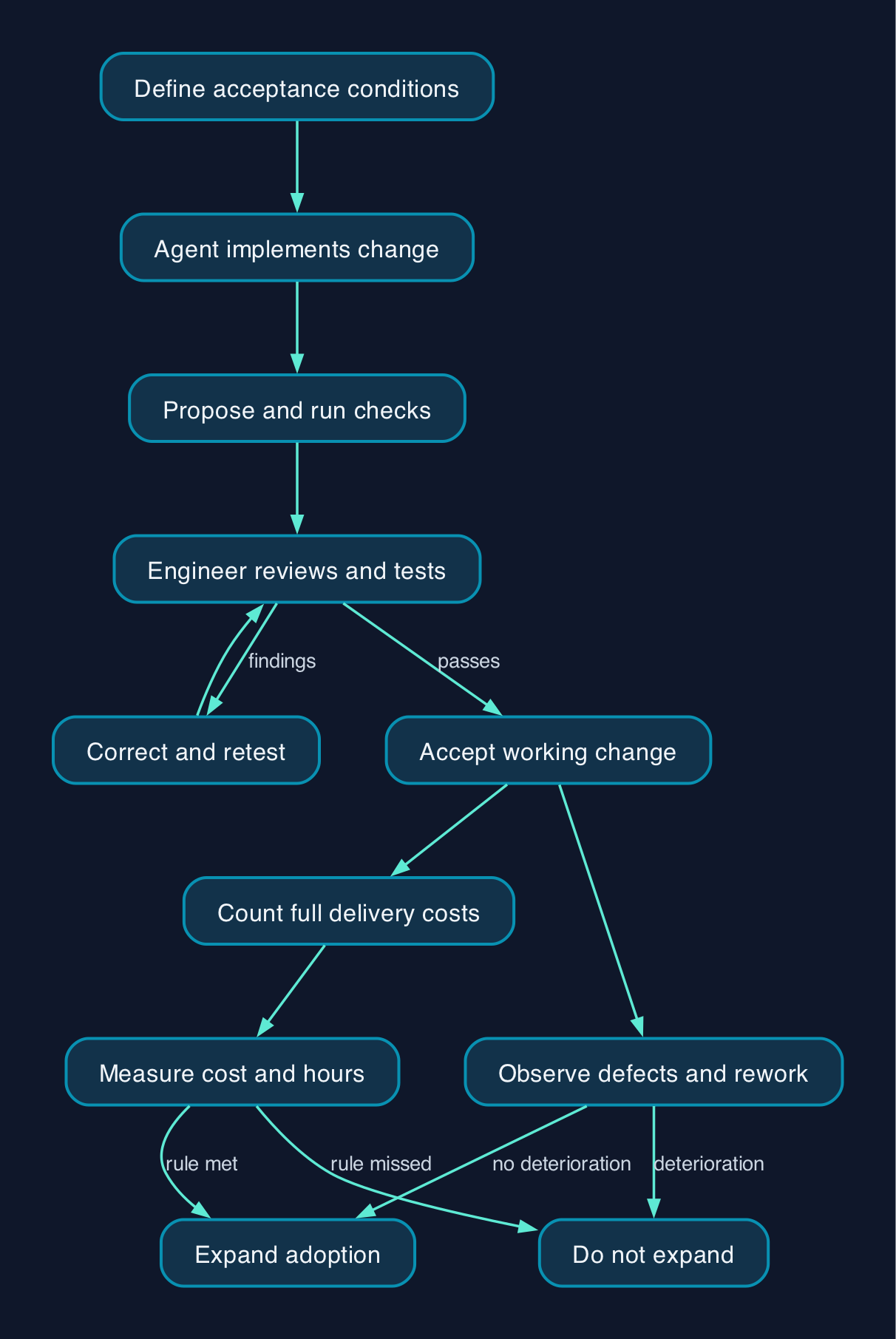
My proposed operating model gives the agent a bounded task and keeps a named engineer accountable for acceptance. It does not require a committee. It requires someone who can explain why the change is correct.
| Stage | Proposed agent contribution | Retained responsibility |
| --- | --- | --- |
| Define the change | Identify relevant code and propose an approach | The task owner specifies expected behaviour, exclusions and acceptance conditions |
| Implement | Produce a scoped patch and explain its changes | An engineer checks that the patch addresses the agreed problem |
| Verify | Propose tests, run permitted checks and report results | An engineer checks that tests cover the requirement and relevant failure cases |
| Review | Flag potential defects and compatibility problems | The reviewer resolves findings and checks assumptions against the real application |
| Release | Prepare release notes and verification steps | The release owner authorises deployment and checks the deployed behaviour |
This is an editorial recommendation, not a claim that every product implements every stage.
GitHub’s guidance for reviewing Copilot output illustrates why ownership still matters. By default, GitHub Actions workflows do not run automatically when Copilot pushes changes. GitHub tells reviewers to inspect the proposed changes before allowing workflows to run, particularly changes to workflow files that may affect access to sensitive secrets. It also documents an option to allow those workflows without human intervention. Reviewing Copilot output
For a small team, that is a configuration decision with operational consequences. Assign responsibility for it during setup, rather than leaving developers to discover the approval step when a delivery is already late.
I would also require acceptance conditions written before implementation. Asking an agent to generate both a patch and tests is useful assistance; accepting those tests without checking their assumptions leaves the original requirement unexamined.
Fewer permission prompts do not establish lower testing costs
Permission handling is one area where the supplied evidence contains concrete counts.
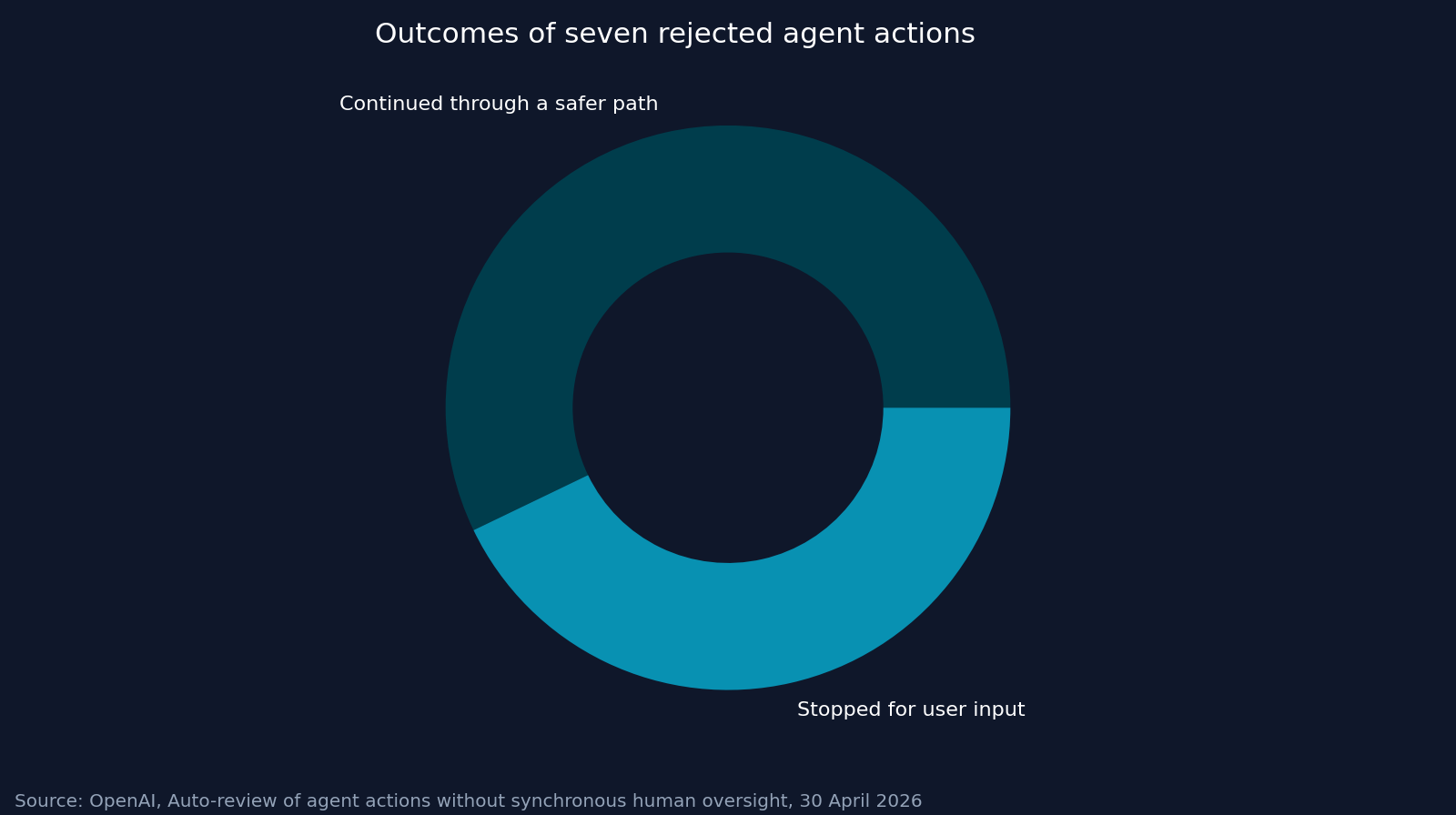
In an illustrative internal deployment snapshot, OpenAI describes 720 out-of-sandbox actions that would have interrupted users under manual approval. With Auto-review, 7 actions were rejected. Of those rejected actions, 4 continued through a safer path and 3 stopped for user input. OpenAI cautions that the ratios depend on the use case, environment and sandbox configuration. OpenAI’s Auto-review research
Those figures describe decisions about whether actions may run. They do not measure whether generated code meets requirements, how long engineers spent reviewing it or how many defects reached customers.
The useful procurement lesson is to measure interruptions separately from verification. Removing a permission prompt may make a session easier to operate. It is not, by itself, a reason to reduce the testing budget.
Price the complete delivery process in pounds
The available evidence does not establish comparable current UK prices, VAT treatment or measured savings across suppliers. A numerical subscription comparison would therefore suggest more certainty than the sources support.
For a UK business, build the cost model in GBP using its actual subscription terms, invoices and internal labour costs. Record billing commitments, usage allowances, additional consumption, exchange charges where applicable and the business’s VAT treatment.
Use the same accounting period for the existing workflow and the trial. Include these components:
- Subscriptions and additional agent usage.
- Computing resources for builds, tests and review.
- Setup, repository instructions and staff training.
- Task preparation and agent supervision.
- Human review, testing and correction.
- Post-release investigation and remediation attributable to the changes.
- Ongoing administration and the work needed to change supplier.
Trial cost per accepted change = total attributable trial cost ÷ accepted changes.
Keep rejected and abandoned attempts in the numerator. They consumed resources even though they produced nothing the company accepted.
Record labour using a consistent internal hourly cost that includes relevant employment costs. Do not count the same hour twice under both supervision and review.
Also distinguish released capacity from cash savings. If salaried engineers use recovered time to clear a backlog, the benefit is additional capacity. Claim a cash saving only where expenditure actually falls, such as reduced contractor work. Both outcomes can justify adoption, but they answer different budget questions.
Compare documented workflows without inventing a market winner
The evidence supports a limited comparison of OpenAI Codex and GitHub Copilot. It does not support a fair feature, price or performance ranking against Google, AWS, Anthropic, open-source agents or UK service providers. Those alternatives should remain eligible for a trial, rather than being excluded because comparable evidence is missing.
For the documented options, these are the differences worth testing.
| Option | Documented workflow | What the buyer should establish |
| --- | --- | --- |
| OpenAI Codex | GitHub reviews can follow repository-specific `AGENTS.md` guidance. OpenAI describes the review as an additional pass and retains tests and approvals as separate controls. [Codex review documentation](https://developers.openai.com/codex/integrations/github) | Whether encoding recurring review concerns reduces human explanation and correction time |
| GitHub Copilot | Its cloud agent can implement changes and run checks. Code review is separately configurable, including whether later pushes receive another review. [Cloud agent](https://docs.github.com/copilot/concepts/agents/coding-agent/about-coding-agent) and [review configuration](https://docs.github.com/en/copilot/how-tos/copilot-on-github/set-up-copilot/configure-code-review) | Whether implementation, workflow approvals and re-reviews fit the team’s existing GitHub process |
| Retain and improve the existing workflow | This is the comparison baseline, not another supplier | Whether clearer tasks, better tests or fewer review delays deliver the required improvement without an agent |
My judgement is that repository fit should outweigh demonstration speed. A team already organised around GitHub pull requests has a different integration task from one whose customer repositories and build systems vary.
Keeping the existing workflow is a credible outcome. If acceptance criteria are unclear or tests cannot reliably run, address that problem before attributing delivery delays to insufficient coding speed.
Editorial analysis
The strongest case for agents is assistance on work whose correctness the team can explain and check. I would start with bounded changes in familiar code, with an existing test path and a reviewer who understands the affected behaviour.
The counterargument deserves attention. Agents can contribute to verification as well as implementation. GitHub explicitly lists improving test coverage among its cloud agent’s tasks, while OpenAI documents repository-specific review rules intended to capture concerns that otherwise live in reviewers’ heads. Copilot task capabilities and Codex custom review rules
That makes lower verification effort a reasonable hypothesis to test. It does not establish the result in advance.
Set the acceptance rule before the trial. For this buying question, I would require lower cost per accepted change, no increase in total human review and testing hours for comparable delivered scope, and no deterioration in observed defects or rework. Include a post-release observation period appropriate to the product.
Expand only where the result survives that accounting. If the agent saves implementation time but increases verification work, report that result directly. It may still be commercially useful, but it has not met the requirement posed here.
FAQ
Can AI coding agents reduce costs without increasing review and testing?
That is a hypothesis worth testing, rather than a result established for UK small software companies by the available evidence. Measure comparable delivered work across implementation, review, testing and post-release correction. A lower coding-time figure alone cannot answer the question.
Can an AI reviewer replace the human reviewer?
I would retain a named human acceptance owner during adoption. OpenAI says its review rules do not replace tests, branch protections or required approvals, while GitHub documents that Copilot reviews normally provide comments, with approval behaviour configurable. Codex review controls and Copilot review behaviour
What should a small UK company include in its cost calculation?
Include subscriptions, usage, computing resources, setup, training, supervision, review, testing and attributable rework over the same period. Use actual GBP costs and record currency conversion and VAT treatment where relevant. Keep recovered staff capacity separate from reductions in expenditure.
Which agent should we trial first?
Start with a product whose documented workflow fits a representative repository and whose commercial terms you can verify. The evidence here supports examining Codex and GitHub Copilot, but does not establish their superiority over other suppliers. Keep the existing process as the baseline and judge each trial against the same acceptance conditions.
Sources
- OpenAI — Agent approvals & security
- OpenAI — Review GitHub pull requests with Codex
- OpenAI — Auto-review of agent actions without synchronous human oversight, 30 April 2026
- OpenAI — Custom Code Review rules for Codex, 20 July 2026
- GitHub — About GitHub Copilot cloud agent
- GitHub — Review output from Copilot
- GitHub — Using GitHub Copilot code review on GitHub
- GitHub — Configuring code review by GitHub Copilot