Britain should build care robots for an ageing world
Britain should build care technology for overseas markets from the outset. Japan offers a practical starting point, but export success depends on demonstrated benefits, full costs and dependable local support.

Japan’s expansion of its long-term care technology priorities gives British companies a reason to design for overseas care settings from the outset. Britain should treat ageing as an export opportunity, with products that demonstrably help residents and staff. Calling it our biggest robotics opportunity is premature without comparative market evidence. The immediate commercial test is whether a supplier can solve a recurring care problem and support that solution abroad.
Key pointers
- Choose a specific care task before choosing a robot design.
- Measure staff time after including setup, cleaning, supervision and troubleshooting.
- Involve older people and care workers before committing to product specifications.
- Identify the overseas buyer, budget holder and maintenance partner before funding expansion.
- Compare robotics with simpler equipment and changes to working practices.
- Make a repeat purchase conditional on demonstrated benefit in ordinary care shifts.
Japan has widened the product brief
Japan’s policy change matters because it describes problems worth solving. The ministries renamed their framework from robot technology to technologies for long-term care, explicitly encompassing information and communication technology alongside robotics. Their announcement scheduled operation under the revised priorities for April 2025. The original policy announcement establishes that direction, although it does not establish subsequent adoption or commercial success.
For a British engineering business, the useful starting point is a task such as helping someone move, supporting meals or reducing repetitive documentation. Each offers a different product brief, buyer and test of success. A company should choose the task for which it can demonstrate an improvement, rather than begin with a humanoid and search for somewhere to deploy it.
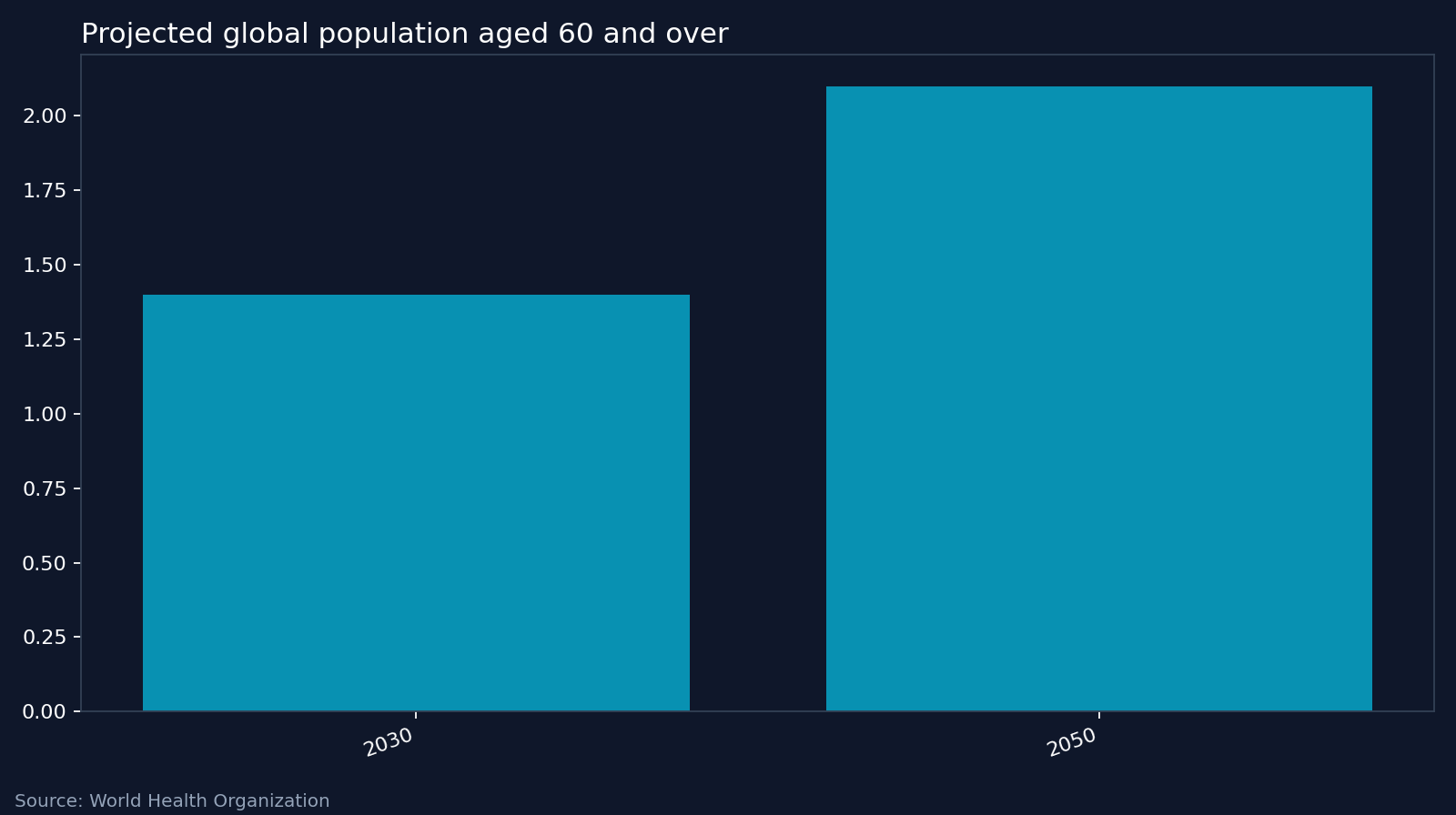
The demographic argument extends beyond Japan. WHO’s projections of 1.4 billion people aged 60 and over in 2030 and 2.1 billion in 2050 describe a growing population whose needs deserve sustained product development. They are population projections, however, not a forecast of robot purchases. An older person is not automatically a care customer, and a care need does not automatically create a funded order.
My position is that Britain should build an export strategy around proven assistance. The evidence here supports investigating that opportunity. It cannot rank care robotics above industrial, agricultural or other robotics markets.
The export opportunity includes the work around the machine
Japan is also considering how domestic healthcare innovation can become an international industry. Its healthcare startup interim report, dated 25 April 2024, connects care sustainability with globally competitive products and services. British firms should therefore approach Japan as a potential development partner and competitor, as well as a customer.
A small UK supplier could pursue a bounded role within a larger care system. Possible routes include a physical assistance device, software connecting equipment to care records, or a service that installs, maintains and evaluates equipment. These are proposed business models, not verified gaps in the Japanese market.
Integration deserves particular attention. A September 2024 US International Trade Administration assessment described limited interoperability between Japanese medical institutions and recommended local partnerships for overseas suppliers. That assessment concerns medical information systems, so it should not be treated as evidence that every care home has the same problem. It does support a practical research question for British exporters about which systems their intended customers already use.
Before building a connection, ask the customer to show the existing workflow. Who receives an alert? Where does the resulting action get recorded? Who notices when the connection fails? Those answers should determine the product specification.
Compare the task before comparing suppliers
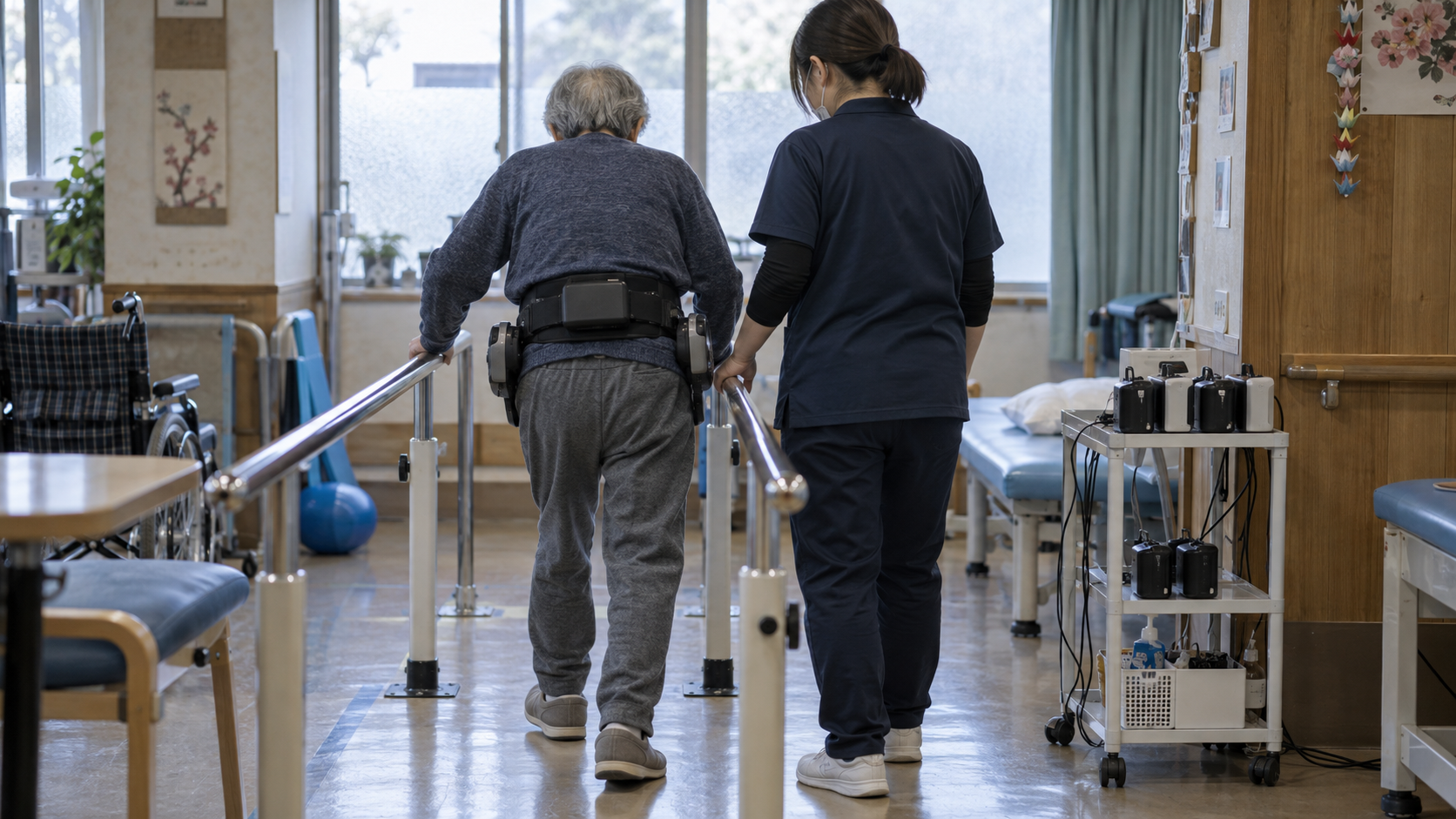
The available examples span very different functions. Reporting from a Tokyo care home described Honda walking assistance equipment and the humanoid Pepper leading group activities. It also observed continuing staff supervision. Those care-home observations reported by the Daily Express illustrate distinct uses, rather than establish comparative effectiveness.
Elsewhere, an operator interviewed by the Japan Care Worker Guide described using Apple iPads for records, under-mattress sensors for monitoring and LINE WORKS for communication. These are operator accounts, not independently measured results.
For a UK buyer or developer, the comparison should follow the job:
| Approach | Proposed evaluation question | Reason to reject it |
| --- | --- | --- |
| Physical assistance equipment | Does it make the selected movement task safer or less demanding under supervision? | Fitting, discomfort or handling requirements outweigh the demonstrated benefit |
| Social or activity robotics | Does participation improve against an equivalent staff-led activity? | Novelty attracts attention without a sustained benefit |
| Sensors and alerts | Do useful alerts lead to timely action with an acceptable false-alarm burden? | Staff cannot reliably distinguish or respond to important alerts |
| Digital records and communication | Does information become easier to find and hand over? | Duplicate entry and troubleshooting add work |
| Existing equipment with better training | Can the same outcome be achieved through improved practice? | The underlying equipment cannot meet the identified need |
These are editorial evaluation criteria. The evidence supplied does not establish current UK availability, comparable prices or a defensible supplier ranking. British providers, international manufacturers and integrators should face the same test of demonstrated benefit.
Sell a supported care workflow
A proposed export model should assign responsibility from installation through to failure recovery. The British supplier owns product performance, updates and technical documentation. A local delivery partner handles agreed installation, training and maintenance. The care provider decides how staff use the system and who responds when assistance is needed.
For a monitoring product, the proposed workflow runs from sensor to alert, then to a named staff member and a recorded response. Access should be limited to the people who need it. The acceptance test should include a failed connection, an unavailable device and an alert that nobody acknowledges.
Older people must also have a meaningful role in evaluation. Ask whether the equipment is comfortable, understandable and acceptable to them. A reduction in staff effort should not compensate for a resident experiencing greater distress.
Before export, commission a product-specific assessment of local market-entry requirements and intended-use claims. A UK pilot should be treated as evidence to examine, not automatic proof that a product fits another country’s care practices.
Price the service over its working life
The evidence pack contains no comparable supplier quotations, so a credible buying decision needs a cost model rather than an invented price comparison.
Request separate costs for equipment or leasing, installation, system connections, training, subscriptions, maintenance, replacement parts and removal. For overseas delivery, add translation, local support, travel and any product-specific assessment work. Establish the contract period, currency, taxes and responsibility for exchange-rate changes.
Staff effort belongs in that model. Record time spent preparing, cleaning, charging, supervising and troubleshooting the equipment, alongside time released from the original task. Avoid counting the same released time as both improved care capacity and a cash saving.
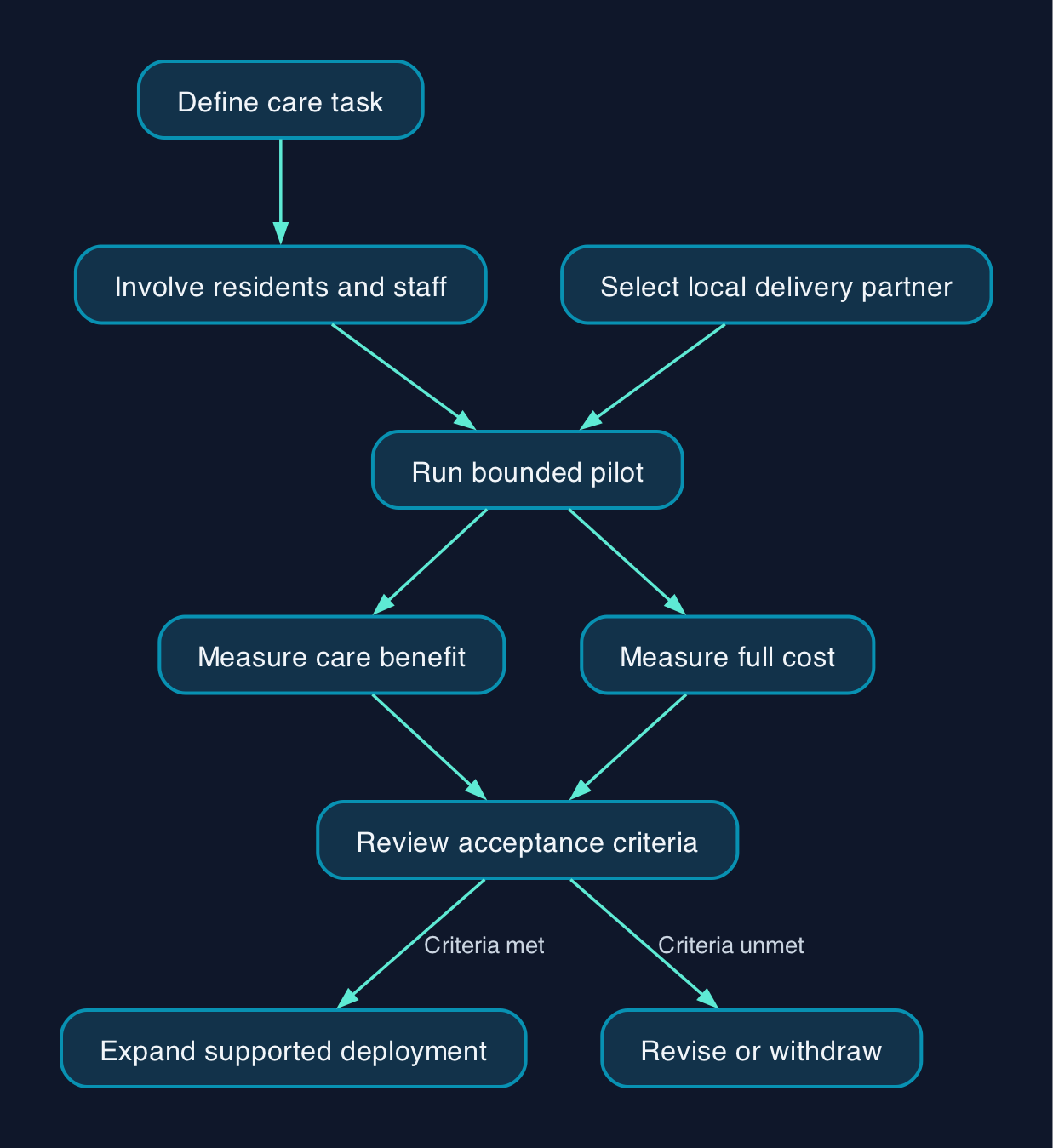
For a small British exporter, my recommendation is a paid, bounded pilot with an agreed decision at its end. The customer should know what evidence would justify renewal, what would trigger withdrawal and who pays to restore the previous workflow.
The strongest objection is that care needs people and funding
The strongest counter-argument is that robotics can absorb scarce money while leaving the underlying care workload intact. A demonstration may work because extra staff are present, equipment has been prepared in advance and failures are handled by the supplier.
The study of nursing care robotics education reinforces the need to investigate cost, discomfort and injury risk. Its small qualitative sample cannot tell a buyer how often those problems occur. It does explain why training and direct experience belong in evaluation.
That objection should change the investment decision. Require evidence from ordinary shifts, include the work the technology creates, and compare against improving existing equipment or processes. Reject products whose economics depend on an unproven reduction in staffing.
A useful device might still justify its cost by reducing physical strain or helping a resident do something independently. Buyers should state that intended benefit explicitly and measure it. Calling every benefit a labour saving weakens the case.
Editorial analysis
Britain should fund and build for repeatable care outcomes that overseas customers will pay to sustain. A successful export programme would produce documented results, maintainable products and local delivery relationships.
The first commitment should therefore be to a specific problem and an accountable customer partnership. Secure a care provider willing to define the baseline, involve residents and staff, and evaluate the result. Expand only when the benefit survives routine use and the full cost is visible.
Ageing could support a substantial British robotics industry. The companies most deserving of backing will be those able to explain exactly whose working day or independence their product improves, and show the evidence.
FAQ
Could ageing become Britain’s biggest robotics export opportunity?
It could, but the supplied evidence does not compare export values across robotics sectors. Japan’s expanded care technology priorities justify investigating the opportunity without treating the superlative as a forecast.
Should a small British company build a complete care robot?
Only if it can fund development, evaluation and continuing support. A narrower product or integration service is worth comparing against a complete machine, using a named customer problem and a realistic delivery budget.
What should a care provider measure during a pilot?
Measure the intended resident benefit, staff effort, failures and the work needed to keep the system operating. Agree acceptance and withdrawal criteria beforehand, including whether existing equipment or changed working practices could achieve the same result.
Does a successful UK pilot prove that a product is ready for Japan?
No, it provides evidence that must be assessed against the intended Japanese setting. Investigate local workflows, language, support and market-entry requirements; the US trade assessment of Japanese medical digitisation also recommends local partnerships, within its specific healthcare IT scope.
Sources
- METI, Priority Fields in the Use of Robot Technology for Long-term Care Revised, 28 June 2024.
- World Health Organization, Japan — a champion for health and well-being at all ages, updated 13 December 2024.
- Ministry of Health, Labour and Welfare, Japan, Policy Recommendations to Bolster Japan’s Healthcare Startup Ecosystem, interim report dated 25 April 2024.
- Nguyen and Saito, Issues in applications of nursing care robots, and in the training of care workers in their use in Japan, 30 April 2025.
- US International Trade Administration, Japan Medical Digital Transformation, 17 September 2024.
- Daily Express US, Inside Japan’s futuristic care homes where robots look after elderly, updated 10 April 2025.
- Japan Care Worker Guide, Cutting-edge nursing technologies that can be experienced in Japan’s regions, Part 1, 1 April 2025.