British data-centre developers should put a funded community proposition into the investment case from the outset. Canada’s Responsible Data Centre Development Principles offer a useful model by connecting local benefits with electricity costs, water use and accountability. My view is that British buyers should start scrutinising those commitments alongside capacity and resilience, while demanding evidence that promised benefits have an owner, a budget and a delivery date.
Key pointers
- Ask developers to identify who receives each proposed local benefit and who pays for it.
- Separate temporary construction employment from permanent operating jobs in every proposal.
- Treat heat reuse as a project requiring a customer, infrastructure and operating responsibilities.
- Ask whether a capacity offer depends on unfinished power infrastructure or unresolved site decisions.
- Compare suppliers through measurable commitments rather than the size of their investment announcements.
- Require a fallback plan for any community benefit that depends on another organisation.
Canada makes the local bargain explicit
Canada’s framework puts a specific question in front of developers. What will the host community receive, and which costs will it avoid inheriting?
The answer extends beyond employment. The principles include local procurement, research partnerships and access to computing resources. They also call for early engagement and independently verifiable reporting of material commitments over time. Those are the framework’s stated expectations, rather than evidence that every signatory has delivered them.
That distinction matters for Britain. My prediction is that a credible community proposition will increasingly become part of how developers compete for support for large sites. I would expect the strongest proposals to explain both the national value of additional computing capacity and the practical consequences for the people living beside it.
A developer promising apprenticeships should identify the training provider and funded places. A proposal offering local computing access should specify eligibility, support and duration. Neither commitment becomes useful merely because it appears in a planning presentation.
What British buyers should take from this
The commercial connection is delivery risk.
The Commons Library’s briefing page says limited grid capacity can mean waiting years for permission to connect. That makes the power assumptions behind a proposed facility relevant to customers choosing where to place future workloads.
My procurement recommendation is to assess community commitments as another part of the site’s delivery plan. A promise dependent on an unidentified heat customer or an unfunded infrastructure partner deserves the same questioning as an uncertain construction milestone.
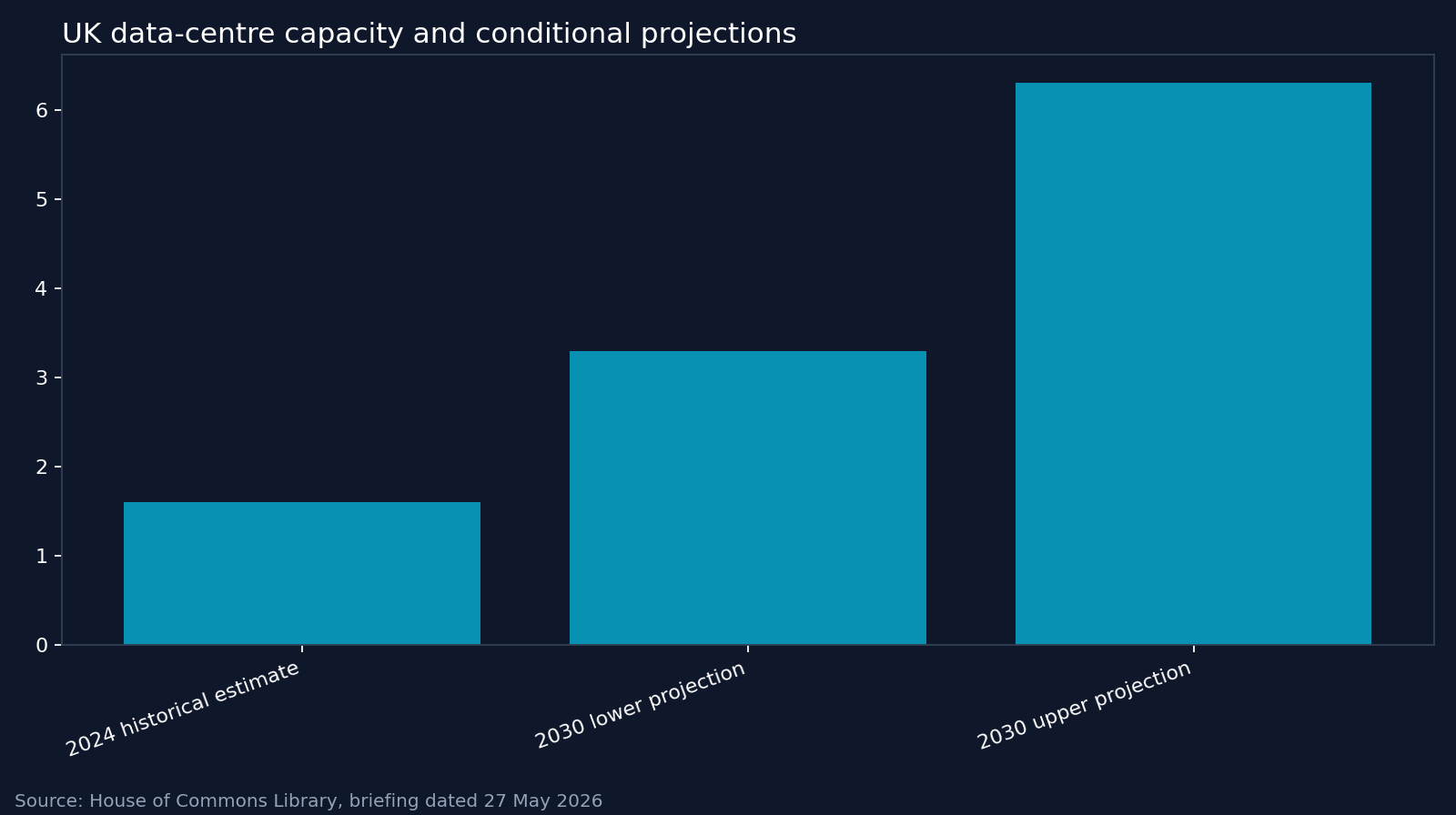
The scale of possible expansion makes that scrutiny worthwhile. The Commons Library’s capacity figures put the historical estimate at 1.6 GW in 2024 and the preliminary 2030 range at 3.3 GW to 6.3 GW. The latter figures are conditional projections, not booked capacity or guaranteed demand.
For a small business buying ordinary hosting, the proportionate response is a short supplier question about dependencies affecting availability or expansion. An enterprise reserving substantial future capacity should seek a fuller explanation of power, construction and local commitments before relying on the promised opening date.
Heat reuse needs a receiving business
Blackpool provides a useful British example of the direction of travel. The Local Government Association’s account describes plans to warm the Sandcastle Water Park and social housing developments, alongside links to local education and skills. The supplied account describes plans; it does not establish completed heat delivery or measured savings.
For a proposed British scheme, I would require the heat offer to identify the receiving buildings, the connection route and the organisation responsible for operating the link.
The developer, heat-network operator and receiving customer should also agree what happens when either side is unavailable. A public building should have an explicit continuity arrangement rather than an assumption that the data centre will always supply usable heat.
Where a workable receiving customer cannot be identified, developers should consider another locally useful commitment. Canada’s principles explicitly include several benefit types, so heat recovery need not become a compulsory centrepiece of every proposal.
Put the community offer into the cost model
A community proposition deserves its own cost schedule within the overall development budget.
For heat reuse, request separate allowances for feasibility work, equipment, connections, maintenance and any backup arrangements. For training, identify recruitment, tuition, supervision and the period of funding. For local computing access, price the capacity, technical support and administration required to make the offer usable.
These are proposed quotation categories. The evidence supplied does not establish comparable project prices, so there is no defensible standard community-benefit premium to add to a British data-centre contract.
Cost allocation also needs discipline. Canada’s electricity principle addresses infrastructure costs directly attributable to a development. I would therefore ask bidders to distinguish essential project infrastructure from additional community benefits. Counting the same expenditure in both categories would obscure what residents actually gain.
Buyers should ask whether these commitments are included in the offered commercial terms, remain conditional on another party, or could generate later charges.
Compare commitments across different suppliers
The Canadian framework’s signatory statements illustrate different emphases. AWS points to workforce development, energy procurement and operations. Equinix highlights investment and employment. eStruxture emphasises community benefits, electricity affordability and environmental impacts.
Those statements establish the suppliers’ positions. They do not provide a comparable assessment of completed outcomes.
British buyers should apply the same questions to those companies and to UK providers. Which commitment applies to the particular facility? Who benefits? What is funded? Who reports progress? What happens if the undertaking is missed?
A local provider should face the same evidence standard as an international group. Equally, a smaller investment announcement should not count against a supplier whose narrower commitment is funded and deliverable.
The strongest objection is that this adds cost and delay
The strongest counterargument is that developers already have to deliver expensive infrastructure, and a growing list of local expectations could make projects harder to finance. British businesses seeking additional capacity have reason to resist requirements that are open-ended or unrelated to a site’s impact.
That objection should determine the design of the proposition.
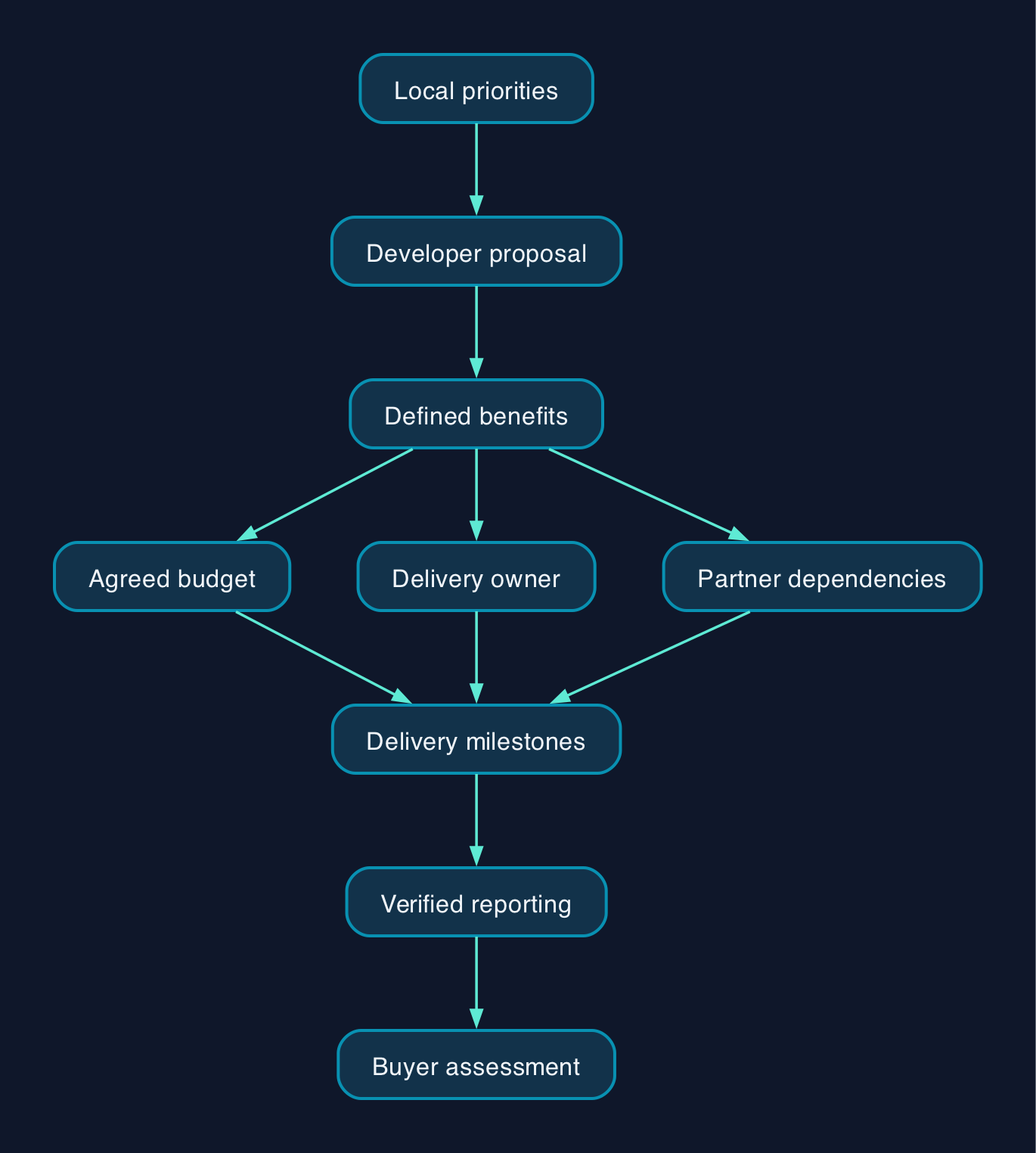
I favour a bounded set of commitments agreed early, with a named beneficiary, delivery owner, budget and acceptance measure. Buyers and communities should reject vague promises, but they should also avoid treating every development as the funding source for every local priority.
The case for this approach is predictability. A defined commitment can be assessed during investment approval. An unresolved expectation remains something the developer and community may dispute later.
The supplied evidence does not demonstrate that community packages shorten British approval times or lower financing costs. My argument is narrower. Making responsibilities explicit gives investors, customers and residents a clearer proposition to assess.
Editorial analysis
The most consequential part of Canada’s framework is its expectation that commitments remain measurable after the announcement.
British procurement teams should borrow that discipline. Ask for a schedule showing the beneficiary, funding, responsible organisation, delivery milestone and reporting method for each material promise. Where delivery depends on another party, require that dependency to be visible.
My forecast is that community propositions will become more commercially significant as developers seek support for additional capacity. The useful test for British technology leaders is whether the local offer is sufficiently concrete to survive a change of project manager, owner or customer.
FAQ
Does Canada’s framework create a new requirement for British buyers?
The Canadian principles describe a framework for development in Canada. This article uses them as a procurement model and a signal of possible change, not as evidence of a new British obligation.
Should every British data centre promise heat reuse?
My view is that a proposal should first establish a viable receiving customer, operating responsibilities and a funded connection. The Blackpool example identifies planned recipients, but the supplied evidence does not establish that the scheme is already delivering heat.
What should a small business ask its hosting supplier?
Ask whether the capacity being offered is operational or depends on a future development, and what could affect its delivery date. The Commons Library identifies grid-connection delays as a constraint, making power dependencies a useful starting point.
Can a community proposition guarantee local support?
The evidence supplied establishes no such guarantee. I would assess a proposition by the specificity and credibility of its commitments, while accepting that residents may still oppose a development on other grounds.
Sources
- Innovation, Science and Economic Development Canada — Canada’s Responsible Data Centre Development Principles.
- House of Commons Library — Data centres, planning policy, sustainability and resilience, research briefing dated 27 May 2026.
- House of Commons Library — Data centres, planning policy, sustainability and resilience, briefing webpage.
- Local Government Association — Local government response to the sustainability of data centres in the UK.