Nuclear should borrow manufacturing’s discipline of repeat orders, controlled designs and traceable components. British technology companies should prepare to support that shift, while demanding evidence that repetition actually reduces costs. Canada’s Darlington project offers a concrete test, with one small modular reactor under construction. The opportunity depends on carrying learning into subsequent units without letting design changes, financing costs and site work consume the savings.
Key pointers
- Ask which components and construction processes will remain identical across successive reactors.
- Separate first-unit expenditure, shared infrastructure and expected repeat-unit savings.
- Treat future reactor orders as a commercial dependency when considering dedicated factory capacity.
- Require component records to connect the approved design, manufacturing checks and installed equipment.
- Compare reactor designers, engineering partners and constructors within their respective roles.
- Keep anticipated nuclear savings out of British electricity budgets until credible supply terms exist.
Canada is testing whether the second reactor becomes a different business
Darlington matters because its planned sequence creates an opportunity to repeat work. A first unit can establish procedures, expose awkward interfaces and train suppliers. Subsequent units could benefit, provided the programme preserves enough of the design and delivery team to use those lessons.
That is the manufacturing proposition. Its success should be measured through repeatable work packages, fewer defects and shorter production cycles, rather than the number of components described as modular.
The Canadian Nuclear Safety Commission’s record establishes construction progress. It does not establish a realised saving from serial production. British buyers should keep that distinction at the centre of their assessment.
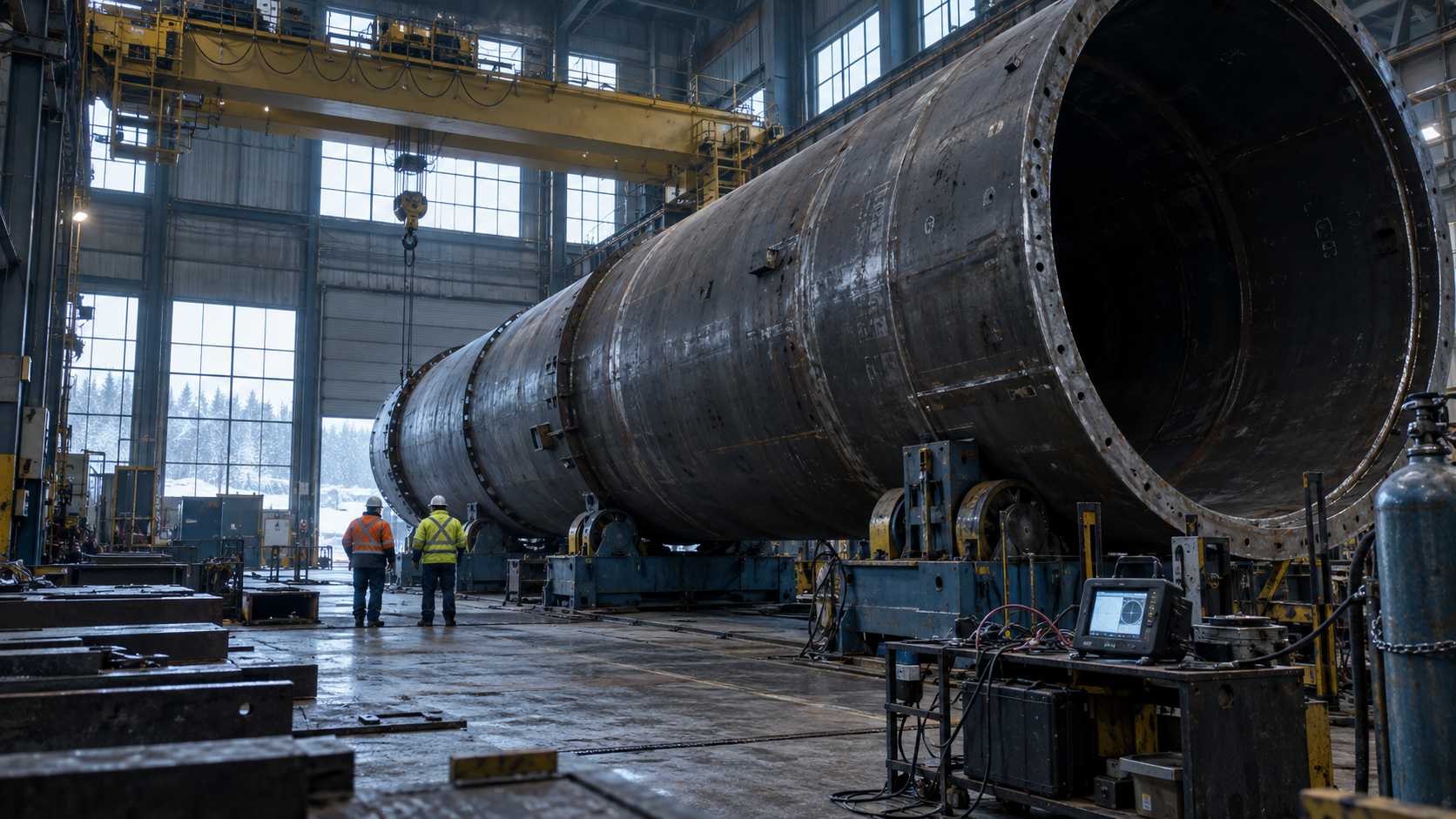
Nor should “factory-made” suggest that a complete nuclear station arrives ready to connect. Darlington’s foundation hold point is a concrete reminder that significant site construction remains. My position is that manufacturing can change how nuclear projects organise and reproduce work, while civil engineering remains a substantial part of delivery.
British technology firms should follow the component record
For a British engineering software company or specialist manufacturer, the useful question is where repeat delivery creates a recurring customer need.
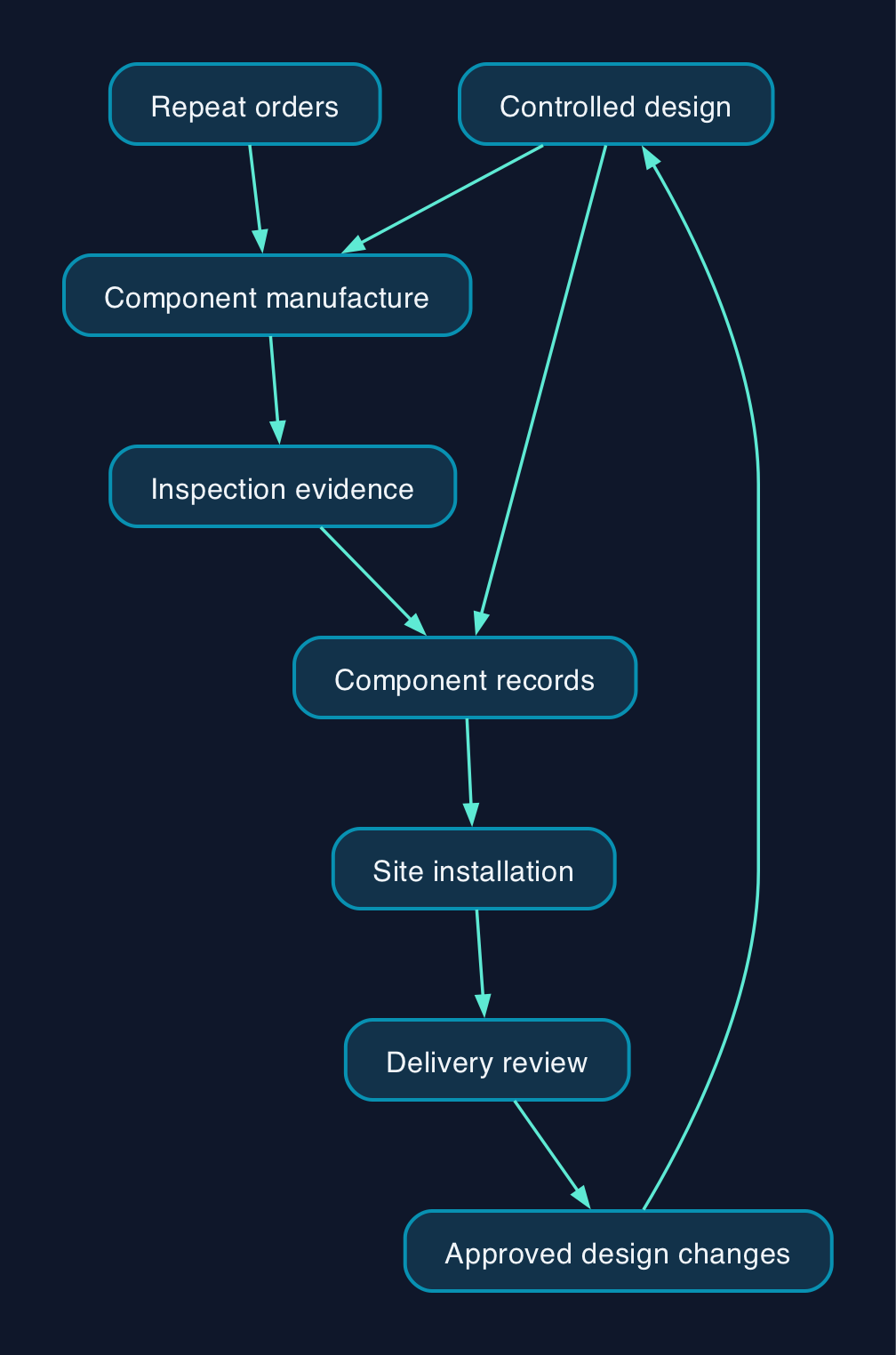
Consider an illustrative component record. It would connect an approved drawing revision to the material supplied, the inspections performed, any accepted deviations and the equipment eventually installed. When the design changes, the operator should be able to identify which components and records need review.
This is a proposed workflow, not a claim about Darlington’s installed software.
There is evidence that the underlying disciplines matter. The US Nuclear Regulatory Commission’s BWRX-300 review register includes submissions on advanced civil construction, structural design and quality assurance. GE Vernova Hitachi’s UK library similarly separates construction and commissioning from management for safety and quality assurance.
The commercial opportunity I see is helping suppliers maintain those connections across repeated orders. A smaller British firm could start with a bounded service, such as inspection-record reconciliation or controlled document exchange, rather than attempting to replace an operator’s entire engineering system.
The acceptance test should be practical. Can the customer retrieve the correct record for an installed component, identify who approved it and export it when the software contract ends? A convincing demonstration would be more useful than a speculative claim about fleet-wide savings.
The cost model still looks like a major infrastructure project
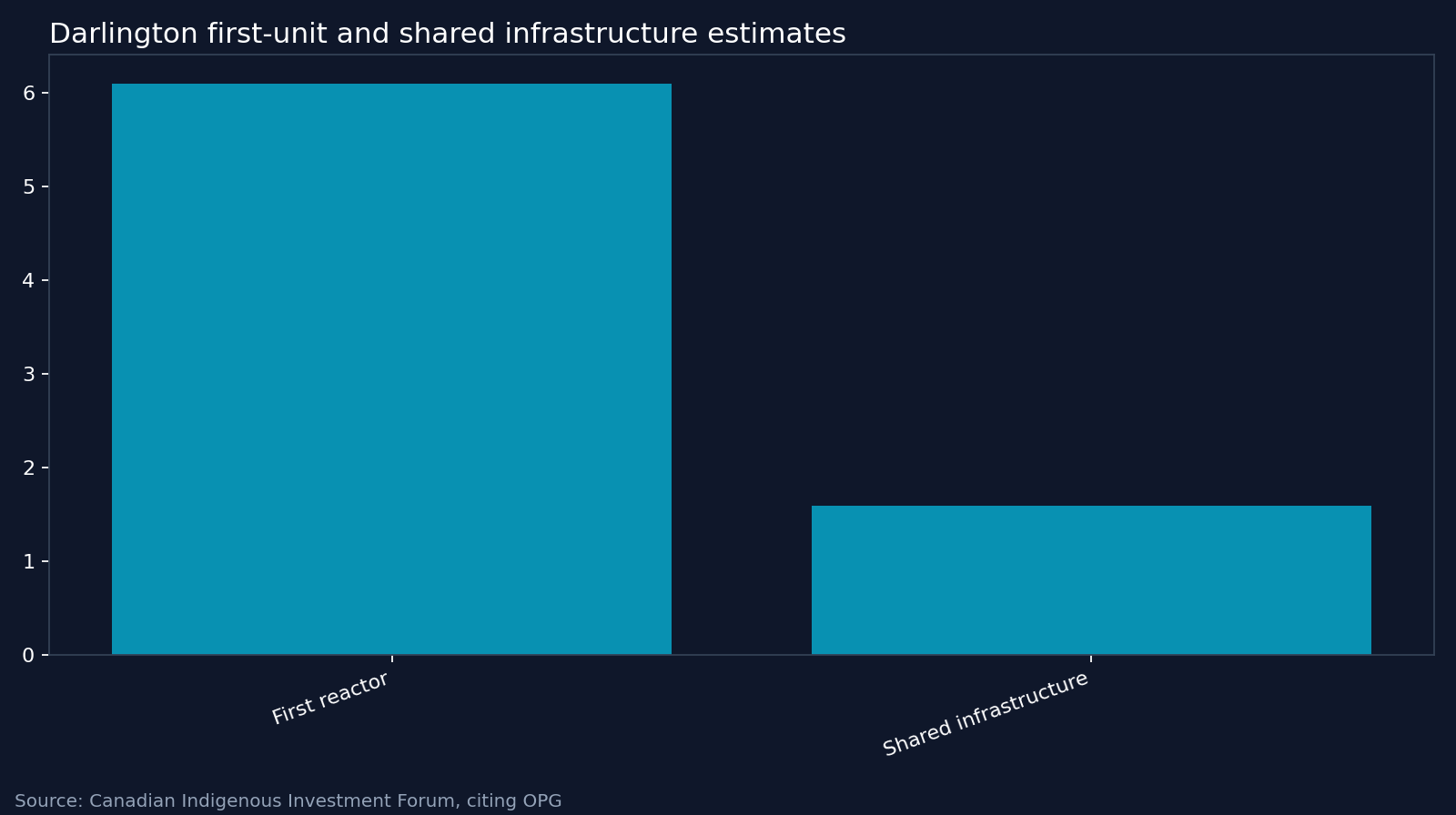
The supplied cost breakdown puts the first reactor at C$6.1 billion and infrastructure shared across the planned units at C$1.6 billion. Together, those form a C$7.7 billion estimate for the first unit and common infrastructure. The four-unit programme estimate is C$20.9 billion, including interest, escalation and contingency, according to the Canadian Indigenous Investment Forum’s fact sheet, which attributes the figures to OPG.
These are Canadian project estimates, not a British supplier quotation or an electricity tariff. The supplied breakdown does not establish a comparable final cost for each subsequent reactor.
For procurement teams, the important distinction is between three possible sources of savings.
Shared infrastructure spreads an initial expense across more units. Repeated manufacturing could reduce the work needed for each component. Faster delivery could reduce financing exposure. A proposal should explain each mechanism separately, with its assumptions, rather than presenting a single unsupported discount for “scale”.
British suppliers should also price their own exposure. Qualification work, tooling, training, record retention and maintaining specialist staff belong in the business case. An attractive margin on repeat orders means little if those orders never become firm commitments.
The strongest objection is that factories need dependable orders
The strongest counterargument is commercial. A supplier can invest in repeat production and still face a succession of projects with different requirements, uncertain schedules and changing designs. Without dependable orders, dedicated capacity could become an additional cost.
Darlington also retains project-specific approval gates. Its construction licence covers one reactor, and the regulator records a separate operating-licence application. Replication has not removed those decisions.
That objection should shape the manufacturing model. Buyers should seek evidence that a common design will survive procurement, that variations have accountable owners and that cancellation risks are allocated explicitly. Suppliers should be able to explain which investments depend on later units proceeding.
The test is demanding but clear. If subsequent units require less rework and more predictable delivery under comparable accounting, the manufacturing argument gains substance. If savings depend mainly on omitting shared costs or assuming an uninterrupted order book, it remains a forecast.
Compare delivery models before choosing a reactor brand
The same questions should be put to GE Vernova Hitachi’s BWRX-300, Rolls-Royce SMR, Holtec’s SMR-300 and Westinghouse’s AP300. A December 2025 overview of British design assessments identifies these designs at different stages; it does not provide a comparable record of completed costs or serial delivery.
That limits any responsible ranking here. British buyers should compare design stability, the scope of factory production, retained site work, supplier qualification and responsibility for changes. They should request evidence against the same criteria from each bidder.
A reactor designer’s offer also needs separating from the engineering partner’s and constructor’s scope. A standard component cannot deliver a predictable project if nobody owns the interface between its factory specification and installation on site.
For technology suppliers, the parallel choice is whether to serve one reactor programme closely or build tools that support several customers. Specialisation may simplify the first implementation. Serving several programmes may reduce dependence on one order book, but only if customer requirements are sufficiently compatible.
Editorial analysis
Britain should prepare for a nuclear supply chain in which repeatability becomes a purchased service.
The valuable deliverable could be a component accompanied by complete, usable evidence of what was made and checked. Software, manufacturing expertise and quality management would then be part of the same commercial offer.
That is a worthwhile direction for British companies to explore through small, paid assignments. It does not require them to assume that small modular reactors have already solved nuclear economics. Darlington’s later units must earn that conclusion.
FAQ
Does Darlington prove that modular nuclear is cheaper?
No. The regulator records one unit under construction, which cannot establish the achieved economics of repeated completed units. The useful comparison will require consistent cost boundaries and evidence from subsequent delivery.
What could a smaller British technology company sell?
A sensible starting point is a tightly defined service connecting engineering changes, inspection evidence and component records. This is an editorial recommendation, not a verified Darlington procurement opportunity. Test it with a paying customer before funding a dedicated product.
Does a standard reactor design remove local construction work?
Darlington demonstrates that substantial site work remains, including a regulatory hold point for the reactor building foundation. Buyers should require bidders to identify precisely which work moves into factories and which remains on site.
Should British businesses expect cheaper electricity from this model?
The supplied evidence does not establish a British electricity price or a saving for business customers. Treat cheaper power as a possible outcome to investigate, while basing investment decisions on credible connection dates, contracts and available supply.
Sources
- Canadian Nuclear Safety Commission — Darlington New Nuclear Project
- Canadian Nuclear Safety Commission — Construction authorisation for one BWRX-300 reactor, 4 April 2025
- GE Vernova Hitachi — BWRX-300 UK document library
- US Nuclear Regulatory Commission — GVH BWRX-300 review register, updated 15 September 2026
- Canadian Indigenous Investment Forum — Darlington Small Modular Reactors project fact sheet
- World Nuclear News — GE Vernova Hitachi SMR design clears key UK regulatory stage, 11 December 2025