The best business software may make government websites invisible
Business software could take routine government administration out of the working day. Estonia's Aruait project shows why that future depends on bounded authority, verifiable outcomes and a route back to a human.


Business software should make routine government administration disappear from the working day, while keeping permissions and decisions visible. Estonia’s Aruait project points towards that future by developing foundations for agents acting on people’s behalf. British buyers should favour software that completes authorised tasks and proves the outcome. The condition is accountability, with clear limits, recoverable mistakes and a human route when automation reaches its boundary.
Key pointers
- Ask suppliers which administrative tasks their software can complete through supported government interfaces.
- Require a demonstration of how authority is granted, restricted and withdrawn.
- Judge completion by the government’s recorded outcome, rather than the assistant’s success message.
- Keep a human approval step for ambiguous information and consequential decisions.
- Compare integration, exception handling and exit costs alongside subscription fees.
- Preserve direct access to public services when commercial software fails.
Estonia is working on permission to act
Aruait’s most useful proposition is a framework through which businesses could authorise software to deal with government. RIA proposes authority that is limited, auditable and revocable, alongside a registry for verifying public and private agents. Its ambition includes agents communicating and completing tasks together. These are planned foundations, not evidence of a service businesses can buy today.
That distinction matters to British technology leaders. A demonstration can show software navigating an application. A dependable administrative service must establish whose application it is, what the software may submit and how the business stops it.
Estonia’s project also exposes the unresolved work. The launch summary, prepared with AI assistance and revised by its project manager, records uncertainty about the scope of autonomy, error liability and the role of private companies. It provides evidence of an active design problem, not a settled accountability model.
My position is that Britain should take that problem seriously before procurement teams start treating an AI assistant as an authorised representative.
Britain already has part of the mechanism
For UK businesses, the idea of handling administration inside commercial software is already concrete. HMRC’s VAT API, an application programming interface through which software communicates with HMRC, supports both submissions and retrieval of account information.
The next opportunity is to connect preparation, permission, submission and confirmation into a coherent workflow. A small business should be able to see what remains unfinished without reconstructing events across an accounting application, an email inbox and a government portal.
Consider a hypothetical building contractor. Its software could assemble the records for a supported submission, identify missing information and present the proposed action for approval. After submission, it should retrieve the relevant government record and show the owner what happened. This is a proposed design, not a claim that a named product already completes that sequence.
There is also an important vocabulary trap. The “agent” in HMRC’s Agent Authorisation API means a tax agent acting for a client. The existence of that interface does not establish a general identity or mandate for autonomous AI.
UK permissions still set the boundary
Software access and authority to act must remain explicit. HMRC’s user-restricted access guidance requires permission from the end user and says its authorisation journey must not be changed or bypassed.
Some administrative steps also remain outside the available interfaces. HMRC’s Income Tax preparation guide rules out API sign-up for security reasons and prohibits robotic process automation for signing up clients. An assistant’s ability to operate a browser does not remove that restriction.
Automation does not automatically transfer responsibility either. HMRC’s integration guidance expressly contemplates automated quarterly updates, while stating that customers remain legally responsible for meeting their quarterly obligations and that safeguards are expected.
This is not legal advice; consult your legal counsel.
What a trustworthy invisible service would do
I would require a supplier to demonstrate the whole transaction, including its stopping points.
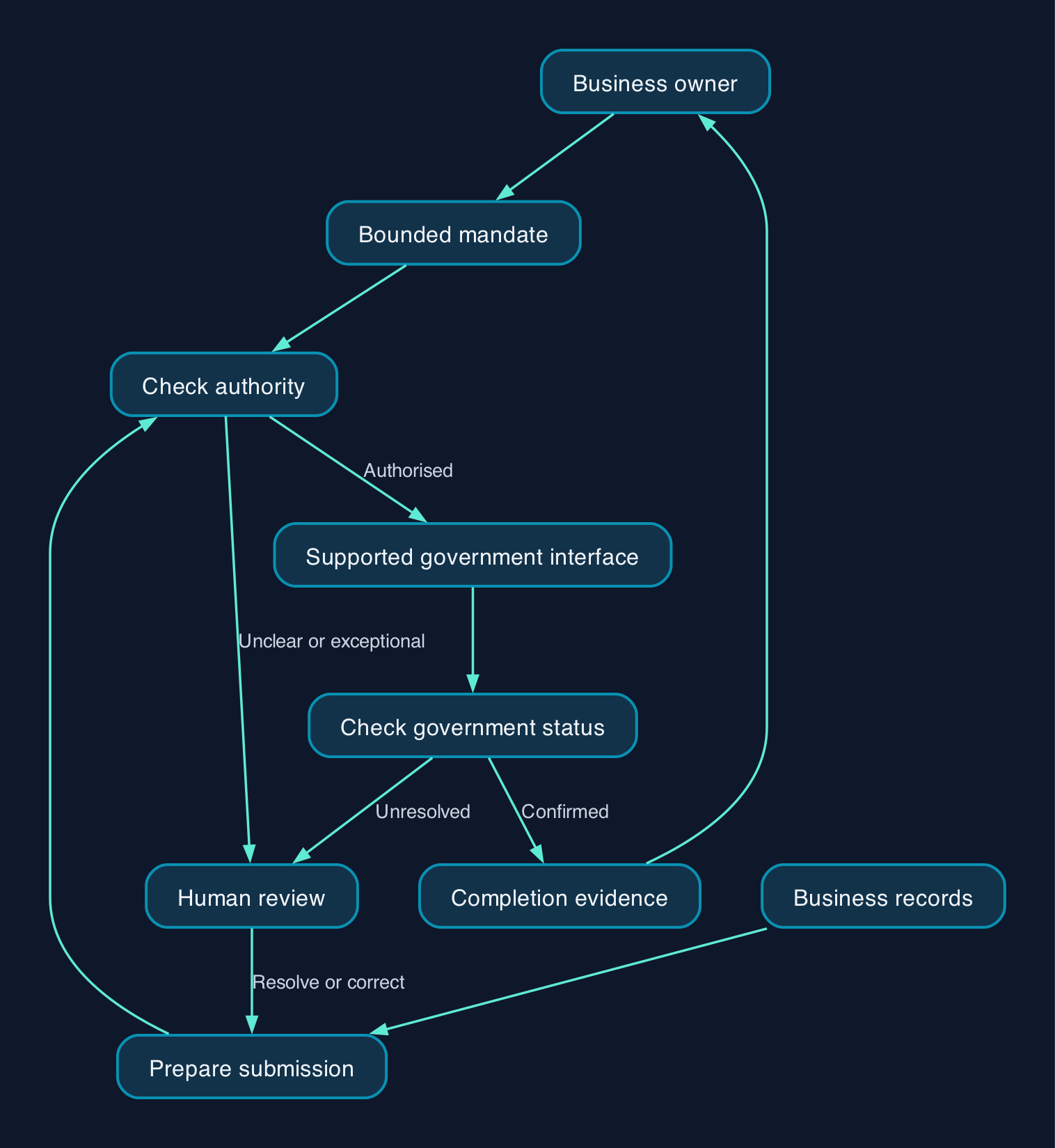
The business owner grants a bounded mandate. The business application prepares the submission from its records. A permission check determines whether the proposed action falls within that mandate. Unclear or exceptional cases go to a named person. Authorised actions pass through the supported government interface, and the application checks the resulting status before recording completion.
The owner should then be able to inspect the submitted information, the authority used and the response. Withdrawal of authority should stop future actions without erasing the history needed to investigate earlier ones.
This is a proposed purchasing standard. Aruait’s limited and revocable authority model supplies part of the reasoning; it does not establish that every component of this workflow has been delivered.
For a business with no internal IT team, the supplier should also name who handles an expired permission, a rejected submission or an unavailable government service. An unattended task still needs an accountable operator.
Buy completed work rather than promised autonomy
I would judge Sage, Xero, Zoho and specialist UK providers against the same questions about supported submissions, approval controls, evidence and recovery. The available evidence does not support ranking their current agent capabilities.
The more useful comparison today is between delivery approaches. HMRC’s software selection guidance recognises software that creates digital records, bridging software that connects existing records, and combinations of products that work together.
For a small business whose records already work well, I would first investigate a supported connection before replacing its accounting system. An integrated product becomes more attractive when maintaining the connections creates substantial work. An accountant-managed approach deserves consideration when judgement and exception handling consume more time than data transfer.
An open-source or bespoke approach should face the same acceptance test. Access to source code cannot substitute for someone maintaining the government connection, monitoring failures and supporting the business.
The commercial test should cover setup, record cleanup, integration maintenance, staff training, supervision, support and export on departure. No supplied evidence establishes a price or measured saving for an Aruait-style service, so a return-on-investment claim would be premature.
Instead, ask a supplier to measure a pilot against the existing process. Count staff time, unresolved exceptions, corrections and confirmed completions. A cheaper subscription is a poor bargain if the owner spends Friday afternoon finding out whether Tuesday’s submission happened.
The strongest objection is that invisible administration hides mistakes
The strongest case against this future is that removing the portal also removes a moment of scrutiny. A business owner might stop seeing the declaration, the missing document or the decision being made in their name. A commercial intermediary could become the only practical route to a public service.
That objection should determine the design. It is a reason to retain visible mandates, decision records and direct routes to correction. Public access should remain available to people who cannot use, cannot afford or do not trust the intermediary.
The Estonian launch discussion offers a useful warning. Its summary records support for explainable decision paths and concern about relying on probabilistic language-model reasoning for consequential state decisions. That is a reported design position, not proof that an alternative architecture has solved the problem.
My answer is selective autonomy. Let software complete tightly bounded, supported tasks. Require human intervention where authority, evidence or interpretation is uncertain. Measure how reliably the system recognises those boundaries.
Editorial analysis
The prize for UK software companies is ownership of a useful administrative workflow. A product earns that role when it can explain what it has done, show the government’s response and help the customer correct an error.
Procurement teams should therefore ask for an exception demonstration alongside the happy path. Withdraw permission halfway through a test. Present an incomplete record. Make the receiving service unavailable. See whether the application stops, preserves evidence and directs the right person to the problem.
I would back software that passes those tests over a more fluent assistant with broader promises. Government websites may eventually disappear from many routine working days. The business owner’s ability to understand and control what happened must remain.
FAQ
Is Estonia already running autonomous public administration through Aruait?
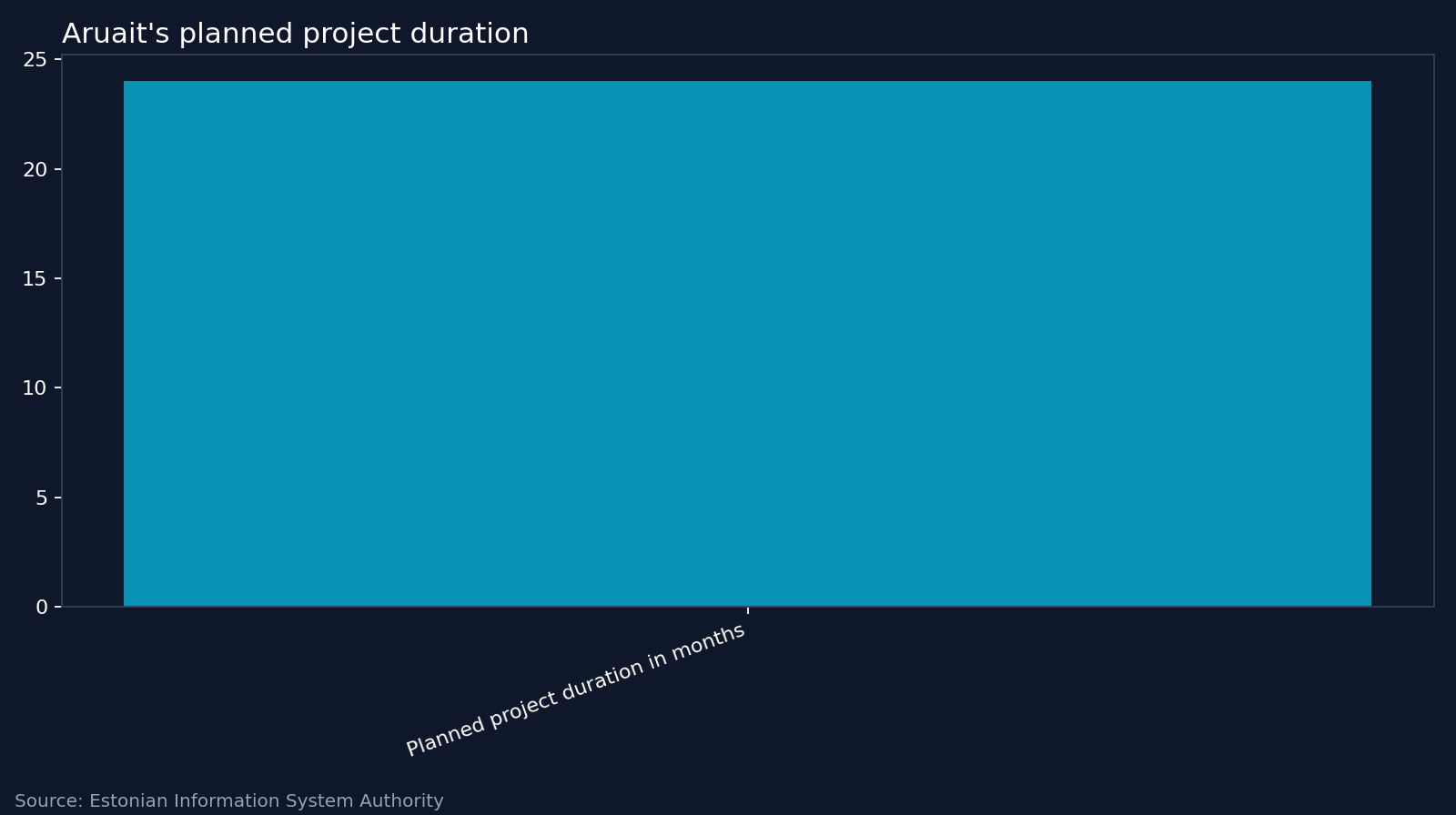
Aruait is an innovation project developing the foundations and a working pilot. Its launch summary explicitly says the project is not intended to deliver production-ready services within two years.
Can UK software already submit information to HMRC?
Yes, for supported services. The VAT API supports submitting and viewing returns, among other functions. That capability does not mean software can automate every HMRC process.
Could an AI assistant remove every government login?
That is not supported by the current evidence. HMRC requires users to follow its authorisation journey, and its Income Tax sign-up guidance excludes API sign-up. Buyers should ask which steps remain manual.
Should a small business replace its accounting software now?
I would start by checking whether its existing records and software can support the required workflow. HMRC recognises bridging software and combinations of compatible products. Replace the system when the demonstrated reduction in work justifies migration, training and ongoing support costs.
Sources
- RIA — Reason Reserve / Aruait, updated 28 August 2026; accessed 28 September 2026.
- RIA — Aruait launch event summary, event held 12 June 2026; accessed 28 September 2026.
- HMRC — VAT (MTD) API, updated 5 August 2026; accessed 28 September 2026.
- HMRC — Agent Authorisation API, updated 17 September 2026; accessed 28 September 2026.
- HMRC — User-restricted endpoints, accessed 28 September 2026.
- HMRC — Customers and agents preparing for Making Tax Digital for Income Tax, accessed 28 September 2026.
- HMRC — How to integrate with Income Tax APIs, accessed 28 September 2026.
- HMRC — Choose the right software for Making Tax Digital for Income Tax, updated 13 July 2026; accessed 28 September 2026.