Ageing could make assistive robotics a mainstream home technology
Assistive robotics could become a mainstream home technology category. British businesses should test specific tasks, compare conventional equipment and price the continuing responsibility for support.

Assistive robotics deserves a place in British companies’ plans for home technology, with investment tied to a specific task and a dependable support service. My view is that installation, maintenance and human response will determine whether it becomes mainstream. Japan’s expanded care-technology priorities offer a direction worth studying, but they do not establish that robots can already extend independent living in British homes.
Key pointers
- Start with a task someone wants help completing, such as moving between rooms or contacting a carer.
- Compare robotic assistance with conventional equipment and changes to the home.
- Identify who pays, who uses the device and who responds when it fails.
- Require suppliers to distinguish supervised rehabilitation from equipment intended for everyday home use.
- Include assessment, installation, training, maintenance and replacement in the business case.
- Make continued use and the resident’s experience conditions for expanding a pilot.
Japan offers a direction for British businesses
The most useful detail in Japan’s announcement is the change of scope. Its ministries placed robotics alongside other technologies intended to improve care quality, reduce the burden on carers and support older people’s independence. The revised definitions also explicitly include monitoring and communication at home. The policy describes these aims and settings.
British technology leaders should read that as an invitation to organise products around daily activities. Walking to the bathroom, transferring from a chair and contacting someone for help are different problems. Each deserves its own assessment, equipment and acceptance test.
My prediction is that assistive robotics could become a familiar category through these narrow uses. A household might buy support for a particular movement or routine without wanting a general-purpose robot.
However, the evidence supplied here does not establish how much longer robotic mobility support keeps people at home, or what British households would pay for it. Those are the commercial questions a pilot must answer. A policy programme is evidence of public priorities, not proof of household demand.
The service must reach beyond the device
For a British installer or managed technology business, I would begin with a proposed service that has a named owner at every stage.
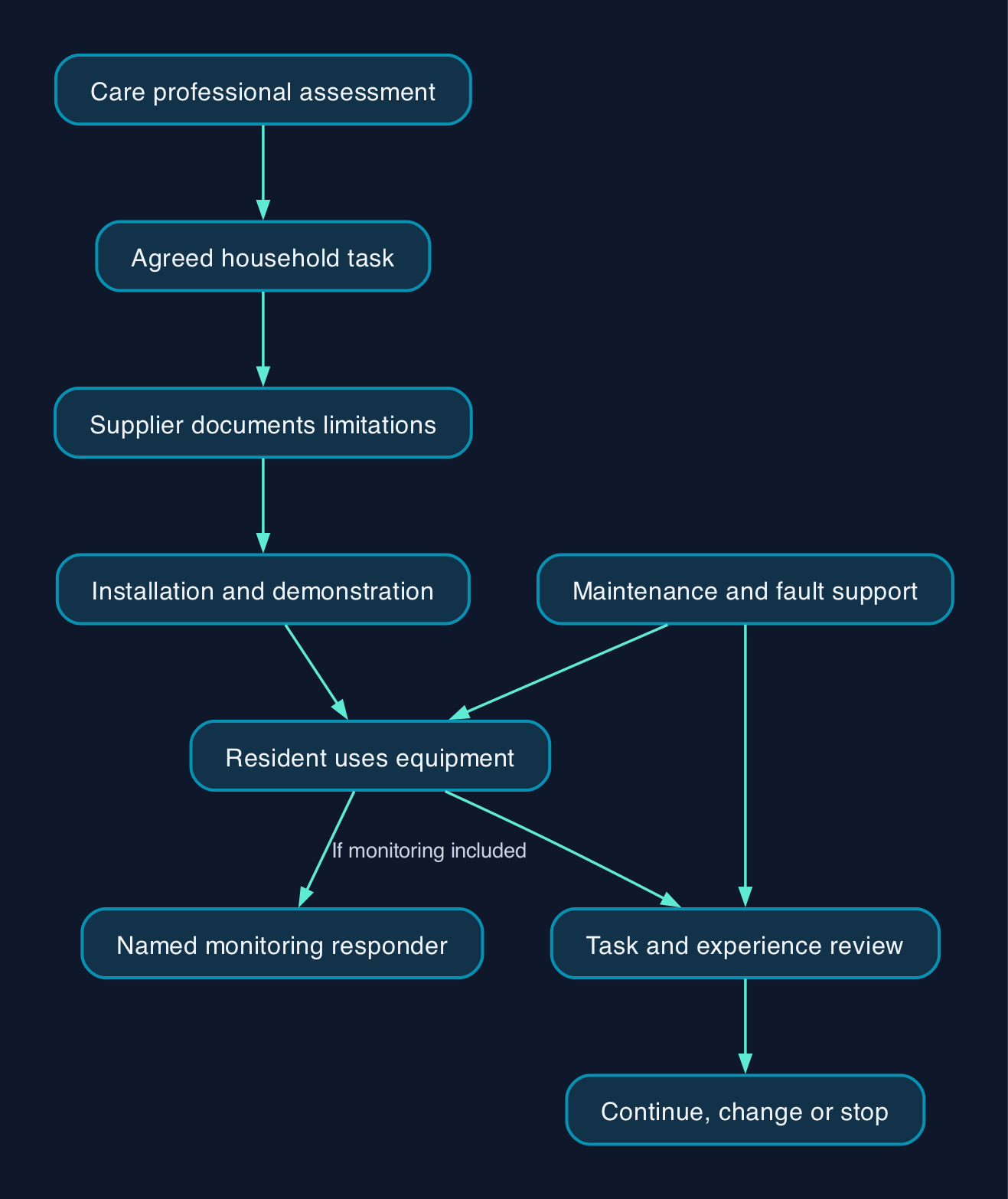
A care professional assesses the task and the person’s needs. The equipment supplier documents intended use and limitations. An installer checks the home and demonstrates operation. A support provider handles maintenance and faults. Where monitoring is included, a named responder accepts responsibility for acting on alerts.
That division should be written into the offer before equipment arrives. Remote technical support and physical assistance need separate commitments, even when they share a customer contact number.
There is already a useful British example of that distinction. Barnsley describes what follows an alarm, including checking with the resident, contacting a nominated person and arranging a response if that contact cannot be reached. It also includes fitting and demonstration. Its telecare description connects equipment to a response process.
That does not demonstrate a robotic mobility service. It does show the level of operational detail I would expect a future home-robotics proposal to match.
Price the continuing responsibility
The commercial test should include the cost of keeping assistance available throughout the contract.
For a proposed robotic mobility service, request separate figures for assessment, equipment purchase or rental, installation, training, maintenance, consumables, connectivity where required, replacement equipment and collection at exit. Identify which party pays for additional visits when the resident’s needs change.
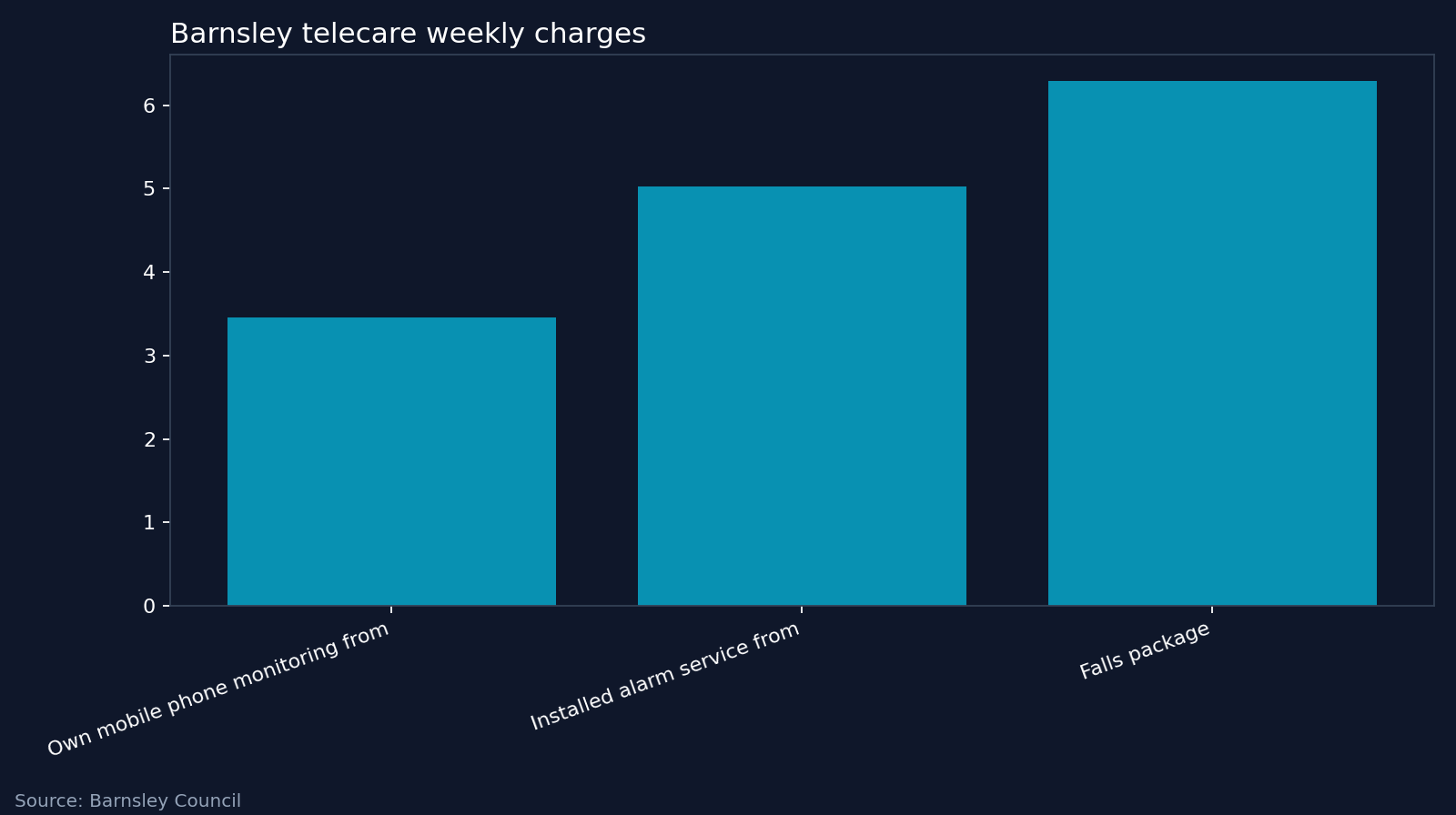
As a benchmark for an existing monitored service, the supplied Barnsley pricing page lists:
- Monitoring through the user’s own mobile phone from £3.46 per week.
- An installed alarm service for one person from £5.03 per week.
- A falls package at £6.29 per week.
These are GBP weekly charges in the evidence supplied for 28 September 2026. The council states that installation and equipment maintenance carry no extra charge; the extract does not specify VAT treatment or minimum commitment.
These prices describe telecare, not robotic physical assistance. Their value to a business case is the charging model and stated service scope. They cannot support a forecast of robot prices or savings from reduced care.
For a small business entering this market, my preference would be a bounded installation and support contract alongside an experienced care provider. Taking responsibility for physical assistance or emergency response requires a different operating model from maintaining connected equipment.
Compare the job before comparing suppliers
The available options illustrate why a single ranking would mislead buyers.
For conventional mobility equipment, CareCo lists rollators, wheelchairs, bath lifts and mobility scooters, alongside a showroom network. These provide a comparison point for the proposed task. A robotics pilot should explain what additional benefit it expects over suitable existing equipment.
For reminders and remote contact, GenieConnect describes a purpose-built companion and care platform. Its stated functions address communication and routines. That description is not evidence of physical mobility assistance.
For robotic rehabilitation, Thor Assistive Technologies describes UK distribution, training, maintenance and after-care services. Its offering concerns rehabilitation equipment and facilities; that does not establish suitability for unsupervised use in someone’s home.
These are different delivery approaches, with different users and responsibilities. The comparison should ask whether the need is movement, rehabilitation, communication or emergency response before considering a supplier shortlist. Manufacturer-confirmed intended use, home suitability and support terms remain necessary for any particular device.
The strongest objection is that households may reject the proposition
The strongest counterargument is straightforward. A device can work in a demonstration and still fail to justify its cost or place in someone’s home.
A Japanese study published in April 2025 offers a limited but relevant warning. Seven students experienced care technologies and completed questionnaires; their responses raised cost, discomfort and injury concerns. Its small qualitative design supports taking those issues seriously, not estimating how often they occur among older users. The study explains its methods and limitations.
My answer is to make rejection an acceptable pilot outcome. Give the resident a clear way to decline the equipment. Ask whether it helps with the chosen activity, whether setup creates extra work and whether the person wants to continue using it.
A credible pilot should also compare the proposed device with an appropriate conventional option. If simpler equipment delivers the required assistance with less disruption, the supplier should recommend it.
Ageing may strengthen the reason to investigate robotics. It cannot settle comfort, affordability, suitability or willingness to use a particular machine.
Editorial analysis
British companies should prepare to sell a supported outcome, with evidence attached to a specific task.
Before expanding a pilot, I would require an agreed assessment of task completion, resident experience, assistance still needed, service interruptions and total support cost. Claims about extending independent living would need longer-term evidence beyond those initial measures.
This leaves room for a substantial home technology category without assuming that every older person needs a robot. The opportunity is strongest where a device earns its place in the household and a provider accepts responsibility for keeping it useful.
FAQ
Are robotic mobility devices ready for mainstream British homes?
The supplied evidence does not establish readiness across that category. It shows Japanese policy support and a UK supplier describing robotic rehabilitation services, but rehabilitation provision does not itself demonstrate suitability for unsupervised home use.
What could a small British technology business offer?
A sensible starting point would be installation, training and technical maintenance within a clearly defined care partnership. The proposal should state who assesses suitability and who provides physical assistance or responds to an emergency.
Does telecare count as robotic mobility support?
No, an alarm and monitoring service does not provide physical movement assistance. Barnsley’s service is relevant because it describes the human response behind connected equipment, a responsibility future robotics services must also address where applicable.
What would justify expanding a pilot?
Expansion should depend on the resident wanting to continue, the chosen task becoming easier and the support costs remaining acceptable. A successful demonstration alone would not justify a claim that the equipment delays residential care or reduces staffing needs.
Sources
- METI and MHLW — Priority Fields in the Use of Robot Technology for Long-term Care Revised, published 28 June 2024.
- Frontiers in Medicine — Issues in applications of nursing care robots, and in the training of care workers in their use in Japan, publication date displayed in the supplied article as 30 April 2025.
- Barnsley Council — Assistive living technology, undated page, supplied extract dated 28 September 2026.
- GenieConnect — Remote care technology for independent living, undated page, supplied extract dated 10 November 2025.
- CareCo — Mobility equipment and UK showrooms, undated page, supplied extract dated 28 September 2026.
- Thor Assistive Technologies — Robotic rehabilitation equipment and support, undated page, supplied extract dated 28 September 2026.