
Private 5G becomes affordable when the operational problem it solves is worth more than the complete network costs. UK managed-service offers include indicative pricing of £500 to £5,000 per month with a 12-month rolling commitment. That does not establish an affordable industrial deployment for every warehouse. For smaller businesses, the decision should turn on measured disruption, compatible equipment and a site-specific quotation, rather than a predicted year when prices finally fall.
What affordability means for a UK warehouse or factory
There is no defensible date when private 5G will become cheap enough for all UK industrial sites. The available evidence contains product descriptions and indicative commercial offers, but no comparable UK price series establishing when costs will cross a universal threshold.
CTC’s assessment is that the buying trigger should be a costly, measured connectivity problem. A warehouse with repeated interruptions to moving equipment has a different business case from a warehouse whose staff simply need more reliable tablet access.
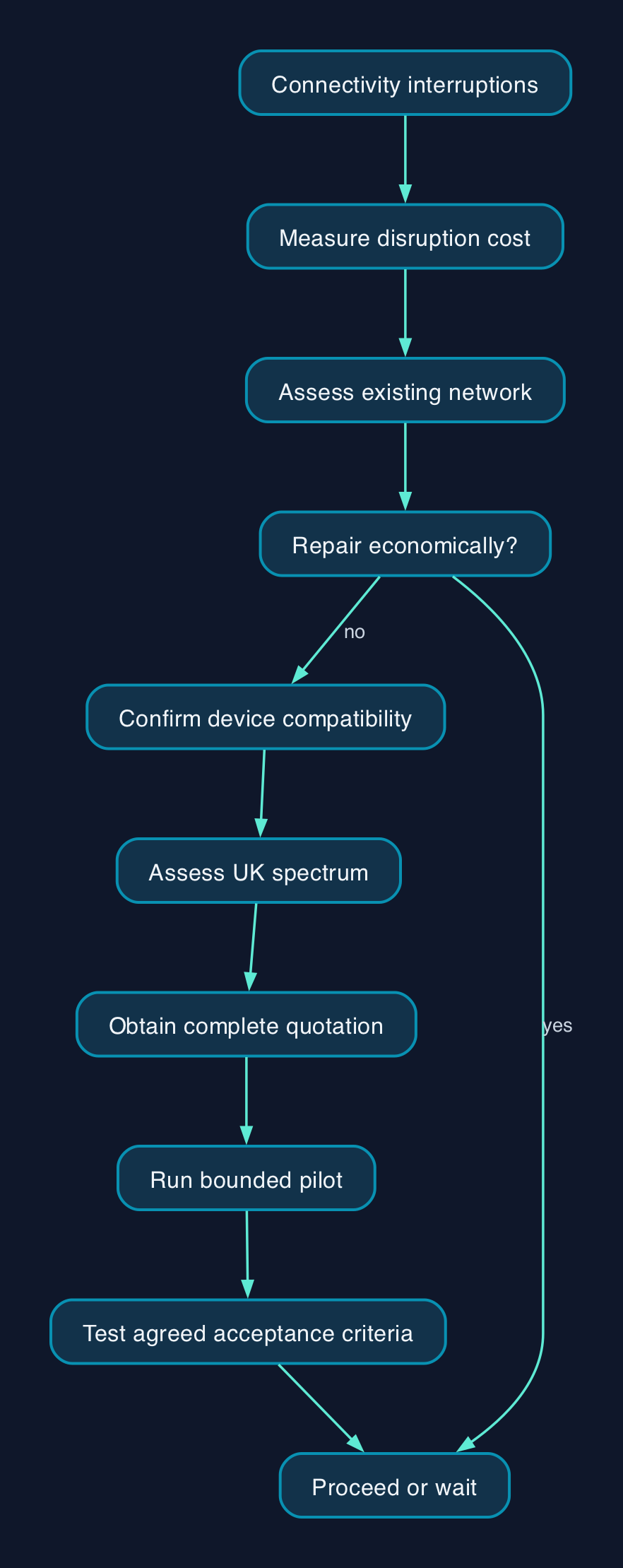
Consider a hypothetical distribution business whose handheld terminals repeatedly disconnect between picking aisles and the loading yard. Before buying another network, its operations manager should establish where the interruptions occur, how much work they delay and whether the existing network can be repaired economically. A private 5G pilot then has a specific result to prove.
Factories should apply the same discipline to production equipment. Ask the machine supplier to approve the proposed connection and acceptance tests before including production savings in the business case.
For a large campus, distinguish operational connectivity from ordinary mobile-phone coverage. Ericsson’s enterprise portfolio announcement separates private networks from neutral-host systems, which support public mobile coverage. Those are different purchasing requirements, even when both involve 5G.
What could make the economics work sooner
Smaller systems, subscription purchasing and phased deployment give buyers more ways to structure a project. They do not, by themselves, prove that its lifetime cost is lower.
Nokia’s Compact launch announcement described a monthly operating-expenditure model with zero upfront investment. However, that announcement specified initial US availability using Citizens Broadband Radio Service spectrum. It cannot establish the same product configuration, price or commercial terms for a UK site.
Ericsson’s current product material describes dual-mode operation and a multisite arrangement in which several locations use a central cellular core. These are configurations worth pricing, rather than automatic savings to enter in a spreadsheet. A shared component also needs an agreed failure and recovery plan.
For a small business, a managed contract deserves consideration when employing or training specialist network staff would be disproportionate. Request explicit responsibility for monitoring, software updates, failed hardware and incident escalation. A manageable monthly payment is useful only if the service covers the work the business needs someone else to perform.
How the network and responsibilities fit together
A private cellular system connects compatible devices through site radios and a cellular core, the software that controls network access and traffic. Ericsson’s product description covers the core, radio infrastructure and network management, while the UK deployment service description includes installation and integration with existing business systems.
The following is a proposed responsibility map for procurement, not a claim that every supplier includes these services.
| Component or task | What the buyer should establish | Responsibility to assign |
|---|---|---|
| Devices and connections | Which scanners, vehicles, cameras or gateways work with the proposed network | Equipment supplier confirms compatibility; network provider validates it |
| Radios and coverage | Which working areas and travel routes must pass acceptance tests | Installer designs and measures coverage; operations team witnesses testing |
| Cellular core | Where it runs and what happens if it becomes unavailable | Provider documents recovery; buyer agrees the acceptable interruption |
| Application integration | How traffic reaches warehouse, production or campus applications | IT team and application supplier approve and test connections |
| Management access | Who can change settings and where management information is processed | Buyer approves access; provider implements and records it |
| Ongoing support | Who responds during operating hours and outside them | Contract names the service owner, escalation route and restoration commitments |
Require suppliers to separate application traffic, management information and remote support access in their design. The word “private” is not a complete description of where every category of data goes.
Spectrum feasibility also belongs before equipment ordering. Obtain a written explanation of the proposed UK spectrum arrangement, who handles the application and which conditions apply to the site. The supplied evidence does not establish current official licence fees or approval times, so neither should be treated as a fixed input here.
Pricing and the complete cost model
The clearest published UK monthly signal in the supplied evidence comes from Aerix’s pricing explanation dated 26 April 2026. It describes typical small and medium managed sites at £500 to £5,000 per month, with design, installation, spectrum, equipment, monitoring, maintenance and support included, and a 12-month rolling commitment.
That is the provider’s indicative range for its own service, not an independently established industrial-market price. The extract does not specify VAT treatment, a precise equipment configuration, device minimums or industrial performance commitments. It also describes broadband services, so a buyer must obtain confirmation that the quotation covers the intended operational workload.
For a UK warehouse buyer, treat the £500 to £5,000 monthly range and 12-month rolling commitment as a concrete test: fewer picking or loading interruptions must be worth more each month than the quoted charge and any costs outside the package. Before accepting the commitment, require written confirmation that the price covers the handheld terminals, aisle-to-yard coverage and recovery support the pilot actually tests.
There are no equivalent published UK prices for the Nokia and Ericsson configurations in the supplied material. A numerical comparison between those platforms would therefore be misleading.
Use the following cost model to request comparable quotations.
| Cost component | What the quotation should make explicit |
|---|---|
| Survey and design | Buildings, outdoor areas, measurements, design revisions and acceptance criteria |
| Network equipment | Radios, core, cabling, mounting, power protection, spares and ownership |
| Devices | Compatible models, replacement terminals, gateways, provisioning and support |
| Installation and integration | Site access, application changes, testing and disruption to operations |
| Recurring service | Software, spectrum charges, monitoring, maintenance and support coverage |
| Internal work | IT time, operational testing, staff training and supplier management |
| Resilience | Backup power, replacement hardware, recovery arrangements and any extra connectivity |
| Exit | Removal, configuration handover, replacement service and termination charges |
Compare every option over the same ownership period. Add setup, recurring charges, internal work, replacements and exit costs, taking care not to charge twice for services already included in a subscription.
On the benefit side, use recoverable operating value. Time saved by staff is not automatically a cash saving, and additional production has value only where the business can use or sell it. Leave uncertain benefits conditional until the pilot supplies evidence.
Which suppliers and delivery approaches deserve comparison
Platform manufacturers and service providers occupy different positions in the purchase. The comparison below identifies what is supported by the supplied material and what still needs a quotation.
| Option | Evidence-backed offering | When to investigate it | What remains to establish |
|---|---|---|---|
| Nokia DAC | LTE and 5G private wireless with scalable deployment options | An industrial site assessing a packaged private wireless platform | UK configuration, compatible devices, delivery partner, support and complete price |
| Ericsson Private 5G | Indoor and outdoor 4G/5G, different deployment sizes and integration interfaces | A site planning phased adoption or a broader industrial rollout | Site design, management responsibilities, service commitments and complete price |
| UK managed-network offer | The published service range discussed above | A smaller organisation evaluating outsourced ownership and operation | Whether its specific industrial workload, equipment and recovery requirements are included |
| Improve the existing network | A baseline alternative for the procurement exercise | A site where faults are localised or the operational requirement is modest | An independent diagnosis, repair quotation and measured acceptance test |
The evidence is insufficient to rank these options by price or performance. Give competing bidders the same device list, operating routes, application requirements and failure tests. A cheaper quotation covering fewer responsibilities is not a cheaper version of the same service.
Editorial analysis
Private 5G should earn its place through an operational result. CTC would prioritise a pilot where the business can identify a recurring interruption, measure its cost and test the proposed remedy under representative conditions.
That means testing with normal stock levels, moving equipment and busy shifts. Record connection failures, completed transactions and application response times against the existing arrangement. Agree how operations return to the previous setup before introducing the pilot into a live process.
Wait when the business case rests mainly on future applications that nobody has funded, or when essential devices have not been confirmed as compatible. Proceed to a bounded pilot when a supplier can connect a measurable problem to a complete quotation and an acceptance test the operations team trusts.
Sources
- Aerix – How Much Does a Private 5G Network Cost in the UK?, 26 April 2026
- Ericsson – Private 5G Networks
- SCC – Private 5G Networks
- Nokia – DAC private wireless
- Ericsson – Ericsson Private 5G product capabilities
- Nokia – Nokia brings 5G private wireless to small industrial sites with compact DAC, 4 October 2023
- Ericsson – Ericsson unveils strategy for enterprise-driven 5G network adoption, 12 September 2024
- Ericsson – Private network for your industry