
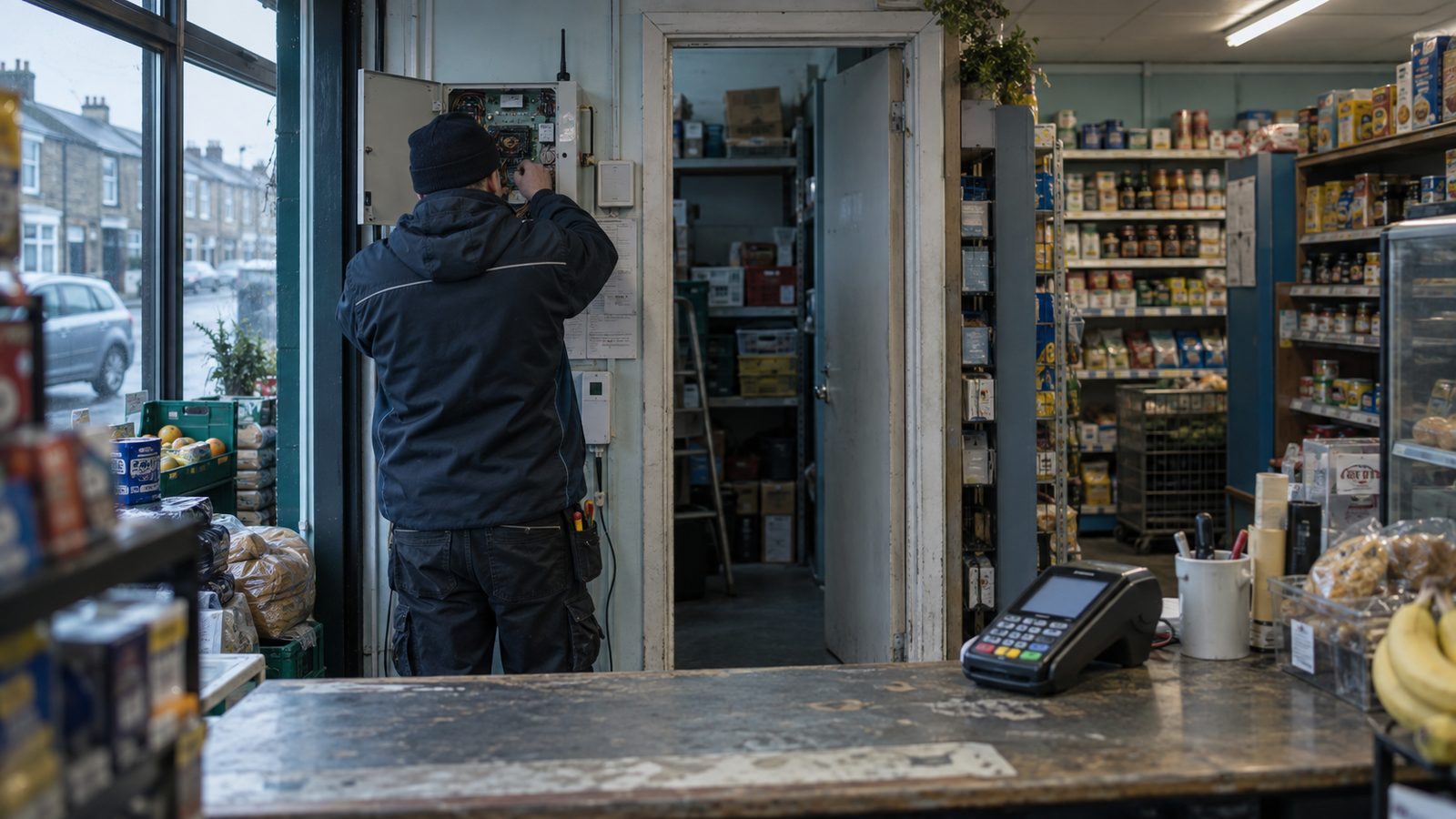

Older security, fire and telecare alarms, payment terminals, ATMs and connected equipment may still depend on 2G, but the answer for your premises depends on the installed communications module and service. The communications regulator identifies these device categories as affected. Ask each supplier to confirm the exact hardware, connection and replacement plan. Prioritise safety-related services and payment acceptance, including any backup connection that your business expects to work during an outage.
Which equipment should UK businesses investigate?
The available sources establish affected categories, but do not provide a verified model-by-model inventory of UK alarms, payment terminals or connected devices. Treat the following as an investigation list, rather than a list of products that must be replaced.
| Equipment | What the evidence establishes | What to ask the supplier |
|---|---|---|
| Security and fire alarms | Identified as potentially affected | What is the exact signalling module, and does either its main or backup path require 2G? |
| Telecare alarms | Identified as potentially affected | Can this installed unit deliver alerts and any required speech without 2G? |
| Mobile payment terminals | Older terminals are potentially affected | Which communications variant do we have, and what connection does it actually use? |
| ATMs | Included among affected equipment | Who manages connectivity, and is migration included in the service contract? |
| Other connected equipment | Older Internet of Things and machine-to-machine devices can depend on legacy networks | Which devices use mobile data, text messages or voice, and which technologies support each function? |
The categories above draw on connected-device guidance and guidance on legacy IoT hardware and services. Internet of Things, usually shortened to IoT, means connected equipment that exchanges information, such as readings or status updates.
For a shop, start with the alarm maintenance agreement and payment terminal contract. For a care provider, start with monitored alarms and their service records. For a business operating remote equipment, request an inventory from whoever manages its SIM subscriptions.
A payment brand is not a hardware specification
One UK supplier page illustrates the identification problem. Seymour Direct advertises mobile GPRS card machines with roaming SIMs and refers to Ingenico hardware, but the supplied page does not identify an exact model or establish whether an individual installed terminal has another connection available.
That is enough to justify checking a terminal described this way. It is not enough to declare every Ingenico terminal affected, or to select a replacement.
Ask your payment provider for written confirmation against the terminal’s serial number. Include the till connection, refunds, reporting and any agreed outage procedure in the replacement discussion.
When the networks are changing
The dates below reflect source material available on 28 September 2026. They describe different milestones, so they should not be treated as equivalent nationwide completion dates.
| Network | Announced milestone | Planning implication |
|---|---|---|
| EE | Switch-off begins from May 2029 | Ask when your locations and service will be affected |
| O2 | Switch-off starts in summer 2029 | Also check whether the SIM’s roaming arrangements have already changed |
| Vodafone | Retirement planned for spring 2030, with possible earlier local readiness phases | Obtain the timetable applicable to your service |
| Three | Has no 2G network | Do not list Three as an existing 2G fallback |
The regulator confirms the EE, O2 and Three positions; Vodafone gives the spring 2030 target and local-phase qualification.
The agreement to end UK 2G services by 2033 is not a promise of service until then. The regulator explains that individual operators can close earlier.
A multi-network service also needs a specific answer about access. O2 began withdrawing 2G access for inbound international roaming services on 1 October 2025. Ask which networks your SIM can actually use, rather than accepting “multi-network” as the complete migration plan.
Who owns each part of the connection?
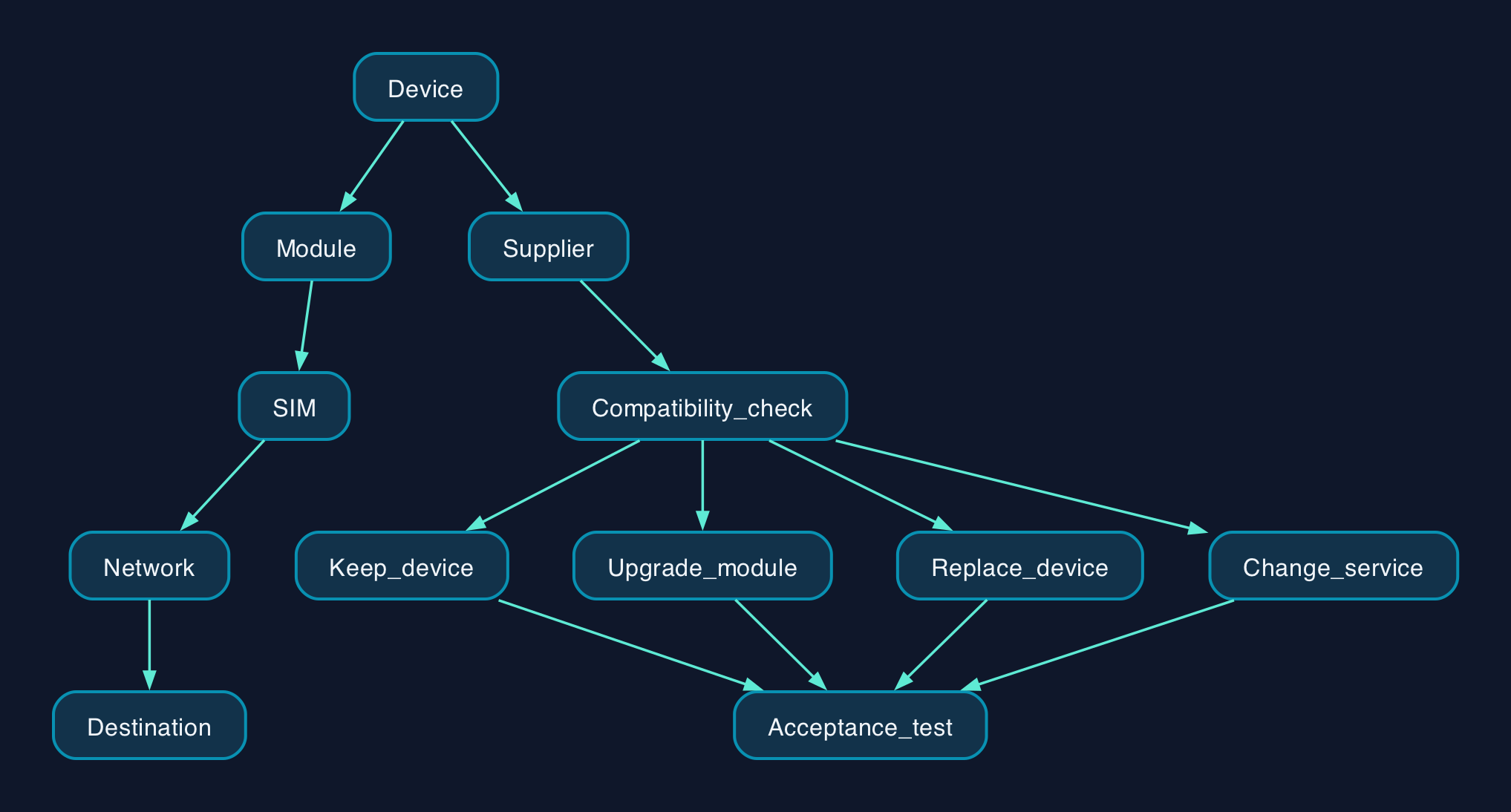
For the audit, describe the service as a chain. Identify the device, its communications hardware, the SIM and network access, and the destination that receives its messages, transactions or calls.
Use this proposed responsibility map to assign the investigation. Actual ownership should be confirmed against your contracts.
| Part of the service | Suggested first contact | Evidence to request |
|---|---|---|
| Alarm, terminal or connected device | Installer, equipment supplier or payment provider | Model, serial number, communications module and supported functions |
| SIM and network access | Connectivity provider | Permitted networks, supported technologies and relevant migration dates |
| Monitoring or processing destination | Monitoring company, payment provider or application operator | Confirmation that the proposed replacement connects and performs the required task |
| Installation and ongoing support | Maintenance contractor or managed service provider | Scope, appointment requirements, testing, support and escalation arrangements |
| Business acceptance | Named manager responsible for the service | Recorded test result, unresolved faults and agreed contingency |
Suppliers of services relying on 2G are expected to ensure continuity after closure, recognising that existing contractual and regulatory responsibilities may apply. The connected-device guidance is a useful basis for requesting a migration plan from the company providing the service.
For safety-related equipment, arrange tests with the responsible service provider. Do not disconnect an alarm or interrupt monitoring simply to discover whether its backup connection works.
What should replace the existing connection?
The first decision is whether an approved communications upgrade can preserve the existing equipment. Ask the supplier to establish compatibility before agreeing to replace the whole installation.
| Approach | When to investigate it | Evidence needed before approval |
|---|---|---|
| Retain the device and update its configuration | The supplier confirms that installed hardware already supports the required replacement service | Written instructions and a successful service test |
| Replace the communications module | The supplier offers a supported upgrade for the exact installed equipment | Compatibility, installation scope and continued support |
| Replace the complete device | No supported upgrade meets the service requirements | Replacement specification, migration arrangements and acceptance test |
| Change the connection or managed service | The existing arrangement no longer meets operational needs | Site coverage, functional compatibility, responsibilities and exit terms |
These are assessment routes, not claims that every product supports each option.
For IoT applications, Vodafone identifies 4G, 5G, NB-IoT and LTE-M as technologies already supported by many devices. NB-IoT and LTE-M are cellular technologies designed for connected equipment. Its advice remains to contact the service supplier where an application depends on 2G. Vodafone’s business IoT guidance
Do not choose between those technologies from the label alone. Ask the supplier to demonstrate the required data, messaging or voice functions at the installation site.
What the migration will cost
The evidence does not establish a like-for-like UK migration price. Request an itemised quotation in pounds, with VAT treatment and contract commitments stated.
| Cost component | What the quotation should make clear |
|---|---|
| Hardware | Module upgrade or complete replacement, including necessary accessories |
| Installation | Site visits, access arrangements, configuration and removal of old equipment |
| Connectivity | Recurring SIM charges, allowances, network access and minimum term |
| Monitoring or processing | Changes to existing fees and any newly bundled services |
| Testing | Who proves that alerts, calls, transactions or readings reach their destination |
| Business disruption | Planned downtime, temporary arrangements and repeat visits |
| Support and exit | Maintenance, replacement cover, cancellation charges and equipment ownership |
Replacement support terms deserve attention alongside hardware price. For example, Paymentsense’s terminal replacement policy describes dispatch within one to two business days when it cannot fix a terminal, depending on location and with geographical exclusions. That policy does not establish a planned 2G migration entitlement or a guaranteed installation date.
Ask separately what your contract covers for a network retirement.
Editorial analysis
The most useful outcome is a signed-off device register, with one owner and one migration decision for each service.
Prioritise equipment by the consequence of losing its connection. A safety-related alarm requires different scheduling and acceptance checks from a non-essential reporting device. Payment acceptance deserves a tested business contingency as well as a replacement terminal.
For each device, request confirmation of its current connection, supported upgrade, service deadline and completion test. Where the supplier cannot identify the installed hardware, keep the item unresolved. A successful test today should not close an investigation into whether that same service can operate after 2G retirement.
Sources
- Communications regulator — Switching off 2G and 3G networks, advice for IoT and third-party device suppliers, updated 1 September 2026
- Communications regulator — Switching off the UK’s 2G and 3G mobile networks, updated 10 August 2026
- Vodafone — VodafoneThree 2G switch-off, published 23 March 2026
- Seymour Direct — Mobile GPRS Card Machines, undated supplied extract
- Paymentsense — Terminal replacement, undated supplied extract