

UK small and mid-sized businesses can test post-quantum cryptography through Microsoft AD CS certificate services, AWS service connections and Google Cloud Load Balancing. These address different jobs, including certificate signatures, cloud API connections and application traffic. Start with the platform you already operate and one bounded pilot. Success means proving which cryptographic protection worked, checking compatibility and identifying the parts of your system that the test did not cover.
What a post-quantum pilot means for a UK business
Post-quantum cryptography, or PQC, uses algorithms designed to withstand attacks from future quantum computers. For this decision, separate two tasks. Key establishment protects the secrets used to encrypt a connection; digital signatures establish authenticity. Google’s documentation explains why recorded traffic creates a future decryption risk, while attacks against authentication have a different mechanism. Google’s explanation of the TLS threats
That distinction determines what to test. A business exchanging confidential files needs evidence about its transfer connection. A software supplier testing signed releases needs evidence about signatures and the systems that verify them. Passing either test does not establish that the other task is protected.
Hybrid key exchange combines a conventional mechanism with a post-quantum mechanism. AWS KMS documents a combination of Elliptic Curve Diffie-Hellman and ML-KEM, the Module-Lattice-Based Key-Encapsulation Mechanism. The pilot therefore tests a combined approach rather than simply removing conventional cryptography. AWS KMS hybrid design
For a UK organisation, keep deployment geography and cryptographic coverage as separate acceptance criteria. AWS documents broad regional coverage for KMS and S3, but that does not establish UK data residency for an entire application. Confirm the actual endpoints, storage locations and service dependencies used by the pilot. KMS regional scope, S3 regional scope
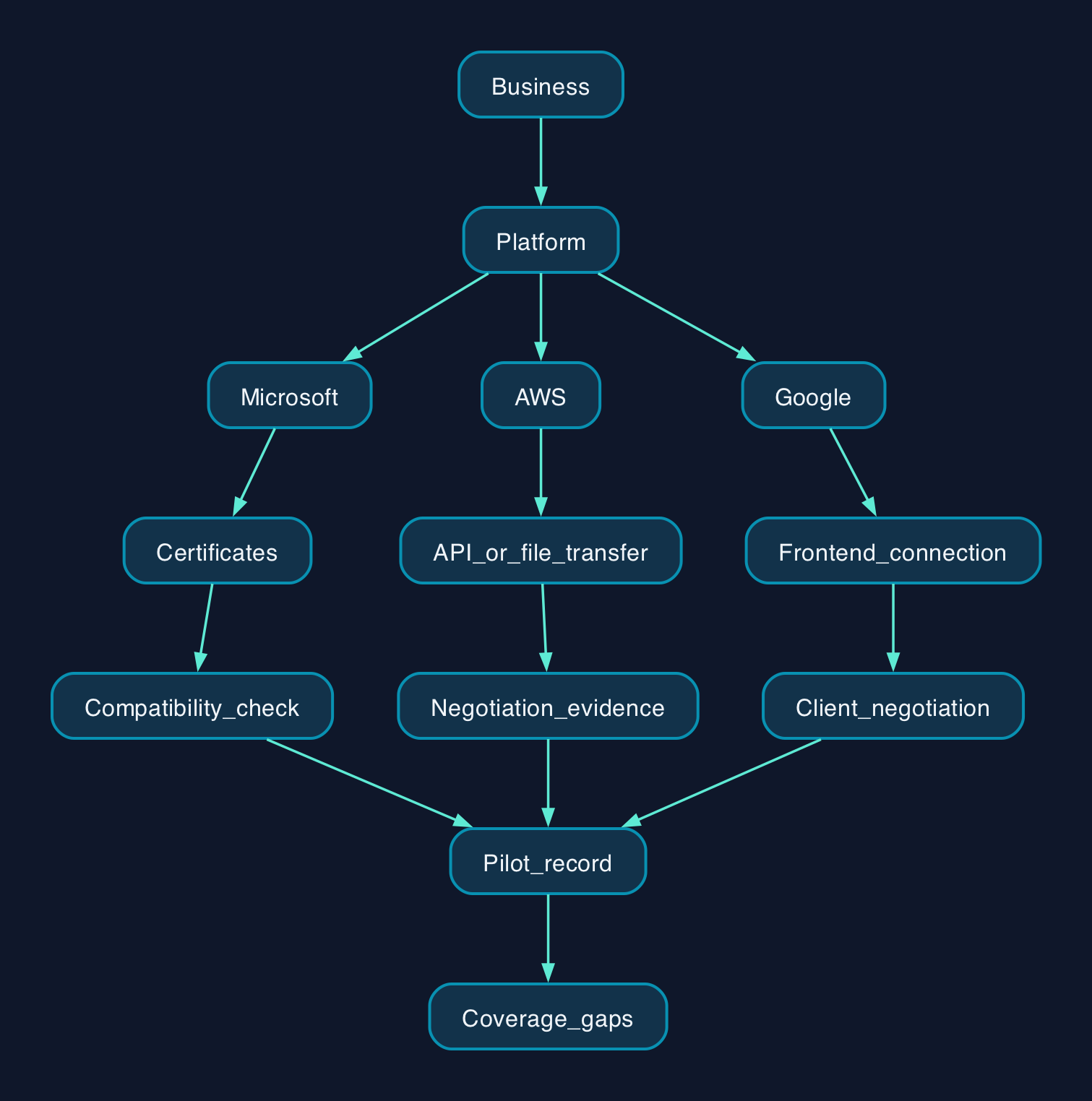
Microsoft offers a certificate laboratory
Microsoft AD CS is the clearest supported Microsoft testing route in the supplied documentation. It can use ML-DSA for certification authorities, code-signing certificates, server and client authentication certificates, and certificate-status response signing. Microsoft warns that third-party applications, devices and services may not recognise these certificates. Supported ML-DSA scenarios
Build a separate test hierarchy rather than changing the authority that issues production certificates. The infrastructure administrator owns certificate issuance; application owners must establish whether their software can validate the resulting certificates and chains. Microsoft’s requirements include Cryptography Next Generation key storage providers rather than legacy providers. AD CS requirements and migration limits
Certificate size is a concrete measurement opportunity. Microsoft lists these signature sizes for its supported parameter sets. They describe signatures, not complete certificate sizes or measured network overhead. Microsoft’s parameter-set table
| Parameter set | Signature size |
|---|---|
| ML-DSA-44 | 2,420 bytes |
| ML-DSA-65 | 3,309 bytes |
| ML-DSA-87 | 4,627 bytes |
Do not infer equivalent capabilities across Azure services. Azure App Service documents TLS 1.3 support, but that page does not establish post-quantum key exchange. Azure Key Vault Managed HSM lists RSA, elliptic-curve and symmetric AES key types, with quantum-resistance guidance for AES-256; it does not establish an ML-DSA or ML-KEM testing route. App Service TLS documentation, Managed HSM key documentation
AWS offers API and file-transfer tests
AWS KMS is a useful starting point for an existing AWS application because it provides documented verification evidence. Make a direct API call from a compatible client and inspect the corresponding CloudTrail entry. A hybrid algorithm such as `X25519MLKEM768` in `tlsDetails.keyExchange` establishes what that connection negotiated. AWS notes that `tlsDetails` is absent when another AWS service calls KMS on your behalf. KMS verification details
Amazon S3 provides a storage-transfer test, subject to its endpoint exclusions. However, AWS says S3 CloudTrail events and server access logs do not expose PQ-TLS key-exchange details. Plan suitable client or handshake inspection before treating a successful upload as proof of post-quantum negotiation. S3 support and logging limitations
Secrets Manager supports API-connection tests, while AWS Payment Cryptography documents hybrid TLS for its endpoints and recent SDKs. These are relevant when the application already uses those services; neither is a reason to introduce an otherwise unnecessary dependency. Secrets Manager guidance, Payment Cryptography guidance
For supplier or customer file exchange, Transfer Family offers a different pilot using hybrid SSH key establishment. Its documentation describes SFTP transfers into and out of S3 or Amazon EFS. Confirm availability in the intended Region before including it in a UK deployment design. Transfer Family scope
Record the exact client environment. AWS documents different support paths for Go, Java, JavaScript, Node.js and other runtimes, including reliance on system TLS libraries on some platforms. A result from a developer’s laptop should not be assumed to apply to the production host. AWS client-support matrix
Google offers a frontend connection test
Google Cloud Load Balancing supports the hybrid key-exchange group `X25519MLKEM768` on specified Application Load Balancers and proxy Network Load Balancers. Enable it through the `post-quantum-key-exchange` setting in an SSL policy. The client must advertise both TLS 1.3 and the supported group. Google’s configuration and compatibility requirements
This creates a practical staging test for an existing web application. Compare compatible and incompatible clients, record the negotiated group and test representative corporate network paths. Google states that clients without the required support are unaffected, so a successful connection alone cannot prove that PQC was used. Google’s negotiation behaviour
The documented boundary is the connection from client to load balancer. Assess the backend connection separately. The supplied evidence does not justify describing the whole application path as post-quantum protected. Google’s frontend-only scope
Architecture and responsibilities
Treat each pilot as a test of a defined boundary. The following responsibility map is an editorial proposal based on the documented product scopes.
| Pilot | Boundary being tested | Suggested owner | Evidence to retain |
|---|---|---|---|
| Microsoft AD CS | Certificate issuance and signature validation | Certificate administrator and application owner | Test chain, validation results and incompatible applications |
| AWS KMS | Client-to-KMS API connection | Application developer and cloud administrator | Client configuration and CloudTrail key-exchange record |
| Amazon S3 | Client-to-supported-S3-endpoint connection | Application or storage team | Endpoint type and client-side negotiation evidence |
| AWS Transfer Family | SFTP client-to-service SSH connection | File-transfer administrator and trading partner | Client compatibility and negotiated key exchange |
| Google Cloud Load Balancing | Client-to-load-balancer TLS connection | Platform engineer and application owner | SSL policy and observed client negotiation |
The product boundaries and verification limits come from Microsoft AD CS, AWS KMS, Amazon S3, AWS Transfer Family and Google Cloud Load Balancing.
Ask an external IT provider to deliver these records alongside its configuration work. “PQC enabled” is too vague an acceptance statement.
Pricing and the cost of a useful pilot
The supplied evidence contains no verified GBP prices or PQC-specific surcharges. A defensible budget therefore needs current service pricing or a scoped quotation rather than an invented licence comparison.
For a UK quotation, request GBP amounts, VAT treatment, billing commitments and a defined teardown date. Separate ordinary service charges from engineering and support work.
| Cost component | What to include in the estimate |
|---|---|
| Test environment | Server licensing, compute, storage or load-balancer resources required by the chosen design |
| Application changes | Runtime updates, HTTP-client configuration and regression testing |
| Network testing | Office, remote-access and proxy paths used by staff or applications |
| Specialist support | Certificate expertise, troubleshooting and documented handover |
| Closure | Configuration rollback, resource deletion and retained test evidence |
These are budgeting categories, not published supplier charges. AWS specifically identifies larger handshake messages and potential interference from proxies or deep-packet-inspection firewalls, which makes network troubleshooting a reasonable item to scope. AWS KMS performance guidance
Editorial analysis
For an existing AWS application, our preferred first experiment is a direct KMS call because its documented logging provides a clear way to verify negotiation. For an application already behind a supported Google load balancer, test the frontend policy and client behaviour. For a Windows certificate estate, use a parallel AD CS laboratory to discover validation failures before considering operational change.
These are recommendations about testability and existing skills, not a ranking of cryptographic strength. The evidence supports different capabilities, so a single vendor score would conceal the decision.
Give the pilot a written acceptance condition before implementation. Require evidence of the algorithm used, successful representative transactions, recorded compatibility failures, performance against an agreed baseline and a tested route back to the previous configuration. Use synthetic data until those conditions are met.
Sources
- Microsoft Learn — Post-Quantum Cryptography in AD CS overview
- Microsoft Learn — What is ML-DSA support in AD CS
- Microsoft Learn — About keys in Managed HSM
- Microsoft Learn — What is TLS/SSL in Azure App Service
- AWS — Using hybrid post-quantum TLS with AWS KMS
- AWS — Using hybrid post-quantum TLS with Amazon S3
- AWS — Post-quantum TLS for Secrets Manager
- AWS — Using hybrid post-quantum TLS with Payment Cryptography
- AWS — Enabling hybrid post-quantum TLS in SDKs and tools
- AWS — Using hybrid post-quantum key exchange with Transfer Family
- Google Cloud — Post-quantum TLS for Cloud Load Balancing