

Xero offers the clearest documented starting point for a UK small-business e-invoicing pilot, while Sage merits consideration where its accounting products already support your finance operation. That is an assessment of available capabilities, not a guarantee of future compliance. The government has announced mandatory e-invoicing for all VAT invoices from 2029. Choose around demonstrated invoice exchange, your exact software edition and responsibility for rejected transactions, with contractual provision for regulatory updates.
What readiness means for a UK finance team
The buying decision is whether your accounting system can exchange usable invoice data with your customers and suppliers, and whether your team can manage the exceptions.
Xero’s documented receiving process illustrates the distinction. An invoice arrives as a populated draft bill, which someone still reviews and approves. Electronic delivery therefore changes data entry without automatically authorising payment. Xero’s UK product description supports that workflow.
For a small business, the useful demonstration is an invoice travelling from its own accounts package into a customer’s system, followed by a supplier invoice coming back. For a mid-sized business, add purchase-order matching, separate approval responsibilities and routing to the correct company or department to the acceptance criteria.
This comparison assesses Xero, Sage and a connector approach because those are the routes supported by the available product evidence. It cannot rank QuickBooks, FreeAgent, Zoho Books or open-source accounting options without equivalent documentation. Their absence from the comparison is an evidence gap, not a finding that they lack capability.
What the UK announcement establishes
The government’s response, updated on 26 November 2025, announces mandatory e-invoicing for all VAT invoices from 2029. It also says standards and implementation would be developed with stakeholders, with a roadmap at Budget 2026. The evidence available here establishes that policy direction, rather than a final specification against which a product can be certified. Government consultation response.
Existing VAT guidance needs to be read separately. HMRC’s supplied notice, last updated on 26 May 2022, permits electronic invoices in structured formats such as XML or unstructured formats such as PDF. That older permission does not prove an emailed PDF will meet the announced future regime. VAT Notice 700/63.
Public procurement is another distinct consideration. Guidance on the Procurement Act 2023 explains the requirement for contracting authorities to accept and process undisputed electronic invoices in the required form under the relevant public contracts. Suppliers should establish which procurement regime and contractual requirements govern their particular customer, rather than treating this as a universal obligation to send every invoice electronically. Electronic invoicing and payment guidance.
This is not legal advice; consult your legal counsel.
How the invoice workflow should operate
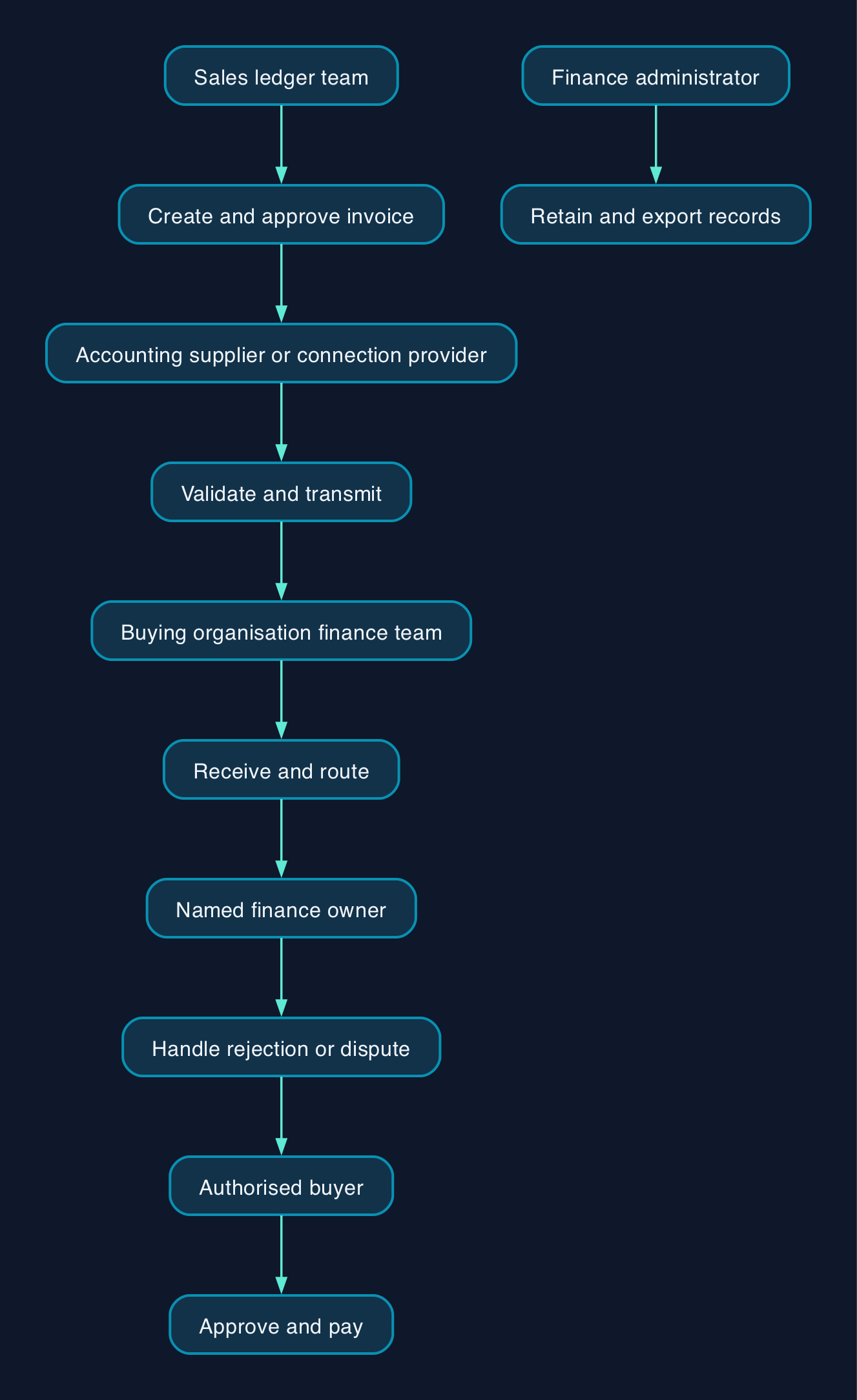
Use the following responsibility model when requesting a demonstration. It is a proposed acceptance framework, not a claim that every compared product supplies every function.
| Stage | Proposed owner | Evidence to request |
|---|---|---|
| Create and approve the invoice | Sales ledger team | Correct customer, tax details, amounts and purchase-order reference |
| Validate and transmit | Accounting supplier or connection provider | Validation result, destination identifier and transmission record |
| Receive and route | Buying organisation’s finance team | Invoice reaches the correct company and approval queue |
| Handle rejection or dispute | Named finance owner, supported by the supplier | Visible reason, correction process and controlled resubmission |
| Approve and pay | Authorised buyer | Approval remains separate from receipt |
| Retain and export records | Finance administrator | Retrievable invoice data and status history, including an exit export |
Sage’s published status-tracking features make rejection handling a reasonable demonstration request. Xero’s draft-bill workflow makes receipt and approval a separate test. Neither description, on its own, proves that your purchase-order rules or specialist invoices will work. Sage Network features and Xero receiving workflow.
Pricing and the full cost of preparation
The supplied Xero UK page lists the following monthly prices after introductory offers. These are accounting-plan prices, not standalone e-invoicing charges or complete implementation costs. Xero’s published plan information.
Pricing basis: evidence supplied on 28 September 2026, GBP, UK plans, advertised price per month after the introductory period. The extract does not establish VAT treatment, minimum subscription quantity or contractual commitment. Confirm those terms before budgeting.
| Xero plan | Listed monthly price after the offer | Selected plan detail relevant to selection |
|---|---|---|
| Ignite | £18 | Lists 20 invoices and 10 bills, with an invoice footnote requiring confirmation |
| Grow | £39 | Lists invoicing and automated bill entry |
| Comprehensive | £55 | Adds multiple currencies |
| Ultimate | £70 | Lists project time and cost tracking for 10 users |
All prices and features above come from the same Xero UK page. The extracted promotional formatting is incomplete, so introductory prices are excluded.
Before budgeting for Ignite at £18 per month, take your invoice and bill volumes to Xero and ask, “Do e-invoices and incoming draft bills count towards the listed 20 invoices and 10 bills, and what happens when we exceed either allowance?” Request the same volume-based confirmation for Grow at £39 rather than assuming its listed invoicing and automated bill entry remove every limit. If overseas customers require billing in multiple currencies, ask whether Comprehensive at £55 is the required plan, then test delivery to those customers separately from currency support.
The available Sage and PaperLess evidence does not establish a comparable price. Obtain a written quotation that identifies the accounting edition, connection service and implementation scope. A missing published price should remain an unknown cost.
| Cost component | What the quotation should establish |
|---|---|
| Accounting subscription | Required edition, billing commitment, VAT and renewal basis |
| Invoice exchange | Charges for sending, receiving, registration and additional entities |
| Implementation | Configuration, data mapping, validation and connection testing |
| Finance-team work | Customer-data cleanup, training and exception handling |
| Support and change | Escalation ownership, response terms and regulatory updates |
| Exit | Export format, historical access, connection transfer and termination charges |
For a three-year assessment, total the contracted recurring charges over that period, then add setup, migration, training, internal staff time, support and exit work. Keep unquoted items visible rather than assigning them zero. Avoid counting an exchange service twice when it is already included in the accounting subscription.
Comparing the documented options
The recommendations below are editorial judgements based on documented functions and outstanding evidence, rather than hands-on testing.
| Route | What the evidence supports | Best-fit circumstances | What must be resolved before purchase |
|---|---|---|---|
| Xero | UK e-invoicing documentation describes direct exchange, incoming draft bills and Peppol connection. Product page | A small business seeking a documented UK workflow, particularly an existing Xero customer | Exact plan limits, customer eligibility, country coverage, rejection handling and export requirements |
| Sage accounting with Sage Network | Sage describes sending, receiving, validation and status tracking through its network offering. Service description | An existing Sage customer seeking an extension to its finance processes | Exact product, version, UK availability, implementation effort, support ownership and price |
| Sage X3 framework | Technical documentation covers inbound and outbound invoice movement, format handling and country-specific connections. Framework documentation | A mid-sized organisation already operating X3 and able to manage a configured integration | UK-specific delivery, required modules, specialist invoice cases and implementation support |
| Existing accounting system with a connector | PaperLess describes converting invoices into Peppol format and transmitting them. Provider description | A business whose ledger still meets its needs and wants to investigate retaining it | Version compatibility, inbound processing, status return, manual steps, price and responsibility across suppliers |
When Xero is the clearest starting point
Start with Xero if your immediate objective is a UK pilot using a receiving workflow the supplier already describes. Its page explains both populated draft bills and VAT eligibility, giving a small finance team concrete behaviour to test. Xero UK eInvoicing software.
International coverage needs a more precise check. Xero’s product page promotes global Peppol exchange, while its customer-ideas page includes a June 2026 user report of UK outbound restrictions. The user comment is not authoritative product documentation, but the discrepancy warrants a destination-specific demonstration before relying on cross-border exchange. Xero’s Peppol discussion and official response.
Do not choose Xero solely on a general Peppol claim if a particular overseas customer must receive your invoices.
When Sage deserves priority
For an existing Sage customer, first establish whether the required connection can be added to the current product. Sage Network describes useful operational functions, including validation, dispute tracking and status updates. Sage Network E-invoicing.
However, “Sage supports e-invoicing” is too broad for a purchase order. The X3 documentation shows that connections and supporting components differ by country, and explicitly excludes detailed treatment of some specialist cases, including prepayments and construction processes. Sage X3 framework scope.
Require the proposal to name your product and version. X3 documentation should not be used as proof that a different Sage accounting package includes the same functions.
Give the Sage supplier a sample invoice from your current edition and ask, “Which UK connection and additional modules does this need, and are they included in the quotation?” During the demonstration, have the recipient reject it, then ask the supplier to show where the reason appears, who corrects it and how resubmission is recorded. If your business uses prepayments or construction invoices, include those samples in the acceptance test and require a written answer on any extra configuration.
When retaining the ledger makes sense
A connector deserves investigation when reporting, reconciliation and staff workflows already work well. PaperLess’s own description supports an outbound conversion-and-transmission approach, but the short extract leaves implementation and receiving capabilities unresolved. PaperLess Peppol service.
Make support ownership a selection condition. Your finance team needs one named route for resolving a failed invoice, even where the accounting supplier and connection provider are separate organisations.
Ask the connector provider to transmit an invoice generated by your exact accounting version, then show whether its delivery status returns to that ledger or requires checking a separate service. Test an incoming supplier invoice separately and record any manual import or rekeying. Request separate quotation lines for outbound exchange, inbound processing and status return, with any unsupported step explicitly identified, before comparing retention with a move to Xero or an extension to Sage.
Editorial analysis
The best placed platform is the one that can demonstrate your invoice journey and accept responsibility for maintaining it.
On the available evidence, Xero provides the clearest starting point for a small-business UK pilot. Sage provides a credible route for existing customers, subject to product-specific confirmation. A connector offers a retention option worth pricing before committing to a ledger migration.
Ask shortlisted suppliers to demonstrate a normal invoice, a credit note, a rejection and an export of the resulting records. Then secure written terms covering the required edition, delivery scope, support and future regulatory changes. That evidence should determine the purchase, rather than a general claim of being ready for 2029.
Sources
The following pages were supplied as extracted evidence for this comparison on 28 September 2026. Dates below are included only where stated in the supplied page content.
- HMRC and Department for Business and Trade – Promoting electronic invoicing consultation response, updated 26 November 2025.
- HMRC – Electronic invoicing VAT Notice 700/63, updated 26 May 2022.
- UK Government – Guidance on Electronic Invoicing and Payment, publication date not established in the extract.
- Xero – UK eInvoicing software, publication date not stated.
- Xero – UK e-invoicing initiative and plan information, publication date not stated.
- Xero – Peppol compliance product discussion, official response dated 28 January 2026; cited user comment dated 12 June 2026.
- Sage – Sage Network E-invoicing, publication date not stated.
- Sage – Sage X3 e-invoicing framework introduction, publication date not stated in the extract.
- PaperLess – E-Invoicing and Peppol, publication date not stated in the extract.