When UK businesses should pay for AI beyond Google Workspace
A separate AI assistant needs a specific job and measurable value. UK businesses should test their existing Gemini entitlement, then fund additional seats where better results or required controls justify the cost.


UK businesses already paying for Google Workspace should make a separate AI assistant earn its place through a specific, measured advantage. Google began including Gemini features in Business and Enterprise subscriptions in January 2025, although availability depends on the edition. Our editorial position is to test that existing entitlement first, then buy additional access for roles where better results, suitable controls or a demonstrably stronger workflow justify the full extra cost.
The separate assistant needs a separate job
For a UK owner-manager whose intended uses are drafting emails, preparing documents and summarising meetings, the first purchasing task should be checking existing entitlements. Google lists assistance across Gmail, Docs and Meet, subject to edition, in its Workspace feature guidance.
That is enough to challenge a proposal for another company-wide subscription. It does not establish that Gemini produces the best output for every business task.
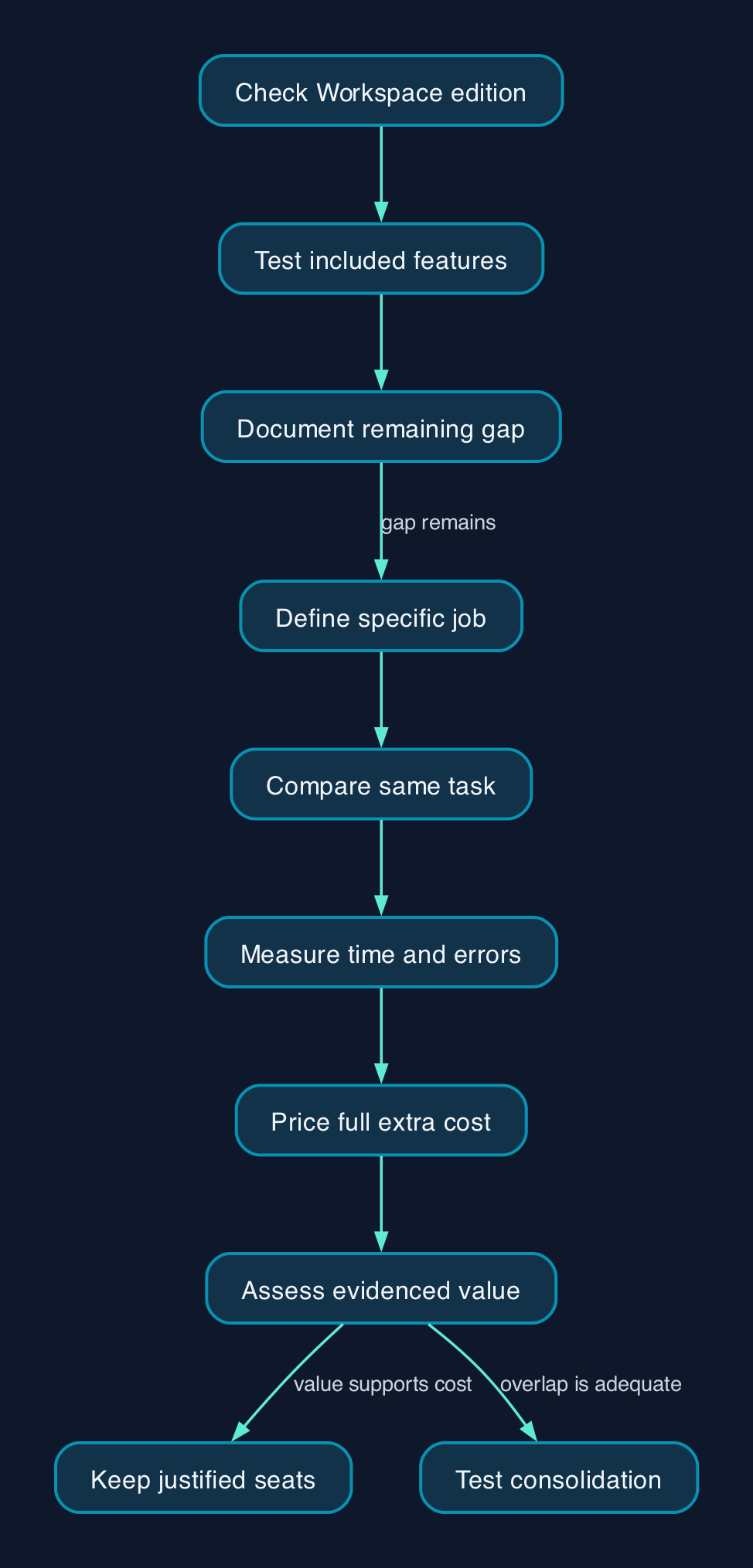
Our position is that a separate assistant needs a written job description. “Improve productivity” is too vague to approve. “Reduce the time our analysts spend correcting a recurring client report, without increasing factual errors” gives the budget holder something to test.
Four groups have a credible reason to run that test.
Specialists with a measurable quality requirement
A software team, research consultancy or technical writing business may justify additional seats if another assistant produces work that needs materially less correction.
The condition matters. Google itself describes Gemini uses including coding, deep research and data analysis in its product overview. A specialist job title alone does not establish a capability gap.
Ask the team to compare completed work using the same task, source material and acceptance criteria. Measure review time and errors alongside generation time. The evidence available here does not establish a rival’s superiority, so this is a purchasing test rather than a product ranking.
Businesses whose work crosses application boundaries
A distributor may need an assistant to help with work spanning email, order records and a stock system. The business case would rest on the exact connection and permitted actions, rather than the assistant’s conversational fluency.
Do not assume Google stops at its own applications. Its Gemini Beta documentation describes third-party integrations, while also explaining that beta features require administrator activation and may differ by edition or acquire usage limits.
Require a demonstration against the actual system and account permissions. A connection that can retrieve a record may still fail the business requirement if the task needs a controlled update, approval or reliable recovery after an error.
Teams with requirements their current edition cannot meet
A separate purchase may be justified by a documented requirement for access control, retention or administration. First establish whether the gap concerns the current Workspace edition, its configuration or Google’s offering more broadly.
Google’s service-level Gemini controls, for example, are not documented as a Business-edition feature. Buying another assistant should therefore follow a comparison of the required control in each proposed edition, rather than an assumption that every business subscription provides it.
Write the requirement in operational terms. Specify who must be prevented from accessing which information, who changes that setting and how the business will verify it.
Existing users who can demonstrate continuing value
An existing separate subscription deserves the same scrutiny as a new purchase. Ask its users to show which recurring jobs would take longer, require more correction or become impractical if it disappeared.
Keep seats where that evidence supports renewal. Where users mainly duplicate work that their Workspace entitlement handles adequately, test consolidation before the next commitment.
Keep ownership clear across both services
A second assistant should have a named administrator and an agreed route for handling business information. The proposed responsibility model below applies whether a business keeps Gemini alone or approves an additional tool.
| Responsibility | Proposed owner | Evidence needed before routine use |
| --- | --- | --- |
| Account and feature access | Workspace administrator or IT provider | Correct business account, edition and approved settings |
| Source access | System or document owner | Test showing permitted material is available and restricted material remains inaccessible |
| Output approval | Person accountable for the work | Checks appropriate to the report, code, message or decision |
| Subscription renewal | Budget holder | Actual usage, accepted results and full additional cost |
| Staff departure and exit | IT administrator | Access removal and an agreed process for retaining necessary business records |
Google says Gemini’s access follows the user’s Workspace permissions, with additional restrictions. If a pilot fails because the required document is unavailable, diagnose that access problem before concluding that the model needs replacing.
Also confirm the account context. Google distinguishes qualifying Workspace access from use without a qualifying edition, where different terms apply and chats may be reviewed or used to improve its services. Its account guidance makes that distinction explicit.
For qualifying Workspace use, Google’s Privacy Hub says content is not human reviewed or used for generative AI model training outside the domain without permission. Treat that as a specific supplier commitment, not evidence that every proposed workflow has been approved.
Compare the additional cost in pounds
The useful budget comparison starts with the Workspace subscription the business intends to retain. Evaluate the additional cost of enabling and supporting its included features against upgrading the plan or purchasing another service.
The available evidence does not establish equivalent current UK checkout prices for both routes. Obtain written GBP prices, billing commitments, minimum seat quantities and VAT treatment before making a savings claim.
| Cost component | Using the existing Workspace entitlement | Adding a separate assistant |
| --- | --- | --- |
| Subscription | Confirm that the required capability is included; price any upgrade separately | Obtain the exact business edition and seat commitment |
| Setup | Allow for settings, permissions and initial task design | Include another account setup and any required connections |
| Staff time | Budget for training and output review | Include comparative testing, training and ongoing review |
| Operation | Assign responsibility for access and problems | Price any additional administration or external support |
| Exit | Record how useful instructions and working material will be retained | Check export, cancellation and handover requirements |
For a UK small business using outsourced IT, request a separate implementation and support quote. A licence price does not reveal what the provider will charge to configure accounts, connect systems or investigate failures.
Assess the extra cost over the proposed contract term. Compare it with evidenced benefits over the same period, after allowing for setup, review and maintenance.
Minutes saved are not automatically cash savings. State whether they release capacity for paying work, avoid overtime or simply make a task less frustrating. Those outcomes can all matter, but they support different spending decisions.
Editorial analysis
The strongest argument against our position is that familiarity has value. A team already producing acceptable work with another assistant should not be forced through a disruptive switch merely because Gemini appears on an existing invoice.
That objection supports a measured renewal test. It does not justify untouched subscriptions indefinitely.
Run a bounded comparison on recurring work, with an agreed reviewer and a decision date. Include failed outputs and correction time in the result. If the additional assistant earns its cost for a specialist team, retain those seats without extending the purchase automatically to everyone else.
For businesses starting from scratch, our recommendation is firmer. Establish what the current Workspace edition can do, give staff enough guidance to test it properly, and identify the remaining gap. The purchasing case should name the work, the users and the acceptance standard before it names another subscription.
FAQ
Does Google Workspace include every Gemini feature?
No. Google says feature availability depends on the Workspace subscription and describes an additional option for higher access. Check the specific feature and edition before assuming it is included.
Which UK businesses should still consider a separate assistant?
Businesses with a measurable specialist requirement, a demonstrated workflow gap or a control their existing setup cannot provide should test one. Approval should depend on accepted work and full additional cost, rather than an unverified claim that one assistant is generally better.
Can we switch off Gemini in one app to stop it using that app’s data?
Do not rely on that setting alone. Google explicitly says that turning Gemini off for one Workspace service does not prevent access to its data through Gemini in another service. Have the administrator verify the relevant access restrictions.
Should we cancel existing AI subscriptions immediately?
Review them before renewal and run a comparison where the work overlaps. Keep subscriptions whose users can demonstrate worthwhile results after correction and review costs. Before cancelling, confirm how necessary business material will be retained and how the replacement workflow will operate.
Sources
- Google Workspace Help — Gemini AI features now included in Google Workspace subscriptions
- Google Workspace Help — Google Workspace with Gemini
- Google Workspace Help — Turn the Gemini App on or off
- Google Workspace Learning Center — What controls Gemini’s access to Workspace data
- Google Workspace Help — Manage access to Gemini features in Workspace services
- Google Workspace Help — Turn access to Google Workspace with Gemini Beta on or off
- Google Workspace Help — Generative AI in Google Workspace Privacy Hub, updated 14 August 2026