6G may matter far more to machines than it ever does to smartphone users
South Korea’s 6G ambitions and factory-focused evaluation work suggest an industrial opportunity. British suppliers should prepare, while buyers should insist on measurable benefits over existing networks.


South Korea’s plan to commercialise 6G by 2030 makes the next mobile generation a business infrastructure question for Britain. My view is that its greatest value may lie in coordinating machines, rather than accelerating smartphone downloads. British suppliers should prepare around factory operations, coverage and recovery, while buyers should demand measurable improvements over existing networks before funding a migration.
Key pointers
- Treat South Korea’s 2030 commercialisation target as a planning signal, not a UK purchasing deadline.
- Ask which operational problem a proposed 6G connection would solve.
- Measure the complete machine workflow, including processing and recovery, rather than radio speed alone.
- Require suppliers to explain what keeps working when connectivity fails.
- Compare improving the existing network with replacing it.
- Budget for integration, equipment, support and retraining alongside connectivity.
South Korea is making an industrial bet
South Korea’s policy connects network development with a wider effort to introduce AI into manufacturing, healthcare, agriculture, fisheries and industrial safety. Its March 2026 announcement places standalone 5G and future 6G within that programme.
That combination deserves more attention from British technology companies than another forecast about download speeds. My reading is that Korea wants communications infrastructure to support changes in how work gets done. A factory connection earns its keep through production, maintenance or inspection outcomes. A faster connection without an operational improvement has a weak claim on the budget.
The satellite programme broadens that ambition. Yonhap’s report on the national space strategy describes a planned low-Earth orbit communications network by 2035, with the space agency identifying it as a foundation for the 6G era. This is a proposed system, not evidence that seamless satellite and terrestrial services are already available.
For British telecoms suppliers, the useful question is where they could contribute to such systems. Testing, integration, operational software and maintenance deserve consideration alongside radio equipment. Those are potential opportunities to investigate, not established export contracts.
Factory tests make the machine argument credible
The strongest evidence for the machine thesis sits in the evaluation work.
The ITU’s June 2026 draft guidelines introduce indoor factory test environments for highly reliable, low-latency communication and integrated sensing and communication. Low latency means a short communication delay. Integrated sensing and communication explores using radio infrastructure for sensing as well as exchanging data.
Choosing a factory as a test environment does not prove commercial demand. It does show that industrial conditions are being built into the evaluation process.
For a British manufacturer, I would translate that into a practical question. Could a proposed network help mobile equipment coordinate, support inspection or maintain useful coverage across a difficult site? The answer should include measured failures and operating constraints, not merely a successful demonstration.
Smartphone improvements still matter. But a machine application offers a different test of value. The buyer can ask whether a connection changes output, rejected work, maintenance effort or downtime. My argument is that these operational outcomes could make 6G more consequential than an improvement that a phone user barely notices.
Design the machine workflow before choosing the radio
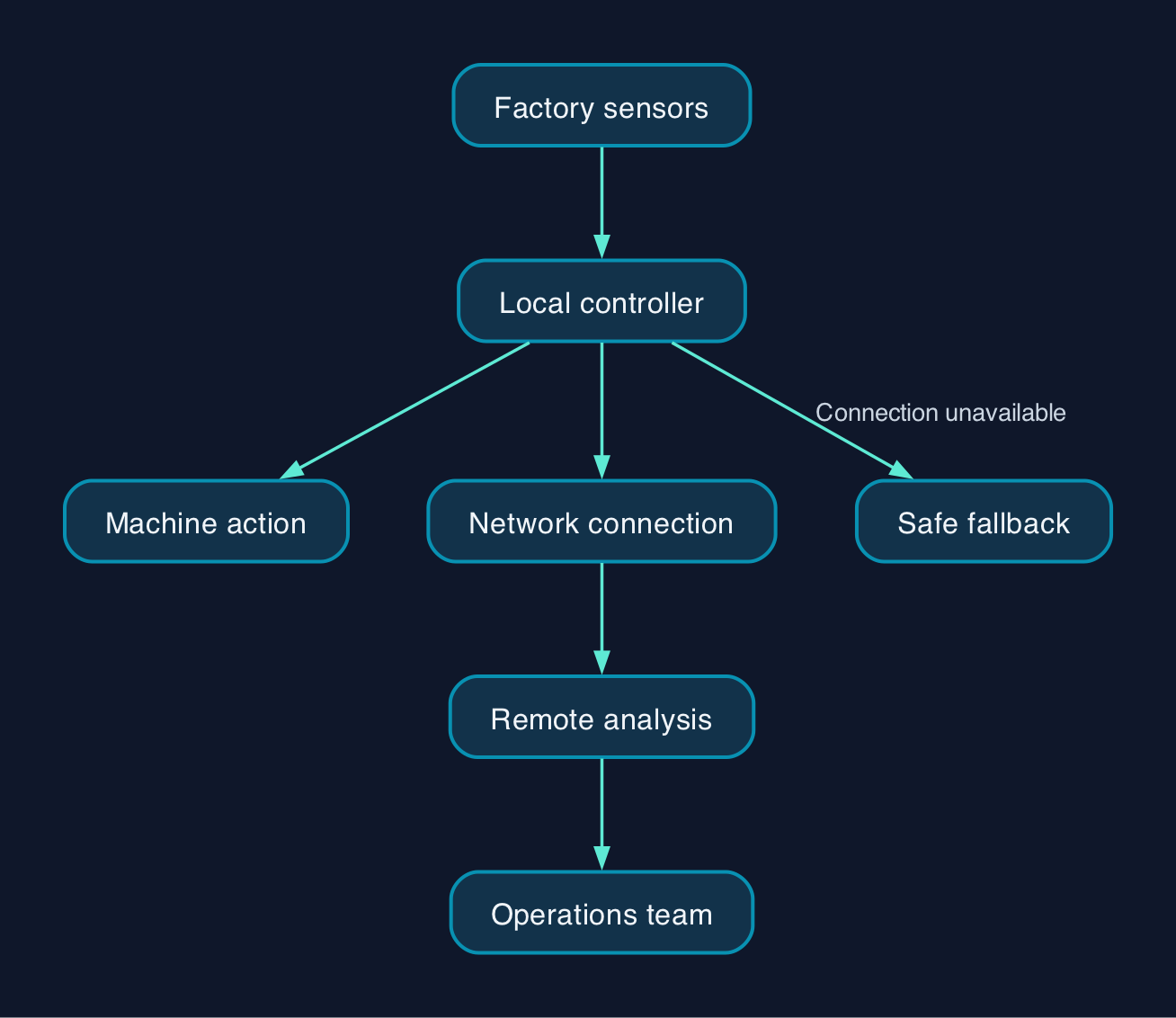
Consider a hypothetical British warehouse assessing connected mobile equipment. A sensible proposed design would send sensor readings to a local controller, which directs machine actions. A separate network connection would carry selected data to remote analysis, with results available to the operations team.
I would require that design to include a defined safe fallback when the connection becomes unavailable. The supplier should demonstrate the fallback and explain who restores normal operation.
This proposed arrangement deliberately leaves the radio choice open. The business should first identify which decisions must happen locally, which information needs to travel and which delays are acceptable.
Responsibility matters as much as architecture. Ask the equipment supplier, connectivity provider and integration partner to name who investigates a missed command, a delayed response or an unavailable service. A contract that leaves those boundaries unresolved is a poor foundation for machine operations.
Price the operational change
The supplied evidence contains no comparable UK commercial 6G tariffs. A meaningful cost comparison therefore needs quotations against a defined service, rather than invented monthly prices.
For an industrial proposal, I would request separate costs for equipment, site preparation, connectivity, local computing, software integration, testing, staff training and ongoing support. Include replacement parts, incident response and eventual migration to another supplier.
The financial test should compare the complete proposal with repairing or extending the current setup. Ask what operational benefit pays for the additional expenditure and who will measure it after deployment.
For a small British business, that may produce a straightforward decision to wait. A company without a measured connectivity problem has little reason to buy into an uncertain migration programme.
Compare delivery models before choosing suppliers
The supplier roles already emerging are different. Seoul Economic Daily’s account of KT’s 6G presentation describes an ambition to combine terrestrial and satellite coverage. It also reports that group affiliate KT SAT distributes Starlink services to business customers in South Korea.
An integrated operator proposition, a satellite service and a provider combining services are different purchasing relationships. KT, KT SAT and Starlink should not be treated as interchangeable products, nor does that Korean activity establish UK 6G availability.
British buyers should compare an operator-managed service, a locally managed network and an integrator-led arrangement against the same criteria. Require a coverage specification, supported equipment list, escalation process, service exclusions and exit terms.
The evidence here does not support ranking suppliers. It supports asking sharper questions about which party owns the complete service.
The strongest objection is that existing networks may be enough
The strongest counterargument is that industrial connectivity does not need a new generation to become useful. A business might achieve its objective by improving existing mobile coverage, using Wi-Fi or wired connections, or moving processing closer to its equipment.
South Korea’s own policy programme includes upgrading standalone 5G alongside preparing for 6G. Its approach gives British buyers no reason to suspend useful work while waiting.
There is also a credible consumer case. The ITU explicitly includes immersive communication and wider connectivity among its ambitions. Future consumer applications could make additional network capability valuable.
I accept both objections. The machine argument only survives if future deployments demonstrate benefits that cheaper alternatives cannot deliver adequately. A standards document and an industrial demonstration cannot settle that question.
Editorial analysis
British suppliers should prepare for machine applications now, but British buyers should purchase against demonstrated needs.
For suppliers, that means developing tests around a customer's operating conditions and making integration responsibilities explicit. For buyers, it means recording current failures, setting acceptance criteria and demanding evidence that a proposed upgrade changes the result.
The most convincing 6G sales presentation may eventually be a production report. Until a supplier can show that connection between network capability and business outcome, the generation number should carry little weight.
FAQ
Should a UK business delay a network upgrade until 6G arrives?
No, if the existing network is causing a documented business problem. South Korea’s national programme combines standalone 5G development with 6G preparation, rather than treating them as mutually exclusive. Specify the outcome required now and ask how the investment can be maintained or adapted later.
Does 6G guarantee reliable real-time machine control?
No. The ITU says its draft requirements do not guarantee real-world deployment performance. Require testing of the complete application, including processing delays, connectivity failures and recovery.
Will satellite connectivity be part of the opportunity?
It is part of South Korea’s stated direction, with a proposed satellite communications network linked to preparations for the 6G era in the reported space strategy. That does not establish the service characteristics of a future UK offering. Buyers should require evidence for their specific location and workload.
What should British technology suppliers do first?
Choose an operational problem and define how a customer would measure improvement. The ITU’s factory evaluation environments provide a useful signal about research priorities. Develop a testable proposition around that problem before promising a complete 6G solution.
Sources
- Korea.net, Blueprint seeks to make Korea top 3 AI power, start 6G by 2030, published 30 March 2026.
- International Telecommunication Union, Technical requirements for the 6G future, published 17 March 2026.
- International Telecommunication Union, IMT towards 2030 and beyond, supplied extract includes June 2026 developments.
- Yonhap News Agency, South Korea plans a low-Earth orbit communications network by 2035, published 3 July 2026.
- Seoul Economic Daily, KT unveils its vision for land, sea and air coverage, published 3 March 2026, AI-translated reporting.