Britain’s next energy asset class could sit hundreds of metres below ground
Britain should develop suitable salt caverns alongside credible hydrogen customers. The opportunity reaches engineering, monitoring and software, but geological potential alone cannot establish a commercial asset.

Britain should treat suitable salt caverns as strategic energy infrastructure and develop them alongside credible hydrogen customers. The Netherlands’ €450 million commitment to HyStock shows why storage deserves attention alongside production. For British businesses, the opportunity extends from underground engineering to monitoring and operational software. But geology becomes a commercial asset only when a project can demonstrate safe operation, connections and a reason for customers to pay.
Key pointers
- Assess a cavern project alongside its proposed producers, pipelines and customers.
- Ask developers to distinguish geological potential from capacity they can realistically deliver.
- Require separate figures for usable hydrogen inventory and withdrawal capability.
- Make monitoring, operating limits and data access part of the initial technology brief.
- Test the business case against delayed connections and slower customer uptake.
- Treat historical feasibility estimates as research inputs, not current supplier quotations.
The Dutch decision makes storage a commercial question
The revealing detail in the HyStock announcement is which risks the Dutch government will support. Its contribution addresses uncertain cushion-gas prices, insufficient utilisation during the early years and possible permitting delays. Construction cost overruns remain the project’s responsibility. The announcement distinguishes these risks explicitly.
That distinction should shape British thinking. A developer can build a technically sound store and still struggle commercially if customers or connecting infrastructure arrive late. My position is that public support should address demonstrable coordination problems, with project sponsors retaining responsibility for delivery.
There is a British policy precedent. In August 2023, the government proposed a storage revenue floor, incentives to sell capacity and a mechanism to share potential upside with the subsidy provider. Those were explicitly provisional proposals, not an offer on which investors could rely. The supplied evidence does not establish the terms available in September 2026. Hydrogen storage business-model proposals
For a British company assessing an opportunity, the useful question is therefore specific. Who pays if the cavern is ready before the hydrogen market is?
Britain’s advantage needs a map and a customer
The strongest geological evidence also supplies the strongest warning against exuberance. The 2026 east-coast study combines underground geology with surface constraints, including infrastructure, settlements and environmentally sensitive locations. Its remaining storage potential still requires further investigation before individual sites can be considered technically, economically, environmentally and socially viable. The researchers distinguish potential from deliverable sites.
For commercial planning, that makes a smaller, well-connected development more interesting than an enormous theoretical resource. I would prioritise sites with credible customers and a transport route over those marketed chiefly through their underground volume.
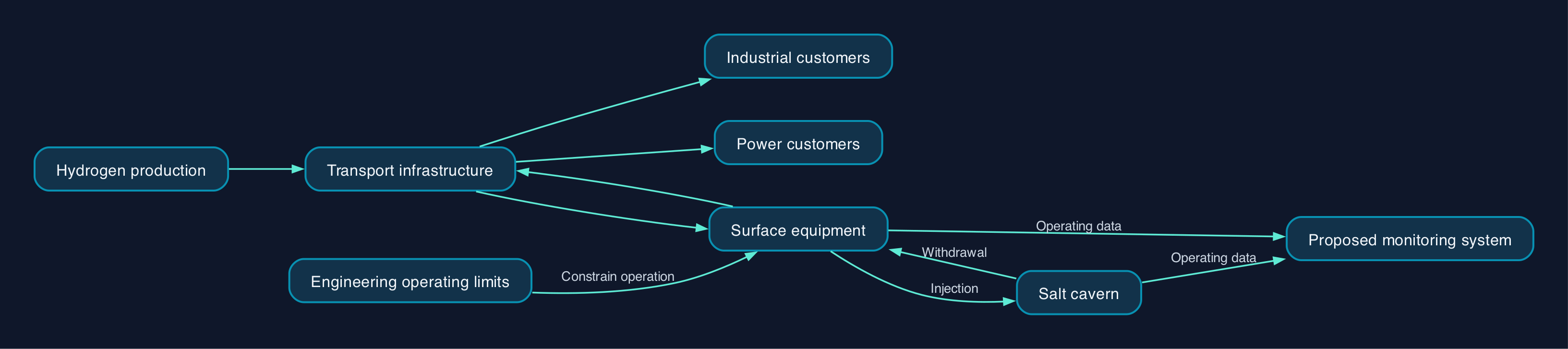
The UK’s December 2023 networks pathway made a related strategic case. It identified salt caverns, pipelines, production plants and industrial or power customers as connected requirements for early development. Its assessment provides a planning rationale, rather than evidence that those connections have since been delivered. Hydrogen transport and storage networks pathway
For most small businesses, direct cavern ownership is unlikely to be the useful entry point. A more practical commercial hypothesis is supplying a defined part of an engineering or operations contract, with a named buyer and an acceptance test.
The technology opportunity sits around the cavern
A salt cavern is created by dissolving underground salt with water, leaving a space into which hydrogen can be piped. Above-ground vessels and geological stores serve different scales and circumstances. The government’s 2022 analytical annex described vessels and road transport as quicker, lower-upfront-cost options for smaller volumes, while identifying pipelines and underground storage as potential solutions for larger volumes. Storage and transport options
HyStock’s planned Dutch development and the historical British HySecure proposal illustrate different project contexts. In the latter, INOVYN and Storengy investigated a variable-pressure cavern design. These are project examples, not interchangeable supplier offers or evidence of current procurement availability. HySecure Phase 1 summary
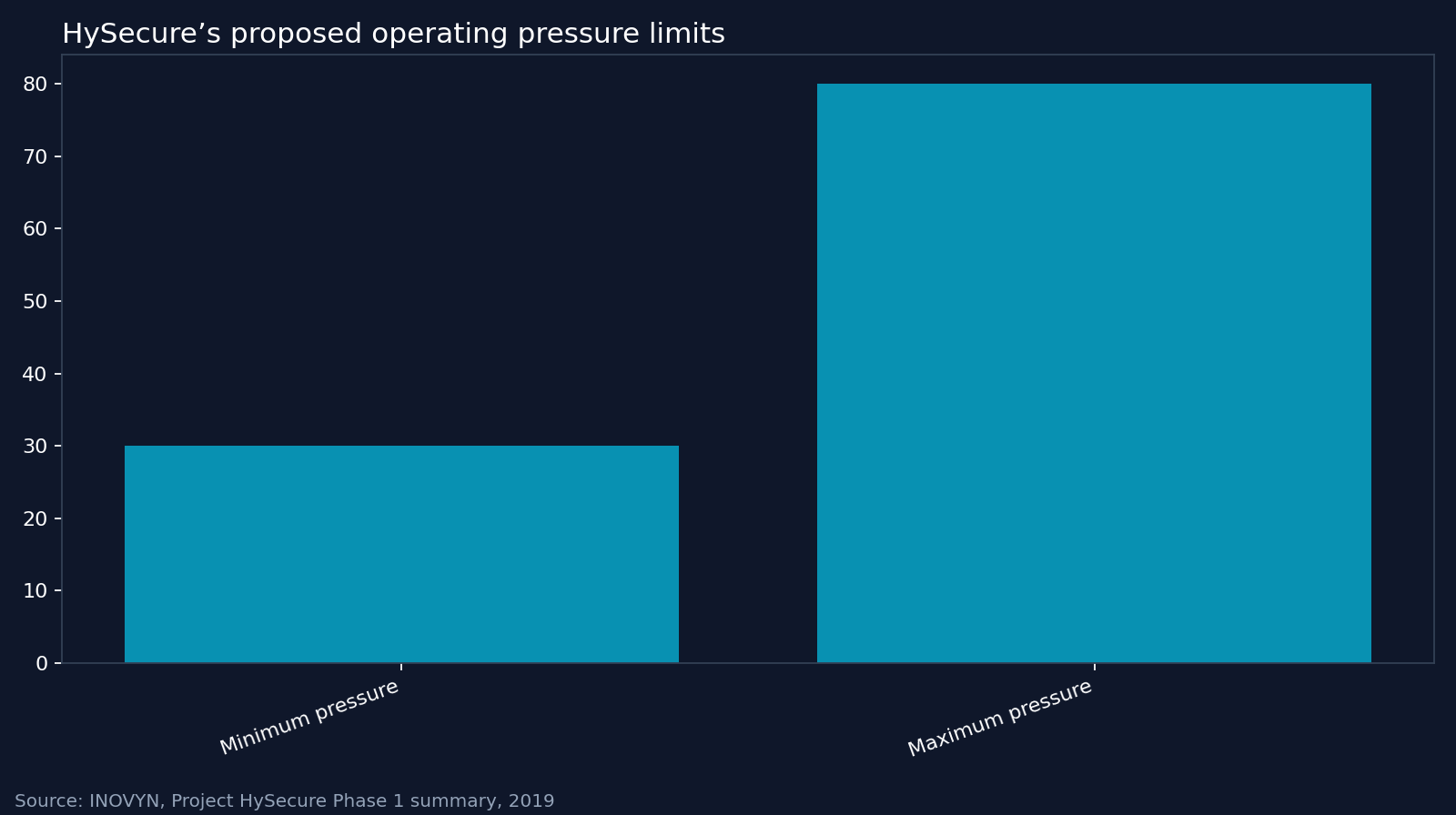
The HySecure study gives technology leaders a useful operational distinction. Its 2019 assessment estimated approximately 1,100 tonnes of working hydrogen between a minimum pressure of 30 bar and a maximum of 80 bar. Working inventory meant the quantity that could be injected and withdrawn within that pressure range; the study also imposed limits on flow rates and temperature. These were design estimates, not measured operating results. HySecure operating assumptions
That creates a concrete software brief. A proposed inventory system should distinguish gas present from gas available for withdrawal. A scheduling tool should respect the engineering operating limits. A monitoring contract should specify who investigates an anomaly and who can authorise an operational change.
Those are editorial recommendations for procurement. They are not claims that a particular platform already performs these functions or that software can replace a qualified storage operator.
Cost the service delivered to the customer
The Dutch funding announcement is a public commitment, not a UK construction quotation or a price per unit of stored hydrogen.
Even published unit costs require care. The Department for Energy Security and Net Zero’s December 2023 cost report found that sources often omitted assumptions needed for fair comparisons, including storage cycling and the allocation of compression or conversion costs. Hydrogen transport and storage cost methodology
A useful commercial assessment should request the following information.
| Cost or exposure | Question for the developer or operator |
| --- | --- |
| Site development and construction | Which investigations, wells, cavern works and surface facilities are included? |
| Hydrogen inventory | Who finances the initial inventory and gas retained to maintain operating pressure? |
| Connections and processing | Where are transport, compression and treatment charged? |
| Operations and technology | Who pays for staffing, maintenance, monitoring and software support? |
| Delayed utilisation | Who carries the cost if customers or pipelines arrive late? |
| Closure | What provision covers decommissioning and continuing responsibilities? |
This is a quotation framework, not a priced total-cost model. It combines the Dutch announcement’s commercial risks, the government cost report’s accounting cautions and the Environment Agency’s treatment of the cavern lifecycle through decommissioning. Lifecycle considerations
My preferred comparison would put each option against the same customer requirement, including quantity, delivery rate, reliability and contract duration. Comparing cavern volume alone would leave the buyer’s actual service undefined.
The strongest objection is that demand may disappoint
The strongest argument against early investment is straightforward. Britain could spend heavily on stores whose customers never materialise, or whose required operating pattern proves harder to deliver than expected.
The geological research supports taking that objection seriously. Its sharp reduction in assessed east-coast potential shows how much can disappear when development constraints are applied. Separately, the Environment Agency warns that energy-system applications could require more frequent cycling than established hydrogen feedstock storage, with further research needed into the effects on salt behaviour and cavern security. Research on frequent cycling
My answer is staged commitment. Fund site investigation and operational evidence first. Make later expenditure conditional on engineering results, credible customer commitments and connection progress. Require developers to explain how the project survives lower utilisation.
Waiting for every uncertainty to disappear is also a choice about delivery dates. Given the development timescales identified in the Dutch announcement, I would support preparing a limited set of credible sites now, while preserving clear points at which unsuitable projects can stop.
Editorial analysis
Britain should pursue this opportunity through projects that make their assumptions inspectable. Geological models, operating evidence and commercial commitments should determine which caverns advance.
For technology leaders, the immediate decision is where their organisation can contribute a verifiable capability. That might be integrating engineering data, monitoring equipment or testing operational software. Before committing a product team, identify the asset operator, the procurement route and the evidence required to accept the work.
For business owners considering hydrogen supply, ask whether storage capacity is actually connected, usable and contractually available to you. An impressive regional resource estimate answers none of those questions.
FAQ
Is underground hydrogen storage new in Britain?
No. The Environment Agency records hydrogen storage for chemical use in Teesside salt caverns since the 1970s. It also explains that larger energy-system applications would involve different operating demands, so historical experience does not settle every engineering question. Established use and new demands
Does suitable salt mean a commercially viable storage site?
No. The 2026 east-coast assessment applies geological and land-use constraints but still calls for further work to establish individual sites’ viability. A business case must also establish how the store connects to producers and customers. Site-selection research
Should a smaller hydrogen user choose cavern storage?
Start with the required quantity and delivery pattern. The government’s 2022 assessment identified above-ground vessels and road transport as potentially suitable for smaller volumes because of lower upfront costs and faster deployment. A cavern-connected service deserves consideration where its scale and connections match the buyer’s needs. Options by scale
What should a UK technology supplier do first?
Identify a specific operator problem and agree how successful delivery would be demonstrated. For monitoring or scheduling work, ask for the relevant pressure, temperature and flow constraints before proposing a system. HySecure’s feasibility study illustrates why those limits belong in the technical brief. Example engineering constraints
Sources
- Dutch government — HyStock funding announcement, 3 July 2026
- Garvey and colleagues, Geoenergy — Revising the theoretical storage potential of hydrogen in UK salt caverns, 2026
- Environment Agency — The geomechanics of hydrogen storage in salt caverns, September 2025
- Department for Energy Security and Net Zero — Hydrogen transport and storage infrastructure minded-to positions, August 2023
- Department for Energy Security and Net Zero — Hydrogen transport and storage networks pathway, 14 December 2023
- Department for Business, Energy and Industrial Strategy — Hydrogen transport and storage analytical annex, September 2022
- INOVYN — Project HySecure Phase 1 summary, updated 25 November 2019
- Department for Energy Security and Net Zero — Hydrogen transport and storage cost report, December 2023