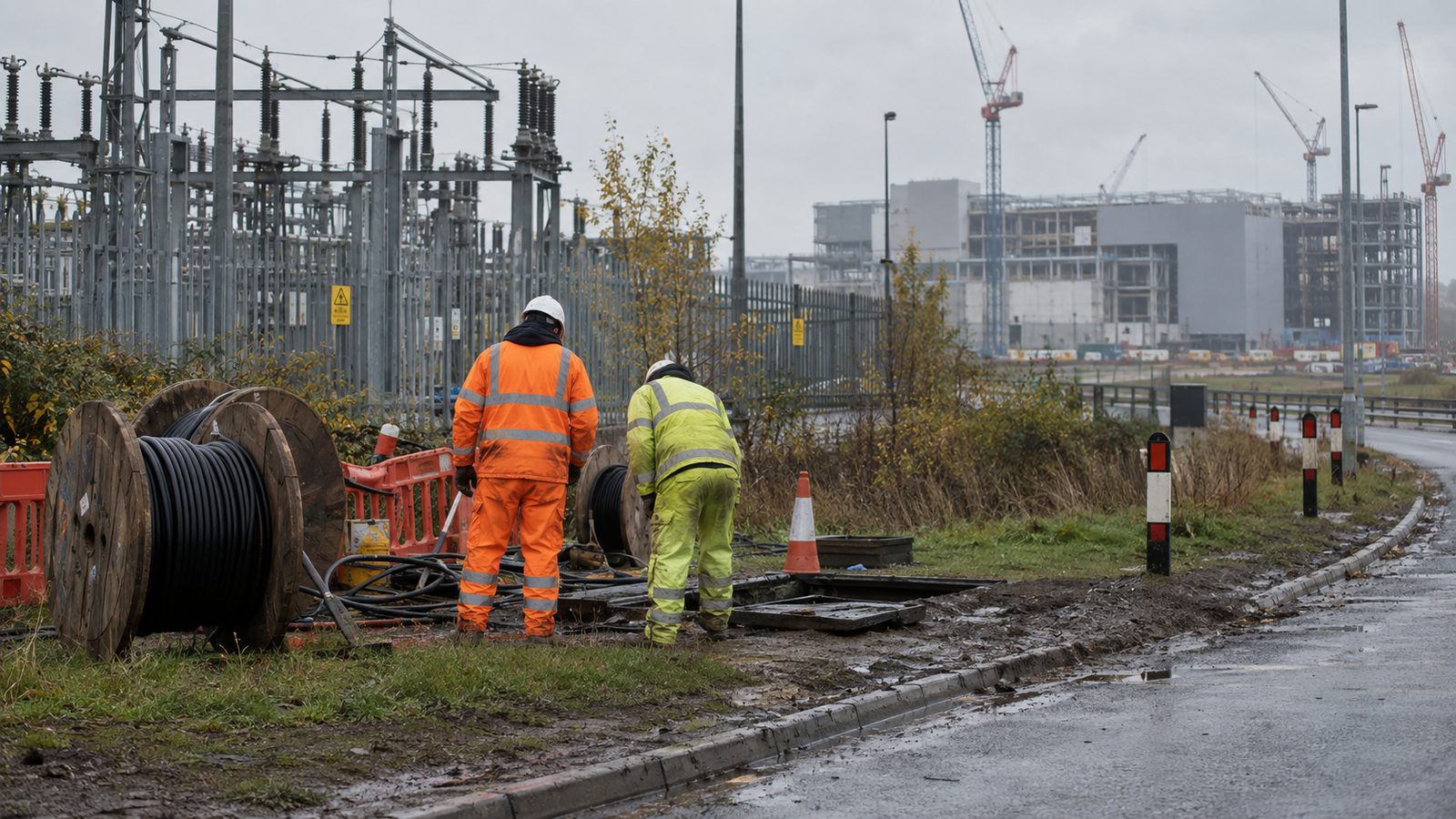

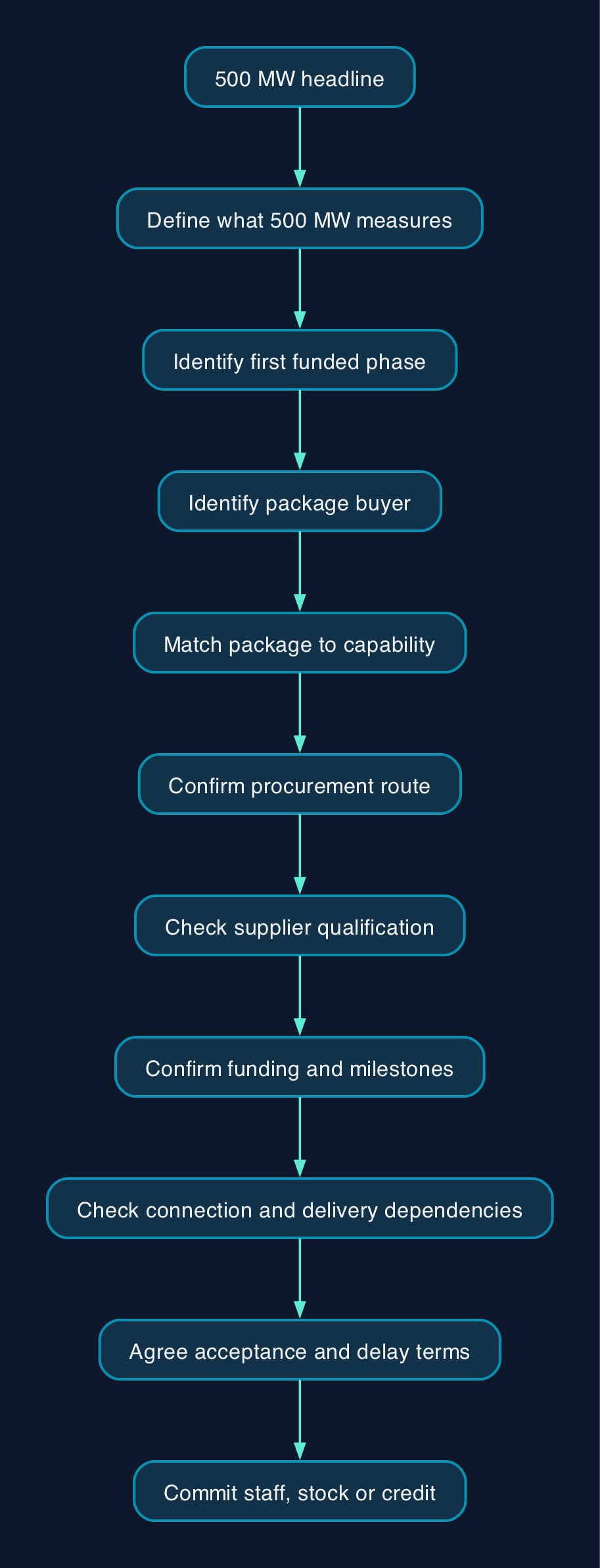
A 500 MW AI data centre should be treated as a potential pipeline of power, connectivity and support contracts, not as guaranteed local revenue. For UK small and mid-sized suppliers, the useful questions are who buys each package, when it becomes funded work and what must happen before delivery. Qualify the connection, construction phase and procurement route before committing staff, stock or credit.
Start by asking what 500 MW measures
Megawatts measure power. They do not, by themselves, describe annual electricity consumption, computing performance, fibre bandwidth or the value of local contracts.
Before treating a 500 MW announcement as a sales opportunity, ask the developer to define the number. Does it refer to the proposed grid connection, the whole campus at eventual completion, or power available to IT equipment? What capacity belongs to the first funded phase?
Those distinctions change the work you should price. A supplier quoting against the eventual campus size needs a different commitment from one delivering a defined first-stage installation.
The national context reinforces that caution. Ofgem’s figures show contracted demand offers rising from 41 GW to 125 GW between November 2024 and June 2025. Its accompanying explanation warns that the queue exceeds even ambitious demand forecasts and contains projects of varying viability. These are pipeline figures, not a forecast that every requested megawatt will become operating capacity. Ofgem’s demand queue assessment
For a local business, the commercial milestone is therefore a funded, specified package with an identifiable buyer. A planning announcement or connection application is a lead to investigate.
Where fibre, power and IT suppliers fit
Treat the campus as a set of connected responsibilities. Electricity enables the facility to operate; external connectivity connects it to other networks; internal infrastructure supports the computing workload. Each boundary needs a named owner.
The following table is a proposed way to qualify opportunities. It describes questions to resolve with the buyer, rather than confirmed packages at a particular development.
| Workstream | Potential supplier contribution | Boundary to establish before bidding |
|---|---|---|
| External fibre | Route surveys, duct construction, cable installation, splicing and testing | Who owns the route, secures access permissions and accepts the completed connection? |
| Connectivity service | Carrier access, service management and fault escalation | Who supplies the underlying network, and who carries the contractual repair obligation? |
| Grid and site power | Specialist design, civil works, equipment installation and commissioning | Where does the network operator’s responsibility end, and who authorises energisation? |
| Cooling and facilities | Installation, monitoring, maintenance and specialist subcontracting | Which equipment and performance requirements are included in the package? |
| On-site IT support | Agreed installation work, equipment handling, inventory and physical checks | Who may access equipment, approve changes and accept completed work? |
| Business-facing IT services | Application integration, migration, training and ongoing support | Is the customer the campus operator, a tenant or a separate local business? |
Fibre opportunity depends on the route
Do not translate 500 MW into a bandwidth quotation. The power headline does not specify traffic volumes, destinations, latency requirements or resilience.
Ask for the required connection points and the physical routes between them. If the buyer requires route diversity, request evidence of where the proposed paths separate and whether they share ducts, building entry points or other infrastructure.
For a local fibre contractor, a defined survey, installation or testing package may fit existing skills better than taking responsibility for an entire connectivity service. For a managed service provider, the relevant offer may instead be monitoring and fault coordination, backed by a carrier agreement.
Nearby businesses should make a separate availability enquiry. A connection built for a campus is not evidence that neighbouring premises can order the same service or obtain a lower price.
Power opportunity depends on the connection programme
The most useful power question is when a particular phase can be energised and what works must finish first.
Ofgem’s June 2026 update identifies both physical network constraints and non-viable queue entries as causes of delay. It also explores changes to the construction and ownership of high-voltage assets. Suppliers should establish the actual project arrangements rather than price on the assumption that a reform announcement has removed a dependency. Ofgem’s Connect update
Request the connection programme, equipment specifications, commissioning responsibilities and the conditions for releasing each work package. A local electrical business should define precisely which work it is qualified, equipped and insured to accept.
IT opportunity depends on access and ownership
An AI campus announcement does not identify who will purchase servers, networking equipment or support. Establish whether procurement sits with the developer, operator, tenant or a principal contractor.
A practical offer from a smaller IT supplier should name the task and its acceptance criteria. Examples include an agreed equipment inventory, an installation package with test records, or on-site checks performed under an authorised support procedure.
Separate this from selling AI services to local businesses. A nearby campus does not establish that a particular application will run there, that capacity will be available to local customers or that prices will fall.
Price the package and the delay risk
No project-specific fibre, electrical or IT quotations are available here. A defensible cost model therefore starts with scope and contractual conditions, rather than a guessed price per megawatt.
| Cost component | What to include in the quotation | Question that exposes missing cost |
|---|---|---|
| Surveys and design | Site visits, technical drawings, route investigation and revisions | Who pays if the design changes after approval? |
| Materials and equipment | Agreed specifications, procurement, transport and storage | When does the buyer commit to non-cancellable orders? |
| Installation | Labour, specialist subcontractors, access equipment and working restrictions | Who bears the cost of unavailable or unprepared work areas? |
| Testing and acceptance | Test procedures, records, inspections and remedial work | What evidence triggers acceptance and payment? |
| Delay and remobilisation | Standby time, return visits and rescheduling | What happens if power, access or another contractor is late? |
| Ongoing support | Coverage hours, travel, spares, escalation and renewal terms | Does the price include attendance, diagnosis, repair or all three? |
| Handover and exit | Documentation, training, asset records and transition assistance | What must be delivered before the contract closes? |
State the currency, VAT treatment, quotation validity and payment milestones. Keep recurring support separate from installation charges, and identify any services already included elsewhere.
Delay deserves an explicit commercial treatment. Ofgem’s December 2025 review reported some developers experiencing delays of years beyond their original connection offers, with major projects reporting substantial losses. That does not predict the outcome of a particular campus, but it supports asking who carries postponement costs before reserving labour or ordering equipment. Ofgem’s end-to-end connections review announcement
Compare delivery routes before choosing suppliers
The relevant comparison is between suppliers that can accept the same defined responsibility. A carrier, a civil-engineering contractor and a managed IT provider should not be ranked as interchangeable bidders.
For a small or mid-sized supplier, these routes offer different commercial positions.
| Delivery route | When it may suit your business | What to establish |
|---|---|---|
| Direct contract with the developer or operator | You can own a complete, clearly bounded package | Technical approval, purchasing authority, insurance requirements and payment security |
| Subcontract through a principal contractor or integrator | Your strength is a specialist installation or commissioning task | Flow-down obligations, access arrangements, acceptance and payment dependencies |
| Work through a carrier or network delivery partner | Your capability concerns routes, ducts, fibre or associated field work | Approved specifications, ownership boundaries and evidence required for handover |
| Recurring facilities or IT support | You can staff the promised coverage and escalation arrangements | Authorised tasks, response commitments, exclusions, spares and termination assistance |
These are commercial alternatives, not supplier endorsements. A named shortlist would require site-specific availability, technical documentation and comparable quotations that the available evidence does not establish.
Keep the market open to UK specialists and smaller subcontractors where their capabilities match the package. Apply the same checks to a large national bidder: a familiar name does not resolve an unclear responsibility.
Editorial analysis
For local suppliers, the strongest opportunity is work that matches an existing capability and survives a realistic delay scenario. Buying stock or expanding a team against the full 500 MW headline puts the financing risk on your business before the customer has committed to your package.
Large campuses should also be considered alongside smaller developments. Savills’ H1 2026 research argues that inference, the use of trained AI models, can support incremental 5–20 MW deployments and expansions of existing facilities. That is a market assessment rather than a guaranteed demand forecast, but it gives suppliers a reason to investigate regional upgrades as well as flagship campuses. UK data centre market research
The next useful action is to request a procurement conversation covering the first funded phase, package ownership, supplier qualification and purchasing dates. Leave with a named buyer and a defined next milestone before committing additional capacity.
Sources
- Ofgem — Demand connections update, letter dated 6 November 2025
- Ofgem — Tackling speculative data centre projects, 29 July 2026
- Ofgem — Connect update on demand connections reform, 16 June 2026
- NESO — Electricity grid connection reforms, 8 December 2025
- Ofgem — Reform package to accelerate grid connections, 8 December 2025
- Savills — UK data centre research, H1 2026