

Accounting and cash-flow software are the clearest starting point for Smart Data’s effect on UK business software, because authorised banking data sharing already supports account management and credit checks. That is CTC’s assessment of the government’s existing-use examples. For a small business, the immediate opportunity is a better connection inside its current software. Wider changes to retail, property and transport applications depend on schemes still being assessed.
Key pointers
- Check your exact bank account before buying a connection, because Metro Bank lists both eligible and excluded accounts for its Xero feed.
- Budget for historical transaction entry as well as activation, because Metro Bank’s feed excludes transactions from before it began.
- Separate access to transaction records from payment authority, since Xero’s bank feeds cannot move money.
- Treat 11:59pm on 1 October 2026 as the multi-sector evidence deadline, not a software migration deadline.
- Ask suppliers to identify an operational scheme and supported connection before giving financial value to proposed functionality.
- Test whether improving your existing connection solves the problem before committing to replacement software.
What Smart Data changes inside business software
Smart Data addresses a specific problem: a useful record sits with one organisation, while the customer wants another service to use it. The government describes secure sharing with authorised third parties and points to retail banking services as an existing application. Its ambition is to support similar, interoperable arrangements beyond banking. The programme overview establishes both the existing use and the wider direction.
For a small business, the effect could therefore appear inside a familiar application. Instead of obtaining records separately and entering them again, the application receives the information needed for a task. Whether that helps depends on which records arrive, when they arrive and what the person using them must still do.
Bank feeds make that mechanism tangible. Xero describes importing transactions, suggesting matches and allowing manual uploads. These are distinct stages: receiving a transaction does not mean the bookkeeping is finished.
CTC’s assessment is that accounting and cash-flow workflows provide the clearest starting point because working connections can already be examined. The evidence does not establish a ranking of accounting suppliers or a confirmed launch order for future Smart Data services.
What the UK roadmap actually commits to
The Smart Data Strategy, published on 26 March 2026, sets a direction for developing schemes that work together. Regulation Tomorrow’s account reports targets of 5 or more active schemes by 2030 and 20 or more by 2035. These are target minimums reported from the strategy, not current scheme counts or promised integrations for particular software.
There is a nearer date for businesses with evidence to contribute. The multi-sector call closes at 11:59pm on 1 October 2026 and covers agri-food, property, retail, trade and transport. Its stated process includes assessing data availability, governance and legal applicability, followed by formal consultation before regulatory change. The call’s scope and timetable make it an opportunity to explain a problem, rather than an instruction to replace a system.
A useful response from a retailer or transport operator would identify the information it repeatedly requests, who holds it and the work that access would remove. That is more concrete than requesting “better interoperability”, and directly addresses the call’s questions about use cases and available data.
The following assessment separates established examples from areas still being explored.
| Software area | What the evidence establishes | What it means for the reader |
|---|---|---|
| Accounting and cash-flow tools | Bank feeds can bring transactions into accounting software | Check the connection against the actual account and bookkeeping process |
| Credit and account-management services | Authorised banking data sharing already supports these services | Ask which records the service uses and what task it performs |
| Retail, property, trade, transport and agri-food applications | Government is seeking use cases and examining scheme design | Document the missing information before specifying a future integration |
| Digital-market applications | Consultation findings inform consideration of next steps | Require evidence of a working service before relying on it in a purchasing decision |
What the law means for a buyer
The official strategy page identifies the Data (Use and Access) Act 2025 as the source of powers to implement Smart Data schemes. That establishes the legal framework; it does not, by itself, identify a sharing obligation or implementation date for your business.
For the use cases in the multi-sector call, legal applicability and formal consultation remain part of the development process. Ask a supplier claiming that a change is compulsory to identify the applicable scheme, requirement and affected data.
Consent and accountability also need precise treatment. Respondents to the digital markets call asked for understandable, granular and revocable consent, alongside auditability and clear responsibility. Those are stakeholder recommendations recorded in the government response, rather than proof that an identical rule already applies to every service.
This is not legal advice; consult your legal counsel.
Follow one bank connection from setup to reconciliation
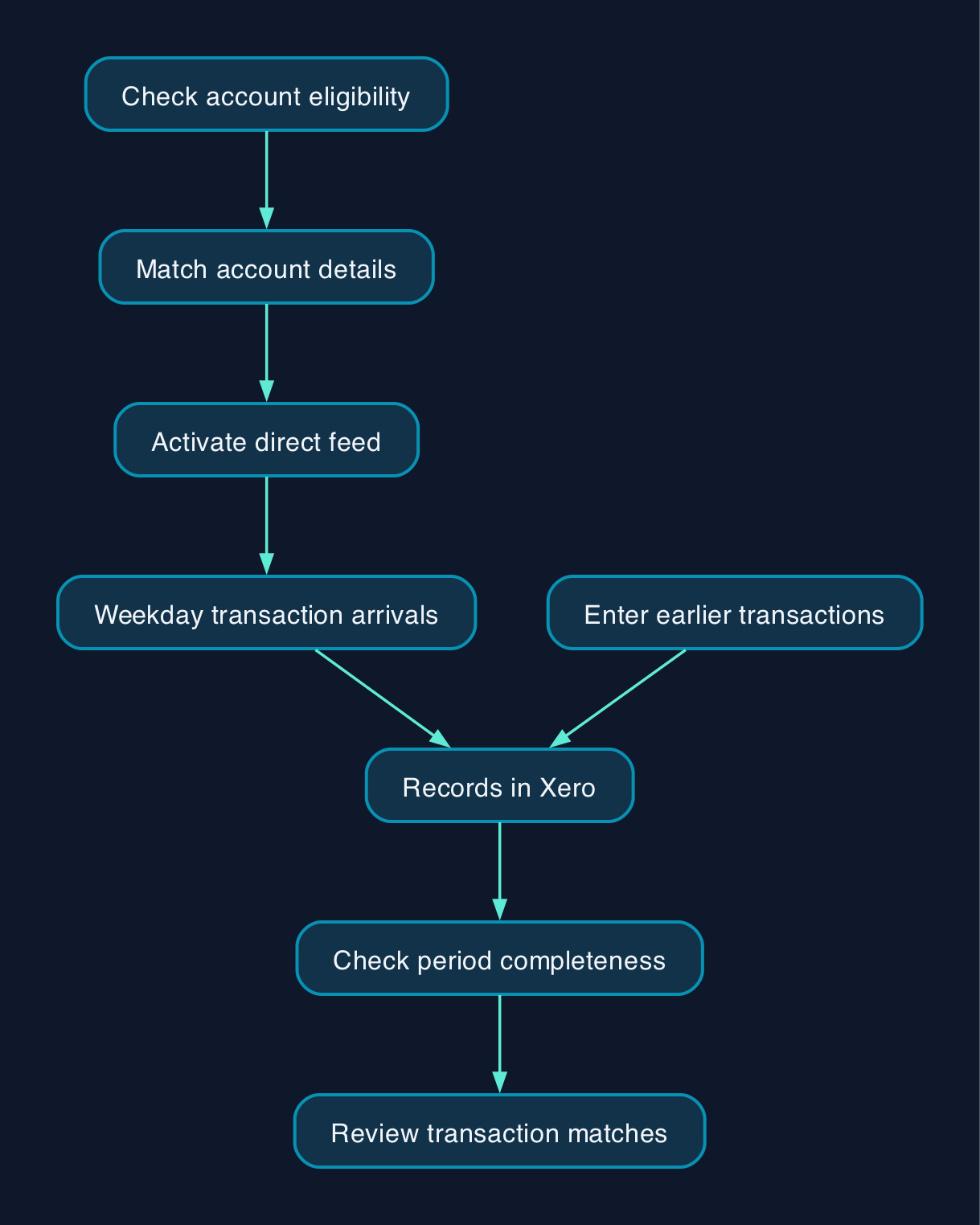
Metro Bank’s Xero documentation shows why a general claim about connected software is insufficient. The bank and the application each describe part of the service, and the specific connection determines what the bookkeeper receives.
Check the account and identity details first
Metro Bank lists its Business Bank Account and Community Current Account among eligible accounts. Its exclusions include the Business Fixed Term Deposit Account and Community Instant Access Deposit Account. The same page describes organisation-name and email-address mismatches as connection problems. The eligibility and troubleshooting information gives the person setting up the feed concrete checks before activation.
The practical consequence is simple: the bank’s name alone is not enough to establish compatibility. Record the account type and check the details used in both services.
Keep historical records separate from new arrivals
Xero’s general page describes automatic historical imports. Metro Bank’s specific page says transactions from before its feed started will not be sent. Xero’s general description and Metro Bank’s connection conditions therefore need to be read together.
For this connection, plan a separate historical entry or import task. Give the bookkeeper a defined date range to cover, then check that the historical records and incoming feed join up without a gap.
Check freshness before using the figures
Metro Bank says feeds are sent daily, Monday to Friday. In an illustrative UK shop checking its finances on Saturday, that means checking the latest transaction received before treating the accounting view as complete. The implication follows from the published feed schedule; it is not a claim about every bank feed.
Once records arrive, the bookkeeping still requires attention. Xero describes suggested transaction matches that the user confirms and states that its bank feeds cannot make payments or move money. Its product explanation separates transaction access from payment functionality.
This is an existing direct-feed example. It does not establish participation in a newly introduced Smart Data scheme.
What the connection costs and what remains unpriced
Metro Bank’s published connection fee is £1 plus VAT per month, added to the Xero subscription. This is the price stated in the supplied page extract dated 28 September 2026, rather than a complete cost for running the bookkeeping process. The bank’s pricing statement also says feeds can be set up from multiple accounts.
| Cost component | Evidence or quotation needed |
|---|---|
| Metro Bank–Xero connection | Published fee of £1 plus VAT per month |
| Accounting subscription | Confirm the required Xero plan and its billing terms |
| Historical records | Establish the work needed for transactions the feed will not supply |
| Setup | Allow for eligibility checks, matching account details and verifying activation |
| Ongoing administration | Assign responsibility for checking arrivals and completing reconciliation |
| Support | Ask who investigates a missing transaction or failed connection |
The connection fee comes from Metro Bank’s published terms. The other rows are budgeting questions, with no costs assigned here.
For future Smart Data services, the supplied evidence does not establish a standard tariff. A business case should therefore identify the actual service and price before assigning savings to it.
Editorial analysis
The useful distinction for a UK buyer is between information that can reach the software today and information that a future scheme might make available. Metro Bank’s account exclusions, weekday schedule and historical gap can already shape a setup decision. A sector’s inclusion in a call for evidence cannot yet provide equivalent operating detail.
Start with the task that fails or consumes time. If the problem is missing historical transactions, changing applications without checking historical coverage may leave the work unresolved. If the problem is information held elsewhere, identify the records and holder before asking a supplier for a Smart Data solution.
Keep the existing application, add a supported feed or use a documented manual import according to that task. Reserve a wider replacement decision for a demonstrated need that the current arrangement cannot meet.
Sources
- GOV.UK – Creating a Smart Data economy, updated 7 September 2026
- GOV.UK – Smart Data opportunities in digital markets, updated 12 May 2026
- GOV.UK – Smart Data Strategy, published 26 March 2026
- GOV.UK – Smart Data multi-sector call for evidence, published 8 July 2026
- GOV.UK – Smart Data opportunities in digital markets government response, updated 12 May 2026
- Regulation Tomorrow – Smart Data 2035 and the UK’s Smart Data Strategy, published 30 March 2026
- Xero UK – Connect your bank feeds to Xero, supplied extract dated 28 September 2026
- Metro Bank – Xero accounting software, supplied extract dated 28 September 2026