
Start by checking your invoice data, assigning responsibility and asking your accounting supplier to demonstrate structured invoice exchange. Avoid replacing a working finance system solely to meet an assumed deadline. The government has announced mandatory e-invoicing for all VAT invoices from 2029, but the official consultation response supplied for this guide does not establish an April start date. Prepare now, while keeping software commitments conditional on the final requirements.
Decide what needs to change in your business
For a small wholesaler, the useful question is whether a supplier’s invoice can reach the accounts system with its line items intact, match the purchase order and reach the right approver. For a consultancy, it might be whether the customer receives the correct project reference without someone retyping it.
These are illustrative workflows, not customer case studies. They show why preparation should begin with the handover between businesses, rather than the appearance of the invoice.
Review both sides of your process. Sending structured invoices will not resolve an incoming-bill workflow that still relies on staff copying figures from attachments.
The distinction between existing electronic documents and future requirements also needs care. HMRC’s published VAT notice allows an electronic invoice to be a PDF or XML document. That does not establish which formats will satisfy the announced 2029 regime. Ask suppliers to demonstrate structured exchange, while treating claims of future compliance as commitments requiring evidence.
Separate the announced policy from existing obligations
The November 2025 consultation response establishes the government’s intention to mandate e-invoicing for all VAT invoices from 2029. The supplied material does not establish the final technical specification, exemptions, penalties or detailed transition arrangements.
Use that distinction in procurement. A supplier should identify the published requirement behind any compliance claim and explain what remains dependent on later rules.
For existing electronic VAT invoicing, VAT Notice 700/63 says businesses do not need to notify HMRC before starting, but must satisfy themselves that their system meets the notice’s requirements. It also restricts running electronic and paper invoices for the same supplies or customers to controlled trials, unless an exception is agreed.
If you supply public bodies, check the purchasing organisation’s instructions and the regime governing your contract. The government’s electronic invoicing and payment guidance describes acceptance obligations for qualifying electronic invoices. Those obligations should not be read as a universal requirement for every UK supplier to use one particular network.
This is not legal advice; consult your legal counsel.
Assign ownership before connecting systems
A proposed workflow starts with approved invoice data in your finance system. Software then validates and transmits that data through the agreed connection. The customer’s system receives it, checks it and routes it for approval or exception handling.
Keep payment authorisation separate from successful delivery. A receipt confirms that a document arrived; your acceptance tests should establish what happens next.
| Stage | Suggested owner | Evidence needed before rollout |
|---|---|---|
| Customer and supplier records | Bookkeeper or finance administrator | Names, addresses, identifiers and routing details checked |
| Invoice creation and tax treatment | Finance lead, with accountant support | Sample invoices reconciled to the underlying transactions |
| Connection and permissions | Software supplier or IT partner | Access documented and test delivery demonstrated |
| Rejections and duplicates | Named accounts team member | Failed documents visible, assigned and resolved |
| Approval and payment | Budget holder and authorised payer | Approval permissions tested separately from receipt |
| Records and exit | Finance lead and system administrator | Invoice data, status history and readable records successfully exported |
In a smaller business, one person may hold several responsibilities. Give each failure route a named owner anyway, including cover for holidays and month-end.
Budget for the workflow as well as the subscription
Request a written quotation that separates the accounting subscription from implementation and ongoing invoice-exchange charges. For each charge, establish the currency, VAT treatment, billing commitment, included volume and renewal basis.
| Cost component | Question to put in the quotation |
|---|---|
| Accounting software | Which edition is required, and what limits apply to incoming and outgoing documents? |
| Invoice exchange | Are sending, receiving, registration and rejected-document retries included? |
| Setup and data cleanup | Who corrects records, maps fields and configures customer routing? |
| Integration | Who maintains the connection when either system changes? |
| Training and support | Are onboarding, exception handling and month-end support included? |
| Records and exit | What does it cost to retrieve invoices, attachments and status history? |
For a concrete subscription reference, the supplied UK pricing page lists post-promotional monthly figures of £18 for Ignite, £39 for Grow, £55 for Comprehensive and £70 for Ultimate. These are accounting-plan prices, not quotations for a complete e-invoicing implementation.
The supplied extract does not establish the VAT treatment, contractual commitment or full exclusions for those base prices. Confirm those terms before using the figures in an approved budget. They also do not provide an equivalent price comparison with another supplier.
Build your own total-cost estimate over a stated period. Include setup, staff training, support, usage charges and eventual exit alongside subscriptions. Leave unknown inputs open until quoted, rather than treating unpriced work as free.
Follow a controlled preparation checklist
Document the starting position
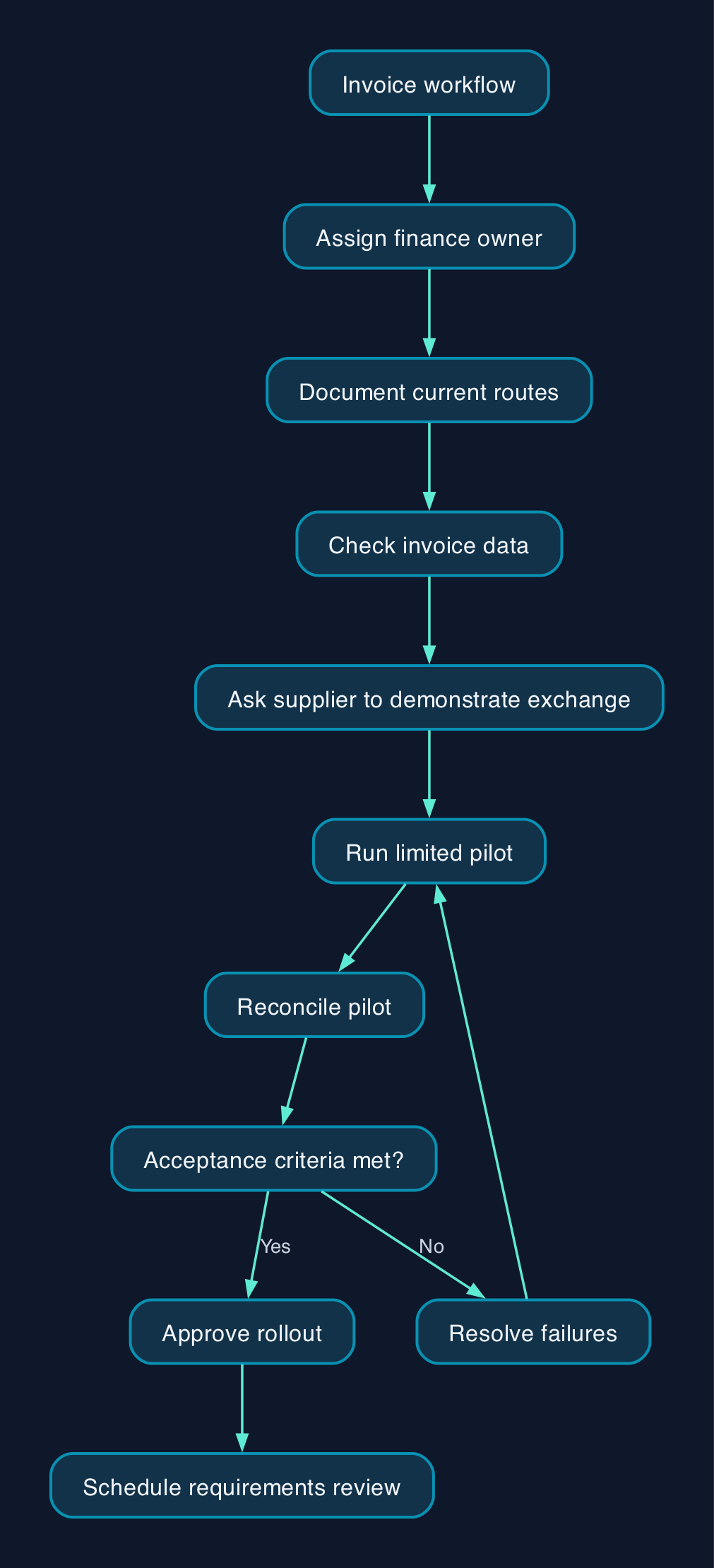
- [ ] Assign a finance owner and deputy, with responsibility recorded.
- [ ] List every route used to send and receive invoices, including customer portals and manual uploads.
- [ ] Record document volumes, rejection reasons and staff handling time over a representative billing cycle.
- [ ] Identify customers with particular invoice references, formats or submission instructions.
The completion condition is a documented workflow that someone outside the accounts team can follow.
Clean the data and test supplier claims
- [ ] Check invoice numbering, business details, customer addresses and tax fields against your accountant’s requirements and VAT Notice 700/63.
- [ ] Remove duplicate customer and supplier records after confirming which transactions belong to each.
- [ ] Ask your supplier to demonstrate sending and receiving with the exact UK edition you use.
- [ ] Record which features are available now, which need an additional provider and which are only planned.
- [ ] Export existing records and test that the export can be read before changing production settings.
Do not accept a demonstration of PDF emailing as proof that structured exchange works.
Run a limited pilot
- [ ] Choose willing trading partners and agree who checks receipt at each end.
- [ ] Test ordinary invoices, credit notes, incorrect references, duplicates and rejected documents.
- [ ] Reconcile transmitted and received amounts, tax values and document identifiers.
- [ ] Test an unavailable approver and a failed connection.
- [ ] Train staff to locate a rejected invoice and recover it without creating a duplicate.
Before issuing live documents, agree which copy is authoritative. The HMRC notice’s controlled-trial provisions matter if the pilot involves electronic and paper invoices for the same supplies.
Approve rollout and recovery
- [ ] Define acceptance criteria covering delivery, correct posting, exception visibility and retrievable records.
- [ ] Obtain finance sign-off after reconciling the pilot.
- [ ] Document how to pause the connection, reconcile in-flight documents and resume safely.
- [ ] Agree a fallback route with trading partners that meets the rules applicable at the time.
- [ ] Schedule a requirements review when the government publishes further implementation detail.
A rollback should preserve the record of what was sent. Switching off a connector without reconciling outstanding documents is not a complete recovery procedure.
Compare suppliers against the same acceptance test
Start with the software you already operate. Replacing it is justified only if an upgrade or connection cannot meet your tested requirements at an acceptable cost.
Consider several candidates rather than assuming one accounting brand owns the answer.
Use these questions to make the comparison concrete.
| Candidate | Test to request | Decision condition |
|---|---|---|
| Xero | Demonstrate the draft-bill and invoice-exchange workflow described on its UK product page in your organisation | Retain or shortlist only if the exact account, trading partners and required documents work |
| Sage | Identify the exact product and edition, then demonstrate sending, receipt and rejection handling | Require written clarity on included functionality and additional services |
| QuickBooks | Demonstrate the complete workflow, including any connector and its support arrangements | Establish who resolves failures across supplier boundaries |
| Zoho Invoice or a broader Zoho accounting proposal | Show where invoice creation ends and bookkeeping, approval and reconciliation take place | Avoid leaving staff to bridge an untested gap manually |
| Invoice Ninja or another technically managed option | Demonstrate exchange, maintenance, permissions and export arrangements | Proceed only with a named operator and funded support |
These are evaluation criteria, not verified feature ratings. The available evidence does not support declaring a universal winner or confirming future compliance for any candidate.
If you outsource implementation, require the provider to price onboarding, field mapping, testing, staff training and handover separately. Ask who owns the connection and records when the service ends.
Editorial analysis
The strongest preparation work is useful even if the final specification changes. Correct customer records, visible rejected invoices and tested exports address identifiable weaknesses in today’s process.
A premature replacement creates a different risk. You could incur migration and training costs before establishing whether your existing supplier can deliver the required connection.
Our recommendation is to fund discovery and a limited pilot first. Make a larger commitment when the supplier can demonstrate your workflow, explain its unresolved dependencies and offer acceptable support and exit terms.
Sources
Dates below are publisher dates where established in the supplied material. Undated product and pricing extracts were supplied for this article on 28 September 2026.
- HMRC and Department for Business and Trade, Promoting electronic invoicing across UK businesses and the public sector consultation response, updated 26 November 2025.
- HMRC and Department for Business and Trade, Government sets out plans for e-invoicing overhaul to cut paperwork, published 13 February 2025.
- HMRC, Electronic invoicing VAT Notice 700/63, updated 26 May 2022.
- UK Government, Guidance on Electronic Invoicing and Payment, publication date not established in the supplied extract.
- Xero, UK eInvoicing software, undated.
- Xero, UK pricing plans, undated.