UK businesses should plan to retire 2G-dependent connections now, but should not automatically replace every device with 5G. Start by checking whether existing equipment can accept a supported communications upgrade. Choose the replacement around movement, message size, power and response time. UK operator schedules now place nationwide retirement starts in 2029 and VodafoneThree’s switch-off in spring 2030, with earlier local trials.
Start with the service your business would lose
The buying decision is about preserving a working service. Before requesting replacement hardware, identify what each connection does, who notices a failure and who must respond.
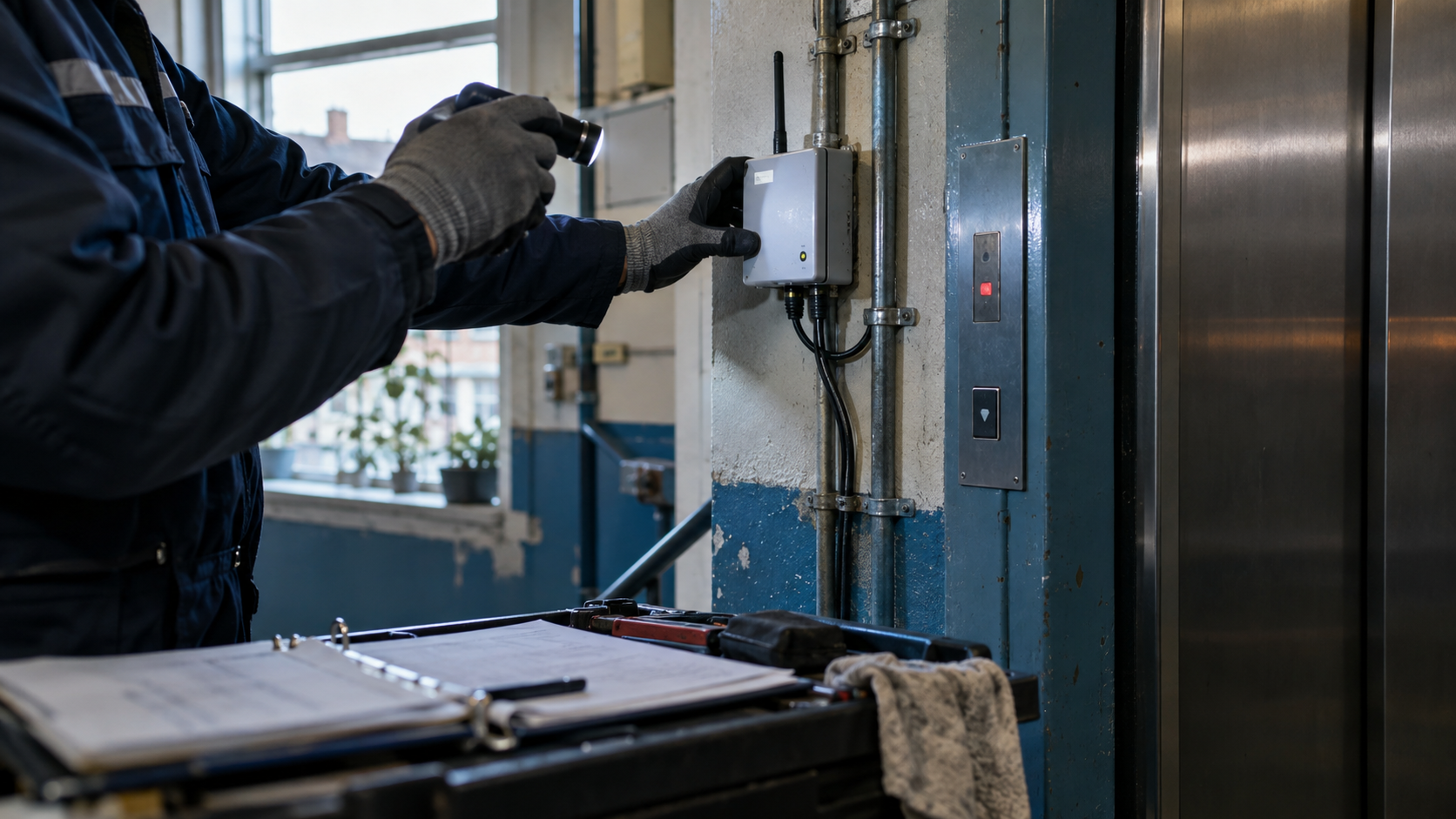
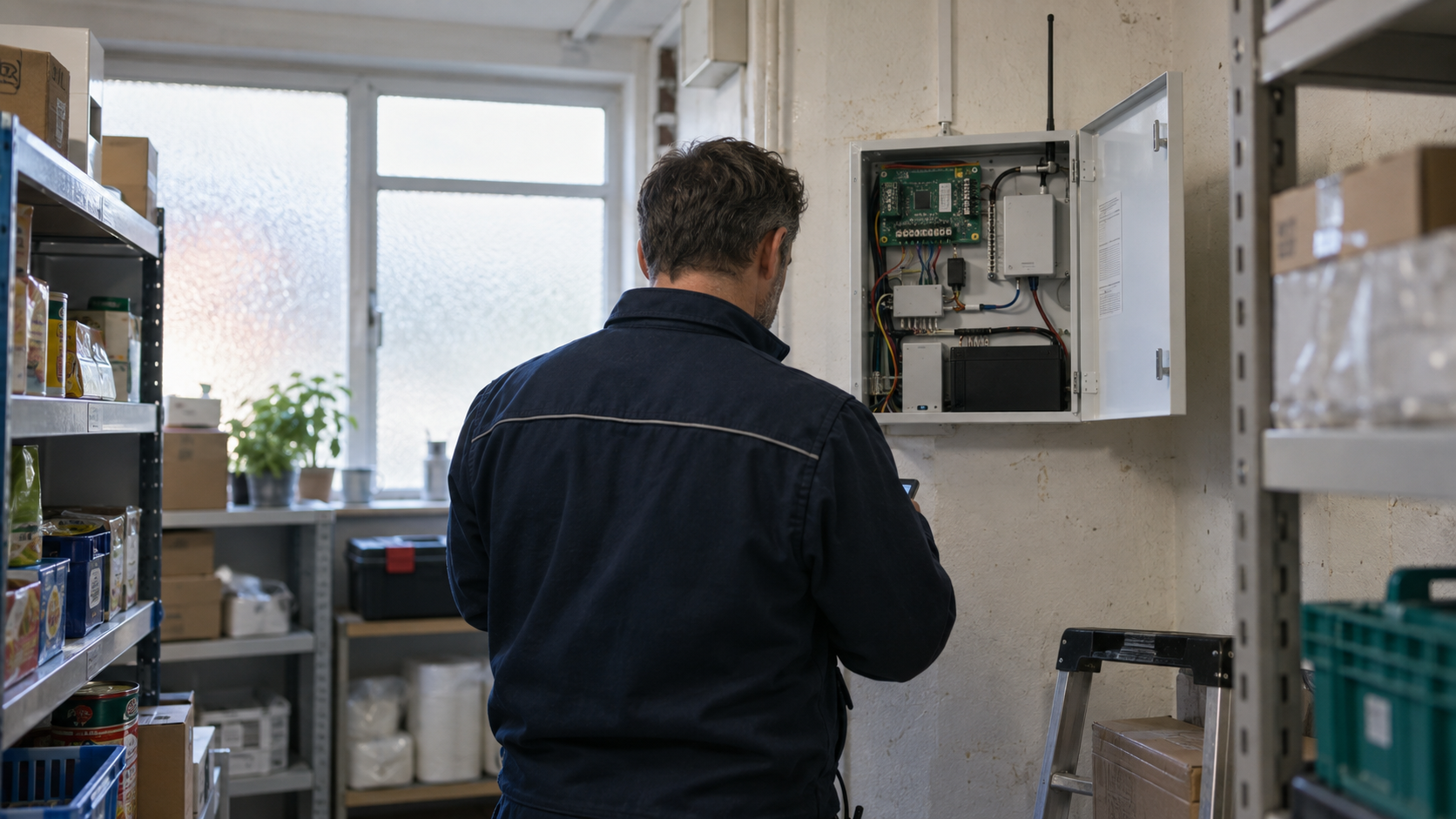
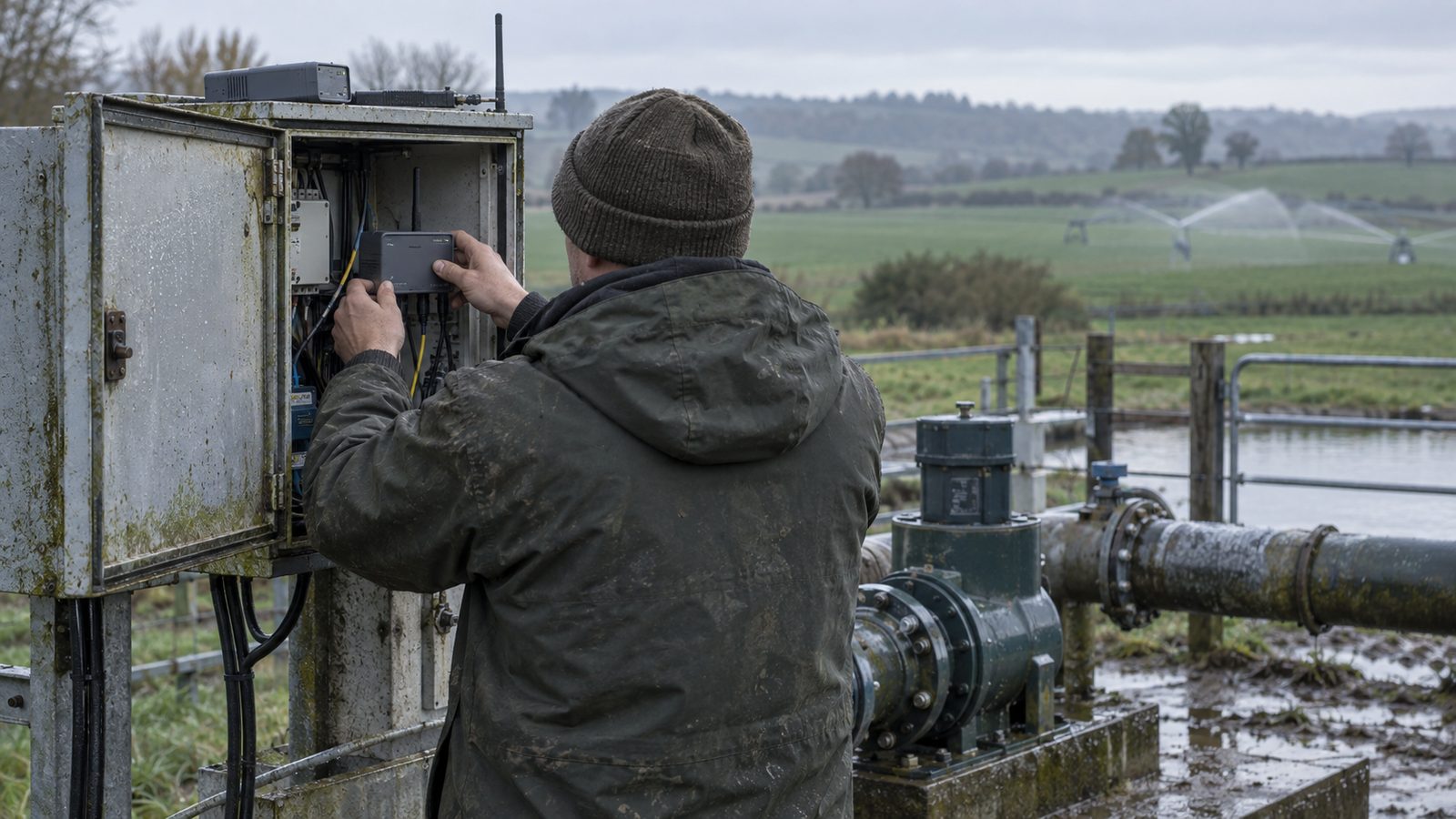
For a small business, begin with equipment maintenance contracts and connectivity invoices. Ask the suppliers responsible for alarms, tracking or remote monitoring to identify the modem, SIM provider, underlying network and supported replacement route. Do not assume the company maintaining the equipment also supplies its connectivity.
The government’s preparation guidance specifically advises users of affected smart devices to check compatibility with their service provider. For an installed system, request that answer against its exact model and firmware version.
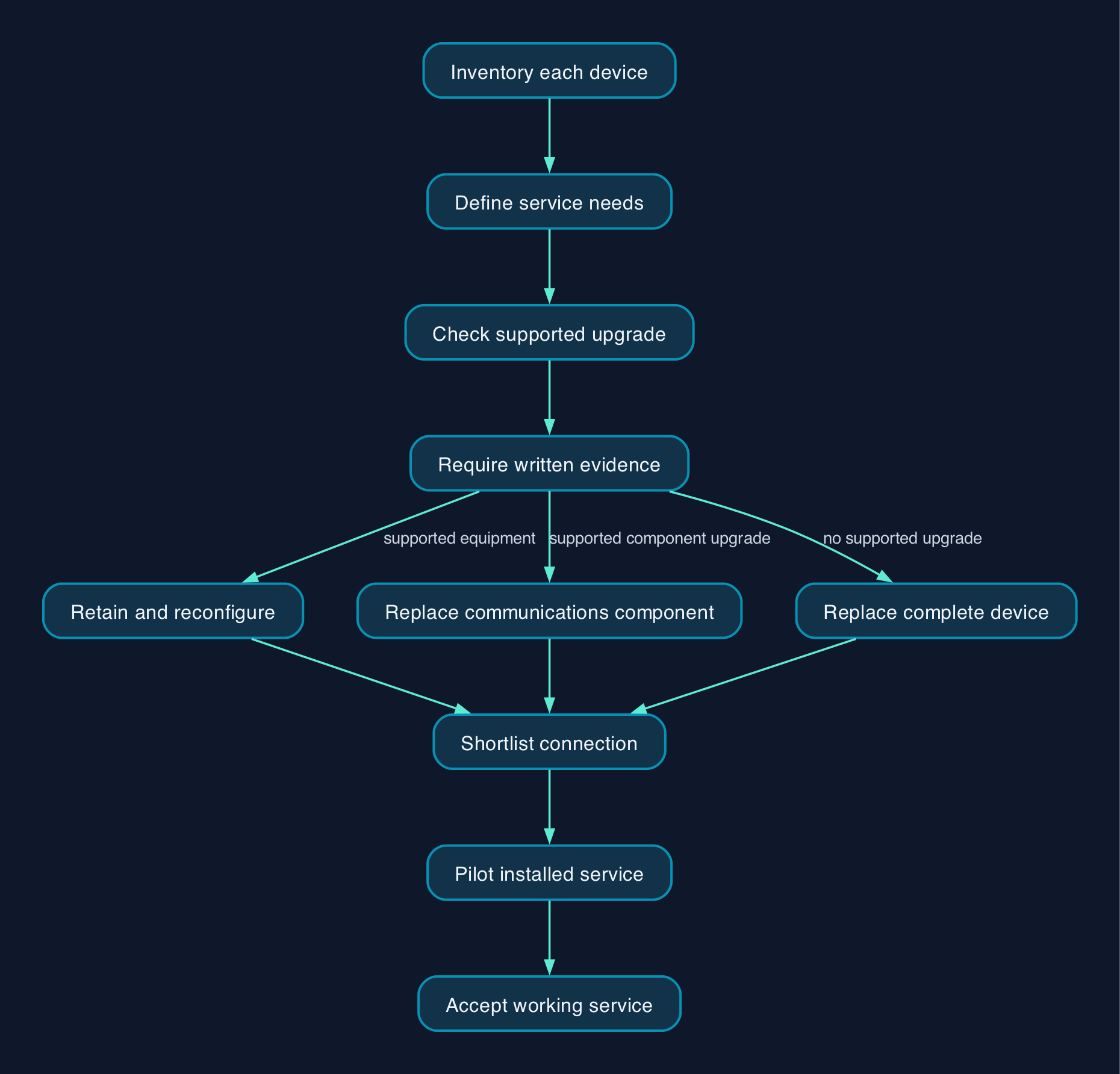
Sort the estate into three purchasing decisions.
- Retain and reconfigure where the manufacturer confirms that the installed equipment already supports an appropriate replacement connection.
- Replace the communications component where a documented upgrade preserves the useful sensor, controller or alarm system.
- Replace the complete device where no supported upgrade exists or its installation and support costs make replacement preferable.
These are assessment routes, not assurances that a particular product can be upgraded. Require written compatibility evidence before ordering parts.
Do not schedule work against 2033 simply because that date appears in older material. The original announcement set an outer limit; the subsequent operator timetable provides earlier planning dates.
Define the replacement connection before choosing hardware
Write a short requirement for each device group. Record whether it moves, its power source, message frequency, largest transfer, acceptable delivery delay and any voice or text-message dependency. Include remote configuration and software updates in the requirement, rather than sizing the connection around routine readings alone.
The technology comparison below is an editorial shortlist. It does not establish that every UK operator, SIM or device supports every listed function.
| Connection | When to investigate it | What must be demonstrated before purchase |
|---|---|---|
| 4G LTE, including Cat-1 bis | General equipment replacement, moving assets and applications needing more throughput than low-power sensor connections | Exact modem compatibility, required voice or messaging functions, site coverage and power consumption |
| LTE-M, also called Cat-M1 | Battery-powered tracking and telemetry where movement or more frequent interaction matters | UK network access under the proposed contract, mobility behaviour, power settings and application response |
| NB-IoT, meaning Narrowband Internet of Things | Stationary sensors sending small readings where delays are acceptable | Delivery time, coverage inside the installed enclosure, battery performance and remote maintenance |
| 5G | A measured requirement for capacity that the shortlisted 4G equipment cannot satisfy | The required 5G mode, device support, local availability and a justified additional cost |
| Ethernet or Wi-Fi | Fixed equipment whose manufacturer supports connection through the premises network | Supported interfaces, network ownership, power resilience and separation from inappropriate local access |
| A local sensor network and gateway | Groups of sensors where a supported gateway design could consolidate connections | Device compatibility, radio coverage, gateway maintenance and the consequences of gateway failure |
Onomondo’s service documentation describes Cat-1 bis as supporting mobility on standard LTE and LTE-M as a low-power option for moving assets. It also states that its own 5G support is non-standalone, with standalone 5G unsupported. That is a useful example of why a quotation saying “5G” needs a more precise specification.
For NB-IoT, Verizon’s technical guidance identifies stationary, infrequently transmitting and delay-tolerant devices as suitable applications. This supports the selection criteria, not a claim about Verizon service availability in the UK.
The available evidence does not establish a specific Ethernet, Wi-Fi or local-gateway replacement product. Treat those routes as questions for the equipment manufacturer, rather than assuming an adapter will preserve the existing service.
Put throughput figures in context
Murata’s published NB-IoT description gives upstream throughput of 62.50 kbps and downstream throughput of 26.15 kbps. These are supplier reference figures, not measured results from a UK installation or universal limits for every NB-IoT implementation.
Their purchasing relevance is the difference between sending a small reading and receiving a larger update. Ask the supplier to demonstrate both tasks with the proposed hardware and connection. A successful reading does not establish that remote maintenance will meet your operational requirements.
Assign responsibility across the whole service
Use the following as a proposed responsibility model. Adapt it to the maintenance and connectivity contracts you actually hold.
| Part of the service | Proposed accountable party | Evidence needed for acceptance |
|---|---|---|
| Sensor, alarm or controller | Equipment supplier | Supported replacement design and correct operation |
| Modem, antenna and firmware | Equipment supplier or appointed installer | Exact compatible parts, configuration record and installed test results |
| SIM and mobile service | Connectivity provider | Permitted networks and technologies, tariff, support scope and escalation route |
| Receiving application or monitoring centre | Application provider or monitoring contractor | Correct receipt, interpretation and handling of messages |
| Ongoing ownership | Named business service owner | Inventory, renewal dates, incident process and approved change records |
For an illustrative refrigerated-storage installation, the acceptance test should cover the reading reaching the application and the alert reaching the person responsible for responding. Testing only whether the modem connects leaves the business outcome untested.
Ask who will diagnose a failure that crosses contractual boundaries. The equipment supplier, connectivity provider and application operator should agree an escalation process before rollout.
The switch-off charter is a voluntary industry commitment. Its notice and coverage provisions do not replace this allocation of operational responsibility.
Price the migration and its operating life
No comparable UK tariffs or hardware quotations are established by the available evidence as at 28 September 2026. A defensible buying exercise therefore starts with cost components and quotation requirements.
Ask each bidder for GBP prices, VAT treatment, minimum quantities, contract commitment, renewal terms and exclusions. Compare the same device inventory, support scope and ownership period.
| Cost component | What the quotation should include | Question that prevents an incomplete comparison |
|---|---|---|
| Equipment | Modems or complete devices, antennas, batteries and mounting parts | Which existing components can remain under support? |
| Installation | Survey, travel, access arrangements, fitting and commissioning | Are repeat visits and difficult locations included? |
| Connectivity | Activation, recurring service, data allowance and any required messaging | What triggers additional charges or suspension? |
| Application integration | Configuration, credentials and receiving-system changes | Who proves that messages and alerts still work? |
| Testing and overlap | Pilot equipment, acceptance testing and parallel service | When can the old contract safely end? |
| Operations | Monitoring, support, staff training and maintenance | Who handles failures outside normal working hours? |
| Exit | Data export, configuration handover and provider change | What can the business retain or transfer at termination? |
Assumptions for comparison
Use the same planned operating life and service requirements for every bid. Record uncertain quantities, such as repeat site visits or battery replacements, separately.
Calculate total ownership cost as equipment, deployment, integration and training, plus connectivity and operations over that period, plus exit costs. Deduct charges only where the contract confirms that they are bundled.
Do not produce a complete total while material inputs remain unknown. For a small estate, compare the installer’s fixed commissioning charge as carefully as the recurring SIM charge.
Migration and rollout checklist
For alarms or other safety-related equipment, agree the change with the responsible maintainer before disconnecting anything. Do not conduct an unannounced interruption as a connectivity test.
- [ ] Complete the inventory. Record each device’s location, model, firmware, connection, supplier and business owner.
- [ ] Confirm the deadline. Obtain the relevant operator or provider schedule, including any local trial affecting the site.
- [ ] Approve the replacement route. Keep written manufacturer confirmation for retained equipment and replacement components.
- [ ] Set acceptance criteria. Define message delivery, alert handling, response time and recovery behaviour before the pilot.
- [ ] Preserve configuration. Back up settings and record permissions, credentials ownership and the receiving application’s configuration.
- [ ] Pilot representative installations. Include difficult locations, actual enclosures and moving routes where applicable.
- [ ] Prove independence from 2G. Have the supplier demonstrate the complete service over the intended replacement connection.
- [ ] Test agreed failure scenarios. Check loss of signal, loss of power and recovery under controlled conditions.
- [ ] Exercise support. Confirm that the service desk can identify the device and follow the agreed escalation route.
- [ ] Prepare rollback or contingency. Document how service will be maintained if the migration fails; do not rely on a retired network.
- [ ] Train the owner and users. Demonstrate fault recognition, escalation and any changed operating procedure.
- [ ] Close the old service deliberately. Obtain acceptance, update the inventory, cancel redundant charges and arrange appropriate equipment disposal.
Compare suppliers against the same requirements
Compare delivery routes as well as radio technologies. A connectivity contract and a fully maintained equipment service answer different needs.
| Supplier or route | What the evidence establishes | What remains to be confirmed |
|---|---|---|
| Existing equipment maintainer | Government guidance directs affected smart-device users to their service provider | Upgrade compatibility, installation scope, acceptance testing and continuing maintenance |
| O2 | Its business page identifies LTE-M and NB-IoT | Current availability for the proposed site and contract, device support, tariff and service features |
| Onomondo | Its coverage documentation describes network selection, supported technologies and diagnostic facilities | Exact UK networks permitted for the proposed SIM, technology access, support commitments and total charges |
| 1oT | Its coverage page advertises access to several cellular technologies through one SIM | The extracted material does not establish the required UK network entries, contract conditions or installed performance |
Also request an equivalent proposal from your existing EE or Vodafone-based service provider where relevant. The government timetable establishes retirement plans, but does not substantiate a particular replacement package or tariff.
For multi-network proposals, require a list of the UK networks and technologies accessible under the actual offer. Ask the supplier to demonstrate switching and recovery with the proposed device. A global network count is not evidence that every network is available to your installation.
If your business lacks device-management skills, seek an accountable installation and support service alongside connectivity. If an internal team already maintains the application and hardware, buying connectivity separately may be practical. Compare who performs each task before comparing prices.
Editorial analysis
CTC’s recommendation is to replace the dependency on 2G while preserving supported equipment where the evidence and costs justify it.
Shortlist NB-IoT for stationary, delay-tolerant readings. Investigate LTE-M for low-power equipment that moves or needs more interaction, and ordinary 4G for broader requirements. Require a measurable reason to pay for 5G. These are starting positions for testing, not universal product recommendations.
The most useful next action is an inventory with an accountable owner and a supplier-confirmed replacement route for each device group. That gives the business something concrete to procure, test and schedule.
Sources
- DSIT and DCMS — Telecommunications Modernisation Connectivity Timeline, updated 29 July 2026
- DSIT and DCMS — 2G Switch-off Charter, updated 15 September 2026
- DCMS — Joint statement on the sunsetting of 2G and 3G networks, published 8 December 2021
- DSIT and DCMS — Preparing for the 2G switch-off, updated 29 July 2026
- Murata — LTE Cat.M1 and NB-IoT modules
- Verizon — LTE-M and NB-IoT technical overview
- O2 Business — LTE-M and NB-IoT
- Onomondo — IoT coverage and supported technologies
- 1oT — Cellular IoT coverage