


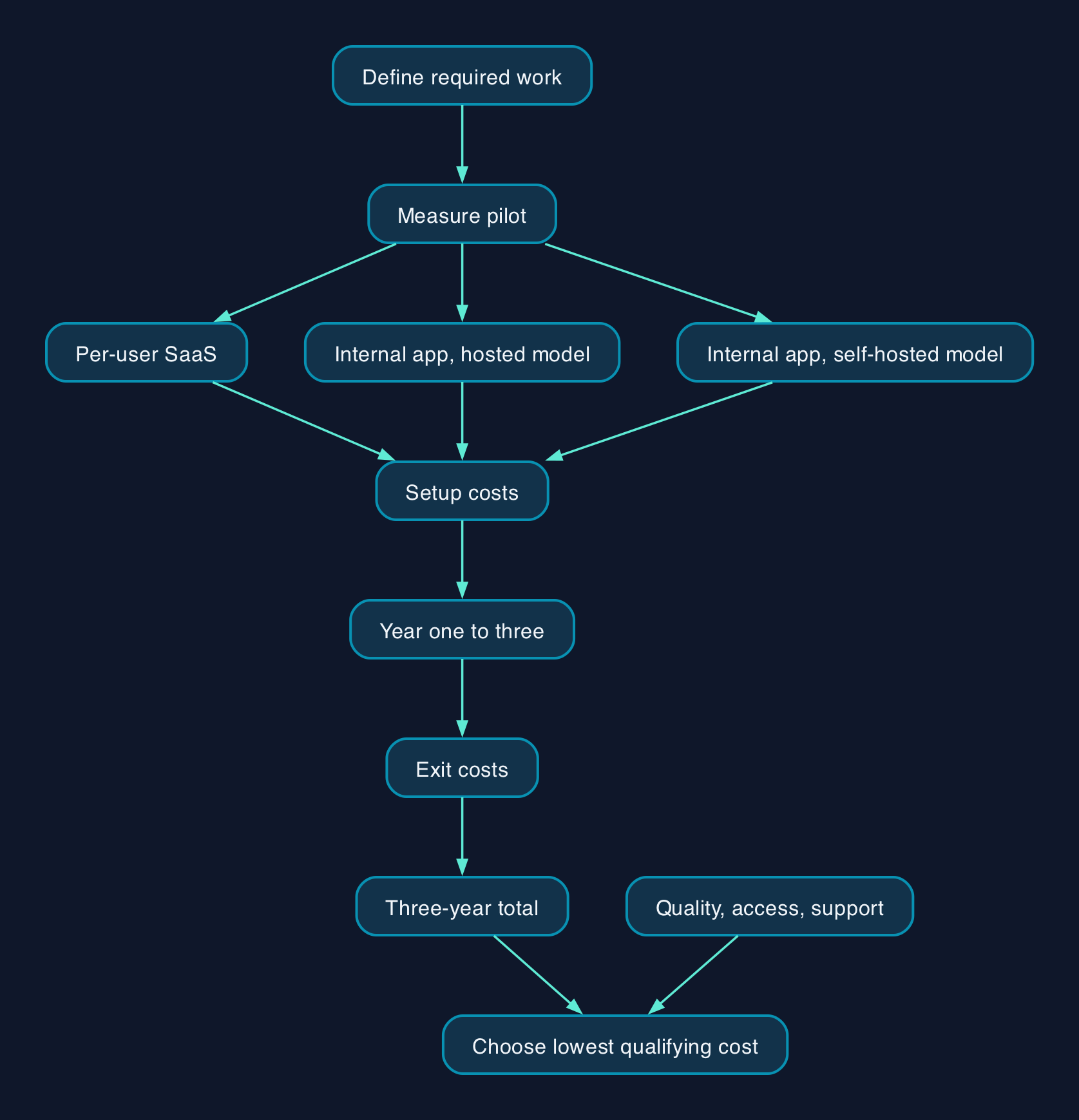
Compare the cost of delivering the same useful work over 36 months, including setup, staffing, support and exit. Build separate totals for a per-user service, an internal application using a hosted model, and an application running its own model. Start with a measured pilot and your existing software contracts. Choose the lowest-cost option that meets your quality, access and support requirements, rather than the one with the cheapest licence or inference rate.
Define the work before comparing prices
Write a short acceptance brief before asking for quotations. For a hypothetical UK wholesaler, the requirement might be to answer staff questions from approved product manuals and internal procedures, while respecting each employee’s document permissions.
That is a narrower requirement than an assistant embedded throughout email, spreadsheets and meetings. Do not charge an internal document assistant with replacing those additional functions unless the pilot demonstrates that it can.
Record the following inputs.
| Input | What to establish |
|---|---|
| Users | Eligible staff, expected active users and paid seats required |
| Work | Questions, documents and tasks the assistant must handle |
| Quality | An agreed test set and the conditions for accepting an answer |
| Demand | Requests per working day, document updates and peak simultaneous use |
| Access | Which users may retrieve which information |
| Service | Required operating hours, response times and recovery arrangements |
| Ownership | The person responsible for content, access, support and spending |
Keep eligible users, active users and simultaneous requests separate. Use paid seats to calculate subscription expenditure; use observed demand and peak load to size an internal service.
For a UK budget, record GBP quotations where available. For overseas charges, retain the original currency and have finance supply a dated budgeting exchange rate. Show VAT separately and ask finance which amounts belong in the cost comparison.
Map the architecture and its owners
Cost three delivery approaches separately. An internal application calling a hosted model belongs in a different column from one running the model itself.
The proposed responsibility map below is a budgeting template. Confirm the actual allocation in each supplier’s contract.
| Responsibility | Per-user SaaS assistant | Internal application with hosted model | Internal application with self-hosted model |
|---|---|---|---|
| User interface | Supplier product; customer configures adoption | Customer or implementation provider | Customer or implementation provider |
| Document access | Customer checks permissions and connector scope | Customer builds and maintains access controls | Customer builds and maintains access controls |
| Model processing | Supplier service | External model API provider | Customer or contracted infrastructure operator |
| Application support | Supplier support plus internal administration | Customer or support partner | Customer or support partner |
| Capacity | Check subscription limits and extras | Manage API limits and application capacity | Size, operate and renew model-serving capacity |
| Exit | Verify available exports and account closure | Transfer application, data and model connections | Transfer application, data, infrastructure and operating knowledge |
For an assistant answering from company documents, budget for retrieval-augmented generation, or RAG. This means retrieving relevant material and providing it to the model with the question. The supplied research blueprint offers an architectural starting point, but its abstract says practical benefits remain under assessment through ongoing case studies and interviews. It does not establish a production cost or return on investment.
Ask whoever proposes the system to identify every external connection, including model calls, logs, monitoring and backups. A company-controlled chat interface alone does not establish where the whole service processes data.
Build the three-year cost model
Use a workbook with separate columns for setup, year one, year two, year three and exit. Against each entry, record the quantity, unit price, evidence date, owner and whether it is a quotation, measurement or assumption.
Use this calculation for each option.
Three-year total cost = setup + year-one operation + year-two operation + year-three operation + exit − supported residual value.
Only subtract a hardware resale value if you have a defensible basis for it. Keep potential productivity benefits outside this cost total.
Include the work around the software
| Cost component | Per-user SaaS inputs | Internal assistant inputs |
|---|---|---|
| Discovery and pilot | Trial licences, evaluation and staff time | Prototype, evaluation and engineering time |
| Deployment | Configuration, access cleanup and connections | Application development, hosting setup and access controls |
| Data preparation | Document cleanup and connector configuration | Cleanup, ingestion, indexing and update processes |
| Recurring technology | Seats, prerequisite plans and usage extras | Model API usage or compute, storage, networking and software |
| People | Administration, training, support and answer checking | Those activities plus maintenance, releases and operational cover |
| Resilience | Required support tier and continuity arrangements | Backups, recovery testing, spare capacity and incident response |
| Changes | New users, configuration and subscription changes | New integrations, model changes and regression testing |
| Exit | Export, migration, overlap and closure work | Export, handover, decommissioning and replacement work |
Use fully loaded staff costs supplied by finance. For each activity, multiply recorded or estimated hours by the relevant hourly cost. An employee already on payroll still has limited capacity, so show that time even when no additional hire is proposed.
Keep two views if necessary: cash expenditure and total resource cost. Label them clearly so that an internal build does not appear cheaper simply because its engineering work is hidden in salaries.
Calculate the SaaS side year by year
For each year, calculate:
Subscription cost = committed seats × contractual monthly-equivalent price × months covered.
Then add setup, administration, training, usage extras, support and exit. Separate a monthly-equivalent price from the actual payment schedule.
The supplied primary-source extracts dated 28 September 2026 provide these GBP reference points.
| Offering | Published price in supplied extract | Commitment and scope |
|---|---|---|
| Microsoft 365 Business Premium with Copilot | £24.60 per user per month, excluding VAT | Paid yearly; annual subscription; productivity and security bundle |
| Microsoft 365 Copilot for enterprise | £23.10 per user per month, excluding VAT | Paid yearly; annual subscription; qualifying base licence purchased separately |
Sources: Microsoft business pricing and enterprise pricing. These are different packages, not equivalent editions ranked by price. Obtain the applicable minimum quantities, offer conditions and renewal terms before committing.
Assumptions for an illustrative calculation
A hypothetical company buys 10 Business Premium with Copilot seats. Assume the quoted £24.60 rate remains unchanged through three annual terms, with no additional usage charges. That flat renewal assumption is not a supplier guarantee.
- Monthly equivalent: 10 × £24.60 = £246.
- Annual subscription expenditure: £246 × 12 = £2,952.
- Three-year subscription expenditure: £2,952 × 3 = £8,856, excluding VAT.
This is a subscription subtotal, not complete total cost of ownership.
If the company would retain a productivity and security suite under either option, calculate the additional expenditure caused by the AI decision. For a bundle replacement, subtract only spending that can actually be cancelled, from the date cancellation becomes possible. Preserve the full contractual cash-flow view alongside that incremental comparison.
Calculate the internal application side
For a hosted model API, measure input and output usage separately. Include retrieved document text, conversation history, repeated attempts and any other billable processing shown in the provider’s usage records.
Monthly model cost = input usage × applicable input rate + output usage × applicable output rate + other billable services.
Normalise units before multiplying. A price per million tokens requires token volume divided by one million.
For self-hosted inference, calculate paid capacity rather than assuming the system costs money only while answering questions. Include the production environment, development and test environments, recovery capacity, storage, networking and the people operating them.
The Fireworks pricing extract, dated 26 September 2026, provides these on-demand reference rates.
| GPU option | Published US dollars per GPU hour |
|---|---|
| H100 80 GB | $8 |
| H200 141 GB | $8 |
| B200 180 GB | $13 |
| B300 288 GB | $15 |
| GB300 288 GB | $20 |
The page says charging is per GPU second and lists a 1.5-times premium for region-restricted deployments. The supplied extract does not establish UK deployment availability, VAT treatment or a minimum purchase. These are infrastructure reference rates, not quotations for a complete internal assistant.
Do not infer cost per useful answer from this table. Measure throughput, response quality and required capacity using the proposed model and your actual documents. No exchange-rate evidence is supplied, so these figures remain in US dollars.
Run the pilot and validate the workbook
Use the pilot to replace assumptions with measurements before approving a wider rollout.
- [ ] Agree the acceptance test. The business owner signs off representative questions, acceptable answers and failure conditions.
- [ ] Prepare a controlled document set. Each source has an owner, an update process and approved access permissions.
- [ ] Test permissions. Users cannot retrieve documents outside their authorised scope.
- [ ] Record demand and quality together. Capture requests, model usage, successful tasks, failed answers and human review time.
- [ ] Measure peak load. Confirm the required response time under realistic simultaneous use.
- [ ] Record operating labour. Include setup, support tickets, document maintenance, troubleshooting and releases.
- [ ] Check commercial assumptions. Obtain applicable UK terms, currencies, billing commitments, usage limits, support scope and renewal conditions.
- [ ] Test recovery. Restore the relevant configuration and data, and record the time and people required.
- [ ] Prepare rollback before switching workflows. Keep the existing document search or business process available until acceptance is signed off.
- [ ] Train the pilot users. Confirm they know how to check answers and report failures.
- [ ] Reconcile actual charges. Match usage records to invoices or billing exports and investigate differences.
- [ ] Set the rollout decision. Finance and the service owner approve the completed model and its remaining uncertainties.
Build low, expected and high scenarios from measured variation. Change adoption, document growth, support hours, usage and renewal assumptions individually so the reader can see which input changes the decision.
If staffing estimates dominate the result, obtain a support quotation or extend measurement of that work. Another round of token-price comparisons will not resolve an unknown maintenance commitment.
Compare suppliers against the same acceptance test
The evidence supports a comparison of purchasing routes, but not a complete current price ranking across all suppliers. Use the following shortlist to obtain comparable offers.
| Candidate route | Decision to test | Commercial evidence still needed |
|---|---|---|
| Google Workspace with Gemini | Can the required work be completed within the company’s existing workspace? | Applicable edition, included AI functions, limits and current UK renewal quote |
| OpenAI ChatGPT Business | Can a shared business assistant meet the brief with acceptable administration and document access? | Current UK checkout terms, required connections, limits and support arrangements |
| Microsoft 365 with Copilot | Does the required work justify a bundle change or an add-on to existing licences? | Exact qualifying plan, incremental cost, agent charges and renewal terms |
| Internal application using Fireworks | Does a hosted model meet the quality and demand requirements at a measured usage cost? | Selected model rates, deployment location, service terms and application support |
| Internal application using a self-hosted model | Does control over deployment justify the infrastructure and operating responsibility? | Model licence, tested hardware capacity, maintenance and recovery costs |
For existing Google and Microsoft customers, CTC’s Workspace and Copilot comparison provides workflow context. Its older pricing is not used in this calculation.
AI Build Group’s supplied ChatGPT Business pricing page reports UK checkout observations, but the pack does not contain the underlying OpenAI checkout extract. Treat that as a quotation lead rather than an independently checked OpenAI price.
For an internal implementation, ask a UK provider to split its quotation into deployment, recurring support, consumption charges and exit. Require named responsibilities for application faults, model-provider incidents and document-access failures. A single “managed AI” fee is insufficient if those boundaries remain unclear.
Editorial analysis
For a small business, the decisive build cost is often the work that nobody has yet agreed to own. The self-hosting guide explicitly identifies engineering time among the easily underestimated costs of self-hosted operation. Price that work before treating existing servers or an available developer as spare capacity.
Choose SaaS when it passes the acceptance test and its complete cost is lower. Choose an internal application when a required capability or deployment constraint justifies the additional work, and the company can fund a named operator and recovery plan.
A staged outcome is also valid. Retain a small SaaS deployment while testing one internal workflow, then expand only where measured results support the change.
Keep benefits separate from expenditure. Calculate cost per successfully completed task alongside total cost, using a consistent definition of success. Report time released as capacity unless the business can show how it becomes avoided spending, additional output or another measurable benefit.
Sources
The article uses the supplied extracts. Dates below identify dates attached to those extracts; they are not claims of a fresh live-page check.
- Bito — Install AI Architect self-hosted, extract dated 24 September 2026.
- Fireworks — Pricing, extract dated 26 September 2026.
- Microsoft — Microsoft 365 Copilot business plans and pricing, extract dated 28 September 2026.
- Microsoft — Microsoft 365 Copilot enterprise plans and pricing, extract dated 28 September 2026.
- Weeger and colleagues — AI Engineering Blueprint for On-Premises Retrieval-Augmented Generation Systems, supplied version dated 1 April 2026.
- OpenHands — How to Self-Host AI Models, published 22 September 2026.
- Compare the Cloud — Gemini vs Microsoft 365 Copilot UK small-team pricing, supplied extract dated 29 May 2026; used for workflow context.
- AI Build Group — ChatGPT Business Pricing UK, supplied extract dated 21 September 2026; used as a quotation lead.