Start with a trial on an existing computer, then buy hardware around the model and task that prove useful. An enterprise GPU server is not a prerequisite for local language models, with llama.cpp supporting inference on ordinary RTX PCs. For a new purchase, assess memory capacity, software compatibility and acceptable waiting time before processor branding. A desktop or Apple silicon Mac deserves consideration, but neither model size nor purchase price establishes business value.
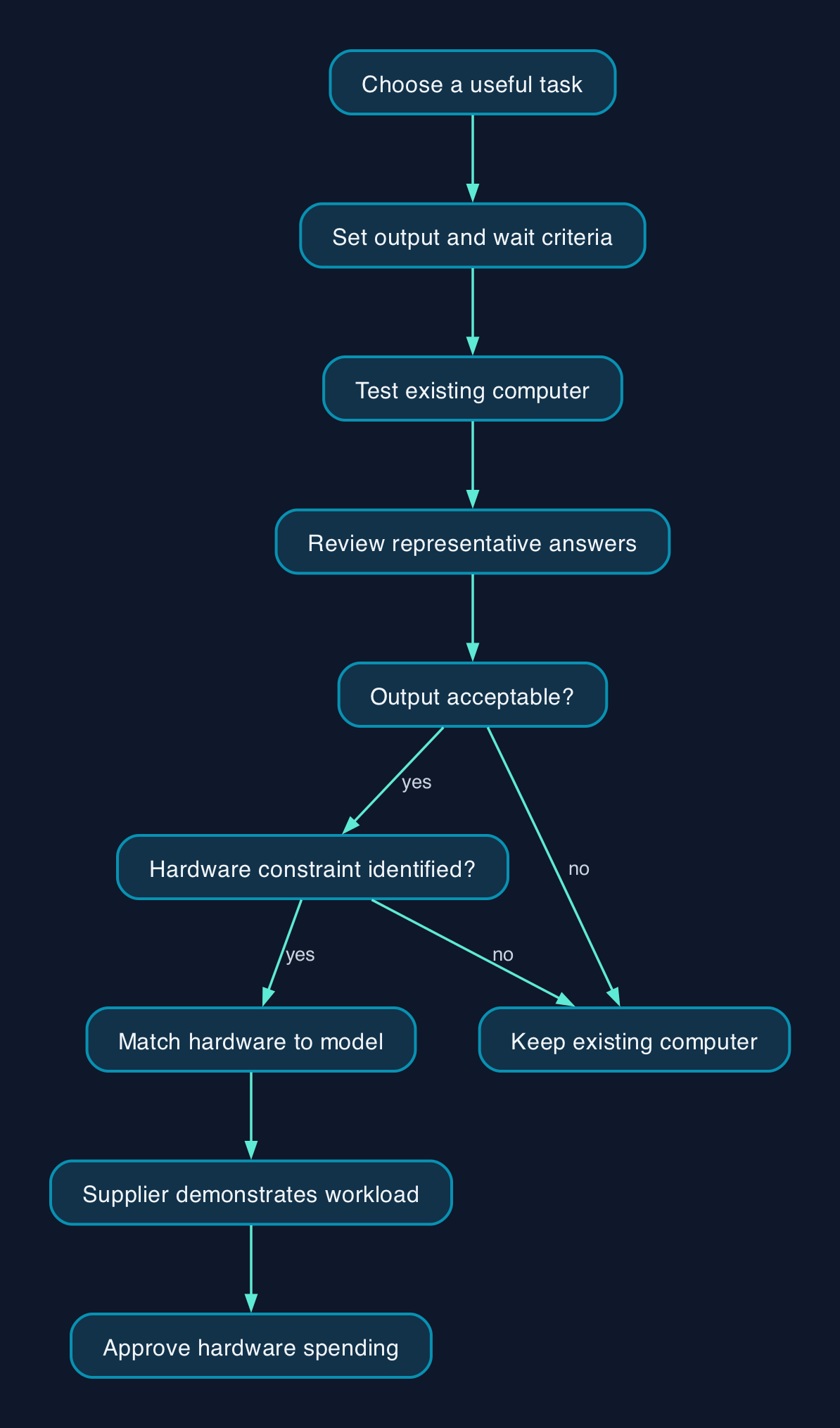
Choose a useful task before choosing a computer
For this decision, concentrate on running existing text models locally. Training a model from scratch, generating video and serving a busy organisation require separate sizing work.
A hypothetical UK accountancy practice might test drafting an internal summary from a short, anonymised document. A distributor might test classifying incoming enquiries. These are proposed pilot tasks, not customer results or promises that a particular model will perform them accurately.
Define success before spending. Specify what a satisfactory answer contains, how much correction staff can tolerate and how long they can wait. Include difficult examples that expose missing information or incorrect conclusions.
A purchase is justified when the pilot demonstrates both acceptable output and a hardware constraint. If the model produces poor answers, a faster computer alone has not resolved the buying question.
Memory determines the shortlist
Keep three specifications separate when reading a quotation.
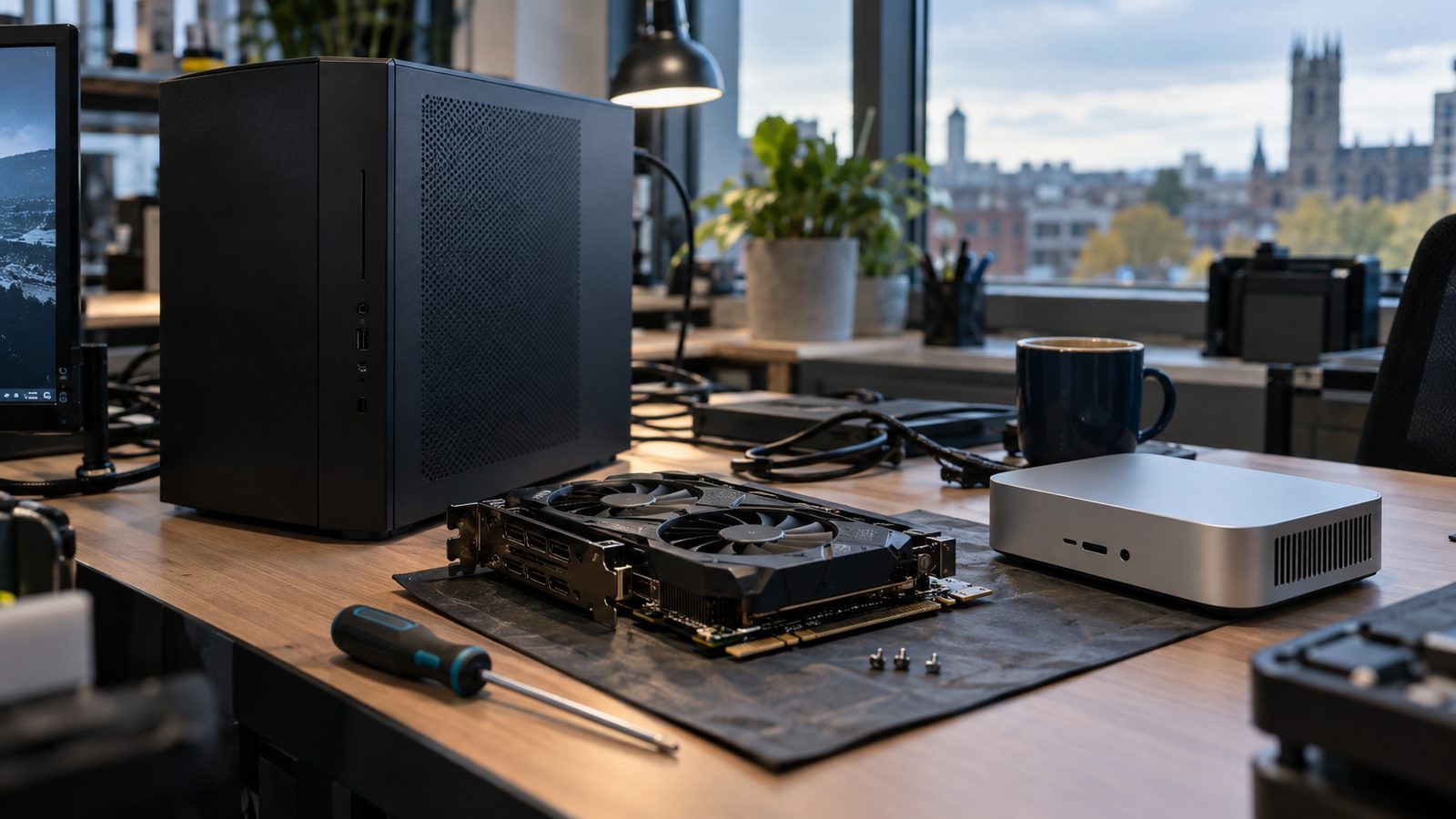
System RAM is the computer’s working memory. Video RAM, usually abbreviated to VRAM, is memory on a discrete graphics card. Storage holds downloaded model files and business data. A quotation containing a large memory figure needs to identify which of these it describes.
Quantisation stores model weights, the numerical values learned during training, at reduced precision. That reduces their memory footprint, but running memory also includes working space and the context cache used while processing a conversation. Longer inputs can therefore change whether the same model fits. LocalLLM.in’s llama.cpp measurements illustrate the difference between model-file size and running memory at different context lengths.
Do not turn a model’s parameter count into a purchasing guarantee. Ask for the exact model, quantisation, input length and software version used in any demonstration. “Runs a large model” leaves too much unspecified.
A practical specification to take to suppliers
The following is an editorial starting brief for a modest text-model pilot, rather than a universal minimum.
| Component | What to request | Acceptance condition |
|---|---|---|
| Processor | A processor supported by the selected runtime | The supplier demonstrates the actual workload without an unexplained compatibility workaround |
| System memory | Enough for the operating system, business applications and model workload together | The pilot remains usable with normal applications open |
| GPU memory | Capacity matched to the exact model and intended input length | The model completes representative tasks within the agreed waiting time |
| SSD storage | Space for the selected models, documents, updates and backups | The quotation identifies usable free space after installation |
| Power and cooling | A complete configuration approved for the chosen graphics card | The supplier confirms power connections, physical clearance and sustained operation |
| Support | Named responsibility for hardware, drivers and AI software | The buyer knows who diagnoses a failed model load or broken update |
There is no defensible universal CPU, RAM or GPU minimum in the supplied evidence. Use these acceptance conditions to obtain a specification that a supplier can demonstrate.
How the local setup fits together
A proposed single-user setup has an application, an inference runtime, a downloaded model and a controlled set of input files. NVIDIA describes llama.cpp as the runtime and GGUF as its model packaging format.
For a first pilot, keep ownership explicit.
| Part of the setup | Proposed responsibility | Check before use |
|---|---|---|
| User application | Business owner selects the task and reviews answers | Staff can identify and correct an unsuitable result |
| Runtime and model | IT owner records versions and configuration | The approved model loads and produces repeatable test results |
| Input documents | Information owner approves the material | Only authorised files enter the pilot |
| Computer and storage | IT team or contracted provider maintains the device | Updates, recovery and access controls have named owners |
| External connections | IT owner checks downloads, integrations and cloud options | The intended offline workflow works with networking disabled |
Do not assume that installing a local model establishes where every connected application sends data. Test the workflow’s network behaviour before introducing confidential material.
If colleagues will share the machine, repeat the pilot with simultaneous requests. A successful demonstration for one person does not establish the capacity or support arrangements for a shared service.
Pricing and the cost of keeping it running
The following are supplied UK price snapshots dated 28 September 2026. They are outright purchase prices for complete PCs, not subscriptions or quotations for an installed AI service.
CyberPowerPC’s listings provide these configurations and VAT-inclusive prices.
| Complete desktop | Graphics card and VRAM | System RAM | SSD | Purchase price including VAT |
|---|---|---|---|---|
| Ultra 55 RTX Next Day PC SY3153 | RTX 5060, 8GB | 16GB DDR4 | 1TB | £949.00 |
| Ultra 57 D456 Next Day PC SY3109 | RTX 5060 Ti, 8GB | 16GB DDR4 | 1TB | £1,249.20 |
| Ultra 75 Ti Next Day PC SY3150 | RTX 5060 Ti, 8GB | 32GB DDR5 | 1TB | £1,498.80 |
These are examples of available configurations, not an AI performance ranking. All three have the same stated GPU memory capacity, while other components differ. Confirm delivery charges, stock, warranty terms and the exact configuration before ordering.
For a meaningful cost comparison, request a three-year budget covering the following.
| Cost component | What belongs in the budget |
|---|---|
| Purchase or upgrade | Computer, graphics card, memory, storage and any required power or cooling changes |
| Deployment | Installation, compatibility checks, model selection and acceptance testing |
| Operation | Electricity, administration, updates and troubleshooting |
| User adoption | Training, output review and correction time |
| Recovery | Backup, replacement arrangements and downtime |
| Exit | Exporting useful configuration and data, removing local copies and replacing the workflow |
No complete total cost of ownership can be calculated from the supplied prices. Staff time, electricity consumption under the intended workload and software support charges remain unpriced.
For electricity, use measured whole-system power, operating hours and the business’s own tariff. Do not substitute a graphics card’s advertised power rating for a measurement of the complete computer.
Compare NVIDIA, AMD and Apple against the same task
The evidence supports considering several hardware approaches, but it does not provide a controlled benchmark across them. The recommendations below are conditional editorial assessments.
| Approach | When it deserves consideration | What must be established before purchase |
|---|---|---|
| Keep the existing computer | The task is occasional and a pilot meets the required quality and waiting time | Runtime compatibility and performance on representative inputs |
| NVIDIA RTX desktop | The chosen software has a documented RTX execution path | Exact GPU memory, complete-system compatibility and measured task performance |
| AMD Radeon desktop | A supported configuration offers a suitable quotation or reuses existing equipment | Exact card, operating system and runtime support, demonstrated together |
| Apple silicon Mac | The business already supports Macs and the chosen runtime works on the proposed configuration | Available unified memory, model compatibility and task performance |
| Used desktop or graphics card | The saving remains worthwhile after testing and support costs | Condition, warranty, sustained operation and a practical replacement route |
NVIDIA’s primary documentation establishes llama.cpp support on RTX systems. It does not establish that every RTX desktop is the best choice.
For AMD, IntuitionLabs identifies the Radeon RX 7900 XTX as a 24GB alternative alongside NVIDIA’s RTX 3090 and RTX 4090. Treat that as a shortlist lead. The supplied material lacks an official AMD compatibility matrix for the proposed software, so require a working demonstration rather than relying on the capacity alone.
Apple takes a different approach through unified memory shared by the processor and graphics hardware. Starmorph’s Mac mini guide explains that macOS, model context and runtime buffers all consume that pool. A Mac’s headline memory figure should therefore not be treated as an equal quantity of dedicated graphics memory.
The Apple and AMD evidence is secondary and does not establish current UK prices or equivalent performance. Neither should be excluded from procurement, but neither can receive a numerical value ranking from this material.
Editorial analysis
The most useful first purchase may be a short, fixed-scope installation and evaluation service.
Ask a local IT provider to demonstrate an approved model against representative tasks, record the configuration and hand over a recovery procedure. Require the quotation to separate hardware warranty from AI software support. Those are different responsibilities, even when one supplier provides both.
Approve hardware spending only after the demonstration identifies the constraint. Keep an existing machine if it passes. Buy a desktop when its measured improvement justifies the cost. Consider more specialised infrastructure when shared demand, availability or support requirements exceed what the desktop pilot proves.
Sources
- NVIDIA Technical Blog — Accelerating LLMs with llama.cpp on NVIDIA RTX Systems, dated 2 October 2024 in the supplied page
- LocalLLM.in — llama.cpp VRAM Requirements, dated 11 March 2026
- CyberPowerPC UK — RTX 5060 PCs, supplied price snapshot dated 28 September 2026
- Novatech — NVIDIA RTX 5070 listings, supplied price snapshot dated 28 September 2026
- IntuitionLabs — Local LLM Deployment on 24GB GPUs, revised 10 July 2026
- Starmorph — Best Mac Mini for Running Local LLMs and OpenClaw, updated 25 August 2026