

Microsoft Foundry is a sensible shortlist option for UK small and mid-sized businesses that want to build AI applications without running model infrastructure. Microsoft hosts the models it sells through Azure, while Foundry Agent Service offers managed agent execution. The deciding factor is how much application work your team can still own. Start with a narrow pilot, then assess answer quality, operating effort, regional requirements and the complete bill.
What a UK IT team is actually buying
Foundry brings models, agents, tools, access controls and evaluation capabilities into an Azure management environment. An agent combines a model with instructions and tools that can act on a request. Model inference is the processing that produces an answer from the inputs you supply. Microsoft’s platform overview explains how these components fit together.
For a small business, the useful buying question is whether managed model and agent services remove work that would otherwise prevent an application from being delivered. The number of models in a catalogue is less useful than evidence that a suitable model handles your actual documents and tasks.
Consider a hypothetical UK wholesaler building an internal product-information assistant. The pilot could retrieve approved specifications and draft answers for staff. Its acceptance criteria should include correct product references, appropriate refusal when information is missing, and protection against staff retrieving documents they cannot otherwise access.
That application still needs an owner. Someone must decide which documents are authoritative, correct bad answers, approve changes and handle failures. Microsoft explicitly places model selection and application-specific evaluation responsibilities on the customer. Foundry Models guidance
UK availability needs a configuration check
Microsoft’s regional table lists UK South for agents, the Responses API and private virtual networking. It also warns that supported models and tools vary by region. Agent Service regional support
Treat that listing as a starting point for procurement. It does not, by itself, establish where every model request, connected tool, document or diagnostic record will be processed or stored.
If UK-only processing is a contractual requirement, make written confirmation of the complete proposed configuration an acceptance condition. The available evidence does not establish a UK-only processing guarantee for an unspecified Foundry application.
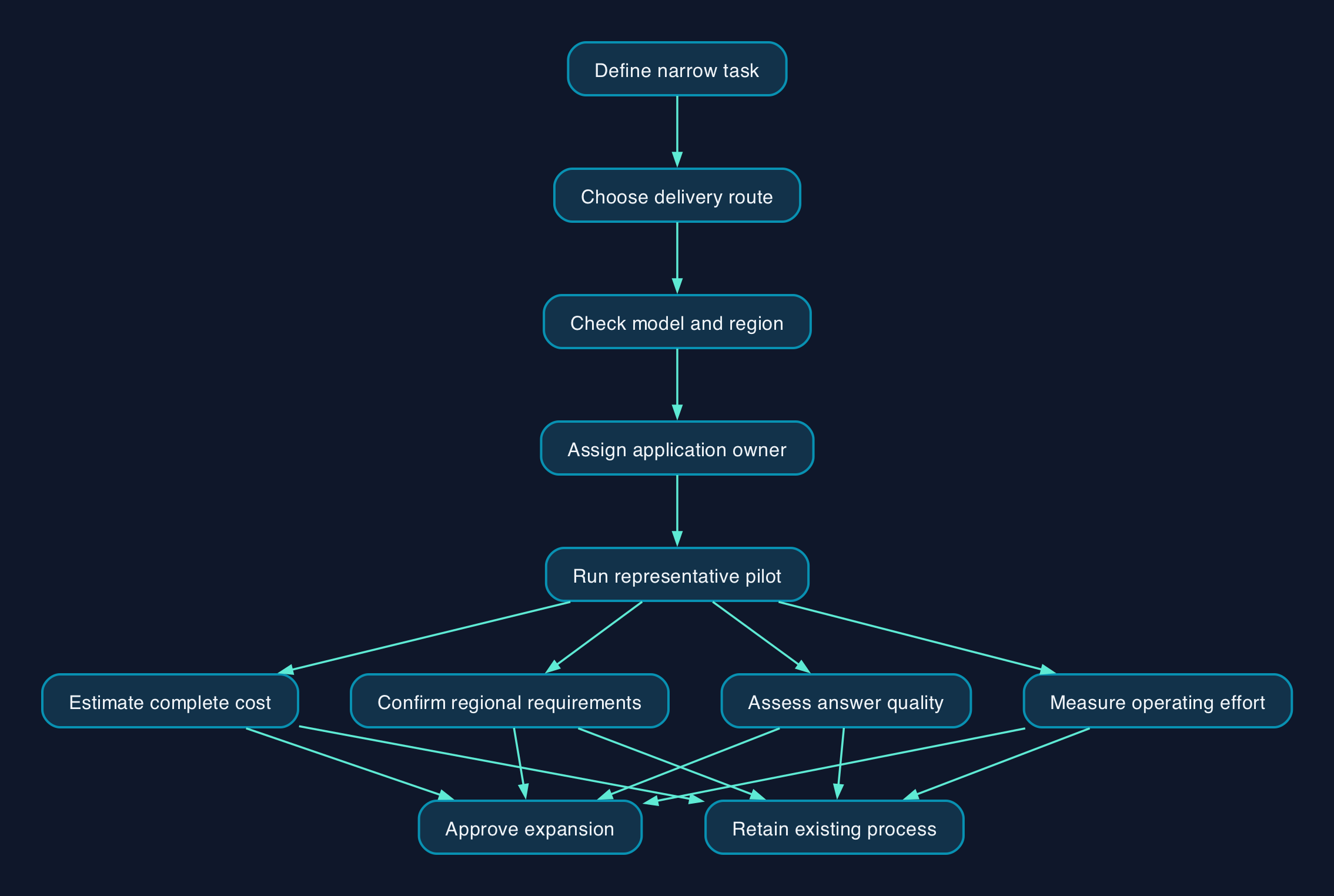
How the application and responsibilities fit together
For a first text application, a prompt agent is worth testing because Microsoft hosts its execution from your configured instructions, model and tools. A hosted agent offers more control by running code that your team packages as a container. Microsoft describes both approaches.
The following is a proposed responsibility split for the wholesaler example, rather than a description of a tested deployment.
| Component | Proposed responsibility | Acceptance check |
|---|---|---|
| Staff interface and sign-in | IT team or implementation partner configures the user experience and access | Authorised staff can sign in; unauthorised users cannot |
| Agent and model | Microsoft operates the selected managed service; the team selects the model and agent configuration | Representative requests meet the agreed quality and response-time requirements |
| Product documents and retrieval | Business owner approves content; IT maintains connections and access restrictions | Answers use current documents and respect each user’s permissions |
| Monitoring and incident handling | IT reviews failures and costs, with named supplier escalation contacts | A failed request produces a useful diagnostic record and reaches an accountable owner |
| Business actions | Business owner defines what the application may do | Any consequential action requires the agreed approval before execution |
Microsoft documents tracing, metrics, evaluations and Application Insights integration within Agent Service. Those capabilities can help investigate behaviour, but the buyer must decide which failures require action and who responds. Agent Service capabilities
For an initial pilot, keep actions read-only and give staff a clear route back to the existing process. Add write access only after the team can demonstrate that permissions, approval and recovery behaviour work.
Pricing and the complete cost model
Pricing position on 28 September 2026. The available primary evidence explains charging structures and cost planning, but does not establish current GBP rates for a specified model, deployment type and region. A reliable UK budget therefore requires an account-specific estimate showing currency, VAT treatment, billing commitment, minimum capacity and exclusions.
Microsoft’s pricing guide describes usage-based inference, provisioned throughput, third-party model pricing and regional price differences. Its newer cost-management guidance says to assemble an estimate from the services actually included in the application. Microsoft pricing guide and Foundry cost planning
| Cost component | What the estimate should contain | What to establish before approval |
|---|---|---|
| Model inference | Selected model and deployment type, input and output usage, evaluation traffic and retries | Applicable charging units, regional rates and expected workload |
| Reserved or provisioned capacity | Any committed capacity and associated term | Minimum purchase, utilisation assumptions and cancellation conditions |
| Agent and application hosting | Services needed for the chosen execution route and user interface | Which resources are required and which remain chargeable when idle |
| Retrieval and storage | Document storage, indexing and search services actually selected | Data volume, refresh frequency and separate service charges |
| Networking and diagnostics | Proposed connections, network configuration and monitoring services | Applicable meters, retained diagnostic volume and retention period |
| Implementation and operation | Integration, testing, training, maintenance and support | Named deliverables, staff effort, support hours and escalation scope |
| Exit | Export, connection replacement, migration testing and decommissioning | What can be recovered, by whom, and under what terms |
The service rows are an estimate checklist, not a claim that every Foundry application needs every component. Microsoft describes Foundry as a combination of optional services and recommends updating estimates as resources are added. Cost estimation guidance
Measure a complete business task
For the pilot, record the model usage and supporting service consumption needed to complete a useful task. Include failed attempts, retries and human correction time in the assessment. A cheap answer that requires substantial checking may be a poor operational choice.
Assumptions to record include expected task volume, document size, response length, operating hours, retention, staffing rates and the support arrangement.
For a 12-month evaluation, calculate total cost as implementation and migration, plus measured recurring service costs over the period, plus staff operation, support, training and any planned exit work. Leave unknown inputs visible rather than treating them as zero.
Microsoft recommends deploying representative test traffic, grouping actual charges by resource and billing meter, and reconciling those charges with the estimate before production rollout. Estimate-and-verify workflow
Migration and rollout checklist
- [ ] Define the task and owner. Document what the application should produce, what it must refuse and who accepts its results.
- [ ] Confirm the deployment configuration. Record the selected model, version, region, agent route and required tools, with their availability and production status checked.
- [ ] Assign access deliberately. Confirm who can create resources, grant permissions, view costs and change the application. Complete a test with an ordinary user account.
- [ ] Prepare approved data. Identify authoritative documents, remove unnecessary sensitive content and preserve a recoverable copy before changing an existing retrieval setup.
- [ ] Establish a baseline. Record how the existing process performs so the pilot has a meaningful comparison.
- [ ] Test representative failures. Include missing documents, misleading instructions in retrieved material, unauthorised requests, unavailable tools and requests exceeding capacity.
- [ ] Reconcile the bill. Match representative usage to actual service charges and explain material differences from the estimate.
- [ ] Train users and support staff. Confirm that users can recognise uncertain answers and that support staff can locate the relevant diagnostics.
- [ ] Prove rollback before switching users. Demonstrate how to disable the new application, revoke its access and restore the previous process. Warn affected users before any disruptive cutover.
- [ ] Approve production against evidence. Require the business owner and technical owner to accept quality, permissions, costs and incident handling.
The resource, availability and billing checks follow Microsoft’s setup prerequisites, regional constraints and cost-validation guidance. The acceptance criteria are editorial recommendations for the buyer.
Comparing the realistic delivery options
Because this decision specifically concerns Foundry, the most useful initial comparison is between ways of using it. These are delivery approaches, not equivalent licence editions. Microsoft documents prompt agents, hosted agents and direct API access as distinct routes. Agent development options
| Approach | Suitable circumstances | Skills and ongoing work | Cost, compatibility and exit checks |
|---|---|---|---|
| Foundry prompt agent | A bounded task that fits configured instructions and supported tools | Agent configuration, data access, evaluation and service administration | Verify tool compatibility and total consumption; retain instructions, test cases and connection details outside the portal |
| Foundry hosted agent | Custom behaviour needs code or a particular framework | Developers maintain the code and container while Foundry runs the managed endpoint | Include development and maintenance; document dependencies that would need replacing on exit |
| Existing application calling Foundry APIs | The team already operates a suitable application and wants managed model access | Existing application operations continue, alongside model integration and evaluation | Test API compatibility and error handling; compare the incremental cost with rebuilding the application |
| Retain and improve the existing process | The pilot cannot demonstrate useful gains or acceptable answer quality | Current process ownership continues | Compare measurable process improvements with the complete cost of building and operating AI |
A prompt agent is the strongest starting candidate when configuration meets the task. Choose hosted code when the required behaviour justifies its maintenance burden. Keep an existing application when its interface, permissions and operations already work and a model connection is sufficient.
For capacity planning, Microsoft lists 250 projects per resource and 32 model deployments per resource. These count different objects and should not be added together or read as performance measures. Check model-specific token and request quotas separately, including whether the applicable quota is regional or shared across a subscription. Foundry resource and rate limits
If you outsource delivery, require the proposal to separate implementation from ongoing support. Ask who maintains integrations, approves model changes, investigates incorrect answers and helps you leave. A working demonstration is insufficient evidence of those responsibilities.
Editorial analysis
Foundry deserves a pilot when model infrastructure is the obstacle and the business can still provide an application owner, integration skills and a realistic testing process.
For a team already comfortable with Azure permissions and billing, reusing that experience may reduce onboarding work. That is a suitability judgement, not evidence that Foundry is universally easier or cheaper than competing platforms.
The decision should turn on the smallest configuration that solves the task. Approve expansion only when the pilot shows useful results, manageable support work and an explainable bill. If it cannot clear those tests, retain the existing workflow while addressing the specific failure.
Sources
Evidence snapshot supplied on 28 September 2026.
- Microsoft Learn — What is Microsoft Foundry?
- Microsoft Learn — Agents in Microsoft Foundry
- Microsoft Learn — Overview of Microsoft Foundry Models
- Microsoft Learn — Microsoft Foundry capability reference
- Microsoft Learn — Set up Microsoft Foundry resources
- Microsoft Learn — Foundry Agent Service limits, quotas and regional support
- Microsoft Learn — Plan and manage costs for Microsoft Foundry
- Microsoft Learn — Microsoft Foundry Models quotas and limits
- Microsoft — Azure AI Foundry pricing guide