

Yes, n8n offers a practical route for UK small and mid-sized businesses to connect AI with existing applications, provided someone owns the workflow and its failures. Its integration framework supports connected processing steps and custom API calls. The strongest starting point is a bounded task such as preparing a customer-service reply. Finance posting and wider support-system integration need checks against the exact application and operation before committing.
What n8n could change for a UK business
The useful decision is which hand-off between existing systems deserves automation. Start with a task where staff repeatedly copy information, look up records or prepare a response, and where an incorrect result can be caught before it affects a customer or the accounts.
n8n provides the connections and processing steps between applications. Its documentation describes nodes that retrieve, filter, reshape and send data, including calls to an application programming interface, or API, when a ready-made operation is unavailable. An API is the interface software uses to exchange information with another system. n8n’s integration guide explains these routes.
Consider a hypothetical UK equipment supplier receiving emailed questions about invoices. A proposed workflow could find the customer record, gather permitted invoice information and ask an AI model to prepare a reply for a member of staff to approve. The business should first prove that its actual email, customer relationship management (CRM) and accounting systems expose the required operations.
The evidence supports parts of that design. n8n documents Gmail authentication, Zoho CRM record operations and OpenAI credentials. It does not establish a complete, tested workflow across those products.
For a UK pilot, use test cases containing pound amounts, VAT fields, credit notes and ambiguous dates. The acceptance question is whether the workflow preserves the source system’s values and meaning. An AI-generated explanation should never become the authority for an invoice amount.
Where the integration evidence stops
CRM coverage is relatively concrete in the supplied documentation. The Zoho CRM node lists contact, lead and invoice operations, among others. However, an invoice record in a CRM does not establish compatibility with a separate accounting ledger.
The evidence does not verify specific Xero or Sage operations, nor ticket creation, assignment or closure in a dedicated support platform. Treat those as implementation questions requiring documentation or a demonstration before purchase.
Connector names can also hide differences in coverage. The supplied Microsoft Dynamics CRM node page documents account operations. It does not substantiate every Dynamics workflow a buyer might expect.
Where a built-in operation is missing, n8n documents an HTTP Request fallback. That is a development route, not confirmation that the destination allows the required action under your subscription and permissions. Ask the implementer to demonstrate the exact read or write operation using representative records.
How the workflow and responsibilities fit together
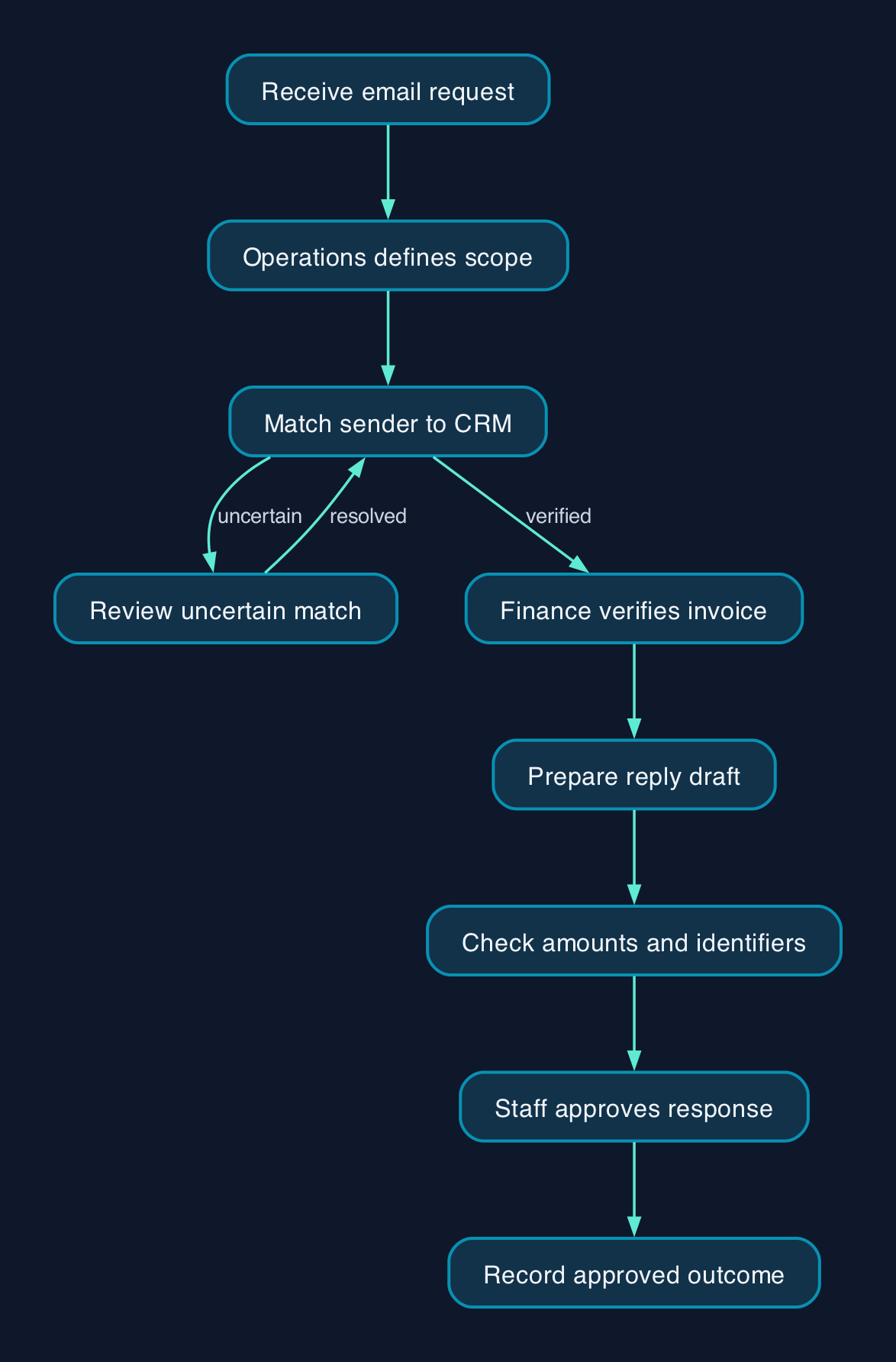
The following is a proposed responsibility model for the equipment supplier, not a tested template. Each stage needs an owner and a defined response when information is missing.
| Stage | Proposed activity | Owner and acceptance condition |
|---|---|---|
| Receive the request | Take an email into the workflow | Operations defines which inbox and messages are in scope |
| Find the customer | Match the sender to a CRM record | CRM administrator verifies the match; ambiguous results stop for review |
| Retrieve financial context | Read permitted invoice fields through a verified connection | Finance confirms the source record, currency and status |
| Prepare a response | Send only approved context to the chosen model | Workflow owner checks that the output preserves amounts and identifiers |
| Approve the action | Present the draft and source records to staff | Named reviewer authorises any customer communication |
| Record the result | Write the approved outcome to the appropriate system | Support lead verifies the destination record and handles failures |
Keep the model’s initial task narrow. Summarising a request or drafting an explanation is a more controllable pilot than allowing it to choose arbitrary records to change.
For model access, n8n documents OpenAI API-key authentication, a Google Gemini credential route and Azure OpenAI credentials. These pages establish connection options; they do not establish which model produces the best answers for your business.
Before using customer information, document which fields leave each application, which model receives them and which execution records are retained. The supplied evidence does not establish UK data residency or the contractual suitability of a particular deployment.
Pricing and the cost of keeping it running
n8n’s pricing page describes an execution-based charging model and lists cloud and self-hosted options. For budgeting, distinguish the number of workflow runs from the number that can run simultaneously.
The pricing evidence supplied for 28 September 2026 lists Starter at 5 concurrent executions and Pro at 20. These figures help frame a capacity discussion, but do not predict completed customer requests per minute. n8n pricing supplies the allowances, not a workload benchmark.
The extracted pricing page shows euro amounts beside a monthly/annual selector without preserving enough context to establish the selected billing commitment or VAT treatment. A dependable GBP subscription figure therefore cannot be quoted from this extract.
Use a cost model that covers the work around the subscription.
| Cost component | What to establish before committing |
|---|---|
| n8n subscription | Execution allowance, concurrency, billing commitment, support and overage terms |
| Model usage | Chosen model, expected request size, usage charges and spending controls |
| Application access | Whether the existing CRM, finance and support subscriptions permit the required API operations |
| Implementation | Authentication, field mapping, validation, exception handling and documentation |
| Ongoing operation | Staff time for failed runs, credential changes, model checks and application changes |
| Self-hosted infrastructure | Hosting, storage, backups, monitoring, updates and recovery work |
| Exit and handover | Workflow documentation, credential revocation and the process for returning work to staff |
For a UK purchase, request the invoice currency, payment schedule and VAT treatment explicitly. Compare proposals over the same operating period, including staff time. An unpriced support commitment should remain an unknown cost.
Choosing who runs it
Editorial assessment: begin by checking whether an existing application can already perform the required task. Adding n8n is easier to justify when the hand-off spans several systems or needs processing that the current setup cannot supply.
For n8n Cloud, the documented managed Google authentication can reduce connection setup for supported services. The business still needs someone to own field mappings, permissions and failed workflows.
Self-hosting should have a named technical operator. n8n’s scaling documentation covers concurrency, execution-data retention, file handling and memory issues. Those are operating responsibilities to include in the decision, rather than details to discover after launch.
For a pilot, require evidence that a repeated request does not produce a duplicate business action, an expired credential raises a visible failure, and an uncertain customer match reaches a person. Verify the resulting record in the destination system. A workflow reporting success is not sufficient acceptance evidence.
If commissioning an implementation partner, make workflow ownership, support hours, escalation, documentation and exit assistance explicit in the quotation. Require a handover that another administrator can use.
Editorial analysis
n8n is worth a bounded trial when a business can name a repetitive task, identify the authoritative records and assign someone to maintain the connection. The documented integration options provide a credible starting point; the business case depends on the particular workflow.
The first pilot should produce reviewable work. Compare its output with the existing process and record staff corrections, failed requests and time spent maintaining it. Expand into financial writes or customer-facing actions only when the business can explain how errors are detected, contained and reversed.
Sources
The article uses supplied extracts accessed by the research workflow for this assignment. Pricing evidence is dated 28 September 2026; the extracts do not consistently establish publisher update dates.
- n8n Docs — Nodes and integrations
- n8n Docs — Zoho CRM
- n8n Docs — Google credentials
- n8n Docs — OpenAI credentials
- n8n Docs — Azure OpenAI credentials
- n8n Docs — Microsoft credentials
- n8n Docs — Microsoft Dynamics CRM
- n8n — Plans and pricing
- n8n Docs — Scaling
- n8n Docs — Control concurrency
- n8n Docs — Handle binary data