Before a British creative company uploads a client asset or publishes an AI-assisted deliverable, it should document permission for the input, check the exact service terms and review the finished work. Treat output ownership as a separate question: UK protection for AI-generated material remains legally difficult. Start with a small, rights-cleared pilot, and retain a conventional production route when permissions or client requirements cannot be satisfied.
Start with the asset and the intended use
For a British design studio, production company, publisher or marketing agency, the useful starting point is a specific job. Identify the material entering the tool, the transformation requested and the destination of the result.
Consider a hypothetical agency turning a client’s campaign photograph into an animated advertisement. Before uploading it, the producer should locate the photography agreement, establish who can authorise the proposed processing and confirm the client’s expectations for the finished advertisement. Record unresolved questions against that asset rather than giving the whole client folder a blanket approval.
Use the following questions to organise clearance. They are practical review prompts, not a statement that every project requires every permission.
| Material | Questions to resolve before uploading | Questions to resolve before delivery |
|---|---|---|
| Images and illustrations | Who controls the original? Does the agreement cover the proposed upload and alteration? Are depicted people or third-party elements relevant? | Does the result retain recognisable protected material? Can the promised campaign use be authorised? |
| Video | Who supplied the footage, soundtrack, graphics and performances? What restrictions accompany each component? | Has someone reviewed the complete sequence, including audio, titles and background material? |
| Music and audio | What permissions cover the composition, lyrics, recording and performance? Does the proposal involve reproducing a person’s voice? | Can the finished track be used in the intended advertisement, film or distribution channel? |
| Written material | Who controls the manuscript, article, script or client document? What permission supports uploading or adapting it? | Are passages copied or closely reproduced? Have quotations, attribution and client requirements been checked? |
For a small business without an in-house lawyer, appoint a producer or account lead to gather the documents. Escalate disputed rights and ambiguous licence wording to an adviser before processing the affected asset.
Separate UK law from supplier and client contracts
The legal question is whether the proposed activity is permitted. The supplier-contract question is what the service allows, takes responsibility for or excludes. The client-contract question is what your company has promised to deliver.
Keep those decisions separate in the project record. A client approval email should not be used as a substitute for the photographer’s licence, and a platform subscription receipt should not be used as evidence that an uploaded recording was cleared.
Do not treat a commercial pilot as an automatic exception
Government guidance explains that section 29A permits certain copying for computational analysis for non-commercial research where the researcher has lawful access. It also describes restrictions on transferring those copies or using them for another purpose. The guidance addresses government departments, but its account of the statutory exception explains why a commercial studio should not simply label a client experiment “research”. Text and data mining conditions
Where someone proposes relying on a copyright exception, ask an adviser to identify the exception and explain how the actual workflow satisfies it.
Do not turn a policy announcement into permission
The government’s copyright and AI consultation ran from 17 December 2024 to 25 February 2025. Its proposals were part of a consultation, not a licence for businesses to use protected material. Official consultation record
The strength of the disagreement helps explain why buyers need project-specific decisions. Reporting the government’s December 2025 progress statement, Hogan Lovells recorded that 88% of Citizen Space respondents supported stronger copyright requiring licensing in all cases, while 3% supported the proposed data mining exception with rights reservation. These figures concern that response channel and reporting stage, not a representative survey of British businesses or the complete final response set. Consultation response figures
The March 2026 government report subsequently said the broad exception with opt-out was no longer its preferred approach and proposed further evidence gathering. That policy position does not settle the permissions for an individual campaign. Government policy position
This is not legal advice; consult your legal counsel.
Assign responsibility from upload to client handover
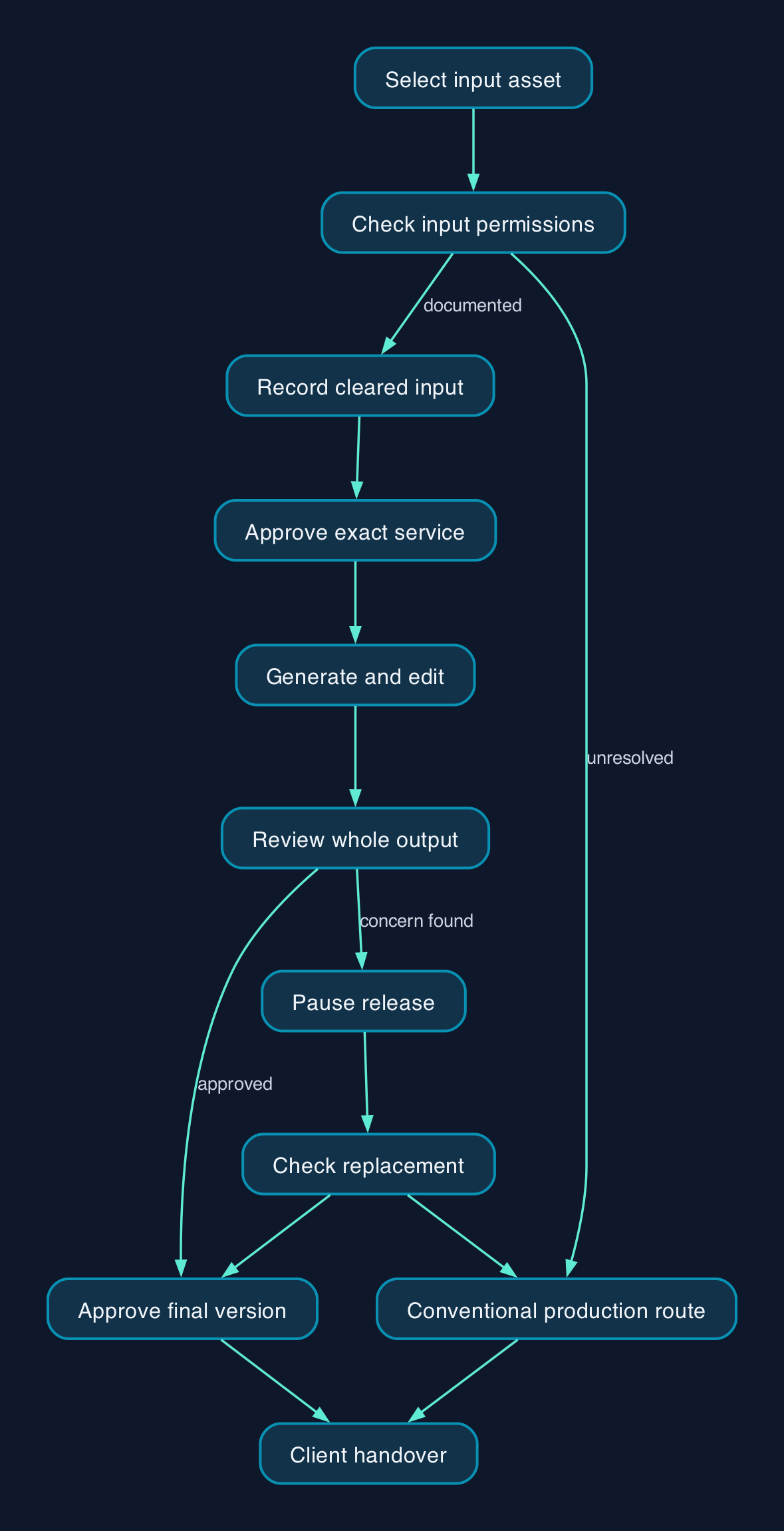
Use a simple approval record that follows the asset through production. The following is a proposed workflow for a small or mid-sized creative company.
| Stage | Responsible person | Evidence needed to proceed |
|---|---|---|
| Select the input | Producer or account lead | Asset identity, source, rights-holder information and relevant agreement |
| Approve the service | Business owner or IT lead | Exact account, feature, terms version and documented settings |
| Generate and edit | Designer, editor, writer or sound specialist | Inputs used, significant prompts, generated versions and human changes |
| Review the deliverable | Senior creative, with legal escalation where needed | Recorded concerns, clearance decisions and client-specification checks |
| Release and retain | Account lead | Approved final file, client sign-off and supporting rights record |
Record which files leave your organisation, which service receives them and who can access the workspace. Ask the supplier about retention, reuse for training, deletion and access controls; the supplied evidence does not establish equivalent answers across vendors.
Keep the original assets and a conventional editing route available. If an AI-assisted version cannot be cleared, the producer should be able to replace it without reconstructing the entire project.
Budget for clearance and review as well as generation
The evidence does not supply comparable GBP subscription prices or rights-clearance quotations. A numerical price comparison would therefore be misleading.
Instead, request costs against the same pilot brief. Specify the assets, intended channels, territories, duration and expected deliverables. Ask whether quoted charges include VAT and whether usage allowances renew monthly or depend on an annual commitment.
| Cost component | What to include in the project budget |
|---|---|
| Tool access | Seats, generation allowances, usage charges, account administration and cancellation terms |
| Input permissions | Licence extensions, rights-holder enquiries and any specialist clearance work |
| Setup and training | Approved settings, staff guidance and a worked example of an acceptable asset record |
| Production and review | Generation attempts, editing, comparison with references and senior approval |
| Legal and contractual work | Unresolved ownership questions, supplier terms and client promises |
| Replacement and exit | Conventional production fallback, file export, retained records and tool migration |
Judge the pilot by the cost of an accepted deliverable. Track staff time spent rejecting, repairing and clearing outputs alongside the time spent generating them.
A rollout checklist with clear stop points
- [ ] Define the permitted task. Write a short brief identifying the input, proposed transformation and intended publication or delivery.
- [ ] Create an asset register. Give every input a record containing its source, relevant agreement and person responsible for clearance.
- [ ] Resolve permissions before uploading. Hold back any asset whose proposed use remains disputed or undocumented.
- [ ] Approve the exact account and feature. Record the service, subscription, model or feature where identifiable, settings and applicable terms.
- [ ] Confirm client expectations. Agree how AI assistance will be described and whether the client requires exclusivity, particular licences or restrictions on processing.
- [ ] Preserve originals. Store source files separately and test that the conventional production workflow remains usable.
- [ ] Run a restricted pilot. Use cleared material and keep generated files out of automated publishing or client-delivery systems.
- [ ] Inspect the whole output. Review visual details, sound, words and recognisable third-party elements, not just overall quality.
- [ ] Record human work. Retain meaningful edits, selections and production decisions without assuming that a prompt count proves ownership.
- [ ] Approve the final version. Name the reviewer and retain the approved file with its clearance record.
- [ ] Test withdrawal and replacement. Confirm who can stop distribution, notify the account lead and substitute an approved alternative.
- [ ] Review before expanding. Add new asset types or services only after their permissions, terms and review needs have been assessed.
If a reviewer identifies possible copied material, pause release and preserve the relevant versions. Do not treat another generation attempt as resolving the original concern without checking its replacement.
Compare suppliers using the same clearance brief
Shortlist tools against the work your company actually performs. Adobe Firefly, Midjourney, Google Gemini and OpenAI services warrant separate contractual checks; a conclusion about one supplier should not be carried across to another.
Comparable current commercial terms for all these suppliers are not established by the supplied evidence. The table therefore distinguishes the documented example from questions that still need answers, rather than assigning a legal-safety ranking.
| Option | Evidence or checks relevant to selection | Decision before adoption |
|---|---|---|
| Adobe Firefly | Obtain the applicable terms for the exact feature, account and underlying model | Establish permitted client use, input conditions and any contractual protection |
| Midjourney | Obtain current account terms and check intended commercial use, visibility and client handover | Confirm that the workflow meets confidentiality and delivery requirements |
| Google Gemini | Identify the precise product and account agreement before evaluating output rights or protection | Confirm which terms govern the proposed use |
| OpenAI API | Its documented output indemnity has exclusions for unauthorised inputs, known infringement, ignored safeguards, modifications, trademark claims and third-party offerings | Check the governing agreement and whether the proposed editing workflow fits the cover. Service terms |
| Existing commissioned or licensed production | Review the actual commission or asset licence against the same brief | Retain this route where the rights and delivery requirements can be established more clearly |
An indemnity is a contractual promise concerning specified claims, subject to its wording. Ask an adviser to assess eligibility, exclusions, claim handling and any limits before treating it as meaningful protection for the project.
Do not infer that ChatGPT Business receives the same output indemnity as Enterprise merely because both appear in a section heading. The cited clause addresses defined Enterprise customers. Account-specific indemnity wording
Editorial analysis
For a small creative company, the strongest initial use case is one with a short, documented permissions chain and a deliverable that a senior creative can inspect properly.
Our recommendation is to choose the pilot by clearance effort before choosing it by visual impact. A modest production task using authorised inputs can establish a repeatable process. A flagship campaign involving disputed source material, a recognisable performer and a promise of exclusivity puts several unresolved decisions into the same deadline.
Keep the procurement decision conditional. If a supplier cannot explain the relevant terms, or the client requires rights your company cannot substantiate, use another production method for that assignment.
Sources
- A&O Shearman, Ownership of AI-generated content in the UK, published 20 August 2024
- OpenAI, Service terms, updated 21 September 2026, accessed 28 September 2026
- UK Government, Copyright and Artificial Intelligence consultation text, December 2024, page updated 19 March 2026
- UK Government, Copyright and Artificial Intelligence consultation record, published 17 December 2024, updated 19 March 2026
- Hogan Lovells, Copyright and AI UK government publishes statement of progress, published 18 December 2025
- UK Government, Report on Copyright and Artificial Intelligence, published 18 March 2026, accessed 28 September 2026