
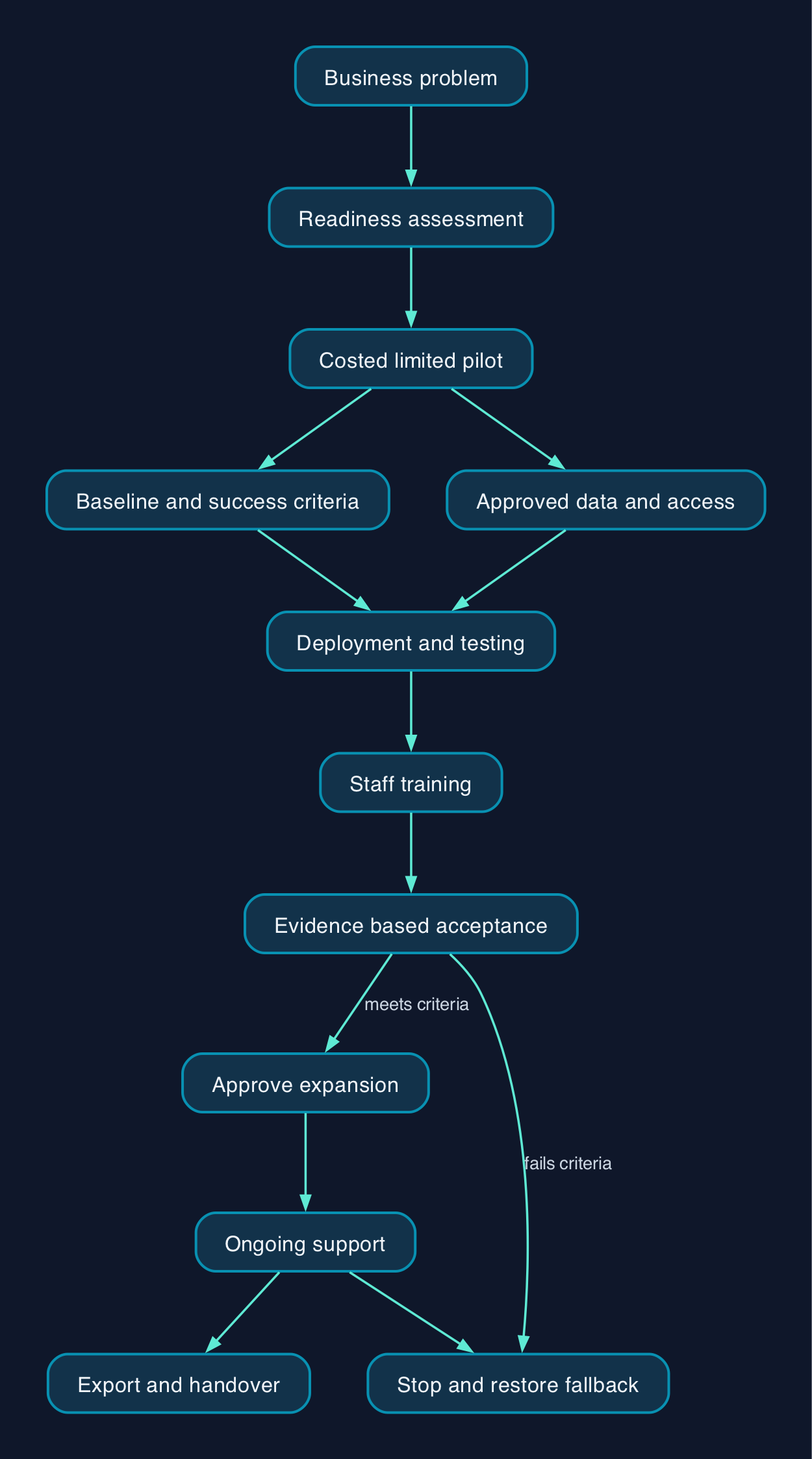
Require a managed service provider to separate AI readiness, deployment, staff training and ongoing support into priced deliverables with named owners and acceptance tests. Start with a business problem and a limited pilot, then expand only when the evidence supports it. For a UK small or mid-sized business, the buying priority should be a service your team can operate, afford and leave, with clear responsibility when something fails.
Buy a defined outcome before choosing an AI platform
For this purchase, separate the managed service provider’s role into assessment, implementation, training and operation. Ask for a deliverable and a price against each. A proposal covering only discovery should not be accepted as a commitment to deliver a working service.
Start with a problem your staff can describe and measure. A hypothetical wholesaler might want to reduce the time spent preparing responses to product enquiries. Its assessment should establish where approved product information lives, who checks answers and whether a simpler search or workflow improvement would solve the problem.
Require the readiness report to contain:
- A prioritised list of use cases, with a named business owner for each.
- A baseline for the chosen task, including staff effort, errors and review time.
- A data and access assessment identifying specific blockers.
- Options covering existing software, additional AI services and a credible non-AI approach.
- A costed pilot proposal, with success criteria and reasons to stop.
- A remediation plan showing which tasks belong to your business and which belong to the supplier.
The CDS service listing provides one example of an assessment built around data architecture, governance, maturity analysis and an action plan. Use those categories to challenge an assessment that offers a score without showing the work behind it.
For a smaller business, keep the initial scope narrow enough for an operations manager or owner to supervise. For a mid-sized organisation, require agreement between the process owner, IT and the teams supplying data before approving integration work.
Set contractual boundaries for data and decisions
Make the supplier document which information the proposed service will receive, where it will go and who can access it. Require answers for prompts, uploaded documents, retrieved records, outputs and logs, rather than accepting a single statement about “secure AI”.
The contract should identify subcontractors, administrative access, retention settings, deletion procedures and any proposed use of your information to improve models. Ask for supporting terms for the exact product edition and configuration being proposed.
The supplied evidence does not establish platform-specific data terms or the legal requirements of a particular workload. Those need checking before approval.
As procurement conditions, require a named person to approve new data connections and material changes to automated actions. Define which outputs need human review, who can suspend the service and how staff should report suspected disclosure or harmful results.
Do not accept “UK provider” as an answer to a question about processing locations. Request the relevant locations and access arrangements explicitly.
Define how the service will run
Ask the MSP to explain the proposed workflow in ordinary language. For an internal knowledge assistant, that means identifying the approved source documents, the access checks, the AI service, the staff reviewing answers and the route for reporting errors.
Use a responsibility table in the statement of work. The following is a proposed allocation to negotiate, rather than a description of any supplier’s existing contract.
| Area | Require from the MSP | Retain within your business | Acceptance evidence |
|---|---|---|---|
| Business outcome | Translate the use case into a testable specification | Set priorities and approve success criteria | Agreed baseline and test plan |
| Data preparation | Identify missing, stale or unsuitable information | Approve authoritative sources and access | Data inventory and recorded decisions |
| Deployment | Configure connections, permissions and monitoring | Authorise production access and changes | Configuration record and test results |
| Output quality | Test representative tasks and failure cases | Decide what quality is acceptable | Reviewed examples and unresolved defect list |
| Staff training | Deliver exercises, guidance and administrator handover | Release staff time and assign internal owners | Practical assessment results |
| Support | Investigate failures and manage agreed escalations | Report business impact and approve workarounds | Support runbook and escalation contacts |
| Exit | Export agreed assets and remove supplier access | Accept the handover and appoint the next operator | Export check and access-removal record |
Specify the boundary between a platform outage, a broken connection, a poor answer and user assistance. Give each a reporting route and an owner.
Northdoor’s service description includes use-case design, permissions work and human verification. Those are useful activities to request, but your contract still needs to state who performs them and what completion means.
Compare prices by scope and charging unit
The supplied evidence pack contains the following G-Cloud 14 listing prices, recorded on 28 September 2026. Each listing describes its charging unit as “a unit a day”. The extracts do not establish VAT treatment, minimum bookings, working-day length, expenses or the roles attached to each rate.
These are published service ranges, not like-for-like project quotations or evidence that a private-sector buyer can obtain the same terms.
| Supplier and listed service | Published lower rate | Published upper rate | Clarification needed |
|---|---|---|---|
| Envitia AI readiness | £300 | £1,580 | Define the unit, staffing mix and separately sourced training |
| CDS AI readiness assessment | £550 | £1,650 | Confirm assessment effort and whether training is included |
| Shivom AI readiness assessment | £480 | £1,500 | Separate assessment, engineering and training activities |
| APPtechnology AI readiness services | £450 | £1,250 | Specify data sources, remediation and platform scope |
A lower daily rate does not establish a lower project cost. Require the proposed number of units, the people delivering them and a maximum authorised spend for discovery.
Request a first-year cost schedule separating:
- Assessment and planning.
- Data preparation and permissions remediation.
- Deployment, integration and testing.
- Software subscriptions, model usage and infrastructure.
- Staff training, preparation and follow-up.
- Your own staff’s participation and review time.
- Ongoing support, maintenance and change requests.
- Export, handover and termination assistance.
For recurring charges, record the billing commitment, usage allowance, overage treatment and renewal terms. Ask for GBP quotations showing VAT separately, including travel and on-site delivery where relevant.
Training illustrates why units matter. Elansio’s own published offer lists a workshop at £980 plus VAT for up to 20 people, a subsequent six-hour Build Day at £1,395 plus VAT and a combined bundle at £2,195 plus VAT. Those packages cannot establish the price of a different supplier’s training or the cost of maintaining what participants build.
Do not sign off a total cost of ownership figure while implementation effort, usage or retained staff responsibilities remain unpriced.
Require a pilot and a practical rollout checklist
Tie approval to evidence from the intended workflow. A demonstration using the supplier’s documents should not be the only acceptance test for a system expected to use yours.
Before changing production permissions or enabling automated actions, agree the recovery procedure and test it in an isolated pilot.
- [ ] Name the owner. Record who can approve scope, expenditure and release.
- [ ] Fix the baseline. Capture the existing task’s completion time, review effort and common errors.
- [ ] Approve the data. List permitted sources and confirm access with their owners.
- [ ] Record the starting configuration. Preserve the settings and relevant data needed to restore the previous workflow.
- [ ] Limit the pilot. Identify participating staff, permitted tasks and excluded uses.
- [ ] Test failures. Include missing information, conflicting records, inappropriate requests and unavailable services.
- [ ] Check permissions. Demonstrate that a user cannot retrieve material outside their approved access.
- [ ] Practise recovery. Show how to disable the new service and resume the agreed fallback.
- [ ] Assess staff capability. Require users to complete a task, check the result and report a problem.
- [ ] Accept the handover. Receive operating instructions, support contacts, configuration records and export procedures.
- [ ] Approve expansion. Review quality, costs and staff feedback against the original success criteria.
Make training specific to the job
Request separate learning outcomes for everyday users, managers and administrators. Users should practise checking outputs and recognising unsuitable tasks. Managers should learn how to assess results; administrators should practise access changes, incident handling and recovery.
Ask for exercises using approved, representative material, accessible learning resources and a route for follow-up questions. Attendance alone should not be the completion condition.
The Shivom listing describes deployment simulations and department-specific training. The CDS listing includes administrator and user training, supporting documentation and a train-the-trainer option. Require the selected supplier to specify comparable deliverables where they fit your needs.
Compare suppliers against the work you need
The available evidence supports comparison of UK service providers’ stated scope. It does not support a ranking of AI platforms, delivery quality or independently measured business outcomes.
| Supplier | Scope described in the supplied source | When to investigate | What to resolve before appointment |
|---|---|---|---|
| Envitia | Maturity assessment, business case, roadmap and proofs of concept | You need assessment and technical feasibility work | Training is marked unavailable; establish who provides adoption support and ongoing operation |
| CDS | Data-focused assessment, action planning and bespoke training | Data quality and internal capability are central concerns | Obtain a defined implementation scope and operational support proposal |
| Shivom | Cloud platform selection, pipeline and architecture planning, technical training | The proposed use case involves cloud engineering | Check staffing, deliverables and the continuing maintenance obligation |
| APPtechnology | Data readiness, access review and training tied to Copilot and ChatGPT | Those tools are already within your intended scope | Confirm exact editions, connection requirements and responsibility for remediation |
| M-Tech Systems | Managed IT, automation, AI deployment, support and adoption | You want AI operation considered alongside existing IT support | Require explicit service levels, exclusions and exit terms for each AI workload |
Treat this as a starting shortlist, not an endorsement. Ask each bidder for a redacted deliverable, the proposed delivery team and a reference relevant to the work you are buying. If a partner status or certification influences selection, verify its current scope through the issuing organisation.
Require bidders to explain their commercial relationships with platform vendors. A platform-specific specialist may fit a settled requirement; an unresolved platform decision needs a documented comparison before licence commitments.
Also compare the incumbent MSP with a specialist working alongside it. Keeping existing support may be sensible if responsibilities for deployment, incidents and handover can be agreed without gaps.
Editorial analysis
CTC’s view is that the strongest proposal should let you stop after assessment with something useful in your hands. You should retain the findings, prioritised use cases, cost assumptions and implementation requirements even if another supplier delivers the next stage.
Prefer a limited pilot with an agreed spending cap over an open-ended commitment justified by promised productivity. Judge savings after including checking, correction and maintenance effort.
For a business with little internal IT capacity, put particular weight on the operating handover and support contract. For a business with an established team, prioritise documentation and skills transfer so routine changes do not always require a paid consultant.
Sources
- Digital Marketplace — Envitia AI Artificial Intelligence Readiness
- Digital Marketplace — CDS AI readiness assessment
- Digital Marketplace — Shivom Artificial Intelligence AI Readiness Assessment
- Digital Marketplace — APPtechnology Artificial Intelligence AI Readiness Services
- Northdoor — Managed AI Readiness Services
- Informed Solutions — AI Readiness Assessment
- M-Tech Systems — Fully Managed Services
- Elansio — AI Training and Consultant Costs UK