

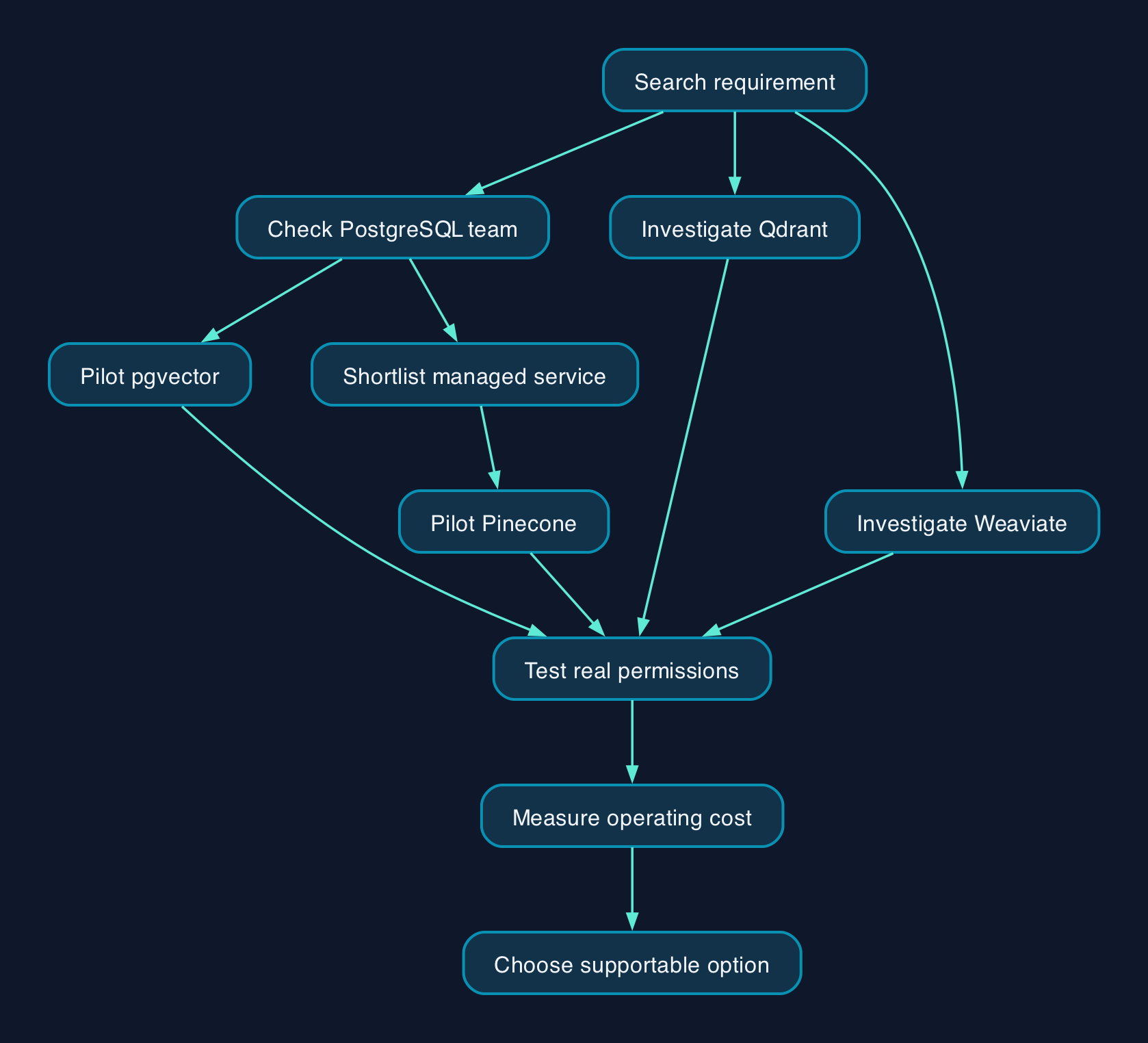
For UK small and mid-sized businesses, the sensible starting point is the platform your team can operate reliably. Test PostgreSQL with pgvector if PostgreSQL already supports your applications. Shortlist Pinecone’s managed service when database administration is the constraint, and investigate Qdrant or Weaviate when their deployment or retrieval options match a specific requirement. Choose through a controlled pilot with real permissions, representative questions and a complete operating budget.
Start with the internal search problem
An internal search pilot should answer a concrete question, such as whether service staff can find the current maintenance procedure without seeing another customer’s records. That gives the buyer something more useful to measure than a database’s advertised maximum size.
For an illustrative UK engineering business, the test collection might contain maintenance manuals, approved quotations and support notes. Include exact part numbers, abbreviated customer names and questions phrased differently from the original document. Have the people who use those documents judge the results.
Treat generated answers as a separate decision. First establish whether search retrieves the correct, permitted source passage. Then evaluate whether an answer-writing model accurately uses that passage and shows its source.
The available evidence is substantially stronger for Pinecone than for the other options. It does not establish comparable current UK hosting, support and commercial terms across all four, so the recommendations below are a shortlist for testing rather than a verified performance or price ranking.
For a UK purchase, make the quotation specify billing currency, VAT treatment, support hours and the location of the selected deployment. If UK-only processing is a contractual requirement, require written confirmation covering document processing, embeddings, search storage, backups and any answer-generation service.
Architecture and ownership
Use the following as a proposed responsibility model. It describes what your internal search service should do, rather than promising that any database supplies the complete workflow.
| Component | Proposed responsibility | Acceptance evidence |
|---|---|---|
| Source systems | Document owners identify approved material and authoritative versions | Every pilot document has an owner and source location |
| Ingestion process | Application team extracts content and preserves document identifiers and access information | Changed and deleted documents produce the intended index updates |
| Embedding process | Application team selects and records the model that converts text into numerical representations | Stored records identify the model and processing version |
| Search database | Platform owner configures storage, retrieval and required filtering | Representative queries return relevant, permitted passages |
| Identity and permissions | Security and application owners determine which records each user may retrieve | Tests using different user roles reject forbidden results |
| Search interface | Product owner presents source links and handles empty or failed searches | Users can inspect the supporting document and recognise a failed search |
| Operations | Named internal team or contracted provider owns incidents, recovery and upgrades | Recovery is demonstrated and escalation contacts are documented |
For a managed service, distinguish a database incident from an application incident. A successful database query that returns an obsolete procedure still needs an owner.
Pinecone describes writes becoming searchable within seconds. Treat that as a supplier statement about indexing freshness, then test your complete update and deletion workflow. Connector polling and document processing belong in that test too.
Pricing and cost model
The strongest directly supported prices here are Pinecone’s published monthly commitments. The following figures come from its cost documentation supplied for this comparison on 28 September 2026.
They are US dollars, not GBP quotations. The supplied passage does not establish VAT treatment, region-specific rates or all contractual conditions. No currency conversion has been applied.
| Pinecone plan | Published monthly commitment in USD | Billing interpretation |
|---|---|---|
| Starter | US$0 | No monthly minimum; plan limits apply |
| Builder | US$20 | Flat fee covering included usage; excess usage is blocked |
| Standard | US$50 | Minimum usage commitment; higher actual usage is charged |
| Enterprise | US$500 | Minimum usage commitment; higher actual usage is charged |
Source for all figures and billing descriptions is Pinecone’s minimum usage documentation. These are plan commitments, not equivalent workload quotations or complete operating costs.
Pinecone gives a useful billing example. Standard usage of US$20 in a month produces a US$50 bill, while usage of US$100 produces a US$100 bill. Adding the minimum to the full usage amount would double count the commitment. Pinecone billing examples
Build a comparable operating budget
Ask each supplier or implementation partner to price the same workload and service requirements. Do not compare a managed production service with an unreplicated development installation.
| Cost component | Inputs to collect | Question for the quotation |
|---|---|---|
| Database service or hosting | Record volume, vector size, metadata, query activity and update activity | What drives charges, and what happens when a limit is reached? |
| Resilience | Recovery requirements, backups and replication | Which recovery provisions are included and which cost extra? |
| Document preparation | File formats, scanning needs, duplicates and access information | Who repairs failed imports and inconsistent permissions? |
| Embeddings and optional generated answers | Initial processing, document changes and expected usage | Which model charges sit outside the database bill? |
| Deployment and migration | Connectors, application changes, validation and cutover | What is included in the implementation price? |
| Support and staffing | Monitoring, upgrades, incidents and user support | Who responds during UK working hours and outside them? |
| Exit | Export, transfer, rebuilding and retesting | Which data and configuration can be recovered, and at what cost? |
For a first-year comparison, add initial implementation and migration to the recurring service, staffing and support costs for that period. Include training and an exit allowance where relevant. Leave unknown items explicitly unpriced rather than treating them as free.
For an existing PostgreSQL installation, request the incremental capacity and administration cost of adding search. For a new installation, include the entire database service. Those are different purchasing situations and should not share a single headline estimate.
Comparing the four options
The recommendations in this table are editorial judgements. They identify the conditions under which each option deserves a pilot, with evidence gaps kept visible.
| Option | When to shortlist it | Main evaluation work | Reasons to defer selection |
|---|---|---|---|
| Pinecone | You want the supplier to manage the search database infrastructure | Measure usage charges, test the current search API, and confirm contractual deployment and support requirements | Required commercial or deployment terms remain unconfirmed, or measured operating cost exceeds budget |
| Qdrant | You want to investigate both managed operation and control over deployment | Obtain current supplier documentation; compare the selected cloud service with a fully costed self-hosted design | Nobody can own the chosen operating model, or the quotation excludes recovery and support you need |
| Weaviate | Your shortlist requires an explicit test of keyword and semantic retrieval together | Verify current product documentation, deployment choices, pricing and retrieval behaviour | Selection rests on an older comparison or an unsupported claim of superior search quality |
| PostgreSQL with pgvector | Your team already operates PostgreSQL and wants to test whether a separate database is necessary | Check extension availability, provider support, retrieval quality and the effect on existing workloads | Search disrupts business transactions, or the team cannot tune and support the proposed configuration |
Pinecone’s current primary documentation establishes both its managed architecture and its expanded search capabilities. That makes “Pinecone cannot do keyword search” an unsuitable basis for rejecting it.
For Weaviate, the available secondary comparison describes native BM25 keyword search. It does not provide adequate primary evidence for current prices or prove that Weaviate retrieves better answers. Use the reported capability as a test requirement, not a winning score.
For PostgreSQL, the supplied pgvector cost comparison discusses deployment on Amazon RDS with instance-based infrastructure costs. Its worked figures use a US region, so they do not establish a UK price or a universal break-even point.
Use one pilot specification
Keep the document collection, embedding model and evaluation questions consistent wherever technically possible. Record any unavoidable differences before comparing results.
Measure relevance, forbidden-result exposure, update handling, response time under expected demand and operating cost. Include unanswered questions and exact identifiers, rather than testing only the natural-language questions that produce attractive demonstrations.
Set acceptance criteria before running the pilot. A buyer might require every forbidden-document test to fail closed, every returned passage to carry a usable source link, and the measured workload to fit its approved budget. Those are proposed purchasing criteria, not claimed product capabilities.
Ask an implementation partner to demonstrate handover as part of acceptance. The deliverable should include the ingestion configuration, evaluation set, operating instructions and recovery procedure, with named responsibility for maintenance.
Editorial analysis
For a business with an established PostgreSQL team, pgvector deserves an early test because avoiding another operational system may have value. That judgement does not establish that it will be cheaper or meet the workload.
Pinecone offers a clearly documented route to supplier-managed database infrastructure. The buying question is whether the reduction in database work justifies the measured service bill and any required plan commitment.
Qdrant and Weaviate deserve evaluation against their own strengths and the buyer’s requirements. The thinner evidence available here should prompt better supplier questions, not a lower product score.
Keep a working search service if it passes the agreed quality, permission and cost tests. A migration needs a measurable benefit large enough to justify rebuilding integrations, retesting behaviour and training the people responsible for incidents.
Sources
- Pinecone — How Pinecone Works
- Pinecone — Understanding Pinecone cost
- Pinecone — 2026 changelog
- Pinecone — Accurate and Efficient Metadata Filtering in Pinecone’s Serverless Vector Database, ICML 2025
- Modern DataTools — Qdrant Pricing, Free Cluster, Cloud, and Self-Hosted
- Rahul Kolekar — Vector Databases for Enterprise RAG, Pinecone and Weaviate Cost Comparison
- Markaicode — How Much Does Pinecone Cost vs pgvector?