Britain’s ports should automate for better trade and better work
Britain should back port automation, with investment judged on cargo reliability and credible workforce transitions. Singapore and Felixstowe show why the decision already extends beyond buying driverless trucks.

Britain should back port automation, with investment judged on cargo reliability and credible plans for the people whose work changes. Singapore’s Tuas Port already combines automated yard cranes with driverless vehicles, according to its Ministry of Transport. The British opportunity is to improve how goods move through existing terminals. Fewer driving jobs may follow, but a smaller payroll alone should not count as proof of competitiveness.
Key pointers
- Require an automation proposal to identify the operational bottleneck it will remove.
- Measure container delays and recovery times alongside equipment productivity.
- Put funded training and named destination roles into the investment case.
- Compare autonomous transport, remote crane operation and improvements to existing equipment separately.
- Ask who restores service when a vehicle, communications link or control system fails.
- Treat announced fleet orders and vehicles already operating as different measures.
Singapore’s example is a starting point for Britain
Tuas makes port automation a concrete investment question. Singapore’s transport ministry distinguishes the fixed-track automated vehicles already used in Phase 1 from planned intelligent vehicles that interpret sensor data and react to changing surroundings. Its stated ambition includes mixed operation with human-driven vehicles. Singapore’s deployment and expansion plans
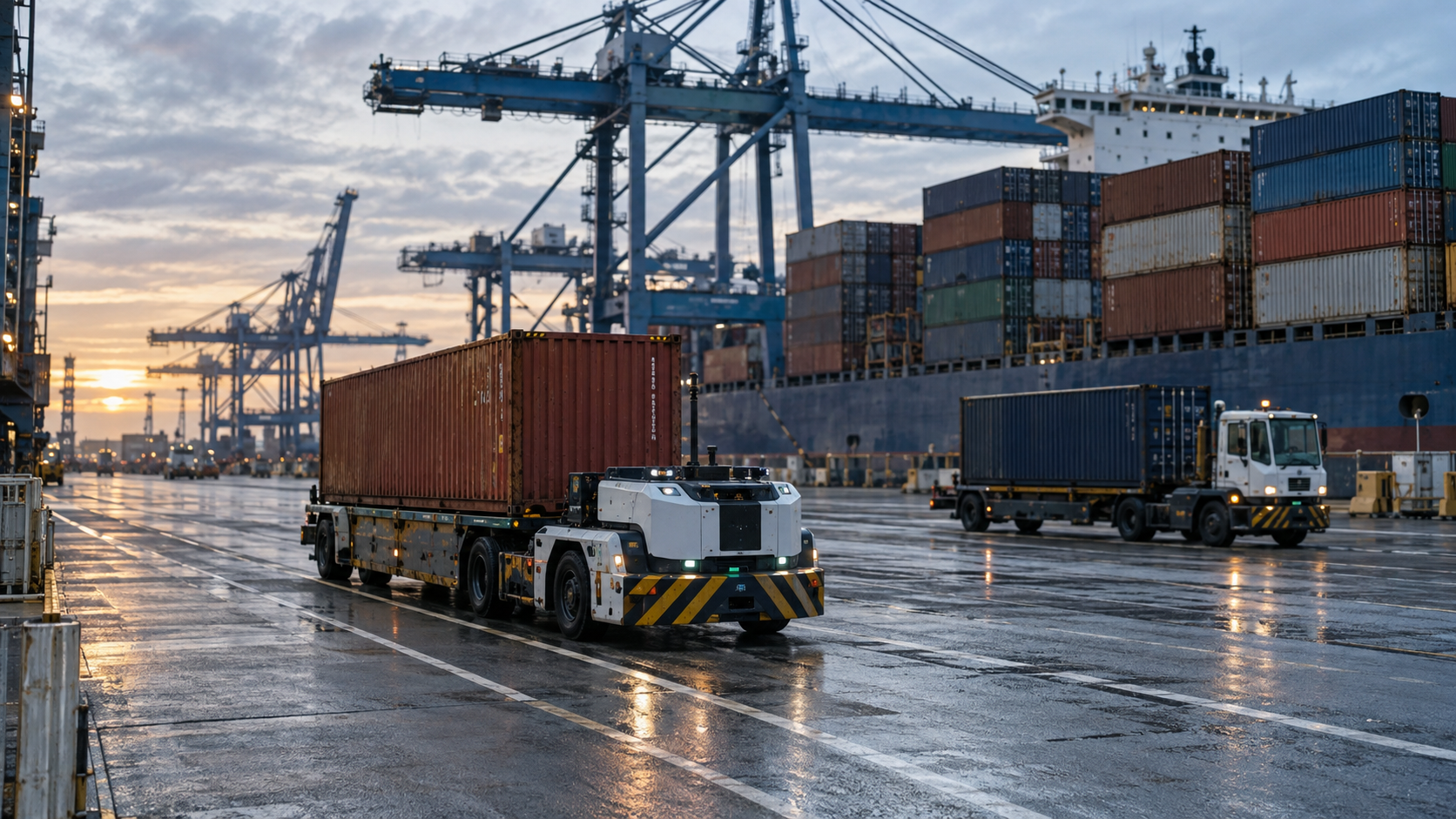
Britain is already addressing that mixed-traffic problem. Felixstowe’s first deployment announcement described autonomous tractors entering a working container terminal in 2022, following commissioning and testing. This is an existing British operational decision, rather than a technology waiting to arrive from abroad. Felixstowe’s initial deployment
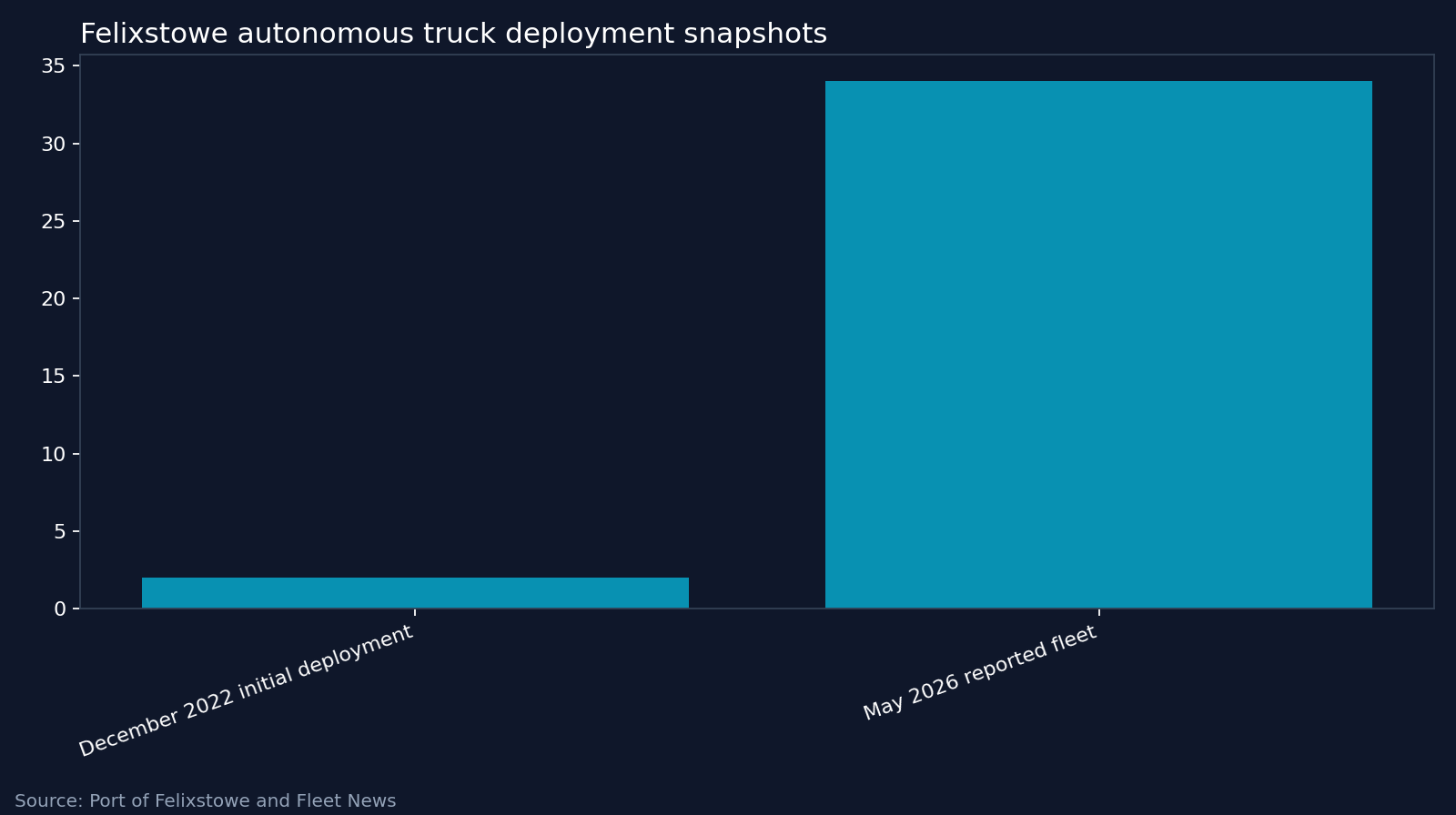
Fleet News reported 34 autonomous trucks at Felixstowe on 15 May 2026, with more than 140,000 containers moved by the vehicles over the preceding 12 months. Those are reported activity figures, not an independently measured productivity comparison. Alongside the initial 2 vehicles announced in 2022, they show expansion between dated snapshots, without establishing the fleet operating today. Reported fleet size and container movements
For British importers and exporters, the useful question is whether automation makes collection and delivery more dependable. A small manufacturer awaiting components should ask its logistics provider about missed collection slots, disruption notices and contingency arrangements. A demonstration of a driverless truck does not answer those questions.
The investment test should follow the container
My position is that operators should approve automation against the movement of cargo through the terminal, rather than the performance of one machine.
Consider a proposed workflow linking quay cranes, terminal transport, yard storage and onward collection. If automated vehicles move containers faster but collection remains constrained elsewhere, the buyer needs to establish whether the investment improves the service customers receive. That is a question for measured trials, not an assumed benefit of autonomy.
The operating design should assign responsibility at each handover. Vehicle suppliers should demonstrate navigation and recovery behaviour. Integration contractors should demonstrate that instructions and status updates pass correctly between systems. The port operator should retain clear authority over traffic rules, stop decisions and the return to service.
Network failure, blocked routes and unavailable equipment belong in those acceptance trials. Buyers should require a documented safe response, an escalation owner and evidence that operations can resume. A private network or additional sensor should earn its place by meeting those requirements.
Price the transition as well as the machinery
The evidence supplied does not establish comparable purchase prices or a complete British port automation cost model. A defensible investment decision therefore needs quotations covering the whole operating change.
For an autonomous vehicle proposal, request separate costs for equipment, energy infrastructure, software, communications, integration, maintenance and replacement parts. Add site preparation, testing, staff training and the period during which old and new arrangements run together. Contract exit should cover access to operational records, configuration information and transition support.
Compare that proposal with retaining and improving the current operation. Scheduling changes, targeted equipment replacement or remote control may address the identified bottleneck without requiring the same deployment scope. These are alternatives to test, not claims that one approach is inherently cheaper.
The financial model should distinguish expected labour savings from benefits to customers. Reduced staffing expense is a commercial return; improved cargo reliability is a service outcome. An investment may deliver both, but the board should require evidence for each.
Compare supplier responsibilities before comparing brands
The available examples cover different parts of a terminal. Westwell supplied Felixstowe’s initial autonomous tractors, while the port’s earlier announcement identifies ZPMC as the builder of electric yard cranes. Those suppliers were delivering different equipment, so their names cannot form a like-for-like purchasing shortlist. Tractor deployment and yard-crane delivery
A 2018 report from Supreme Freight described ZPMC crane construction alongside Siemens drive, control and automation systems, including engineering and commissioning. That historical allocation illustrates why buyers must distinguish the equipment manufacturer from the controls and integration supplier; it does not establish either company’s current commercial offer. Reported crane project responsibilities
For British technology firms, I would target the work between those responsibilities. Candidate services include testing interfaces, securing remote access, monitoring equipment condition and supporting operational recovery. Any bid should identify the system it touches, the permissions it requires and the failure it helps the operator resolve.
Ports should compare bidders within those defined work packages. Ask for equivalent operating conditions, support hours, spare-parts commitments and acceptance evidence. The supplier offering the broadest platform is not automatically the supplier best equipped to maintain a particular terminal.
The strongest objection is that the jobs may disappear
The strongest argument against automation is that productivity gains can coexist with fewer jobs and a worse outcome for the people displaced. A promise of new technical roles does not demonstrate that existing drivers can obtain them, afford the training or find enough vacancies.
Singapore’s ministry presents higher-value employment as an intended benefit of port automation. That is a policy ambition, not evidence of a measured net employment gain. The material available here does not establish net job losses, net job creation or wage outcomes at either Tuas or Felixstowe. Singapore’s stated employment objectives
That uncertainty strengthens the case for conditions on investment. Before removing a role, an operator should specify which employees can move into which positions, what training is funded, how competence will be assessed and what happens when redeployment is unavailable. Worker representatives should help design that transition.
The objection does not justify freezing every operating method. Felixstowe’s remote-crane description provides a narrower example of changing the workplace: the driver moves from a cab above the quay into an operations centre. Automation decisions should distinguish that form of job redesign from removing the driving task altogether. Felixstowe’s remote operating arrangement
Editorial analysis
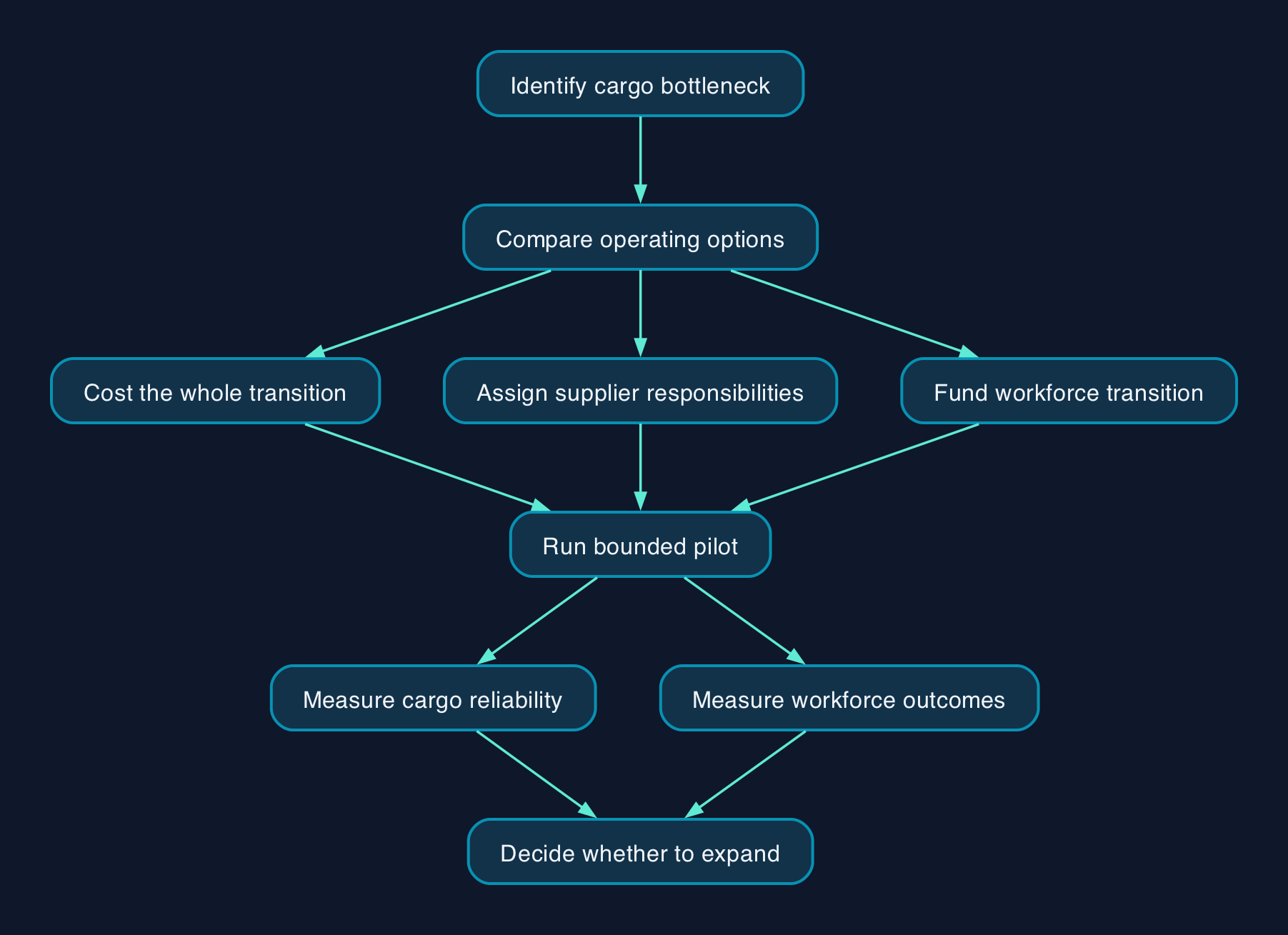
British ports should publish an operational scorecard and a workforce scorecard for major automation programmes. The operational measures should include container delays, equipment availability and recovery after disruption. The workforce measures should record funded training, completed redeployments, departures and changes in pay.
Those measures would make the competitiveness claim contestable. A terminal that removes jobs without improving the customer’s experience should have to explain the result. One that handles cargo more reliably while giving affected employees a credible transition would have a stronger case for further investment.
For technology leaders, the next decision should be a bounded pilot with agreed acceptance criteria and a named owner for the workforce transition. Expansion should follow demonstrated results from both.
FAQ
Are British ports still waiting to adopt autonomous vehicles?
No. Felixstowe announced its first autonomous terminal tractors in December 2022, initially for movements between its Trinity and North Rail terminals. That deployment establishes British adoption, without proving that the same design suits every port. Felixstowe’s announcement
Does remote control mean a crane operates without people?
No. Felixstowe’s gantry-crane description places drivers in a nearby operations centre instead of a cab above the quay. Buyers should ask which tasks remain under human control and which functions are automated. Remote-control operating arrangement
What should a smaller British business ask its logistics provider?
Ask whether the proposed changes affect collection arrangements, disruption communications or contingency capacity. Request evidence of the service outcome relevant to your shipments, rather than accepting the number of automated vehicles as a proxy for reliability.
Where should UK technology suppliers focus?
Focus on a defined operational responsibility, such as integration testing, maintenance support or recovery procedures. A proposal should explain who uses the service, which failure it addresses and how the port will verify the result before extending the contract.
Sources
- Singapore Ministry of Transport — Automated and autonomous vehicles — updated 31 July 2026.
- Port of Felixstowe — Port of Felixstowe deploys first autonomous trucks — posted 13 December 2022.
- Port of Felixstowe — Remote control gantry cranes at Port of Felixstowe — supplied extract.
- Fleet News — Port of Felixstowe makes efficiency gains from autonomous vehicles — published 15 May 2026.
- Port of Felixstowe — Remote Controlled RTGs at the Port of Felixstowe — supplied extract.
- Supreme Freight — Port of Felixstowe orders RTGs with automation and remote control technology — published 23 May 2018.