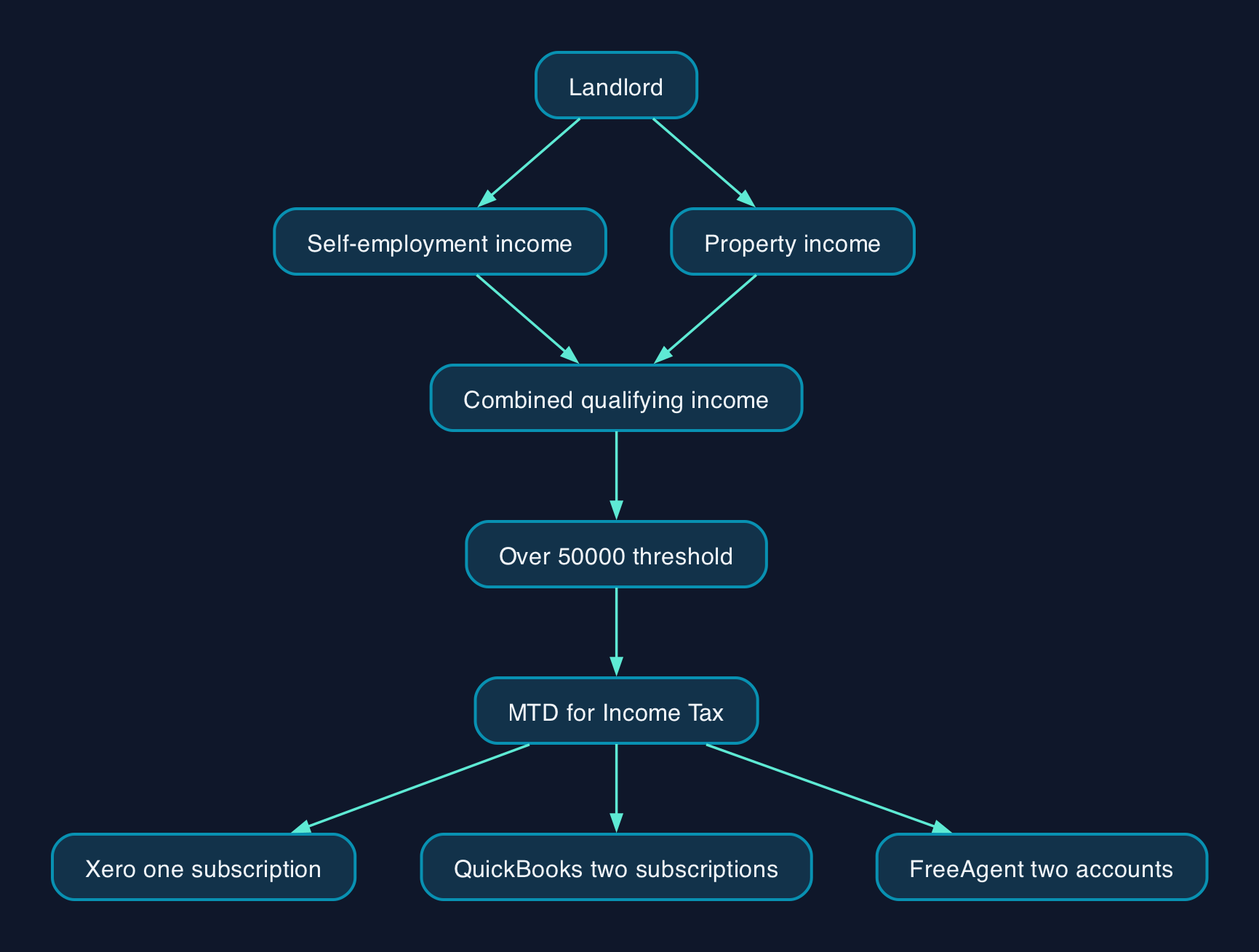
Making Tax Digital for Income Tax becomes mandatory on 6 April 2026 for anyone with combined self-employment and property income over £50,000 (HMRC). For a landlord who also has a self-employed business, the deciding factor isn't which software looks nicest. It's whether the platform can report both income streams from one subscription. Xero says one organisation can cover both (Xero); QuickBooks and FreeAgent both need two separate subscriptions instead.
Key pointers
- Check your qualifying income against £50,000, which is turnover before expenses from self-employment and property combined, taken from your last tax return, not profit (HMRC).
- Xero says one organisation can cover self-employment and property together; QuickBooks and FreeAgent both require two separate subscriptions for the same combination (Xero).
- Budget the real monthly cost, not the entry price: roughly £7 on Xero, £20 on QuickBooks, £29 on FreeAgent once both income sources are covered.
- Ask if you bank with NatWest, Royal Bank of Scotland, Ulster Bank or Mettle: FreeAgent gives you one free account per qualifying business bank account, so a mixed-income landlord pays for the second unless they hold a qualifying account for each business (FreeAgent).
- There are no penalty points for a late quarterly update in the first year, 2026 to 2027, but the 31 January final return and payment deadlines are unchanged and can still be penalised (HMRC).
- If you're VAT-registered on your self-employed side, budget for Xero Ignite at £18 a month or QuickBooks Simple Start at £16 a month instead, since Xero Simple and QuickBooks Sole Trader Plus don't include VAT submission.
- Quarterly update deadlines are fixed by HMRC, not by the software: 7 August, 7 November, 7 February and 7 May, whichever platform you choose (HMRC).
What Making Tax Digital for Income Tax means for this landlord
If your rental income and your self-employment income add up to more than £50,000, HMRC combines them for the purpose of the April 2026 mandate, even though you'll file them as separate businesses within your software (Xero). Instead of one Self Assessment return a year, you'll send a quarterly update for your property business and a separate quarterly update for your self-employment, four times each (HMRC), then one final declaration by 31 January that covers both (HMRC).
That structure is why the choice between Xero, QuickBooks and FreeAgent matters more for a mixed-income landlord than for a landlord with property income alone. HMRC's rules let you keep both income sources inside one piece of software, but not every platform is built to do that inside a single subscription. Xero explicitly says you can manage multiple income streams, including a sole trade and a property business, "within one Xero organisation" (Xero). QuickBooks' own help centre says the opposite: "you will need a separate QuickBooks account for each business income source" (QuickBooks), and its support team confirms that on Sole Trader Plus "only one income source is allowed per account" (QuickBooks Community). FreeAgent takes the same two-account approach: "you'll need a sole trader and an unincorporated landlord account," and property income can't be recorded in a sole trader account at all (FreeAgent Support). Across the two accounts you'll still send four quarterly updates and one end-of-year update per income stream, then one final declaration covering everything (FreeAgent Support).
UK compliance mapping
The £50,000 threshold is qualifying income, meaning turnover before expenses, based on the tax return you already submitted, not your profit after costs (HMRC). A landlord with a large portfolio and thin margins can be well inside MTD even in a low-profit year.
HMRC has given the first year some slack. There are no penalty points for a late quarterly update in the 2026 to 2027 tax year, so missing one of the four in-year deadlines during that first year won't cost you a point (HMRC). That grace period does not extend to the final declaration or to paying what you owe: the 31 January deadline for both is unchanged, and from year two the points-based penalty applies to quarterly updates too, with a £200 fine once you reach four points (HMRC). This is not legal advice; consult your legal counsel.
Pricing and cost model
List prices, excluding VAT, as published by each vendor and checked on 29 September 2026. All three run promotional pricing for new customers, typically half to 90% off for the first six months, so budget from the list price for what you'll actually pay from month seven.
| Platform | Plan for this landlord | List price | Current promo | What it covers |
|---|---|---|---|---|
| Xero | Simple | £7/month | £0.70/month for 6 months | Self-employment and property, said to fit in one subscription (Xero) |
| QuickBooks | Sole Trader Plus, x2 | £10/month each, £20/month total | £1/month each for 6 months | A separate QuickBooks account for each income source (QuickBooks) |
| FreeAgent | Landlord + Sole Trader | £10 + £19 = £29/month | £5 + £9.50 = £14.50/month for 6 months | A dedicated Landlord account plus a separate Sole Trader account |
Chart 1 shows the realistic monthly cost once both income sources are covered: £7 on Xero, £20 on QuickBooks (assuming Sole Trader Plus on both sides) and £29 on FreeAgent.
None of these figures is the final bill. Add VAT if you can't reclaim it, add £5 a month on FreeAgent if you go over ten receipt captures, and check whether you need VAT submission, which sits above the plans compared here on both Xero and QuickBooks. FreeAgent gives you one fully-funded account for as long as you retain a qualifying NatWest, Royal Bank of Scotland or Ulster Bank account, or make at least one transaction a month through Mettle, but a landlord who needs both a Landlord and a Sole Trader account only gets one of the two free unless they hold a qualifying account for each (FreeAgent).
Xero, QuickBooks and FreeAgent compared
| Criterion | Xero (Simple) | QuickBooks (Sole Trader Plus x2) | FreeAgent (Landlord + Sole Trader) |
|---|---|---|---|
| Self-employment and property in one subscription | Yes | No, two subscriptions needed | No, two separate accounts needed |
| Whole rental portfolio in one property subscription | Yes | Yes, HMRC treats all UK properties under one owner as a single Property Business | Yes, including joint ownership splits |
| Realistic monthly list price for this landlord | £7 | £20 | £29 |
| Free route through business banking | No | No | One account free per qualifying NatWest, RBS, Ulster Bank or Mettle account held; a second account still needs its own qualifying account or a paid subscription |
| VAT return submission on the cheapest plan | No, needs Ignite at £18/month | No, needs Simple Start at £16/month | Included as standard on the Sole Trader plan; not listed as a Landlord plan feature |
| Submissions for combined income | One final declaration from one organisation | Both accounts linked to one HMRC Personal Tax Account, reviewed and submitted together | Four quarterly updates and one end-of-year update per account, then one final declaration covering both |
Xero suits a landlord who wants the lowest ongoing bill and doesn't want to run two separate subscriptions for one final declaration. QuickBooks suits someone who'd rather keep the property business and the trading business fully ring-fenced, and doesn't mind two invoices. FreeAgent suits a landlord who already banks with NatWest Group for at least one of the two businesses, cutting the two-account cost to one paid subscription, or one who wants dedicated landlord tooling such as per-owner joint ownership splits.
Editorial analysis
None of these platforms is wrong for MTD compliance; all three are built to submit quarterly updates and a final declaration to HMRC. The practical difference for a landlord with mixed income is administrative rather than technical. Running two subscriptions on QuickBooks or FreeAgent means two logins, two bank feeds to set up, two support relationships and two renewal dates to track, even though the properties themselves can sit together in one of those accounts. That overhead is worth a look before price alone decides it, because the promotional pricing on all three narrows the gap in year one and widens it again from month seven. A landlord who already banks with NatWest Group has the strongest case for accepting the two-account structure, since one of the two FreeAgent accounts is free and only the second needs paying for.
Sources
- Sign up for Making Tax Digital for Income Tax, HMRC
- Penalties for Making Tax Digital for Income Tax, HMRC
- Use Making Tax Digital for Income Tax, send quarterly updates, HMRC
- Xero UK pricing plans
- Step confidently into Making Tax Digital for Income Tax, Xero
- QuickBooks UK pricing
- Will a single Sole Trader Plus account cater for a self-employed individual who also has rental properties, QuickBooks Community
- MTD for IT: Managing combined business and rental income in QuickBooks
- Find out if and when you need to use Making Tax Digital for Income Tax, HMRC
- FreeAgent pricing
- Accounting software for landlords, FreeAgent
- Fast-track guide for landlords for filing MTD for Income Tax quarterly updates, FreeAgent Support
- Making Tax Digital software for businesses and landlords, FreeAgent
- Xero Simple pricing plan details
- Free accounting software for your business, FreeAgent
- How to use FreeAgent for MTD for Income Tax if you're a sole trader with multiple businesses or rental income, FreeAgent Support