
For a UK multi-site retailer, Cisco Meraki and Fortinet FortiGate are the more affordable standardisation choices for branch SD-WAN, with a small-branch box and three years of licence and support landing in the low thousands of pounds per site. HPE Aruba EdgeConnect is priced and sized for stores with heavier WAN engineering needs, such as poor circuits or latency-sensitive tills and VoIP, and its cost is quote-only. The right choice depends less on brand and more on how much of a store's traffic needs active path steering versus simple failover.
Key pointers
- Cisco Meraki's cheapest MX tier (Enterprise) already includes real SD-WAN: automatic failover, sub-second dynamic path selection and policy-based routing, not just the pricier Secure SD-WAN Plus tier.
- A Meraki MX68 branch appliance costs £447.52 ex VAT in hardware, plus £340 a year (Enterprise) or £540 a year (Advanced Security) in licence.
- A FortiGate 60F comes as a single bundled SKU: hardware, FortiGuard licence and FortiCare support together, from £1,348 ex VAT for the first year.
- Fortinet builds SD-WAN into FortiOS on every FortiGate at no extra bandwidth-based charge, so the appliance refresh and the SD-WAN rollout can be the same project.
- HPE Aruba EdgeConnect's smallest branch gateway, the EC-XS, is quoted by UK partners rather than list-priced; ask for the bandwidth-tier subscription and Orchestrator hosting cost together.
- If any stores take card payments over the same appliance, ask each vendor how their tier maps to PCI DSS network segmentation before comparing headline price.
- Meraki and EdgeConnect appliances stop passing traffic if their licence lapses; a FortiGate keeps routing and running SD-WAN on an expired FortiGuard licence, but loses new signature updates, FortiCare support and hardware replacement cover. Put every platform's renewal date on the rollout calendar regardless.
- Budget for a five-year total, not a first-year number: Meraki and Fortinet licence costs both exceed the hardware price well before year five.
What Standardising on One SD-WAN Platform Means for a UK Retailer
A multi-site retailer's stores typically share the same pattern: a card payment terminal, a stock system, guest Wi-Fi and not much else, connected over ordinary broadband because a leased line to every store is rarely worth the cost. SD-WAN sits on top of that broadband, adding a software layer that steers each application down the best available path and fails over automatically if a line drops. Standardising on one platform across the estate means one dashboard, one set of firmware to patch, and one renewal calendar, rather than a different appliance and console at every acquired or legacy site.
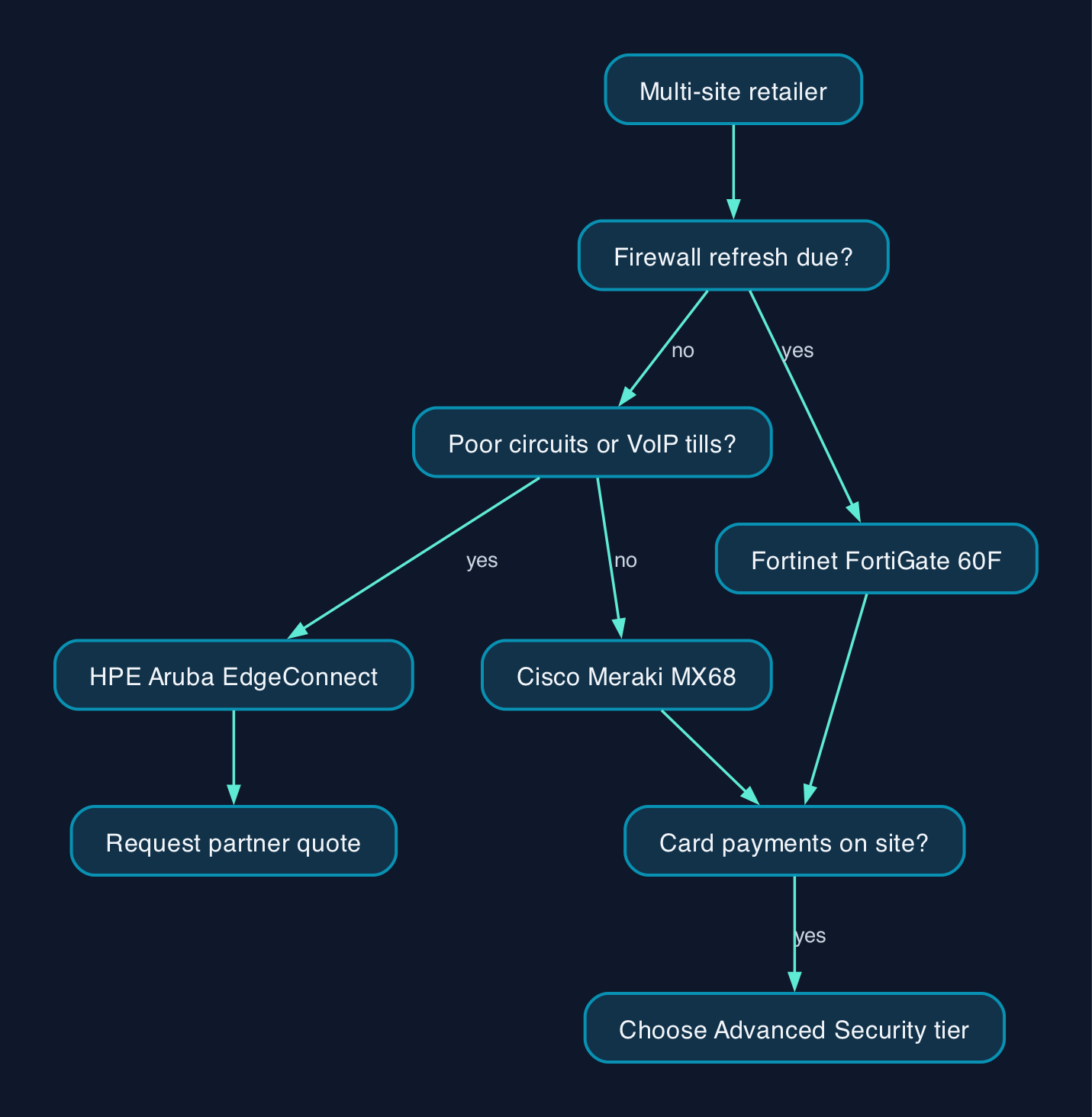
Cisco Meraki, Fortinet FortiGate and HPE Aruba EdgeConnect solve this in different ways, though all three now bundle a firewall with the SD-WAN engine rather than requiring a separate box. Meraki and FortiGate build SD-WAN into the same small appliance a store needs for its firewall anyway, so the SD-WAN decision and the branch security refresh happen together. HPE's own EdgeConnect QuickSpecs confirm it also includes a built-in next-generation firewall with intrusion detection and prevention, DDoS defence and role-based segmentation, certified by ICSA Labs; what sets it apart is a heavier focus on WAN optimisation for sites where the underlying circuit is poor or the traffic is latency-sensitive, such as VoIP tills or real-time stock synchronisation, and integration with third-party SSE partners for a fuller SASE architecture. For a retailer whose main pain point is "our stores drop off the internet and card payments queue up," Meraki or FortiGate is usually the simpler and cheaper starting point. For a retailer whose stores run on unreliable rural broadband and cannot tolerate jitter on voice or real-time POS traffic, EdgeConnect's WAN optimisation depth is worth the extra evaluation effort.
Pricing and Cost Model
Prices below are ex VAT, indicative UK reseller list prices as of September 2026, for the smallest branch-class appliance from each vendor. They are a starting point for a like-for-like comparison, not a quotation; a retailer buying dozens or hundreds of units should expect a lower price under a partner or distributor agreement.
Cisco Meraki MX68 (up to 50 users, the size fitting most single stores). Hardware is £447.52 ex VAT from thenetworkingnerds.co.uk. Cisco's own MX and Z security licensing datasheet sets out three licence tiers: Enterprise, Advanced Security and Secure SD-WAN Plus, on a strict 1:1 device-to-licence ratio, and confirms that automatic WAN failover, sub-second dynamic path selection, SD-WAN steering and policies, and cellular failover are included in all three tiers equally. Secure SD-WAN Plus adds advanced analytics, Smart SaaS quality-of-experience monitoring and ThousandEyes internet intelligence on top, aimed at businesses that depend heavily on SaaS and cloud-hosted applications rather than at basic SD-WAN mechanics. According to a UK reseller pricing guide from Cloudswitched, an MX68 Enterprise licence costs £340 for one year or £1,280 for five years, and Advanced Security costs £540 for one year or £2,050 for five years, both ex VAT. Combining hardware and licence for a single store's first year: £787.52 on Enterprise, or £987.52 on Advanced Security, which most retailers handling card payments will want for its unified threat management. Over five years the same combination totals £1,727.52 on Enterprise or £2,497.52 on Advanced Security, both ex VAT, the point by which the licence has clearly overtaken the hardware as the larger cost.
Fortinet FortiGate 60F (25 to roughly 70 users, a workable retail-branch size). Cambridge Shield, an authorised Fortinet reseller, prices the FortiGate 60F as complete first-purchase bundles that combine the appliance, the FortiGuard licence and FortiCare support in one SKU: £1,348 for one year, £2,282 for three years or £3,135 for five years, ex VAT, at its indicative September 2026 RRP. The appliance alone, without a licence bundle, starts from £798 ex VAT. Fortinet's own product page confirms SD-WAN rides on FortiOS at no separate cost: "there is no licensing required based on bandwidth, data transfer, or service tiering" for Secure SD-WAN. Fortinet's own administration guide adds an important distinction for renewal planning: "the FortiGate will still function as a firewall if any or all of the FortiGuard licenses are expired," continuing to route traffic and run SD-WAN on its existing configuration; what stops is new signature updates, plus FortiCare technical support and hardware replacement cover once that separate contract lapses.
HPE Aruba EdgeConnect is the odd one out on pricing transparency. HPE's own EdgeConnect SD-WAN service description confirms the model: customers buy an EdgeConnect gateway (physical or virtual) plus a term-based bandwidth licence in one of three editions. Foundation covers three bandwidth tiers with a cloud-hosted Orchestrator; Advanced steps up to eight tiers from 20 Mbps to unlimited, still cloud-hosted; On-Prem offers the same eight tiers but with a self-hosted Orchestrator that the customer runs and maintains. Optional WAN Boost (per-megabit-per-second, per-month) and Dynamic Threat Defense add-ons are available on top. According to ObsidianX, a vendor-agnostic connectivity consultancy, HPE's own documentation states that an EdgeConnect gateway stops passing traffic once its subscription licence expires, unlike a FortiGate's continued operation on an expired contract; the same analysis notes that HPE's July 2025 acquisition of Juniper Networks leaves it running two separate SD-WAN product lines, EdgeConnect and Juniper's Session Smart Router, with no rationalisation plan announced. Servnet UK lists the EC-XS as the model for small branches, 2 Mbps to 1 Gbps of WAN bandwidth, but does not publish a price; its listing asks buyers to "request a quote" with a stated four-hour response time. No UK reseller found in research published a clean EC-XS list price, so any figure for this platform should be treated as quote-only until a partner responds with a line-itemised cost.
The charts below set the confirmed first-year and five-year figures for Meraki and FortiGate side by side; HPE Aruba is excluded from both because no comparable published price exists.
Vendor and Option Comparison
| Criterion | Cisco Meraki MX68 | Fortinet FortiGate 60F | HPE Aruba EdgeConnect EC-XS |
|---|---|---|---|
| Branch size fit | Up to 50 users | 25 to ~70 users | Small branch, 2 Mbps to 1 Gbps WAN |
| SD-WAN mechanics | Dynamic path selection, auto failover, policy routing in every tier | Built into FortiOS, no separate SD-WAN charge | Application-aware steering, sub-second failover, WAN optimisation |
| Security | Enterprise tier is basic; Advanced Security adds full UTM | Firewall and SD-WAN in the same box and console by design | Built-in next-generation firewall with IDS/IPS and role-based segmentation; integrates with third-party SSE for full SASE |
| Management | Cloud dashboard, zero-touch provisioning | FortiManager, single console if staying on FortiOS | Cloud or self-hosted Orchestrator depending on tier |
| Year-1 cost, single site (ex VAT) | £787.52 to £987.52 | £1,348 (bundled, all-in) | Quote-only |
| Licence enforcement | Device stops forwarding traffic if licence lapses | Keeps routing and running SD-WAN if FortiGuard lapses; loses updates, support and RMA | Gateway stops passing traffic if the subscription lapses |
| Best fit | Retailers wanting the simplest cloud dashboard and lowest entry cost | Retailers doing a firewall refresh at the same time as SD-WAN | Retailers with poor circuits or latency-sensitive voice/POS traffic |
| Who should not choose it | A retailer needing deep WAN optimisation on bad circuits | A retailer wanting a single cloud console with zero on-box configuration | A retailer wanting a straightforward, budget-led, self-service rollout |
None of the three is a universal winner. A retailer standardising 40 small stores on ordinary FTTC or FTTP broadband, with limited in-house networking staff, will usually find Meraki's dashboard the easiest to run at scale. A retailer already committed to Fortinet for other security appliances, or refreshing branch firewalls anyway, gets SD-WAN "for free" inside the same box. A retailer with a handful of stores on genuinely poor rural connections, or latency-sensitive VoIP tills, should put EdgeConnect on the shortlist and get a partner quote before ruling it out on price alone.
Editorial analysis
Retailers researching this decision often start by comparing sticker prices for a single appliance, then discover the licence, not the hardware, dominates the five-year bill on both Meraki and FortiGate. That argues for negotiating the licence term and renewal price as hard as the hardware discount, and for checking each vendor's PCI DSS-relevant segmentation features (Meraki's Advanced Security tier, FortiGate's Enterprise Protection bundle) if any store takes card payments over the same appliance. It also argues against treating "SD-WAN" as a single feature to shop for: on Meraki, basic SD-WAN mechanics ship in the cheapest tier, and the premium tier buys visibility and analytics, not the failover itself. It is also worth separating what a lapsed contract actually breaks on each platform: a FortiGate keeps a store trading on its last configuration, where a Meraki or EdgeConnect site goes dark the moment its subscription runs out, which changes how tightly a retailer needs to police renewal dates on each. HPE Aruba's quote-only pricing is not evasiveness so much as a reflection of its market position: EdgeConnect competes on WAN optimisation depth for harder sites, not on a published branch-box price list, so it needs a proper site survey before a number means anything.
Sources
- Meraki MX/Z Security and SD-WAN Licensing datasheet - Cisco Meraki
- Meraki MX68 Cloud Managed Security Appliance - thenetworkingnerds.co.uk
- Meraki Licensing Cost in the UK: 2026 Pricing Guide - Cloudswitched
- What is Secure SD-WAN? - Fortinet
- FortiGate 60F datasheet and UK price - Cambridge Shield
- License expiration, FortiGate/FortiOS Administration Guide - Fortinet
- Cisco SD-WAN Alternatives: The Honest 2026 Comparison - ObsidianX
- HPE Aruba Networking EdgeConnect SD-WAN service description - HPE
- HPE Aruba Networking EdgeConnect SD-WAN QuickSpecs - HPE
- HPE Aruba EdgeConnect SD-WAN UK, EC-XS to EC-XL - Servnet UK
- Networking Providers directory - Compare the Cloud